Two refurbished phones can look identical and still differ by four years of useful life. When buying a refurbished phone, the deciding criterion is update support, meaning how many months remain before the maker stops sending security updates for that exact model. Battery and grade matter too, as does storage, but each can be replaced or bought around, while an update window cannot be extended. Four checks follow in priority order, written for a buyer in the UK who plans to keep the phone for three years. The numbers in the examples are samples only, and the listing in front of you holds the real ones.
What Decides Buying a Refurbished Phone to Keep
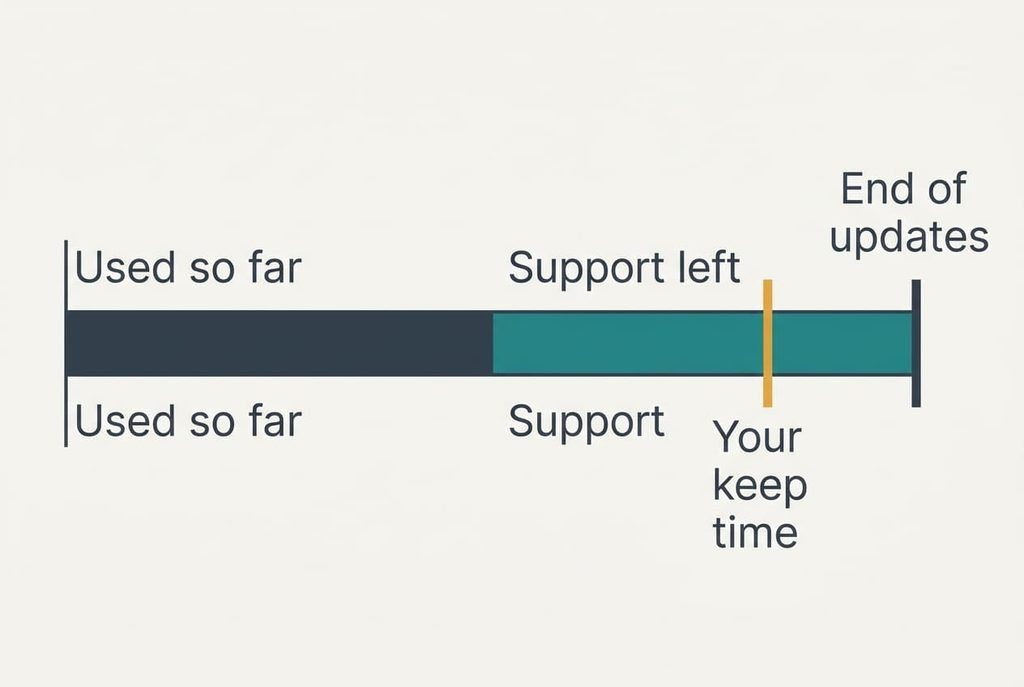
Update support decides the purchase, because the system software is the one part of the phone that nobody can replace. Updates close security holes, and apps stop supporting a phone once its system is too old to run them. A cracked screen or a tired battery can be repaired. A phone whose updates have ended cannot be repaired back into support.
Makers publish a window for each model, counted in years from release. The remaining time is that window minus the phone’s age. Hannah, a teacher in Sheffield, wants to keep a phone for three years, or 36 months. Her first candidate came out three years ago with a seven-year promise, so 7 − 3 = 4 years remain. That is 48 months, a margin of 12 over what she needs. Her second came out five years ago with a five-year promise, so nothing remains at all.
The second phone fails whatever its grade says.
Search for the exact model number, because one marketing name can cover several models with different windows.
Four Checks in Order of Priority
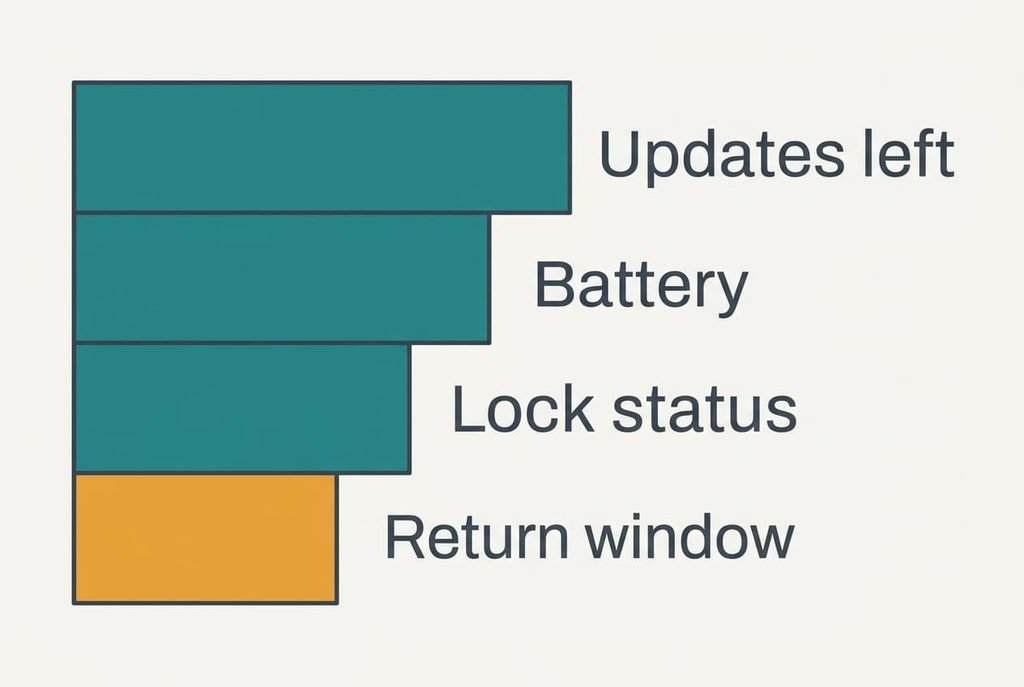
1. Update support left. This is the number of months between today and the maker’s published end date for that exact model. Day to day you never notice it, until apps start refusing to install or update. Judge it by subtracting the phone’s age from the window and setting the result beside your keep-time. Hannah needs at least 36 months. If you get this wrong, the phone becomes a risk long before it stops working, and no repair fixes that.
2. Battery condition. This is the share of its original capacity the battery still holds. You feel it as the hour of the afternoon when the phone needs a charger. Open the phone’s battery page and read the capacity figure, or ask the seller for a photo of it. A sample rule: 85% or more is fine, and 80% or less means planning a replacement. If you get this wrong you pay for a repair, yet a battery is the one part here that a repairer can swap in an afternoon.
3. Network lock and blocklist status. This is the check buyers skip most. A locked phone only accepts one network’s SIM, and a blocklisted phone is refused service because it was reported lost. Day to day you only find out when the first SIM from another network fails. Dial *#06# to show the phone’s IMEI, then run it through an IMEI checking service. If you get this wrong the phone is a paperweight, and a return becomes the only remedy.
4. Return window and the written grade. The grade describes the screen and body, and the window leaves you time to try out everything else. Look for a window of at least 14 days, because a week of normal use is the minimum needed to judge a battery. A short window with a vague grade leaves you holding every fault the listing missed, and nobody will take the phone back once the window has shut.
Specs That Refurbished Phone Sellers Oversell
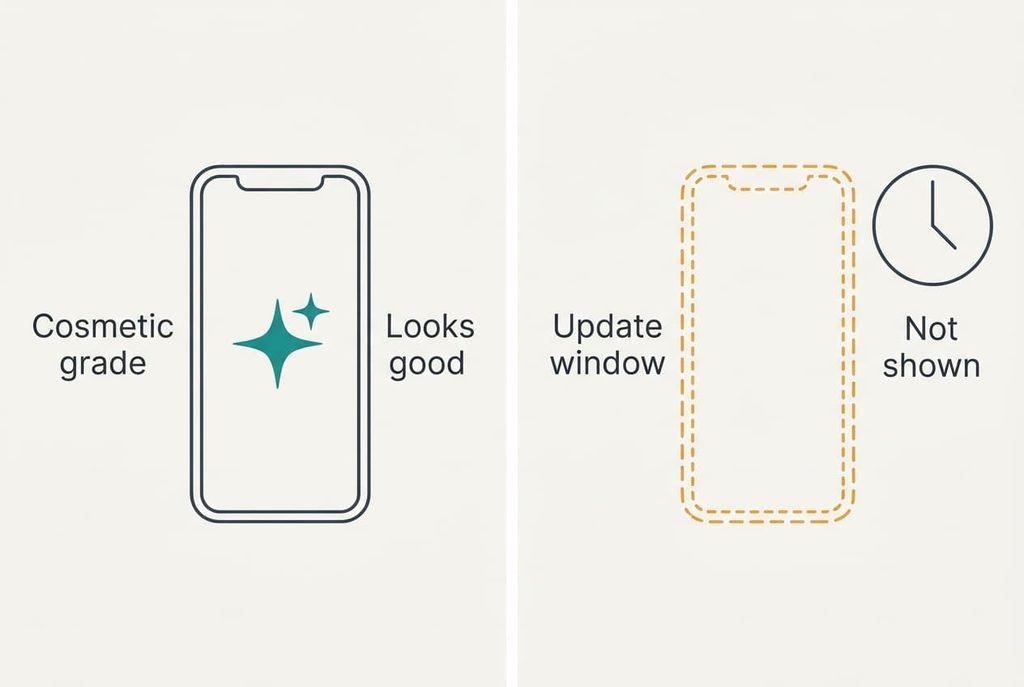
A top cosmetic grade describes only scratches, so a phone graded “like new” can still have two years of updates left or a battery at 78%. Sellers push it because a clean case photographs well and sells fast. It deserves a look once the first three checks are done, and not before.
Storage size gets the same treatment. A phone with a large capacity feels generous, yet it can’t extend an update window, and extra gigabytes do nothing for a tired battery. Buy the storage you need. When you’re buying a refurbished phone, a bigger number in that box is easy to sell and rarely changes how long the phone stays useful.
A model name that sounds recent causes the third mistake. Names often cover several variants, so one listing can hide an older model with a shorter window. Always check the model number printed in the phone’s about page, because that number settles which variant you’re holding.
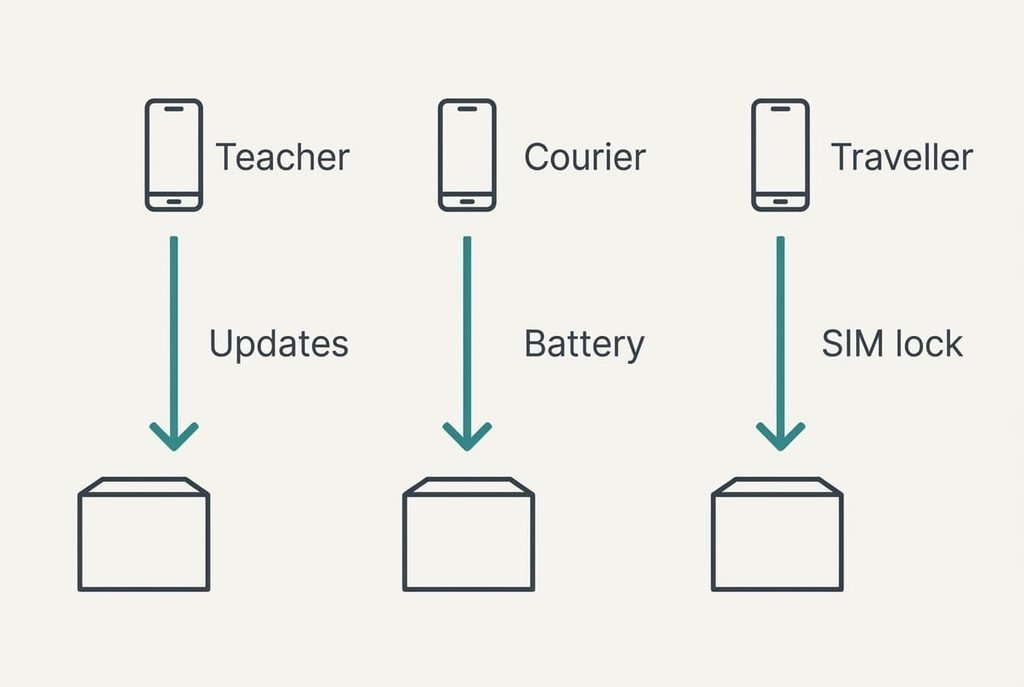
Three Buyers and Where Their Priorities Move
Hannah keeps her phone for three years, so update support stays first and the return window moves up. She needs the window to run past a full week of normal use, since that’s how long a battery takes to show its habits.
Omar is a courier who needs 12 hours from one charge. A new battery gives 14 hours, so at 80% capacity he gets 14 × 0.8 = 11.2 hours, short of his day. For Omar the battery moves to first place, and he budgets for a replacement before he commits.
Priya changes SIM cards when she travels. Lock status moves to the top of her list, since a locked phone refuses her local SIM abroad and a blocklisted one refuses all of them. For anyone buying a refurbished phone to use across borders, that check comes before the grade.
When to Walk Away From the Listing
Walk away when the seller can’t give the exact model number and the IMEI before you commit. A seller who hides either has something to hide, and you can’t run the checks above without them. Anyone buying a refurbished phone is trusting a stranger’s description, so the listing has to earn that trust with specifics.
Leave the listing too if the update window ends before your keep-time, even by a few months. A bargain with no software future wastes the saving. A return window under seven days is another reason to go, as is a battery below your threshold with no replacement offered. Listings that show only stock images need a message asking for photos of the real phone, and no reply is a reply. Waiting a week for a better listing costs little. Each of these gaps is cheap to spot before payment and costly to fix afterwards.
The Two-Minute Check When the Phone Arrives
Run these checks as soon as the parcel arrives, while the return window is open. Dial the IMEI code and compare the number against the one on the box label, then run it through the checking service. That takes about 30 seconds.
Open the about page and confirm the model number matches the listing. Look for the system version and any waiting update, which takes another 30 seconds. Read the battery capacity and set it beside your threshold. Finally, insert a SIM from a different network and make a test call. If any step fails, return the phone that day.
Rank them in the order above, with update support first. It decides whether the phone is worth having at all, and the other three decide what you must fix or return. Do the sums on one sheet before you commit, and keep a copy of the listing until the return window closes.
Questions Readers Keep Asking
What battery reading is acceptable?
As a sample rule, 85% or more of original capacity is comfortable, and 80% or less means budgeting for a replacement. The figure matters less than your day: if the remaining hours still cover yours, the phone works. A reading near 80% is fine for a light user.
How should I think about spending in relative terms?
Divide the share of the new price by the years of updates left. A phone at 60% of the new price with 4 years left costs 15% per year. One at 40% with 1 year left costs 40% per year, so the cheaper listing is the dearer choice.
How long will a refurbished phone last before I regret it?
Regret comes when updates end, not when the phone stops working. Count the months left in the window and add nothing for hope. A battery can be replaced and a screen repaired, but the update date is fixed, so decide on that date alone.