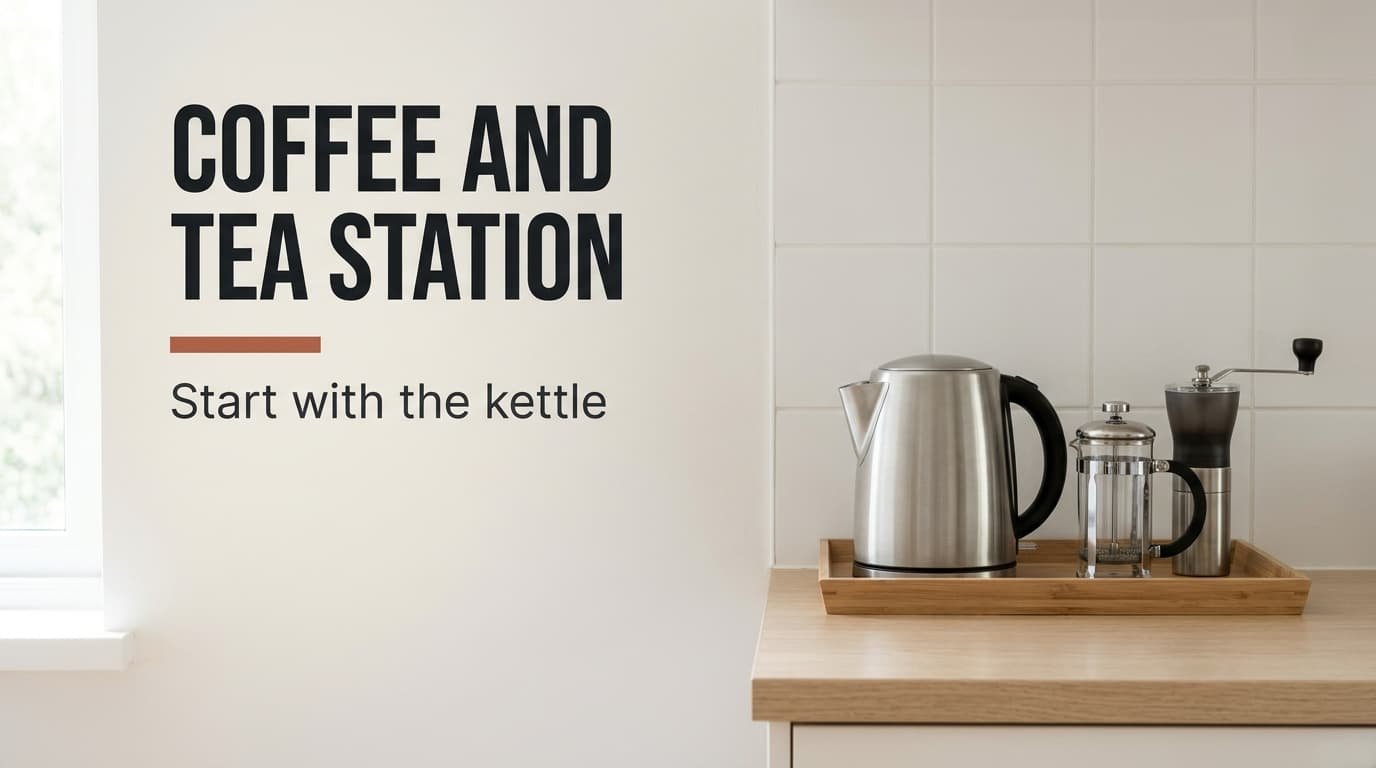
A coffee and tea station pays off through water first and gadgets last. Every hot drink starts at the kettle, and a kettle that boils a full litre for one mug heats three quarters of it for nothing. Five purchases made in a sensible order fix that waste first and leave the clutter for later. Work down the list from the biggest saving to the smallest. We follow a Dutch kitchen with a free worktop of 80 cm by 60 cm, plus a socket at 105 cm. Replace the numbers with your own readings wherever they appear.
What Decides a Coffee and Tea Station on One Worktop
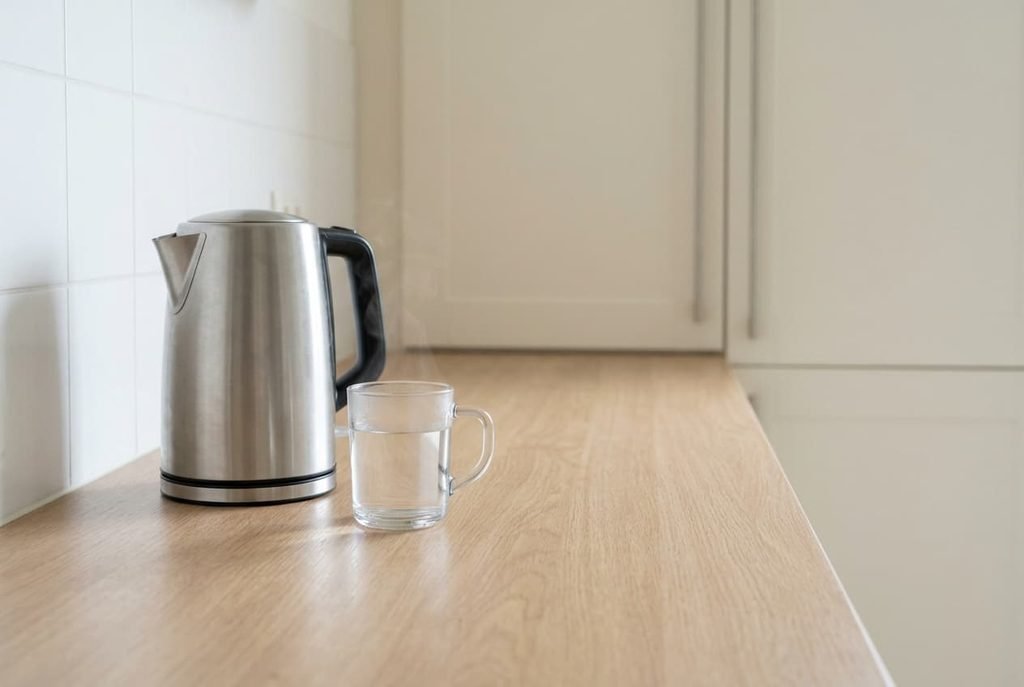
Heat is the one cost you can calculate. Raising 250 ml of water from 15 to 100 °C takes 0.25 × 4.186 × 85 = 89 kJ, which is 0.025 kWh. A kettle rated at 2,200 W delivers that in about 40 seconds. A full litre needs four times the energy and roughly 160 seconds, and a morning round for two mugs then means a long wait.
Boiling only the water you will pour is the habit that matters most. Four mugs a day for a year come to 1,460 mugs. A litre boiled each time uses 144 kWh, whereas 250 ml uses 36 kWh, a gap of 108 kWh. Those sums explain why the kettle leads the list and the coffee gear follows.
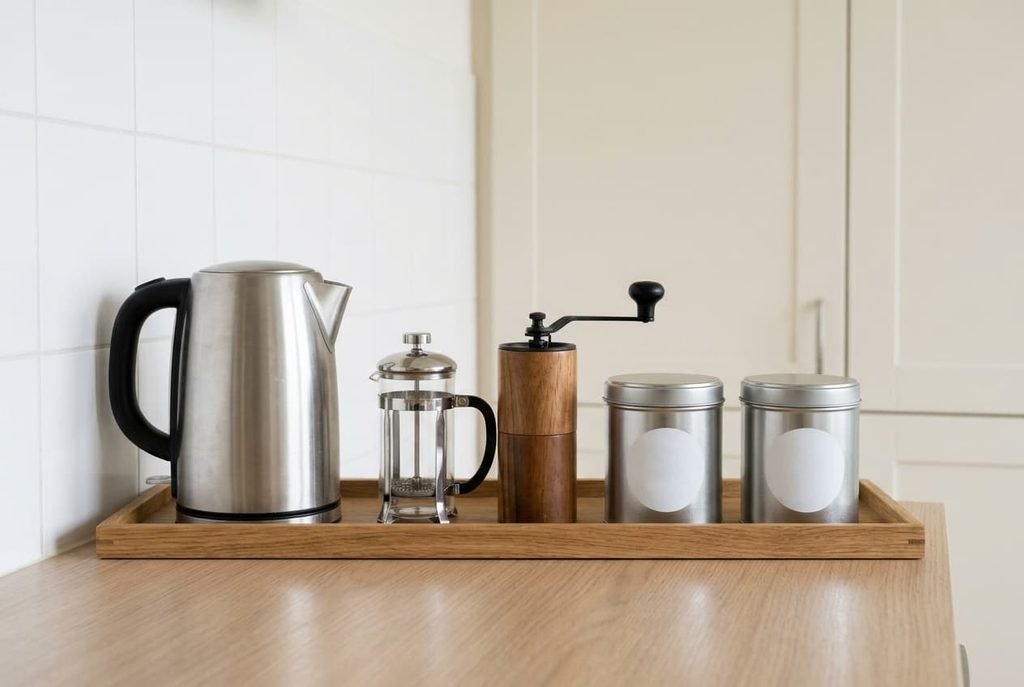
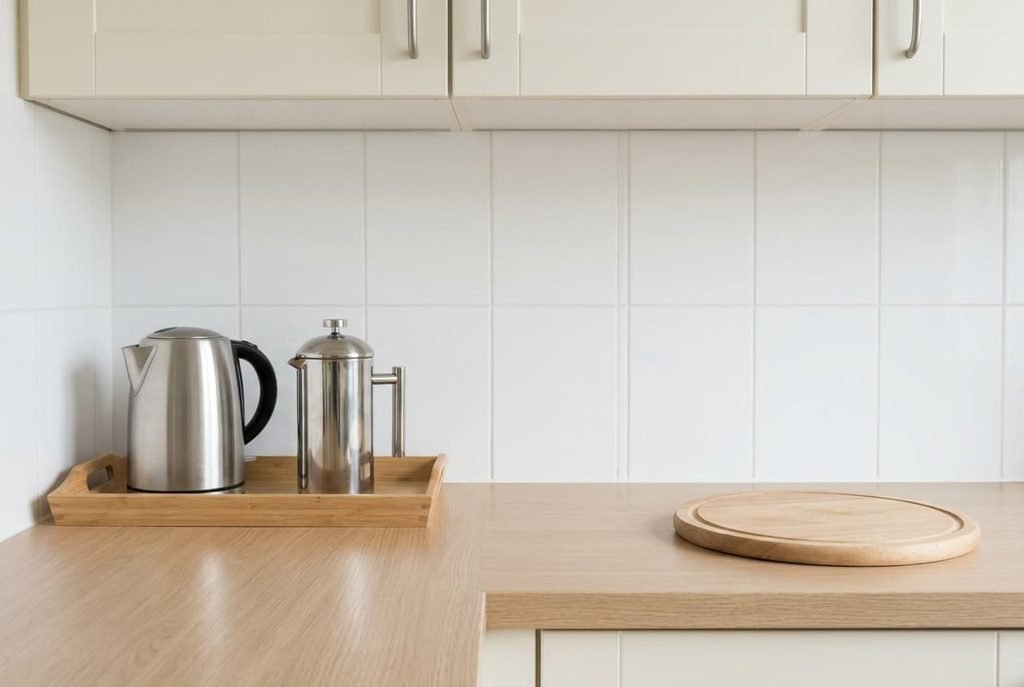
Space is the second limit. Our run measures 80 × 60 = 4,800 cm². A tray of 45 × 25 cm takes 1,125 cm² of it, or 23%. Everything the station owns lives on that tray or in the cupboard below it. That leaves 3,675 cm² of the run free, which is 77% of it, and it’s the area you chop on. A coffee and tea station that spreads beyond its tray has begun to eat the chopping space.
Five Purchases in Order, Kettle First
1. A 1 L kettle with a fill line at 250 ml comes first, because every drink begins with hot water. Tier: MID, since the element decides how the kettle ages. A flat element hidden in the base plate leaves no coil to collect scale and still covers a single mug. Look inside and check that the floor is smooth steel. An exposed coil crusts over the months and slows the boil. The lid should shut with a firm click, which sends steam out by the spout.
2. Next comes a steel press pot of 0.5 L, which makes two mugs of 250 ml. Tier: BUY CHEAP (the pot only holds grounds under water), and a one-piece steel body gives a wall without joins that could crack. Push the plunger down while the pot is empty and feel for even resistance all the way. A mesh edge that leaves a gap against the wall lets grounds slip into the cup.
3. A hand grinder with a steel burr set and a hopper that holds 30 g. Tier: BUY ONCE (the burr set sets the quality of every cup you will ever make). Two mugs need 2 × 15 g, which means 30 g covers one session. Turn the empty handle and look for wobble in the shaft. A shaft that rocks lets the burrs drift apart, and the grind comes out as boulders and dust.
4. Two airtight canisters come fourth, one of 0.6 L for a 250 g bag of beans and one of 0.4 L for leaf tea. Tier: MID. A silicone ring under the lid does the sealing, whereas plastic against plastic leaves a hairline gap. Close the lid and press down; a good seal grips with a faint pop when you lift it.
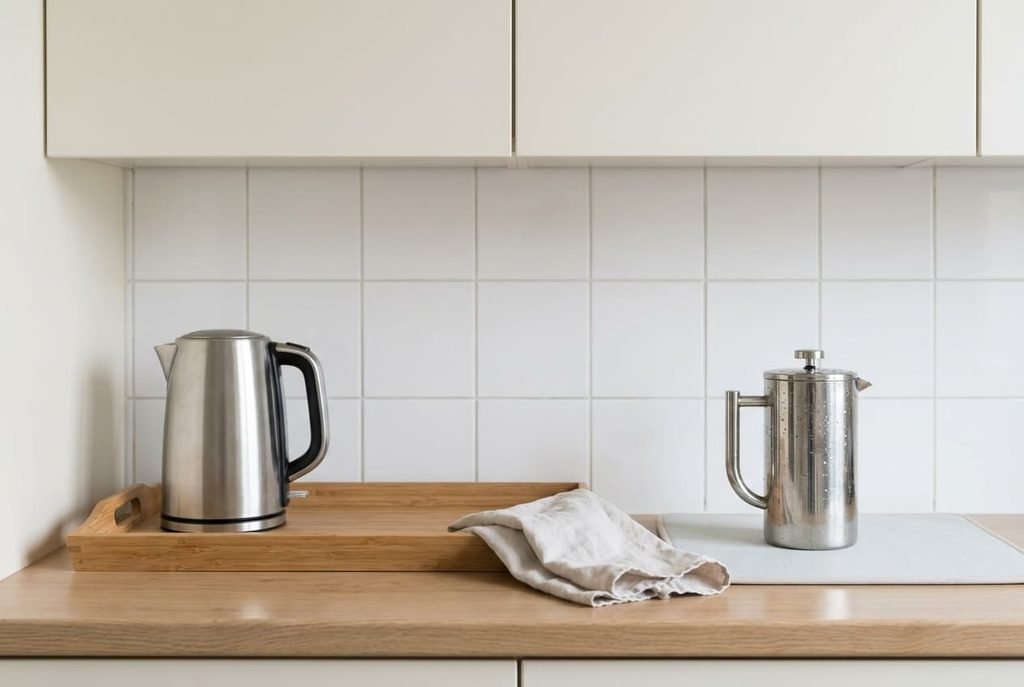
5. Last is a tray of 45 × 25 cm with a rim 2 cm high. Tier: BUY CHEAP, because nothing on a tray wears. This one should be folded from a single sheet, since glued corners let a spilled mug creep underneath. Tip a cup of water into it before you commit. A coffee and tea station that sits on a tray can be lifted aside in ten seconds when you need the worktop.
Why the Canisters Are the Item to Scale Down
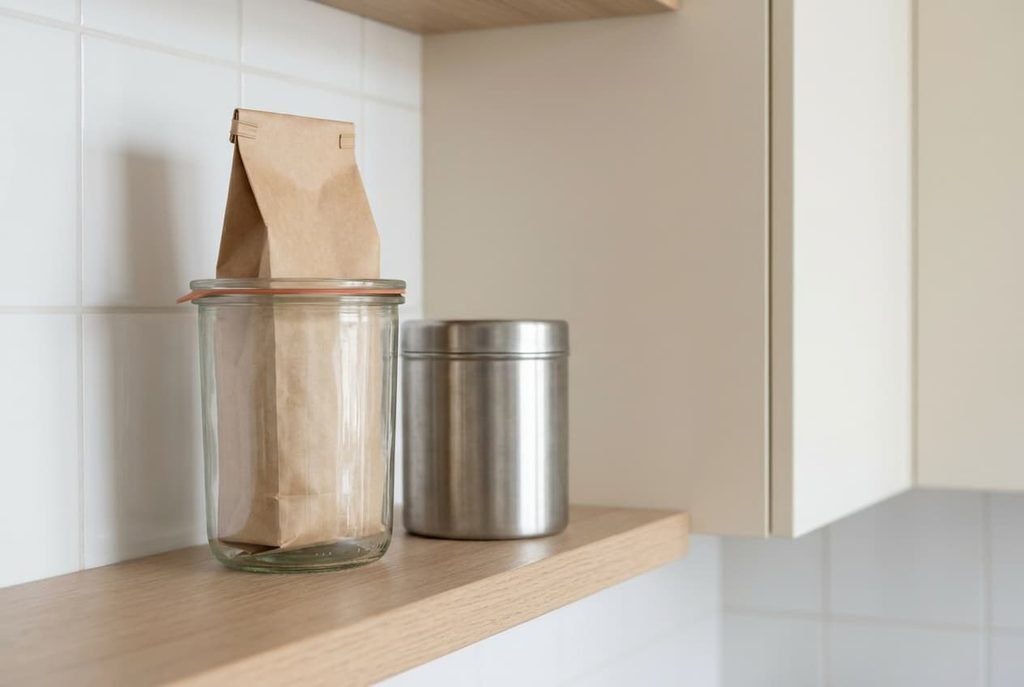
Of the five, the canisters are the easiest to drop. A pair of them, each 10 × 10 cm, takes 200 cm² of the tray, which is 18% of its 1,125 cm². A 250 g bag of roasted beans fills roughly 0.6 L, and the bag already seals itself at the top. Clean jars with rubber rings, which most kitchens hold, do the same work for nothing.
Clip the original bag shut and stand it inside a jar you own, and the contents stay sealed until you reach the bottom. The bag also keeps its one-way valve, where it has one, which lets gas escape without letting air in. A round jar 10 cm across covers only 79 cm², and the leaf tea can stay in its cupboard.
A bag of 250 g gives 16 mugs at 15 g each. At two coffees a day that lasts eight days, and the beans don’t sit open for long.
Buy canisters only when you stock several bags at once, as happens after a gift, and put the money towards the grinder until then.
Habits That Keep Coffee and Tea in Their Place
Measure the water in the mug first. Pour that amount into the kettle, then boil it. That one step removes the 108 kWh from the earlier sum.
Wipe the tray after the morning round, because a drop of coffee dries to a ring within an hour. Rinse the press pot straight away. Wet grounds left in the mesh turn sour by the afternoon and taint the next brew.
Line the pieces up in the sequence of the morning. The kettle sits nearest the socket, and the press pot waits at the far end. Your hand then travels one way across the tray, and nothing gets knocked over.
Look at the kettle floor once a month. A pale crust means scale, and an evening’s descaling soak clears it. Check the spout filter on the same day. Keep the grinder in the cupboard under the tray and bring it out only when you use it.
Store the tea canister away from the kettle’s spout, where steam reaches the leaves.
What to Skip
Skip the automatic machine with a heater plate. At 1,000 W it joins the kettle’s 2,200 W to make 3,200 W, which is 87% of a 16 A circuit, and it claims 25 × 35 cm of worktop for a job the press pot does in four minutes. Skip the three-tier mug tree, which uses 900 cm² of surface to hold mugs the cupboard already holds. A milk frother can go too, since steam from the spout warms milk adequately. Skip a second kettle for tea too, because the first one boils 250 ml in 40 seconds. A set of cup warmers or sample tins of leaf tea doesn’t earn a place either, as one bag of each kind covers a month.
Stop buying once the kettle and press pot sit on the tray. Everything beyond them improves a station that already works. Test it for three weeks, and add the grinder only if the fresh grind justifies it in your routine. You’ll taste the difference there first. Keep the packaging for the first fortnight, in case a piece disappoints. You’ll find that a coffee and tea station on one worktop takes just 23% of the worktop, far less than a kitchen shop will suggest.
Questions Readers Keep Asking
How many pieces do I need to start?
Three do the job. A kettle heats the water and a press pot makes the brew, while a tray gives both a home. Add the grinder when you notice stale coffee, and the canisters when a second bag arrives. The remaining items are optional extras.
In what order should I buy them?
Buy the kettle first, as both drinks begin with hot water. The press pot follows within a week. Then comes the tray, and the grinder once a month has passed. Canisters come last, if at all. Waiting spreads the spending and shows which drink you really make.
How do I judge a kettle in a shop?
Look inside for a smooth flat floor with no coil. Find the fill line at 250 ml and fill to it, then see whether the water covers the element. Open and close the lid; it should click. Lift it full of water, since the handle must feel steady in your hand.