Every step along the hallway announces itself, nearly always on the same two or three boards. Two surfaces shift by less than a millimetre against each other under your weight. Pinning the loose board to the joist beneath is what most often ends it. Below, a hallway floor that creaks gets measured, one cause at a time. The model is a pine-boarded hallway of 100 by 420 cm on timber joists set 40 cm apart, with boards 12 cm wide and 2.2 cm thick. Every load and movement quoted is an estimate. Use readings from your own floor wherever you have them.
The mechanism behind a hallway floor that creaks
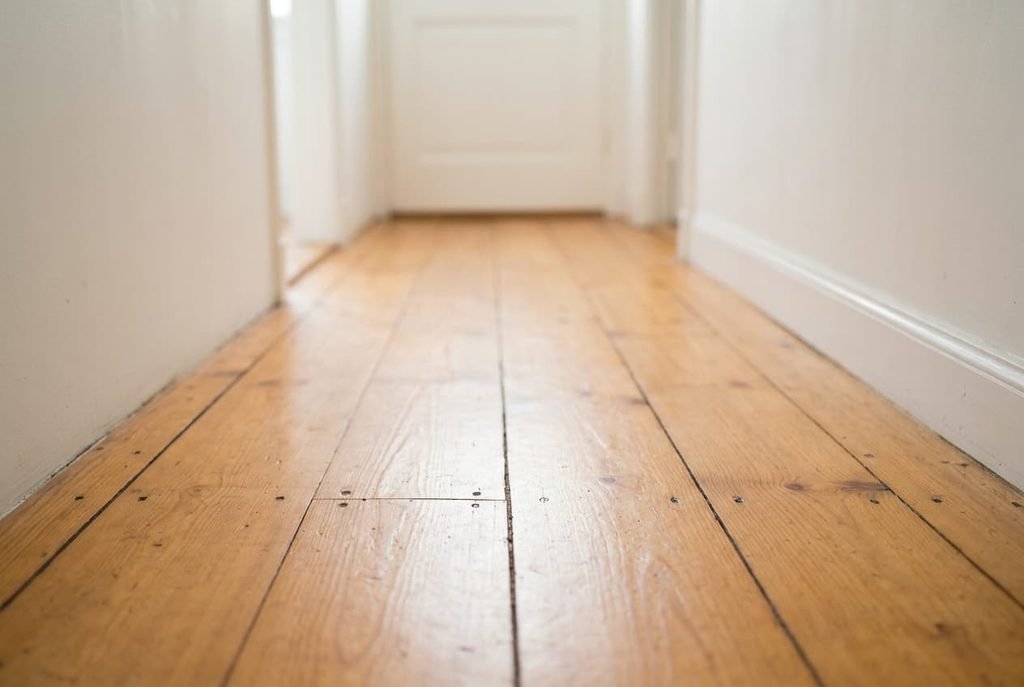
A board creaks when it grips a surface and slips a tiny distance. Then it grips again, hundreds of times a second. That stick-slip friction is the noise. It needs a surface to rub on, and a step supplies the force. At 70 kg a step sends about 690 N through the boards, and a board without a firm fixing flexes around 1.5 mm between joists.
Wood also moves with the seasons. Heating can pull room humidity from 55% down to 35%, which dries the boards by about 3 percentage points of moisture. Pine narrows roughly 0.25% across the grain for each point, so a board 120 mm wide loses close to 1 mm. A nail that gripped in autumn loosens by midwinter, because the hole around it has opened up, and the board then slides along the shank with every step.
Quiet floors have boards held tightly enough that nothing can move. The same hall can therefore be silent in August and loud in January.
Bare feet find the problem first, and a rug hides it without curing it.
Confirm which version of the creak you have
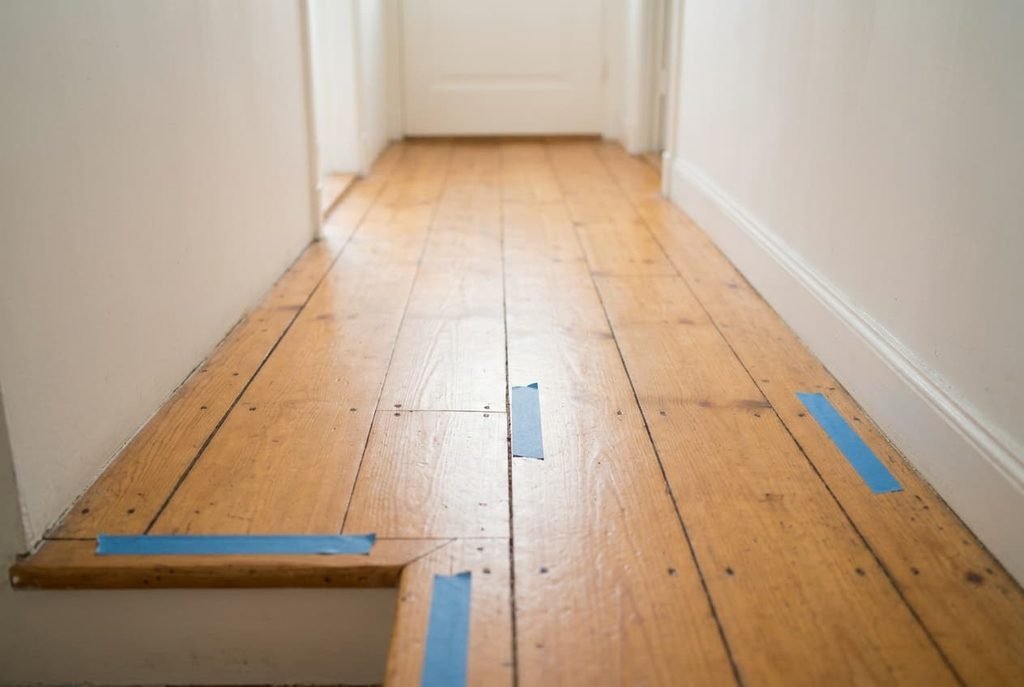
Three short tests separate the causes, with each telling you whether a hallway floor that creaks has a loose board or a loose joist. Start by finding the exact board. Walk the hall slowly in socks and mark each noisy spot with a strip of tape. A creak sitting on a single board, near its edge, points to a loose nail or to two board edges rubbing. That version suits the first three fixes below.
Then rock your weight from heel to toe on the marked spot. A faint dip of 1 to 2 mm under the board, arriving with the sound, means the board has lifted off its joist. If the whole floor bounces across 2 m or more, the trouble lies deeper in the joist, and only the last fix applies.
Finally, watch the calendar. A creak that fades by May and returns in November is seasonal shrinking. One that stays loud all year suggests a worn joint or a gap that won’t close. Most hallways show the first pattern, with a touch of the second near the stairs.
The fixes, in order
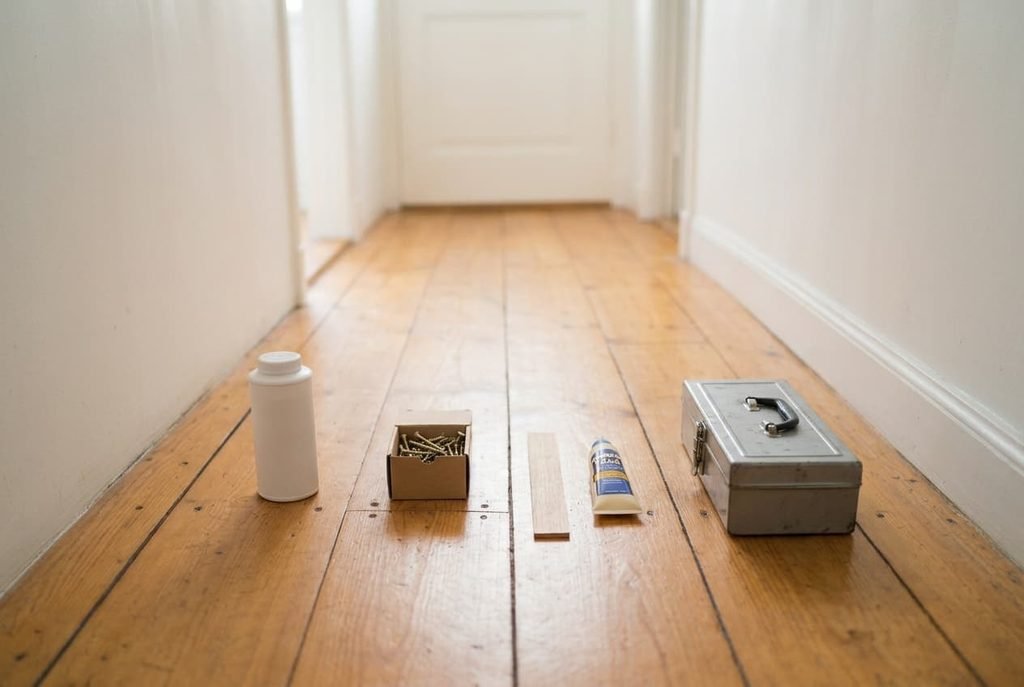
Work talcum powder into the joint, which addresses friction between board edges. Brush a pinch along the seam and press it in with a stiff card, then walk the board a few times to work it deeper. It’s free if talc is already in the bathroom, and a soft pencil’s graphite behaves alike. The limit is time. The powder wears out within weeks, and it helps nothing on a board that has lifted off its joist.
Screw the board down into the joist, which addresses a loose fixing. Find the joist. Then drill a pilot hole and drive a countersunk screw through the board at a slant. Use a 4 by 50 mm screw, about 2.5 times the board thickness, so it bites into the joist without reaching the room below. One screw per joist crossing is enough, and a box of them costs little. The limit is access. A fitted carpet or runner has to come up first, and a tenant needs the landlord’s agreement before piercing a floor.
Slide a glued wedge into the gap under the board, which addresses a space between board and joist. Where a gap of 1 or 2 mm is visible, a thin wood shim coated with glue stops the board from dropping each time a foot lands. The glue is the only cost, and a shim 3 mm thick tapered to a point fits most gaps. Reach is the limit, because fitted skirting hides many gaps. The glue also needs a day to cure with nobody crossing the spot, which is awkward in a hall that every room uses.
Hire a carpenter to stiffen the joist, which addresses movement in the structure. A bounce across 2 m means a joist that has twisted or sagged. A carpenter adds a block between joists or fixes a strip along the side, which takes two to three hours and leaves the boards untouched. The visit is the expense, and the landlord must approve the work, so keep this for last. Taken in that order, and tested after each step, the cheap steps settle a hallway floor that creaks before anyone books a visit.
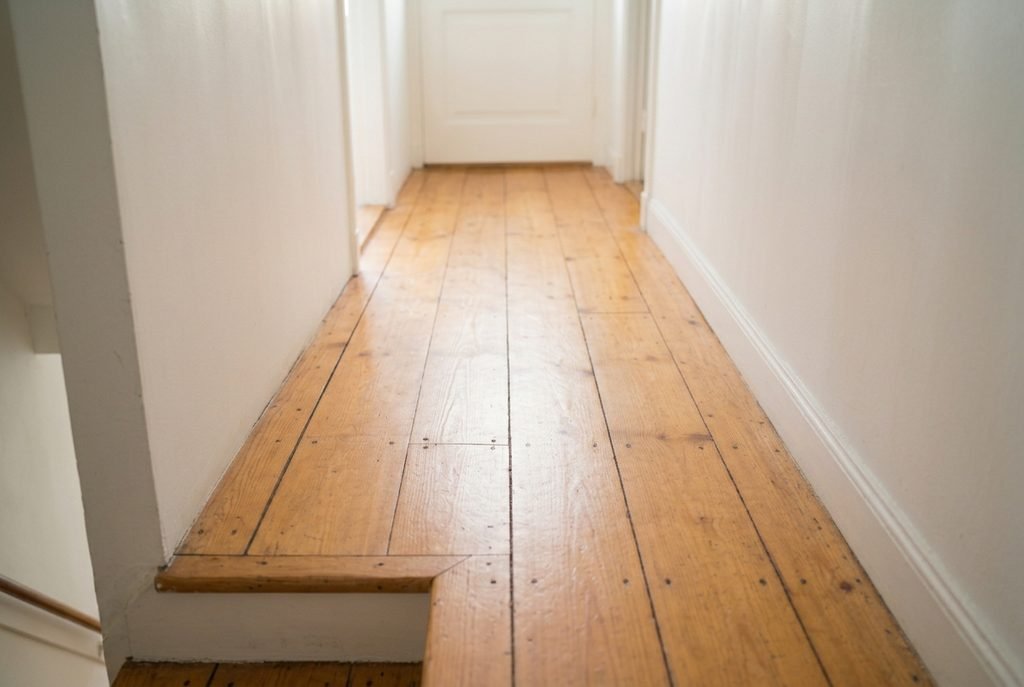
Why a floor in the hallway creaks and what stays fixed
The hall measures 100 cm across and its boards run the full 420 cm, so each board crosses ten joists at 40 cm centres. That’s a lot of nails for movement to loosen, and no board can be lifted because the skirting holds both sides. The hall also joins every room, so you can’t close it for a day while glue cures.
Temperature is the second fixed feature. The stairwell below is unheated, which makes the hall colder than a bedroom and swings the humidity harder, so the creak is worst near the stairs.
A tenant can’t change the joist spacing or the board length either. What can change is the fixing at each point. Ten crossings per board is also why one screw rarely quiets a whole board. Two or three along its length are normal.
So the cure has to happen at the nail, not on the surface.
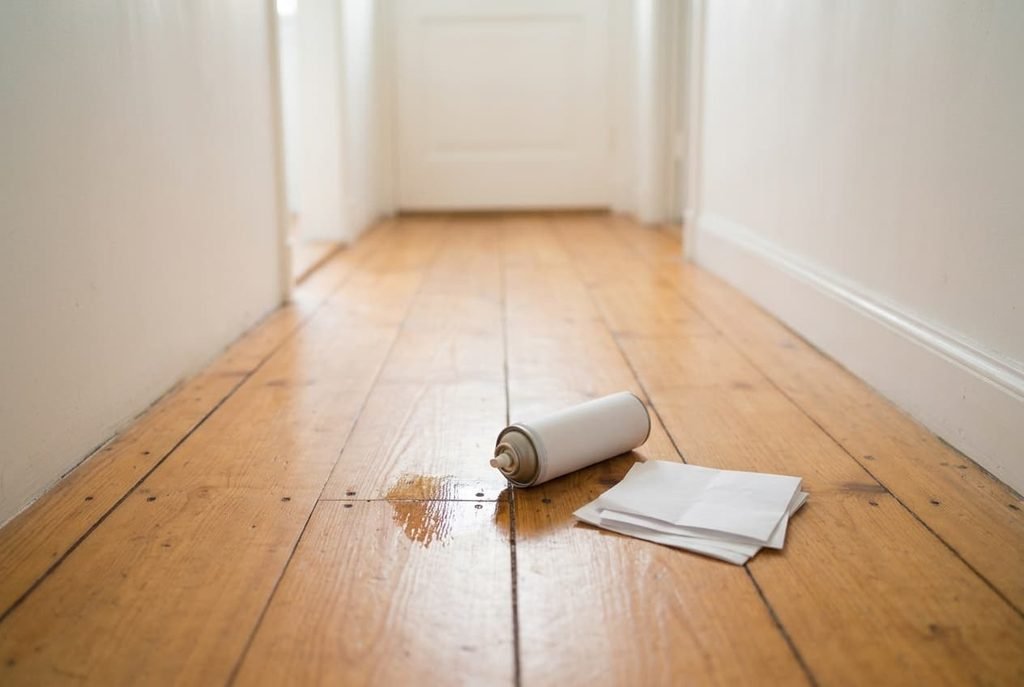
The fix that doesn’t work
Spraying a lubricant oil into the seam is the remedy people try first. It silences the board for a few days. Then it collects dust and leaves a dark stain that won’t wash out of pine. The oil never reaches the nail shank where most of the sliding happens. It can also mark a finish you’re obliged to keep, and a deposit can pay for that stain.
Stuffing the gap with folded paper or card fails for a similar reason. It moves the friction to another surface and often adds a new squeak of its own. Foam strips pushed under the skirting behave the same way. They muffle one spot while the board still slides.
A thick underlay is a costlier version of the same mistake. It muffles the sound for a season while the board keeps wearing its nail hole wider.
Choose a fixing that stops the movement. A dry powder or a screw does that without staining the floor, so a hallway floor that creaks quiets down once its board can no longer slide. Mark each board you treat with a pencil dot, then walk the hall again after a week. A silent dot has earned its place. A noisy one points to the next fix.
Questions readers keep asking
Can I fix a creaking floor in a rented flat?
Often yes, for the first fixes. Powder and a few screws leave little trace, but you need the landlord’s agreement before piercing a floor or lifting the covering. A joist problem is theirs to repair, so report it in writing together with the dip you measured.
How much does it cost?
The cheapest fix is free when you already have the powder. Screws or a shim add only a small outlay. The carpenter is the only real expense. Start with the cheap fixes and see how far they get you before calling anyone in.
Will the creak come back?
Possibly in winter, since the boards shrink again once the heating runs. Screws hold far longer than powder does. If the creak returns at the same spot following a screw, the joist is probably moving and needs a carpenter’s attention.