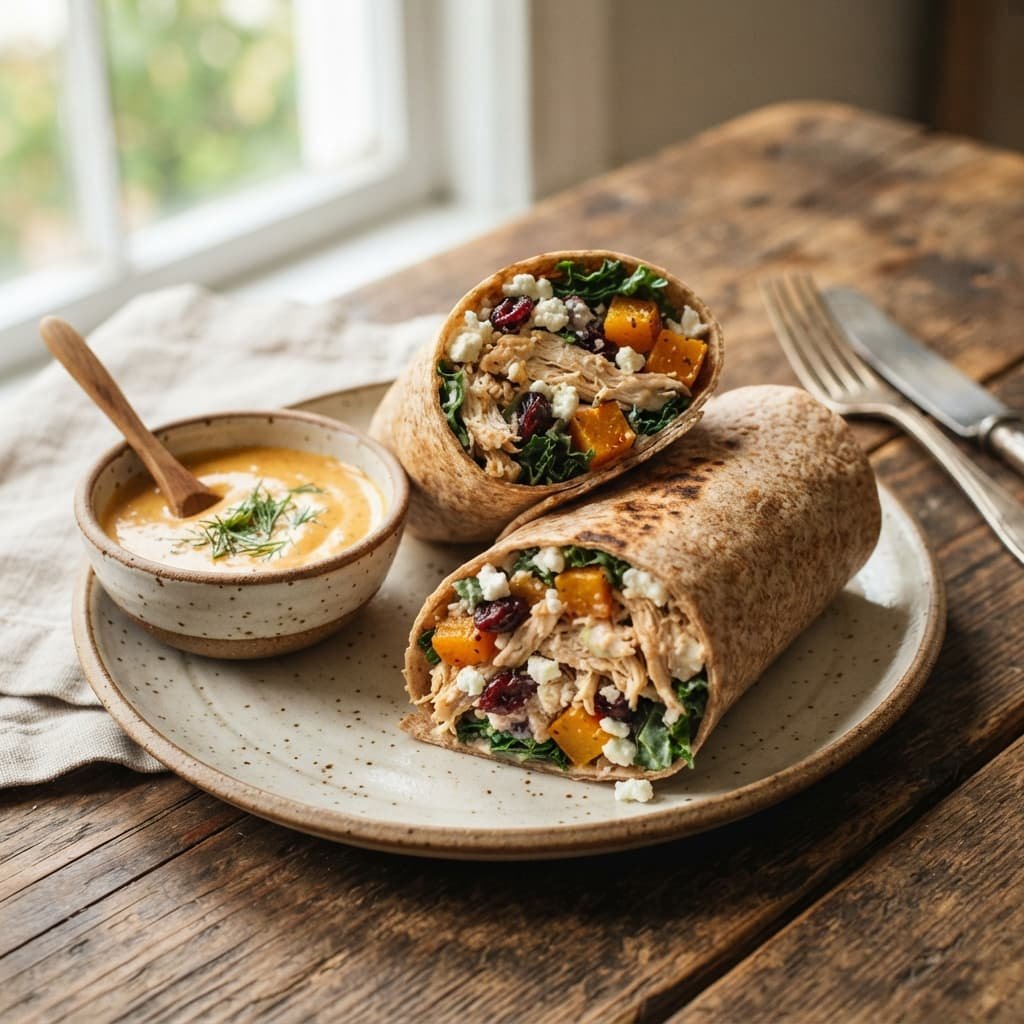
There’s no complicated technique hiding inside Winter Wood-Fired Rotisserie Chicken Wraps. A wood-fired rotisserie chicken gets shredded, a warm maple-mustard sauce gets whisked together, roasted winter vegetables go in alongside, and everything gets rolled into a warm tortilla. What actually separates a forgettable wrap from a genuinely good one isn’t a hidden step — it’s one ratio: how the sauce’s mustard and maple balance against each other, and how much filling actually fits without the wrap splitting apart.
Both halves of this dish are already real and well established. Wood-fired rotisserie chicken is a documented technique on its own, prized specifically for the smoky depth the wood imparts that a standard oven can’t replicate, and shows up in sandwiches and wraps built specifically around that smoky, already-cooked meat. Rotisserie chicken wraps loaded with vegetables and a creamy or tangy sauce are also extremely common. This version leans into winter with roasted squash, kale, and a warm maple-mustard sauce that plays off the chicken’s smokiness rather than competing with it.
Getting the Balance Right in Winter Wood-Fired Rotisserie Chicken Wraps
This dish takes about 35 minutes, most of it spent roasting the squash while the chicken and sauce come together. The key ratio is the sauce itself: roughly 2 parts maple syrup to 1 part mustard, so it stays sweet with a real tangy edge rather than tasting purely sugary or overwhelmingly sharp.
Too much mustard and the sauce turns sharp enough to fight with the chicken’s smoky flavor instead of complementing it; too much maple and it just tastes like syrup poured over savory food, which nobody actually wants. The second thing worth paying attention to is portion size inside the wrap itself: overfilling is the single most common reason a wrap splits apart the moment you try to roll it, so a moderate, even layer of filling across the tortilla matters more than piling everything as high as possible, no matter how tempting that extra handful of chicken looks.
Ingredients
This makes 4 generous wraps, enough for a full meal each.
For the Filling
- 1 wood-fired rotisserie chicken, meat shredded (about 3 cups)
- 2 cups butternut squash, peeled and cut into 1/2-inch cubes
- 1 tablespoon olive oil
- Salt and black pepper, to taste
- 2 cups baby kale or chopped kale
For the Maple-Mustard Sauce
- 3 tablespoons maple syrup
- 1 1/2 tablespoons Dijon mustard
- 1 tablespoon olive oil
- 1 tablespoon apple cider vinegar
- Salt, to taste
To Serve
- 4 large flour tortillas
- 1/4 cup dried cranberries
- 1/4 cup crumbled feta or goat cheese
How to Make Rotisserie Chicken Wraps with Winter Vegetables
- Preheat the oven to 425°F (220°C). Toss the butternut squash cubes with the olive oil, salt, and pepper on a large baking sheet.
- Roast the squash for 20 to 25 minutes total, stirring once halfway through, until tender and lightly caramelized at the edges.
- While the squash roasts, whisk together the maple syrup, Dijon mustard, olive oil, apple cider vinegar, and salt thoroughly in a small bowl until smooth.
- Shred the rotisserie chicken meat carefully, discarding skin and bones.
- Toss the shredded chicken evenly with about half the maple-mustard sauce.
- Warm the tortillas fully in a dry skillet or directly over a low flame until pliable and soft.
- Layer each warm tortilla with kale, roasted squash, the sauced chicken, cranberries, and crumbled cheese, keeping the portion moderate and even.
- Drizzle the remaining sauce over the filling, fold in the sides carefully, and roll tightly. Slice in half and serve.
Good vs. Excellent: The Details That Matter
A good version of this wrap is already satisfying. An excellent one comes down to a handful of specific calls.
- Don’t overfill the tortilla. A moderate, even layer rolls tightly and holds together well; piling filling too high guarantees a split wrap and a genuine mess on the plate.
- Warm the tortillas before filling. A cold, stiff tortilla cracks the moment you try to fold it, no matter how carefully the filling was portioned out beforehand.
- Save some sauce for drizzling at the end. Tossing all of it with the chicken alone leaves the kale and squash underseasoned; holding some back for the final drizzle ties the whole wrap together properly.
- Let the squash caramelize properly. Pulling it early leaves it merely tender instead of genuinely sweet, which is a real, noticeable difference in the finished wrap.
Common Mistakes and How to Fix Them
Wrap split open while rolling: almost always means it was overfilled, or the tortilla wasn’t warmed enough to stay flexible. Use a slightly smaller portion next time, and make sure the tortilla is genuinely pliable before you start layering, since a cold tortilla cracks no matter how carefully the filling is portioned.
Sauce tasted too sharp: the mustard-to-maple ratio leaned too far toward mustard. Whisk in a touch more maple syrup and taste again, adjusting gradually rather than guessing at the right amount all at once, since small changes shift the balance more than they might seem to on paper.
Squash stayed bland instead of caramelized: it likely didn’t roast long enough, or the oven wasn’t fully preheated before it went in. Give it the full 20 to 25 minutes, and check that your oven has actually reached temperature before starting the timer, since an underheated oven steams vegetables rather than roasting them properly.
Variations and Substitutions
Sweet potato can also replace butternut squash using the same roasting method and timing, with only a slight difference in sweetness and texture once roasted. If wood-fired rotisserie chicken isn’t readily available, a standard rotisserie chicken works fine, though it will lack some of the smoky depth the wood fire adds to the finished wrap.
Spinach can substitute for kale if that’s what’s on hand, and won’t need any wilting since it’s tender enough to eat raw in the wrap without any extra preparation. Pecans or walnuts, toasted and roughly chopped, add a nice crunch in place of or alongside the cranberries, giving the wrap another layer of texture.
Serving and Pairing
These wraps are filling enough to serve as a complete lunch or light dinner on their own without any other sides needed. A warm bowl of soup, such as butternut squash or tomato soup, rounds out the meal nicely on a cold winter day when something warm feels especially welcome. Extra maple-mustard sauce served on the side lets anyone who wants more dip their wrap as they go, rather than committing to a fixed amount for everyone at the table. These wood-fired chicken wraps also travel well for a packed lunch the next day.
Storage and Reheating
Store the chicken, squash, and sauce separately in airtight containers in the refrigerator for up to 3 days, assembling fresh wraps as needed rather than storing them fully built. Once fully assembled, wraps are best eaten within a few hours, since the tortilla softens and the kale wilts further the longer everything sits together, losing the contrast between warm filling and fresh greens that makes the wrap work in the first place.
Nutritional Information
Values below are estimates per serving and will vary depending on exact brands and quantities used.
| Calories | 460 kcal |
| Protein | 30 g |
| Carbohydrates | 44 g |
| Fat | 17 g |
| Fiber | 4 g |
Final Thoughts
This recipe was tested and refined in the bebup.org kitchen, with a few rounds spent specifically dialing in the maple-to-mustard ratio in the sauce before publishing it here.
Winter Wood-Fired Rotisserie Chicken Wraps don’t ask for much beyond a couple of simple calls — a sauce that tastes balanced rather than one-note, and a filling portioned so the wrap actually holds together instead of falling apart mid-bite. Once those two pieces line up, this becomes a genuinely satisfying way to turn an already-cooked chicken into a real meal in well under an hour, without much extra effort beyond roasting a single tray of squash.
Winter Wood-Fired Rotisserie Chicken Wraps
Ingredients
Method
- Preheat the oven to 425°F (220°C). Toss the butternut squash cubes with the olive oil, salt, and pepper on a large baking sheet.
- Roast the squash 20 to 25 minutes, stirring once, until tender and lightly caramelized.
- Whisk together the maple syrup, Dijon mustard, olive oil, apple cider vinegar, and salt until smooth.
- Shred the rotisserie chicken meat, discarding skin and bones.
- Toss the shredded chicken with about half the maple-mustard sauce.
- Warm the tortillas in a dry skillet or over a low flame until pliable.
- Layer each tortilla with kale, roasted squash, the sauced chicken, cranberries, and crumbled cheese, keeping the portion moderate.
- Drizzle the remaining sauce over the filling, fold in the sides, and roll tightly. Slice in half and serve.