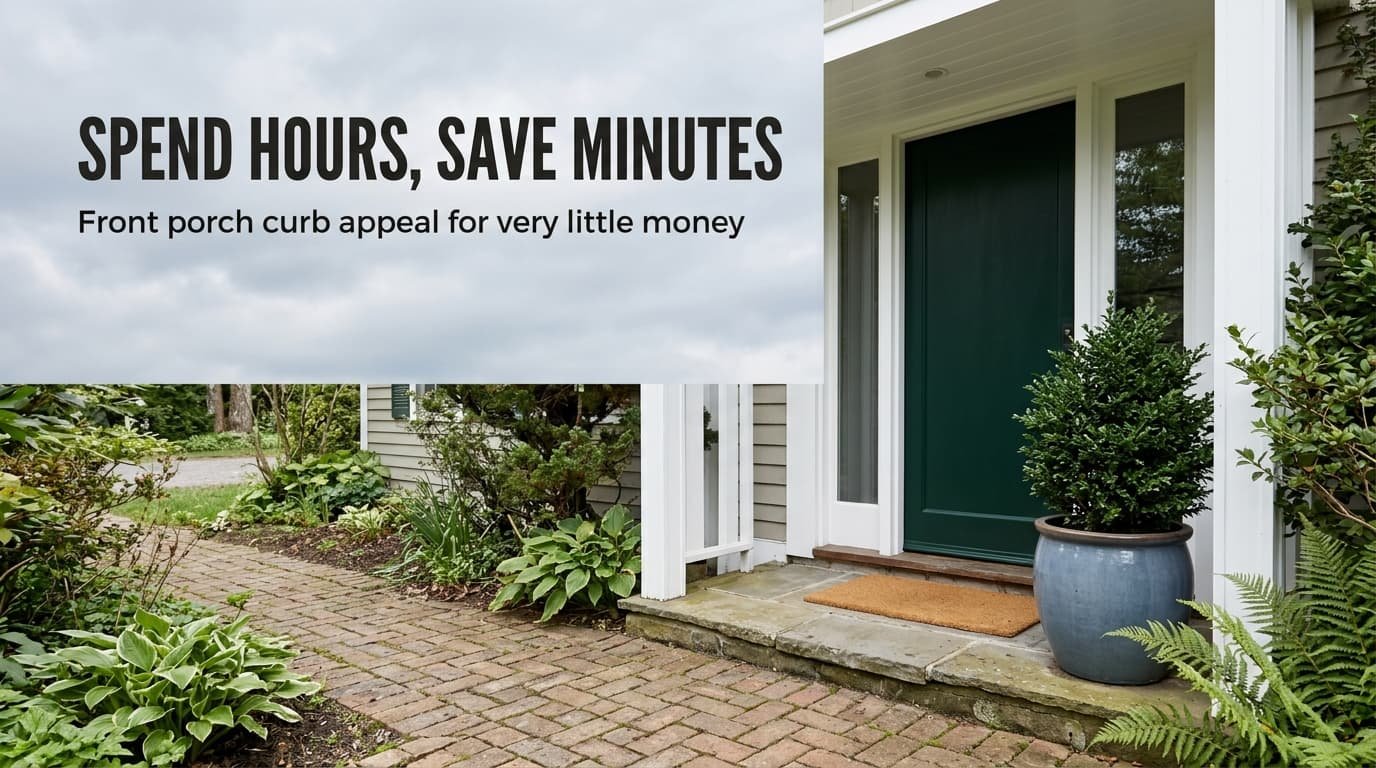
What should the first money buy on a porch that looks tired? Paint, and the preparation that makes it last. Front porch curb appeal comes from surfaces a visitor sees whole from the pavement. A sound coat on the door and the ceiling boards repairs more of that view than any object does.
After the paint come a pot with a hardy evergreen, a house plate, matching hardware and, last, a mat. The porch here measures 240 by 150 cm under a 250 cm roof, in the Netherlands. No prices appear, since figures date. Each piece is ranked by how it’s built.
The rule that decides front porch curb appeal
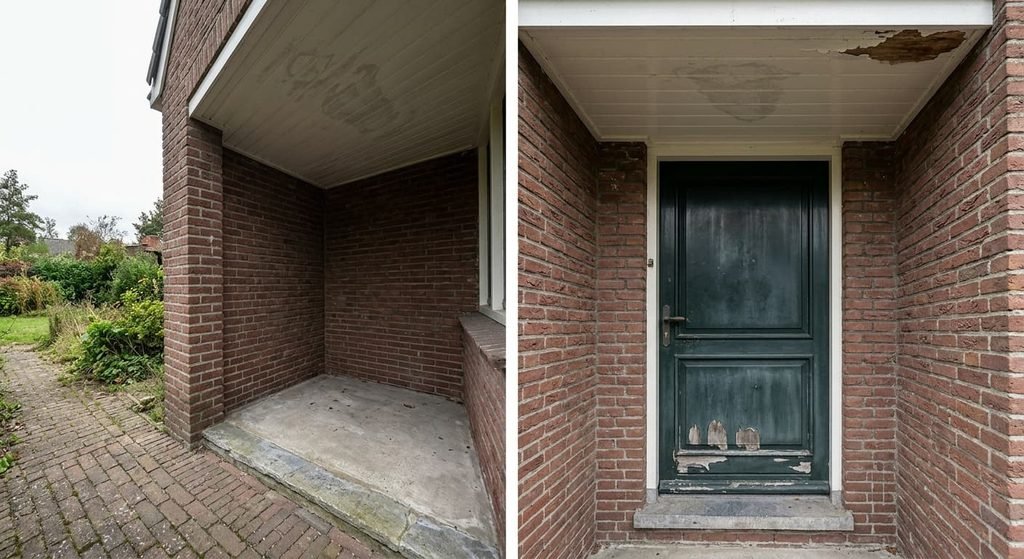
Ask of every purchase how long it takes to redo. Then ask how far from the pavement a failure shows. Paint on joinery fails in sheets. A patch lifts and water gets under it. Within a season the flaking is visible from the road. Redoing it means scraping and sanding first. Priming and two coats follow, with drying time between them. Together that’s a day’s work spread across a weekend. A worn mat takes a minute to swap.
Preparation decides how long paint lasts, more than the grade of the tin does. A film laid on a clean, sound, sanded surface with primer keeps its grip for years. The same film on dust or damp lets go early. How many years depends on how much weather reaches your boards, and I can’t see that from here. A porch open to the west gets more rain than one facing north. Dry weather matters too: paint laid onto a wet surface, or below the temperature the tin states, cures badly, so the work waits for a dry spell.
Spend on what takes hours to redo, and buy cheap what you can swap in a minute. Hours measure the cost of a mistake better than a price tag does.
Everything in the list follows that rule.
The list, in buying order
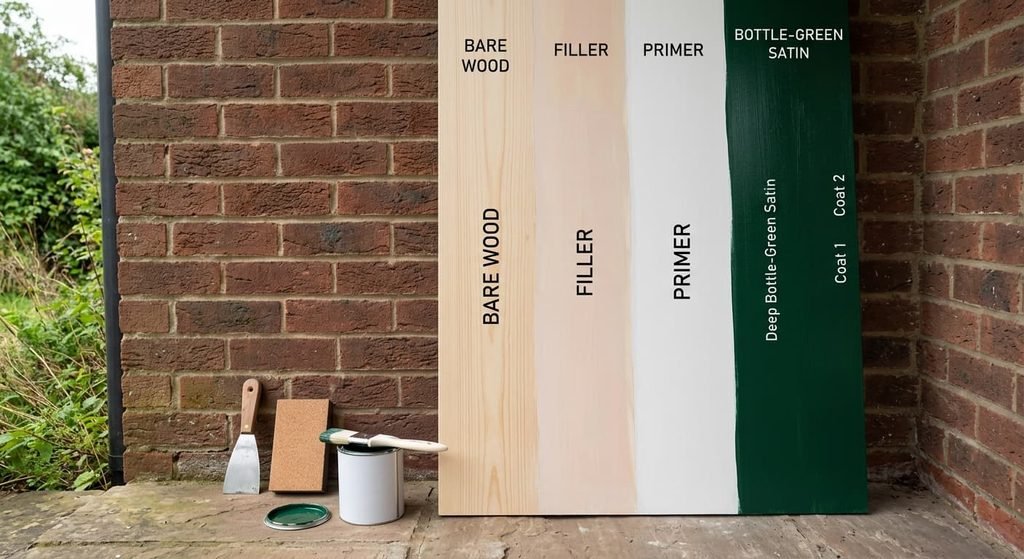
1. An exterior paint system for the door and the ceiling boards: filler for cracks and gaps, a stain-blocking primer on bare or knotted wood, then two coats of satin exterior paint. The door leaf is 93 × 211 cm, which is 1.96 m². Add about 0.6 m² of frame and 3.6 m² of ceiling. Two coats cover roughly 12 m², so about 1.2 litres at a typical 10 m² a litre (check the tin). It goes first because everything else sits beside it and it needs several dry days. Tier: BUY ONCE, since the binder, the part of the paint that forms the film, decides whether it flexes with the wood. The cheap version is a thin paint with no exterior rating. It chalks and cracks inside two seasons.
2. A large pot of frost-rated glazed stoneware holding a hardy evergreen that tolerates shade, such as skimmia. Second place suits the plant, which needs a season to settle. Tier: MID. Glaze and firing decide whether the walls survive winter. The weak version is unglazed terracotta. It soaks up water, and water expands by about 9% as it freezes, so the wall flakes.
3. A house plate in solid metal, fixed with stainless-steel screws. It sits third because it’s small and fixed once. A visitor reads it before anything else. Tier: BUY ONCE. The weak version uses zinc-plated screws. Those can rust within a year or two and run orange streaks down the brick.
4. A bell push and a letter plate matched in one metal: solid brass or stainless steel. They follow because hands touch them daily. Tier: MID. The weak version is plated plastic, where a thin chrome layer peels at the edges.
5. A coir doormat with a rubber backing. It comes last because it wears out fastest, and buying it after the rest lets you match it to a finished porch. Tier: BUY CHEAP, since coir wears down inside two years at any price. The weak version has loose fibres held by a thin glue film. It sheds and curls at the corners.
Where porch curb appeal money goes, and where it doesn’t
Spend on the paint’s preparation materials. Spend on the pot’s glaze too, and on the screws. Each is hidden by what it holds or fixes. Each fails slowly enough that you notice only when it’s late. A glaze that rings when you tap it, with no bare patches on the foot, is one to keep. A paint tin that names an exterior rating and a coverage per litre beats one that names neither.
The remaining pieces can be plain, including the plant. A small evergreen grows into its pot within a few seasons. Front porch curb appeal gains little from paying for years you’d otherwise wait.
Most guides treat a new front door as the main outlay of a porch, and I’d argue the new door down. A door that looks tired usually has a tired surface: peeling paint, a stained lower panel, dull hinges. Sanding and filling, then two coats, fix those in a day. A replacement ties you to the frame’s 93 × 211 cm opening. It often means redoing the frame and threshold, which is a second job. Keep the door you have, and put that money into the paint system instead.
What this order assumes, and when it breaks
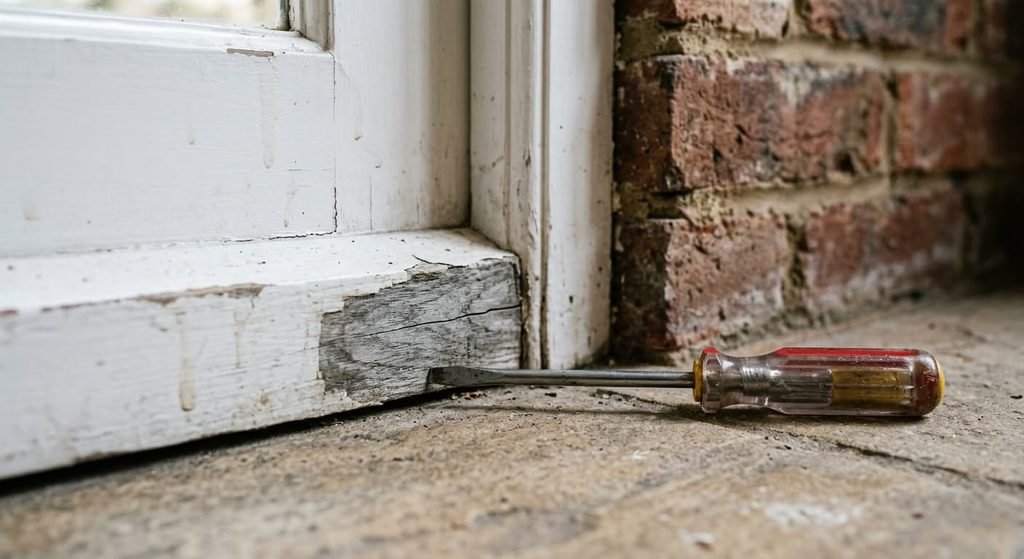
This sequence needs two things: permission to paint what a visitor sees, and joinery underneath that is sound. Probe the bottom rail of the door and the foot of the frame with a screwdriver tip. If the tip sinks in, the wood is rotten. Front porch curb appeal then starts with repair, and the door argument flips.
Three situations change the sequence. In a rental, ask first. Then drop item 1’s door, since items 2 to 5 all lift out and move with you. Rules from your municipality or an owners’ association may restrict what you change on a street-facing facade, so check before you open a tin. On a damp north-facing porch, wash off the algae first. Then wait for several dry days, because paint won’t grip a surface that hasn’t dried. A south-facing porch fades dark paint faster, since sun breaks pigment down. Pick a mid or light shade there. Plan the work for a dry spell in spring or early autumn.
What to skip entirely
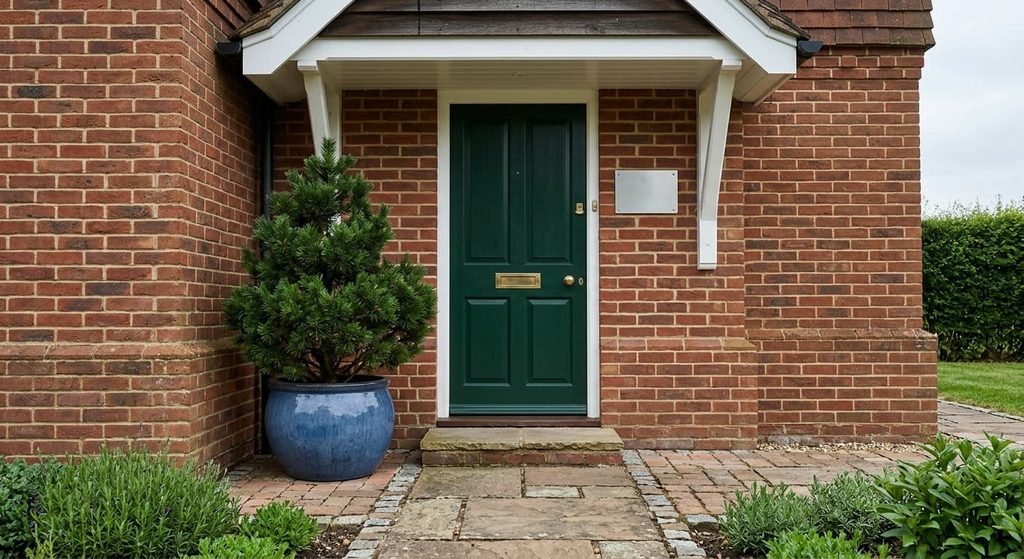
Artificial plants top the list. Their colour fades after one season of sun, dust shows on the leaves, and at 2 m they read as plastic. Next comes the high-pressure jet for the brick. It blows soft mortar out of the joints and drives water behind them. A stiff brush and water does the job. Hanging baskets come third. A basket holds only a litre or two of compost, so it needs watering daily and looks dead after a week of neglect. Stick-on house figures are fourth. The vinyl fades and peels at the corners.
None of the four earns a place under the rule, and each fails in a way you’d have to redo.
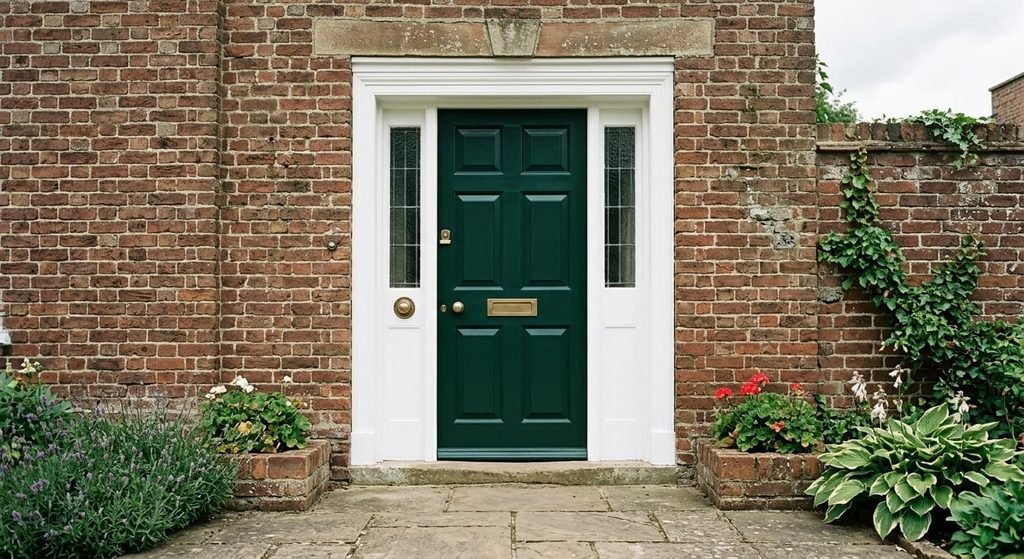
Front porch curb appeal starts with paint and preparation on the surfaces that take hours to redo. A pot follows. A plate and matching hardware come next, and the mat is last. The rule behind the order is to spend on hours and save on minutes. I’d put the money into preparation and not into the grade of the paint. Start with the door this weekend. Keep the tin and the pot receipts, since both should outlast several mats.
Questions readers keep asking
What is the minimum to buy for a better front porch?
Five pieces cover it. They are the paint system and a pot with an evergreen. A house plate and matching hardware follow. A mat comes last. Start with the paint, because it needs dry days. Add nothing more until the five are in place and you’ve seen the porch from the pavement at dusk.
What should you do first to improve a front porch?
Wash it, then repair it, then paint it. Brush off algae with water. Fill the cracks, and sand any flaking. Choose a run of dry days for the paint, because damp wood stops the film gripping. The prepared surface does more for the look than the colour you choose.
How can you judge exterior paint without knowing its price?
Read the tin. It should name an exterior rating and a coverage per litre. It should also state the coats it expects and the primer it pairs with. A paint that names none of these hasn’t been designed for weather. Then judge it a year on: a good film hasn’t chalked.