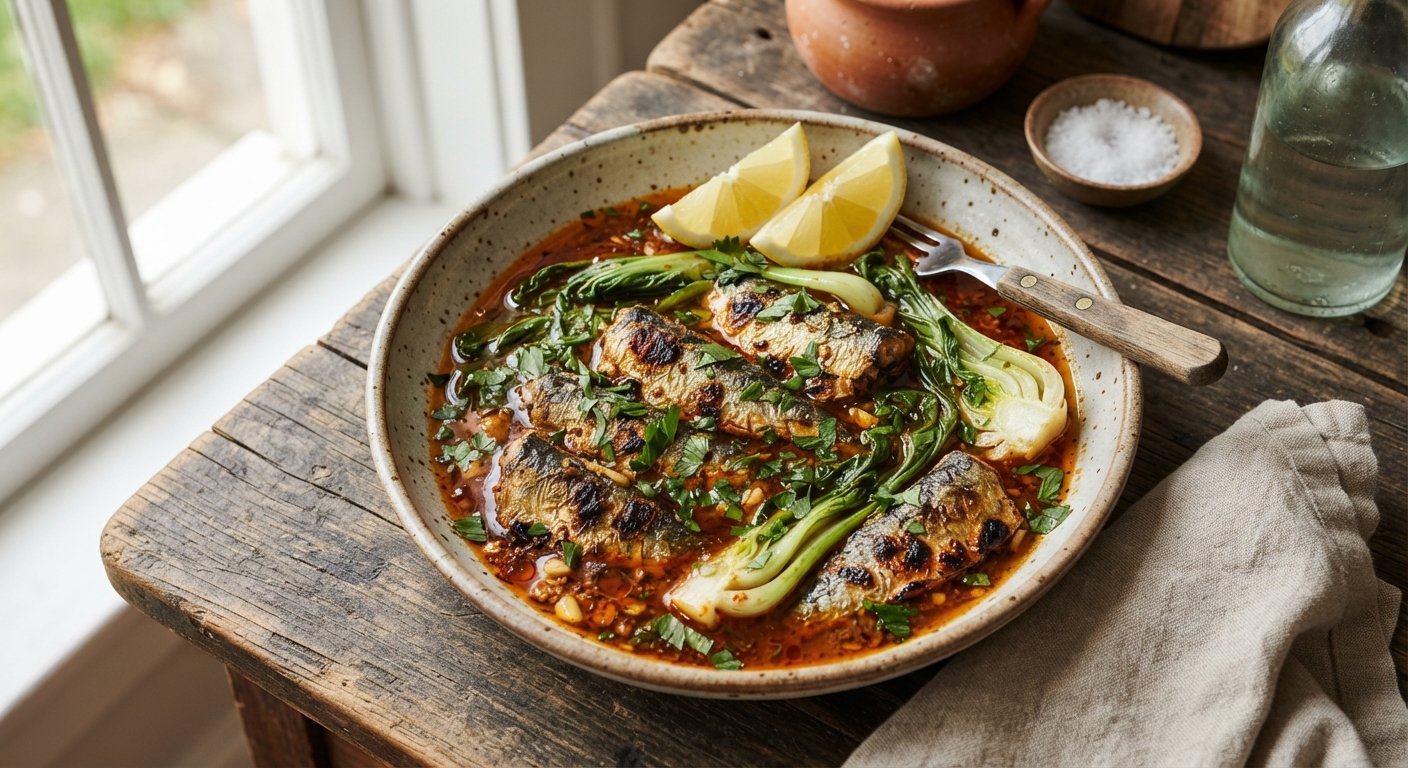
Searing fish skin-side down does something you cannot get any other way: contact with hot, dry metal triggers the Maillard reaction, the same browning chemistry that turns bread crust golden and steak edges deep brown. That single minute of undisturbed contact is what separates a good One-Pan Sardines with Bok Choy and Harissa from a great one, because the crisped skin holds its structure even after the fish sits in a spiced, brothy pan sauce for the rest of the cook.
This is a weeknight dish built from two things that already belong together in real kitchens: sardines rubbed with harissa, a pairing that shows up constantly across Mediterranean and North African cooking, and a quick-wilted leafy green folded into the same pan to soak up the spiced oil. Bok choy stands in here for the chard or spinach a Tunisian or Sicilian cook might reach for — it wilts in under three minutes, keeps a faint crunch at the stem, and needs nothing more than the fat already in the pan. Anyone wondering how to make bok choy and harissa sardines on a weeknight will find the whole process fits inside one skillet and about 25 minutes.
Key Techniques for One-Pan Sardines with Bok Choy and Harissa
This dish comes together in under 25 minutes and rests on three moves: searing sardines skin-side down until the fat renders, blooming harissa paste in warm oil to release its fat-soluble spice compounds, and wilting bok choy briefly so it keeps color and bite.
Harissa is built on dried chilies, garlic, caraway, and cumin, and most of the flavor compounds in those spices are fat-soluble rather than water-soluble. Stirring the paste into warm olive oil for thirty to forty seconds before anything else touches the pan pulls those compounds into the fat, where they coat every other ingredient that follows. Skip this step and the harissa tastes flat and one-note instead of layered.
Three Moves That Make the Difference
- Dry the fish first. Any surface moisture on the sardines turns to steam in the pan and blocks browning, so pat the skin dry with paper towels before it goes anywhere near the harissa oil.
- Bloom the paste, don’t burn it. Thirty to forty seconds over medium heat is enough to release aroma; longer than that and the natural sugars in the chilies begin to scorch and turn bitter.
- Add bok choy stems before leaves. The stems need roughly ninety seconds more cooking time than the leafy tops, so staggering them keeps both parts at the right texture instead of one mushy and one raw.
Ingredients
This makes two generous main-course portions or four smaller plates alongside bread or grains.
For the Sardines and Harissa Base
- 8 fresh sardines, cleaned and gutted, or 2 tins (about 400g) good-quality tinned sardines in olive oil, drained
- 3 tablespoons olive oil, divided
- 2 tablespoons harissa paste (mild or hot, depending on preference)
- 3 garlic cloves, thinly sliced
- 1 teaspoon ground cumin
- 1/2 teaspoon smoked paprika
- 1 cup vegetable or fish stock
- Salt and black pepper, to taste
For the Bok Choy
- 4 baby bok choy, halved lengthwise, or 1 large bok choy, cut into wide strips
- 1 lemon, half juiced and half cut into wedges for serving
- 2 tablespoons fresh parsley or cilantro, roughly chopped
How to Make Sardines with Bok Choy and Harissa
- Pat the sardines completely dry with paper towels. Season both sides lightly with salt and pepper.
- Heat 2 tablespoons olive oil in a wide, heavy skillet over medium-high heat until it shimmers. Lay the sardines skin-side down and press gently with a spatula for the first 20 seconds so the skin stays flat. Cook undisturbed for 2 to 3 minutes until the skin releases easily from the pan, then flip and cook 1 more minute. Remove to a plate.
- Lower the heat to medium. Add the remaining 1 tablespoon olive oil, then the harissa paste, garlic, cumin, and smoked paprika. Stir constantly for 30 to 40 seconds until fragrant — do not let it darken past a deep brick red.
- Pour in the stock, scraping up any browned bits from the bottom of the pan. Bring to a gentle simmer.
- Add the bok choy stems first, cover, and cook 90 seconds. Add the leafy tops, cover again, and cook 60 to 90 seconds more, just until wilted but still bright green.
- Nestle the sardines back into the pan on top of the bok choy. Spoon a little of the harissa broth over the fish and warm through for 1 minute.
- Finish with lemon juice, scatter parsley or cilantro on top, and serve straight from the pan with lemon wedges on the side.
Good vs. Excellent: The Details That Matter
A good version of this dish tastes fine. An excellent one comes down to timing and heat control more than any extra ingredient.
- Pan temperature before the fish goes in. The oil should shimmer but not smoke. A pan that is too cool lets the sardines steam instead of sear; too hot and the skin scorches before the flesh cooks through.
- Resist stirring the sardines while they sear. Moving the fish breaks the crisping skin before it has released naturally from the pan surface.
- Taste the harissa oil before adding stock. This is the one moment to adjust heat level — a splash more paste if you want it bolder, or a pinch of sugar if the chilies taste sharp.
- Undercook the bok choy slightly. Residual heat from the broth keeps wilting it after you plate, so pulling it a touch early avoids a soft, gray-green result.
Troubleshooting Common Problems
Why did the sardine skin stick to the pan instead of releasing? The pan usually was not hot enough, or the fish was moved too soon. Skin releases naturally once a light crust forms; forcing it early tears the skin. Wait an extra 30 seconds and try again before flipping.
Why does the harissa taste bitter? The paste likely sat in the oil too long or the heat was too high during the bloom step. Chili sugars scorch quickly past the 40-second mark, so pull the pan off heat the moment it turns fragrant.
Why is the bok choy mushy? It went in too early relative to the stems, or it sat covered too long. Leafy tops need roughly half the cooking time of the stems and continue softening off the heat.
Variations and Substitutions
Fresh sardines can be swapped for good tinned sardines in olive oil when fresh ones are not available; drain them well and add them straight to the pan at the end, warming through for a minute rather than searing, since they are already cooked. Mackerel fillets work as a close substitute if sardines are hard to find, using the same searing method.
No bok choy on hand? Swiss chard, tatsoi, or baby spinach wilt in a similar timeframe and pick up the harissa oil just as well — spinach needs closer to 30 seconds, not two minutes, so adjust down. For a heartier version, stir a drained can of chickpeas into the broth, which also stretches this bok choy harissa sardines dish across more servings.
If harissa paste is unavailable, a mix of smoked paprika, a pinch of cayenne, ground caraway, and a spoon of tomato paste approximates the flavor, though the result will be milder and less complex than the real thing.
Serving and Pairing
Serve this dish straight from the skillet with crusty bread for mopping up the harissa broth, or spoon it over warm couscous or steamed rice to soak up every bit of the pan sauce. A simple side of yogurt thinned with a little lemon juice and olive oil cools the heat of the harissa and adds a creamy contrast without competing with the spice. A crisp, herby side salad with cucumber and mint rounds out the plate well. However you plate it, harissa sardines with bok choy are best served hot, straight from the pan, while the broth is still loose enough to soak into bread or grains.
Storage and Reheating
Leftovers keep in an airtight container in the refrigerator for up to 2 days. The bok choy softens further on storage, which is expected and still tastes good. Reheat gently in a covered skillet over low heat with a splash of water or stock to loosen the sauce; avoid the microwave, since it tends to overcook the fish and turn the greens gray. This dish does not freeze well — both the sardines and bok choy lose their texture once thawed, so it is best eaten within two days.
Nutritional Information
Values below are estimates per serving and will vary depending on exact brands and quantities used.
| Calories | 385 kcal |
| Protein | 28 g |
| Carbohydrates | 9 g |
| Fat | 26 g |
| Fiber | 3 g |
Final Thoughts
This recipe was tested and refined in the bebup.org kitchen before publishing, with the searing and blooming times adjusted across several rounds to keep both the fish and greens at their best texture.
One-Pan Sardines with Bok Choy and Harissa rewards attention to small moments — the sound of skin releasing from hot metal, the moment harissa turns fragrant instead of sharp, the few seconds that separate bright bok choy from a dull, overcooked green. None of it demands special equipment or a long ingredient list, just a willingness to watch the pan closely for twenty-five minutes.
Mastering the Technique
The skill that carries over from this dish to almost any other pan-seared fish is patience at first contact. Once sardines, or any thin, oily fish, touch a properly heated, lightly oiled pan, resist the urge to check the underside for the first 90 seconds. A bond forms between the fish proteins and the hot metal early on, and it releases on its own once enough browning has developed underneath. Prying at it early tears the skin and leaves it stuck to the pan instead of on the fish. The same patience applies to the harissa bloom: watch color rather than the clock, since stove strength and pan thickness both shift how fast forty seconds actually passes.
One-Pan Sardines with Bok Choy and Harissa
Ingredients
Method
- Pat the sardines completely dry with paper towels. Season both sides lightly with salt and pepper.
- Heat 2 tablespoons olive oil in a wide, heavy skillet over medium-high heat until it shimmers. Lay the sardines skin-side down and press gently for the first 20 seconds. Cook undisturbed 2 to 3 minutes until the skin releases, then flip and cook 1 more minute. Remove to a plate.
- Lower the heat to medium. Add the remaining olive oil, harissa paste, garlic, cumin, and smoked paprika. Stir constantly 30 to 40 seconds until fragrant.
- Pour in the stock, scraping up browned bits. Bring to a gentle simmer.
- Add the bok choy stems first, cover, and cook 90 seconds. Add the leafy tops, cover, and cook 60 to 90 seconds more until wilted but bright green.
- Nestle the sardines back into the pan on top of the bok choy. Spoon harissa broth over the fish and warm through 1 minute.
- Finish with lemon juice, scatter parsley or cilantro on top, and serve straight from the pan with lemon wedges.