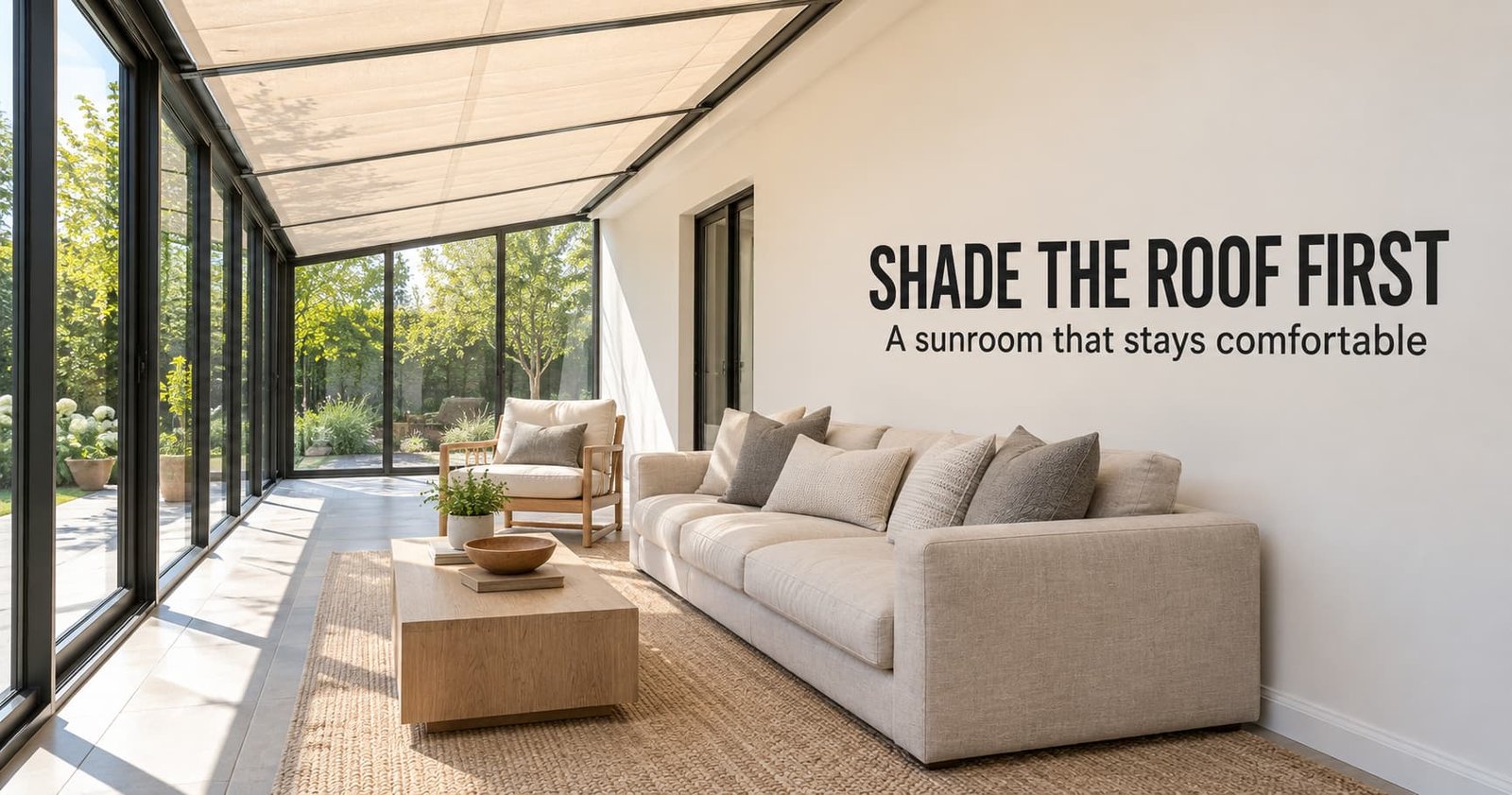
A sunroom is a greenhouse with a sofa in it, and at midday it behaves like one. A sunroom that stays comfortable comes down to where the heat arrives, and it arrives from above. Shade the roof first. Then sit low, and let the hot air out at the top. This guide assumes a room 300 by 450 cm in the Netherlands. It has a glazed roof and a long glass wall facing south. The sums are simplified, so they’re the right order for the jobs and not a forecast. Check local rules before changing anything structural.
What a sunroom that stays comfortable demands
Start with where the sun stands at midday. At midsummer noon in the Netherlands it is about 61° above the horizon. A horizontal surface catches direct sunlight in proportion to the sine of that angle, 0.88, while a south-facing wall catches it in proportion to the cosine, 0.48. Per square metre, the roof takes about 1.8 times what the wall does.
Now multiply by area. Here the glazed roof is 13.5 m² and the glass wall is about 9.5 m². Multiplying, 13.5 × 0.88 gives 11.8 units for the roof. The wall gives 9.5 × 0.48, or 4.6. That makes roughly seven parts in ten of the midday sun come through the roof. A pitched roof facing south takes even more at noon, so the share only grows.
Heat adds a second rule: warm air rises. The layer under the roof runs hotter than the layer at sofa height, often by several degrees in a tall glazed room. Seats at 40 cm sit in the cooler layer. A hanging plant at 220 cm sits in the hot one.
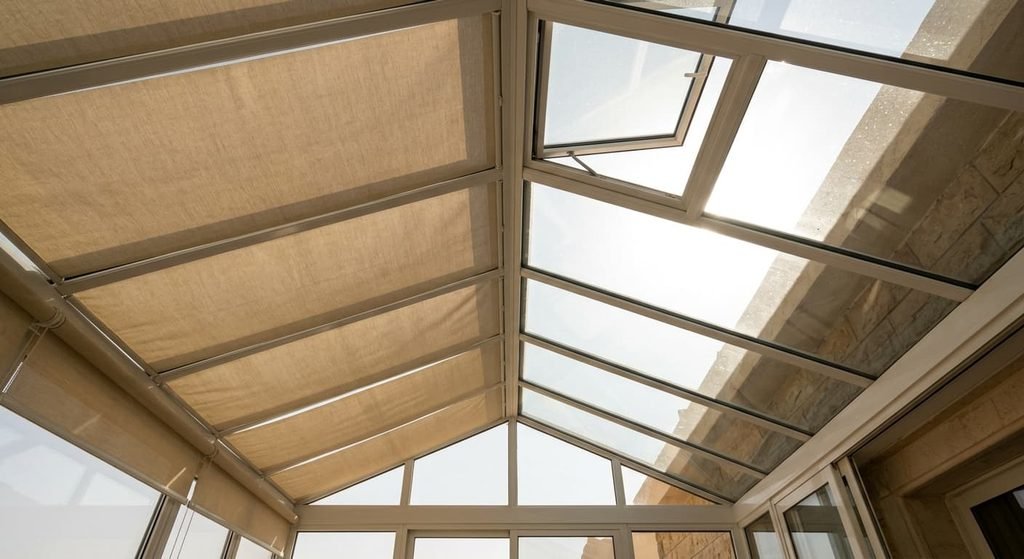
Shade the roof before the walls. I’d defend that against the usual advice to start with blinds on the side glass, because those cut the smaller share of the heat.
Both numbers are checkable with a thermometer, and a sunroom that stays comfortable depends on them.
Four layouts for a sunroom that stays usable
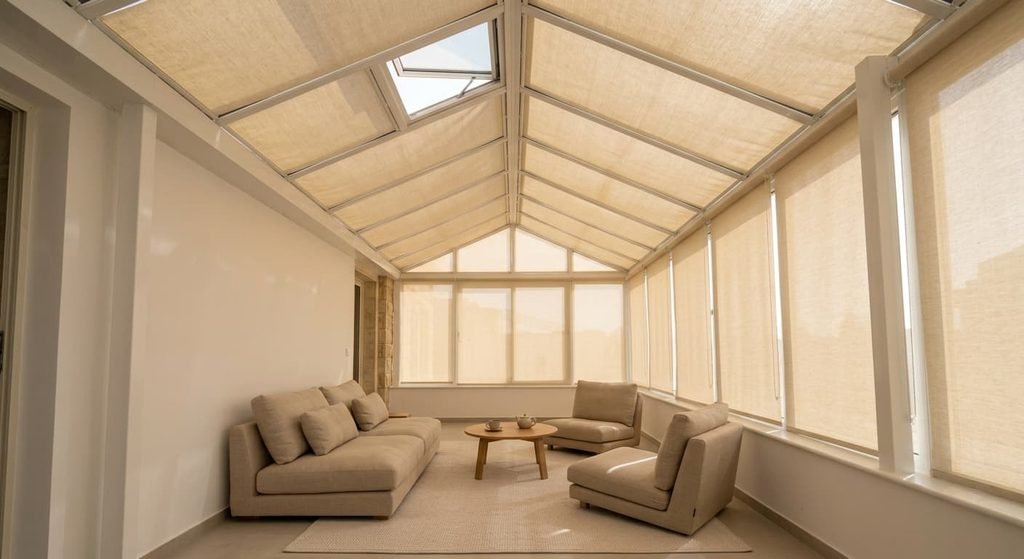
– Lean-to, 300 × 450 cm: a roof blind on a track covers the whole 13.5 m² of glazing. Two lounge chairs with 40 cm seats and a low sofa stand along the house wall on a pale flat-weave rug of 160 × 230 cm. A vent at the highest point stays open. Linen-cotton cushions in oat keep the surfaces light.
– Narrow veranda, 200 × 500 cm: one bench 400 cm long runs down the house wall, with a 70 cm strip clear in front. Shade fabric stretches tight below the roof glass, 15 cm under it so air can pass. Two top vents sit at opposite ends. A low table 40 cm high holds the cups.
– Part-solid roof, 350 × 400 cm: a solid insulated panel replaces 150 cm of glazing over the seating end. A sofa 200 cm wide sits under that shade. The lit end holds planting in large pots at floor level, where the cooler air collects.
– Large dining sunroom, 400 × 600 cm: a table 180 × 90 cm with six chairs, seat height 45 cm, stands under a roof blind. Vents at both ends of the ridge let the hot layer out. A tile floor in light stone stays cooler to the hand than a dark one.
Where people get this room wrong
Blinds on the side glass only are the usual first purchase. The cause is arithmetic, and it isn’t close: the roof carries about seven parts in ten of the midday sun, and the side blinds act on the other three. Fit a blind or a shade cloth to the roof first, then the walls if the room still needs it. In this room the side blinds act on 4.6 of the 16.4 units.
A dark floor in front of the glass collects heat all afternoon. The cause is absorption, and the heat doesn’t vanish: it comes back out into the evening. Hold the back of your hand on the floor at 2 pm to see how much it holds. A dark tile that stores heat is welcome in October and a burden in July, so a pale rug that lifts in winter is the easy answer.
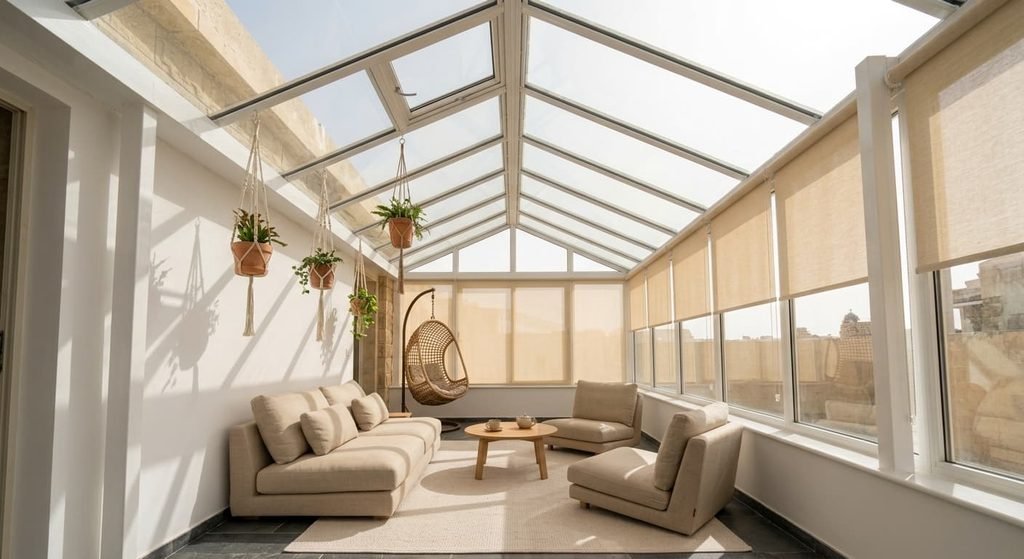
Everything hung high puts the lamp shade and the plants in the hottest layer, along with the hanging chair. The cause is that warm air rises and collects under the roof. Bring plants down to 150 cm or lower, and keep hanging seats low. A plant at 220 cm sits in air several degrees warmer than a pot on the floor, so it dries faster too.
A shut top vent keeps the hot layer in. The cause is the habit of closing a room to keep it cool. Open the highest vent at midday. Open a low door or window opposite, so cooler air feeds in below as the hot air leaves. A vent that opens only 5 cm still helps, since the aim is a path for the air.
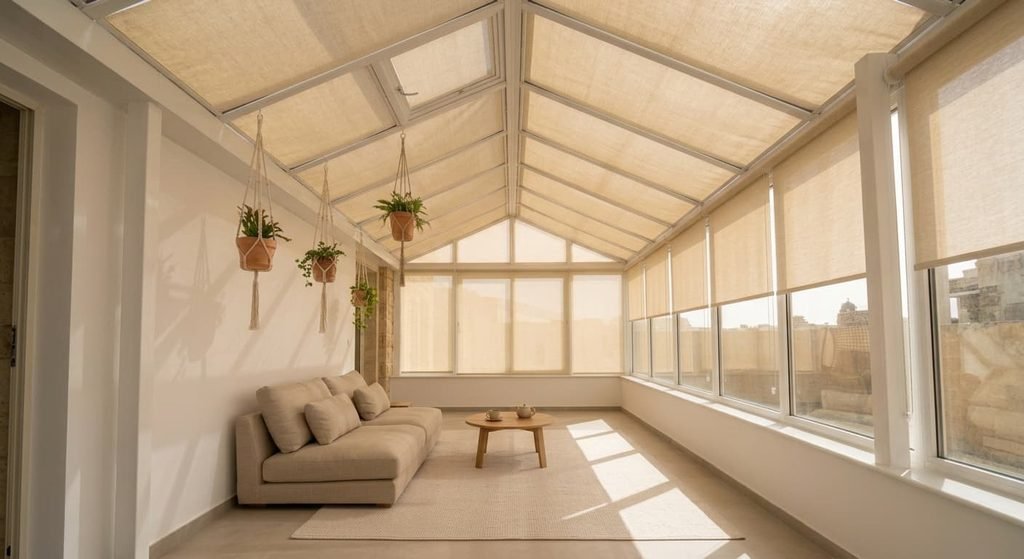
When the obvious layout is wrong
The obvious layout puts the sofa against the glass, facing out, to enjoy the view. With the roof shaded, the south glass still puts a patch of sun on the floor at noon. A wall of glass 2.1 m high at 61° throws that patch 2.1 ÷ tan 61°, or about 1.2 m, into the room. A sofa 60 cm from the glass sits inside it.
Put the sofa against the house wall, facing the glass. In this room the house wall is 300 cm from the glass, so a sofa 90 cm deep has its front edge at 210 cm. That keeps the seat about 90 cm clear of the patch, and the view stays.
In a sunroom that stays comfortable, the seat waits outside the patch.
In winter the sun is about 14° up at noon, and the same glass throws its patch 8 m, past the back wall. That is welcome, and it is why the rule is for midday in summer and not for the whole year. In a room only 200 cm deep, a sofa on the house wall has its front edge at 110 cm, just inside the patch, so add a side shade.
Three things to try this weekend
1. At 1 pm on a sunny day, stand one room thermometer on the sofa seat and hang another just under the roof. Shade each with a card so the sun doesn’t heat it directly, and read both after twenty minutes. A gap of several degrees confirms the layers, and the vent is the first thing to open.
2. Open the highest vent and hold a strip of tissue in it. If the strip leans outward, hot air is leaving. That’s the sign you want. If it hangs still, open a low window opposite. Cooler air then has a way in.
3. At 2 pm lay the back of your hand for five seconds on each cushion and on the floor by the glass. Move the warmest item out of the sun, and notice which fabric stays closest to the air.
A sunroom that stays comfortable is shaded from above. It seats you low and vents at the top. Measure the roof share before you buy a blind, and expect the first change to come from the roof and not the walls. That order of jobs does more at midday than any amount of cushions, and it won’t cost you the view. I’d start with the thermometer this weekend.
Questions readers keep asking
Should a roof blind go inside or outside the glass?
Outside stops the heat before it reaches the glass, and inside shades the room after the glass has already warmed. Outside is stronger, and inside is easier to fit. Check the maker’s sheet for the roof you have, and treat an inside blind as the practical first step.
How far from the glass should seating sit?
For a sunroom that stays comfortable, keep the front edge of the seat about 120 cm or more from a glass wall 2.1 m high, so the noon patch in summer doesn’t reach it. Against the house wall in a room 300 cm deep, a sofa 90 cm deep clears it comfortably.
Which fabric stays coolest in a sunroom?
Pale natural fibres such as linen and cotton stay closest to the air temperature. Test by hand at 2 pm: lay the back of your hand on a sample in the sun for five seconds. The fabric that feels closest to the air is the one to buy.