What makes a TV remote only work when you stand close? Four small losses multiply, and the reach falls with the square root of their product. No single fault looks big enough to blame. Tired batteries take one share and a filmy lens takes another. A half-hidden receiver takes a third, and afternoon sun takes the last. Our test lounge is a British one, with a sofa 3.2 m from the screen. Every loss is a guess, so put in readings from your own room afterwards. The reach shrinks a few centimetres at a time, and nobody notices until the sofa is out of range. The tests below find which loss is yours.
What makes a TV remote only work up close, and why the loss multiplies
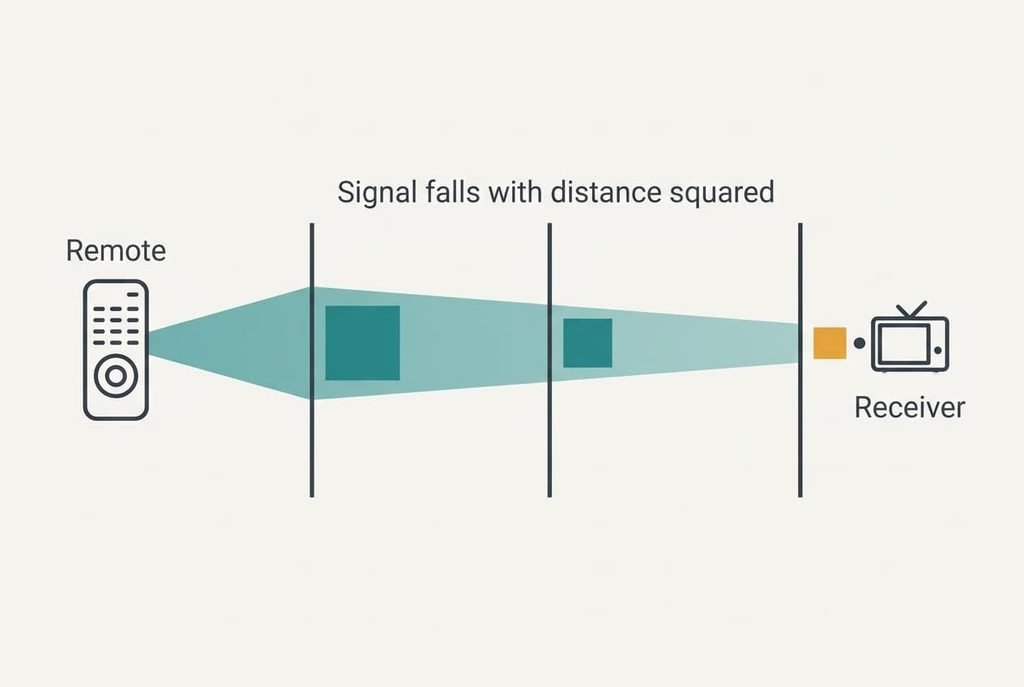
A remote sends infrared pulses from a small LED, and the TV’s receiver decodes them. Light fans out on its way, so what reaches the receiver drops in proportion to distance squared. Doubling the distance cuts the signal to a quarter. Aim matters too: 30° off-axis keeps only 0.87 of the signal, a minor loss here.
Assume a healthy remote reaches 8 m. Reach scales as the root of the starting signal, so halving the signal cuts it by 29%. That’s why four small losses multiplied together can shrink a long reach to a short one. Our four are batteries at 0.47 of full strength, a lens film passing 0.6, a receiver half hidden at 0.5, and sun doubling the threshold, which counts as 0.5. Multiply them and you get 0.0705. The square root of that is 0.265, so the reach falls to 8 × 0.265, or 2.1 m.
Our sofa sits 3.2 m away, so the signal needs a factor of at least (3.2 ÷ 8)², which is 0.16. At 0.0705 the shortfall is more than half, and the remote works from the arm of a chair but not from the centre cushion.
Four tests to run when your TV remote works only up close
Record each result before changing anything, and take all four readings in one evening so the cells and the light stay the same. First, point the remote’s front at a phone’s front camera and press volume. A faint white or purple dot means the LED fires. A weak dot at 10 cm points to batteries or a dirty lens.
Second, face the screen. Step back 50 cm at a time, pressing volume at each stop. Press the same button each time, and note the last distance that works. In our room it’s 2 m.
Third, repeat the walk with the curtains drawn, or after dark. Taking the sun out of the sum moves the factor to 0.141 and the reach to 3.0 m. A gain of that size, about 40%, shows the sun is a player.
Fourth, look at the TV’s front edge for the small dark window that holds the receiver. Check that no soundbar lip or bezel trim covers it. A window half hidden halves the signal.
These tests are all free.
The four fixes, in order
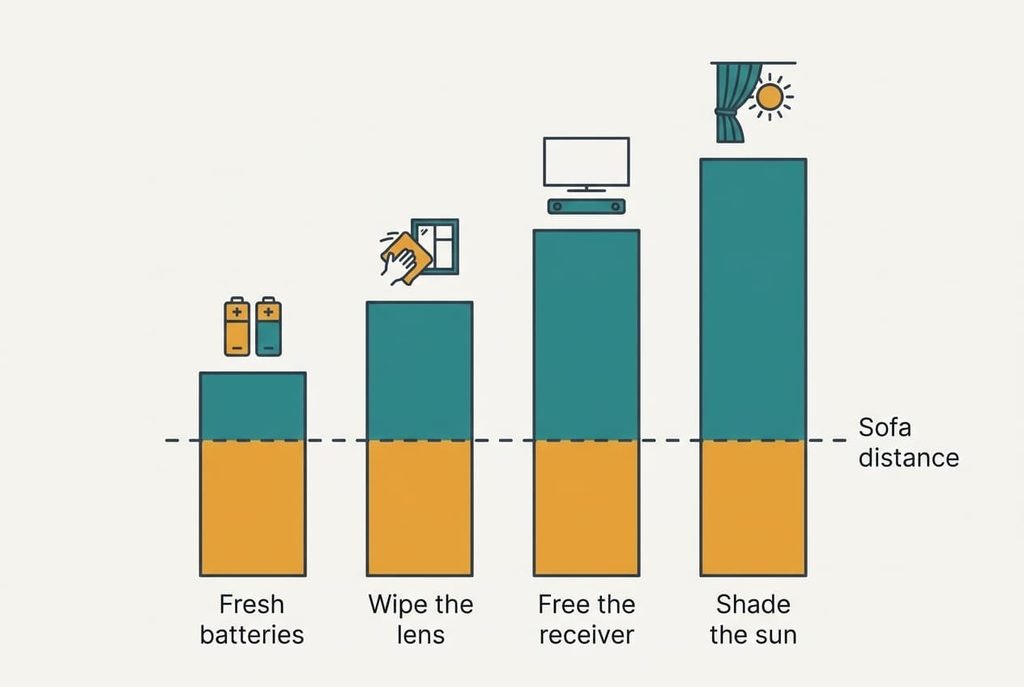
Work down this list with one change per step, and walk the distance ladder again after each. The reach should climb with every step.
Fit two fresh batteries, which lifts the signal 2.1 times. The LED’s current comes from the cells. Taking 1.5 V for the LED and its driver, two fresh cells at 3.0 V give (3.0 − 1.5) ÷ 15 Ω, which is 100 mA. Tired cells at 2.2 V give 47 mA. Fresh ones lift the factor from 0.0705 to 0.15 and the reach from 2.1 m to 3.1 m. That’s just short of 3.2 m, so more is needed. It costs a pair of cells. Alkaline cells sag under pulses before they’re empty, so test with new ones before you blame the remote. Cells left in a remote for years also leak a little, and a fresh pair resets that. Each fix removes one of the things that make a TV remote only work close up.
Wipe the remote’s LED window with a dry cloth, which lifts the signal 1.7 times. A film of skin oil and dust passes only 0.6 of the light. Removing it takes the factor to 0.25 and the reach to 4.0 m, which clears the sofa. It’s free. Try a slightly moist cloth if the film is stubborn, and let it dry before pressing a button. Check the small clear window at the front, because the cover plastic around it matters less.
Free the receiver window, which doubles the signal. Pull the soundbar forward by 3 cm, or move any trim away from the dark patch. The factor reaches 0.5, so the reach is 5.7 m. It costs nothing, but the soundbar may not fit the shelf in its new spot. If it won’t, tilt the soundbar’s front edge down by a few millimetres, or lift the TV’s stand a little.
Shade the sun, which doubles it again. A curtain or a blind drawn on the sofa side lowers the infrared that floods the receiver. The factor reaches 1.0 and the full 8 m returns. The loss is a darker room in the afternoon, and a blind that’s drawn all day is a poor trade. Close it only when you’re watching. Light-coloured voiles often block less infrared than they seem to, so test with the curtains you own.
If none of that worked
If the remote still works only at 10 cm after fresh batteries and a clean window, gather evidence before you call support. Note the distance it works at now. Note whether the phone camera shows a bright dot. Try every button, because one dead button with the rest working points at a worn rubber pad.
Borrow a second remote for the same model, or a universal one. A reach of 5 m means the receiver is healthy, so the first remote is at fault. A failure here points at the receiver or the board behind it. Keep the TV model number ready for the support desk, since it decides which spare parts exist. Two or more weak causes can make a TV remote only work at short range even when none looks bad on its own, so don’t rule out the first fixes after one failed test.
The fix that is not worth doing
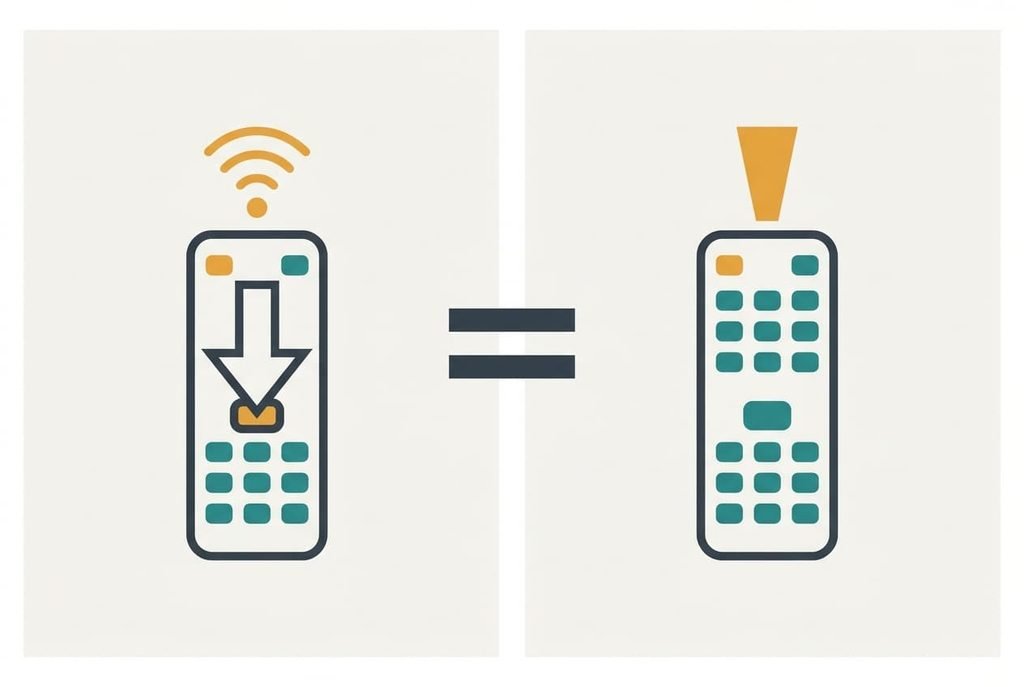
Pressing the buttons harder is the habit most people fall into, and it fails. The LED’s current is set by the cells and a small resistor, so squeezing harder doesn’t raise it. The factor stays at 0.0705 and the reach stays at 2.1 m. A pressed button sends the same pulses with the same current, whatever your thumb does.
A harder press changes nothing.
Waving the remote in a circle looks hopeful and loses signal on the way. Each wave points the LED away from the receiver for most of the swing, which cuts the average. Aiming at the ceiling to bounce the beam adds a longer path and a weaker reflection, so the signal arrives smaller than a direct aim. A cardboard tube around the LED doesn’t help either, since it narrows the beam without adding any light.
Fixing a TV remote that only works up close rests on one sum. Multiply the losses, then clear them from the largest cheap one down. Start with fresh cells. Wipe the lens. Then free the receiver and shade the window. Keep the distance ladder written down, so you’ll spot the next loss. Whatever makes a TV remote only work up close, the cure is to find the loss. Clear it. Measure again.
Questions readers keep asking
Can sunlight stop a TV remote working?
Yes. Bright sun and some low-energy lamps flood the receiver with infrared, so it needs a stronger signal to hear the remote. In our sums that doubles the threshold and trims the reach by 29%. Draw the curtains on the sofa side and test again.
How far should a TV remote reach?
A healthy infrared remote usually works from 5 to 10 m when you aim at the receiver. Our sums assume 8 m. If yours falls well short of that with fresh cells and a clean lens, one of the other losses is acting on it.
Do TV remotes wear out?
Slowly. The LED rarely fails, but the rubber button pads wear and the contacts under them go dull. One button failing while the rest work points to the pad. A remote that fails at long range on every button points away from the pad. Check the cells and lens first, then the receiver.