Halfway through the film the sun drops, and the screen starts showing the window behind your sofa. That’s the usual complaint in any room that has windows on two walls, where each wall that could carry the television faces some glass. Our case is a Utrecht flat with a living room of 460 by 360 cm. The long left wall holds a 140 cm window, and the far wall holds a second, 120 cm wide. Everything below comes from a measuring tape plus a small mirror. All figures are approximate, so swap them for readings taken in your own flat.
Why the Screen Turns Into a Mirror in a Room With Windows on Two Walls
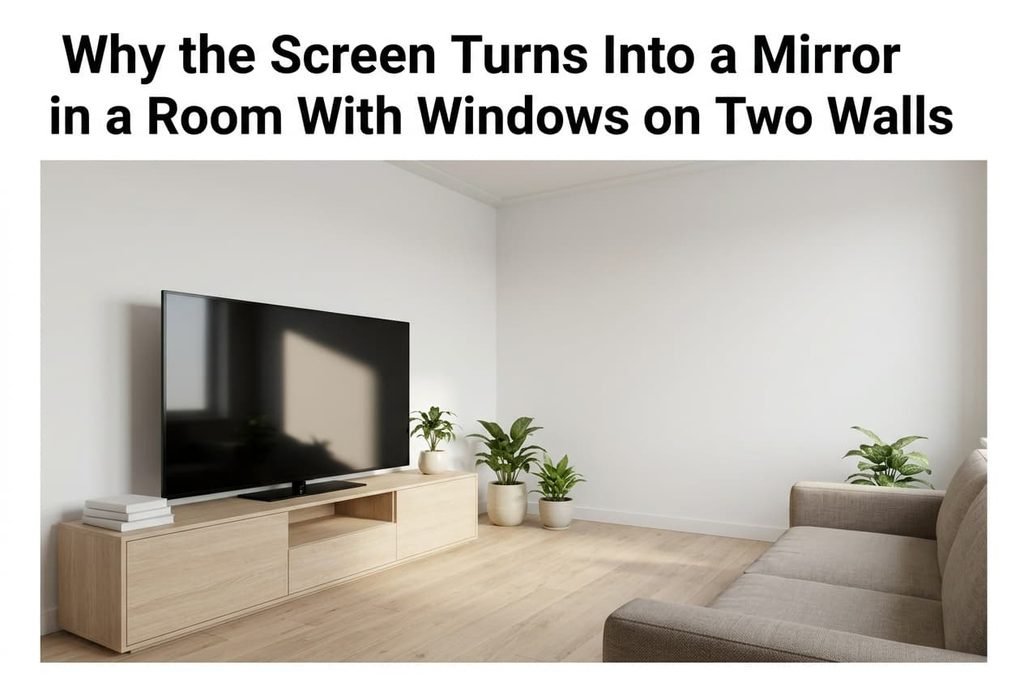
A glossy screen behaves like a mirror, and a mirror shows an object as far behind the glass as the object sits before it. The long window faces the right wall across 360 cm, so its image sits 360 cm beyond that wall. Draw a straight line from your eye to the image. The point where the line crosses the wall is where the window appears on the screen.
Try it from the middle seat of a 200 cm sofa against the left wall, with your eyes 340 cm out from the far wall and 270 cm away from the right wall. The long window spans 80 to 220 cm along its wall. Its reflection lands between 229 and 289 cm along the right wall, a band 60 cm wide. The far window adds a second band from 105 to 160 cm.
A 55-inch (140 cm) screen is 122 cm wide. Centred on the right wall it covers 169 to 291 cm and swallows the whole long-window band. The centre of the free wall is the one spot that mirrors the long window, and it is also where most people mount the screen, because it looks balanced.
Moving along the sofa alters the picture. Each 100 cm of sideways travel shifts the band by 57 cm, so the end seats get different glare from the middle one.
Three Seat Checks Before You Lift the Screen
Do these in any room that has windows on two walls before you drill anything.
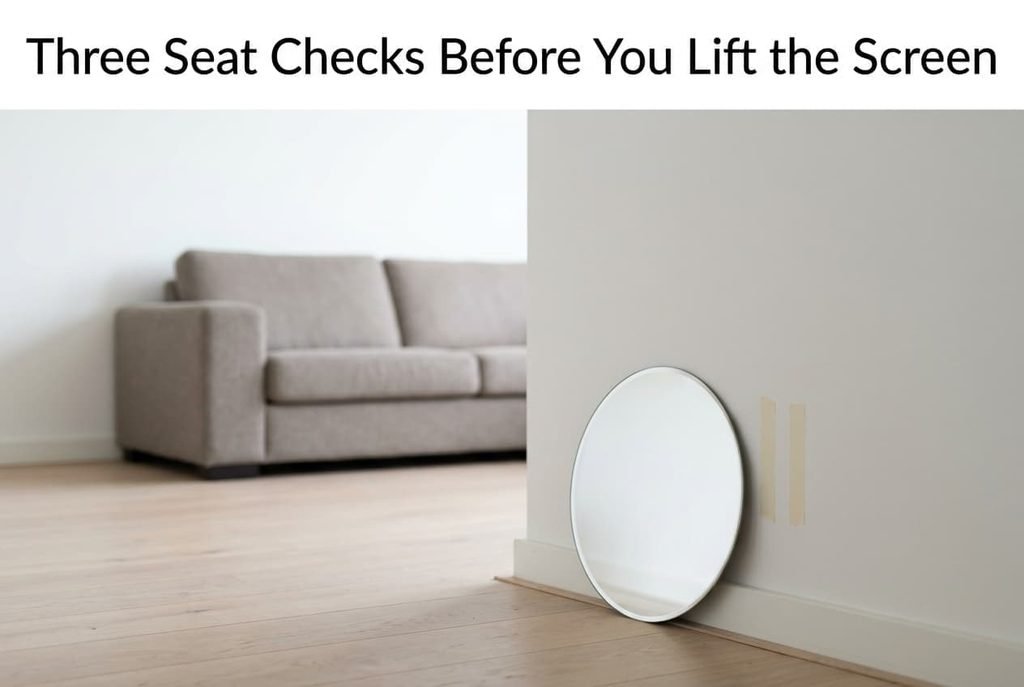
– The mirror test. Hold a small mirror flat against the wall where the screen will hang, then sit in each seat in turn. A mirror 20 by 30 cm is large enough, and a bathroom hand mirror does the job. Whatever window or lamp appears in the mirror will appear on the screen as well. Mark the edges of the patch with masking tape and compare its width with the screen’s 122 cm.
– The hour test. Repeat the mirror test after lunch and again after dark. By day the window is the bright source, whereas after dark the lamps take over and the patch moves with them. A spot that’s clear at one hour may fail at the other, and the winter sun sits lower than the summer one, so note the season on your sketch.
– The end-seat test. Sit at either edge of the sofa and mark where the patch moves. The door-end seat, 410 cm from the far wall, sends the long-window band to 269 to 329 cm, so it overlaps a screen that starts at 314 cm by 15 cm. The opposite end seat, 270 cm from the far wall, puts the band at 189 to 249 cm, well clear of the screen.
Write the tape marks down for every seat. Those figures drive each decision that follows.
A Room With Two Walls of Windows: Four Moves for the Screen
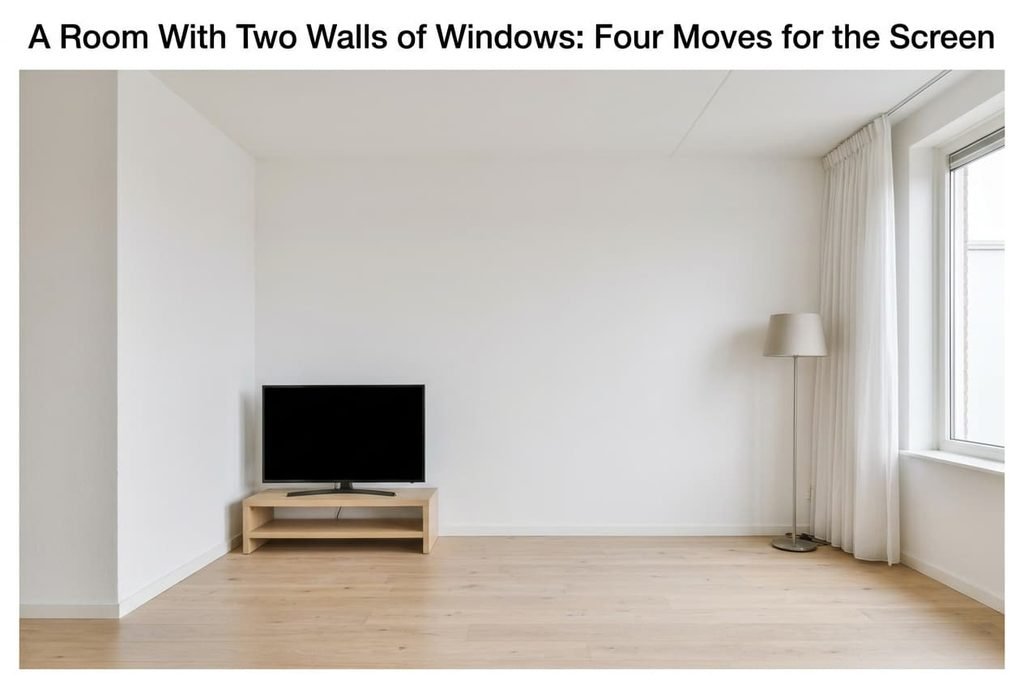
Slide the screen toward the door wall. Centre it 375 cm from the far wall, so it spans 314 to 436 cm. That sits 25 cm beyond the long-window band, which ends at 289 cm, and leaves 24 cm to the corner. The move costs nothing when the screen stands on a unit. You give up the tidy symmetry of a centred screen, and the door-end seat still grazes the patch by 15 cm.
Turn the lamps away from the screen. A lit shade shows in the glass exactly as a window does. Run the mirror test with the lamp on. Then turn the shade or shift the lamp until the bare bulb vanishes from the mirror. This costs nothing either. You lose a little reading light in one corner of the room.
Hang a sheer curtain on the long window. A sheer diffuses the daylight, so the 15 cm graze at the door-end seat turns faint instead of sharp. A rail and a curtain across 140 cm of glass make a modest purchase. You lose a little daylight and some of the view.
Fit a swivel arm as the last resort. Turning a screen by 15° swings the reflected line by 30°, enough to push the band onto bare wall. The arm needs drilling, which a rented flat may forbid, and the screen then stands proud of the wall. Choose it only when the free and cheap moves leave glare at your usual seat.
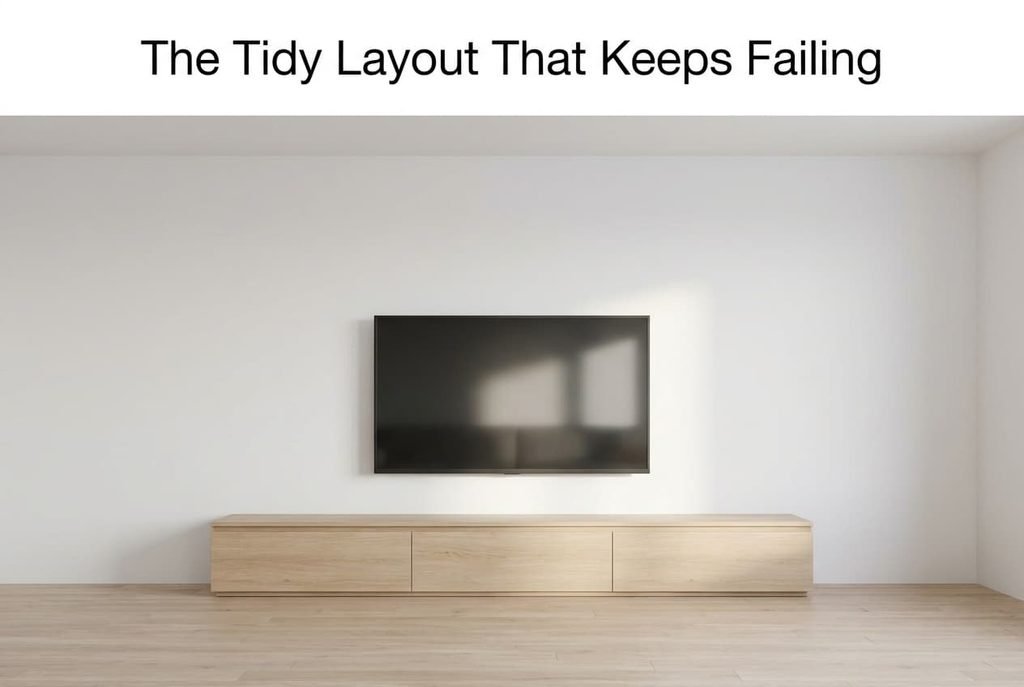
The Tidy Layout That Keeps Failing
Most advice centres the screen on the free wall because the room then looks symmetrical. For windows on two walls I’d defend the off-centre screen over the centred one, since symmetry is all the centre has going for it. From the middle seat the centred screen takes the entire 60 cm patch, while the off-centre one takes none of it. From the door-end seat the centred screen still catches 22 cm of the band, because the band reaches 269 to 329 cm and the screen ends at 291.
The offset puts the screen 145 cm from the wall’s midpoint, which means the unit beneath it moves too, and the cables travel a little further. A wall mount needs a new hole. Those are real costs, yet each is paid once, whereas the glare comes back every sunny afternoon. Sliding the sofa 60 cm toward the door would shift the band by 34 cm as well, so test the seat people really use.
The rule has a limit. With a single window, or with windows that both sit behind the seat, the centre can work. Run the mirror test before you trust either rule.
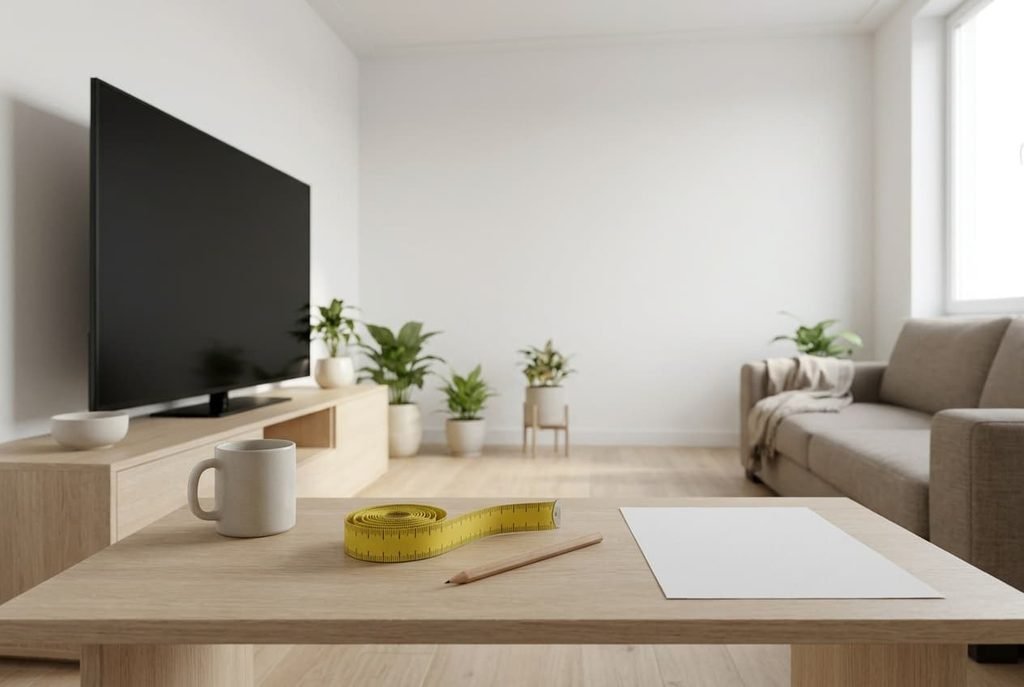
A Five-Step Order for Placing the Screen
Any room that has windows on two walls changes with every metre of width, so write each step in your own numbers.
1. Measure the edges of each window along its wall. Ours run 80 to 220 cm and 120 to 240 cm.
2. Run the mirror test from the middle seat and tape the patch on the free wall. Ours runs from 229 to 289 cm.
3. Place the screen’s 122 cm width so that 20 cm of bare wall separates it from the patch, which puts our centre at 375 cm.
4. Repeat the test from both end seats and with the lamps lit, then note any graze. Ours is 15 cm at the door end.
5. Soften a graze with a sheer curtain first, and keep the drill for the very end.
Seat first, screen second, drill last. That order lets a mirror and a tape measure catch the mistake while it’s still a pencil mark. If the patch and the screen edge sit 20 cm apart, the evening film stays clear of reflections, and the afternoon one needs nothing more than a sheer. Pin the tape marks to a sheet of paper for next time. You’ll have spent an hour, not a weekend.
Questions Readers Keep Asking
How big a screen suits this room?
A 55-inch (140 cm) screen suits our 272 cm seat distance, nearly twice its diagonal. A 65-inch (165 cm) one is 144 cm wide, 22 cm wider than ours, so it widens the strip of wall that must stay clear of glare. Measure the free gap before you choose.
Can the sofa go under the long window instead?
It can. With your eyes 150 cm from the far wall, the long-window band moves to 120 to 180 cm along the right wall, well clear of a screen spanning 314 to 436 cm. The glass then sits right behind your head, so a sheer curtain matters more than before.
Does a darker wall behind the screen help?
A matt mid-grey (#6F747A) wall softens the contrast between the bright screen and its surround, so the picture looks calmer. It does nothing about window reflections in the glass, which only the screen’s position or a sheer curtain can change.