A prayer or meditation corner rests on a single patch of floor that has to be bigger than the mat, with a free gap before the wall you face and a position away from household noise. We use a rented Dutch lounge measuring 340 by 480 cm, where the east wall holds the window and a three-seat sofa fills the north end. Assume your practice fixes the direction you face and that it points at the east wall. All sizes are invented for this example. Measure your own room to correct them. Nothing needs drilling, and no furniture has to leave the room.
What a Prayer or Meditation Corner Needs From the Floor
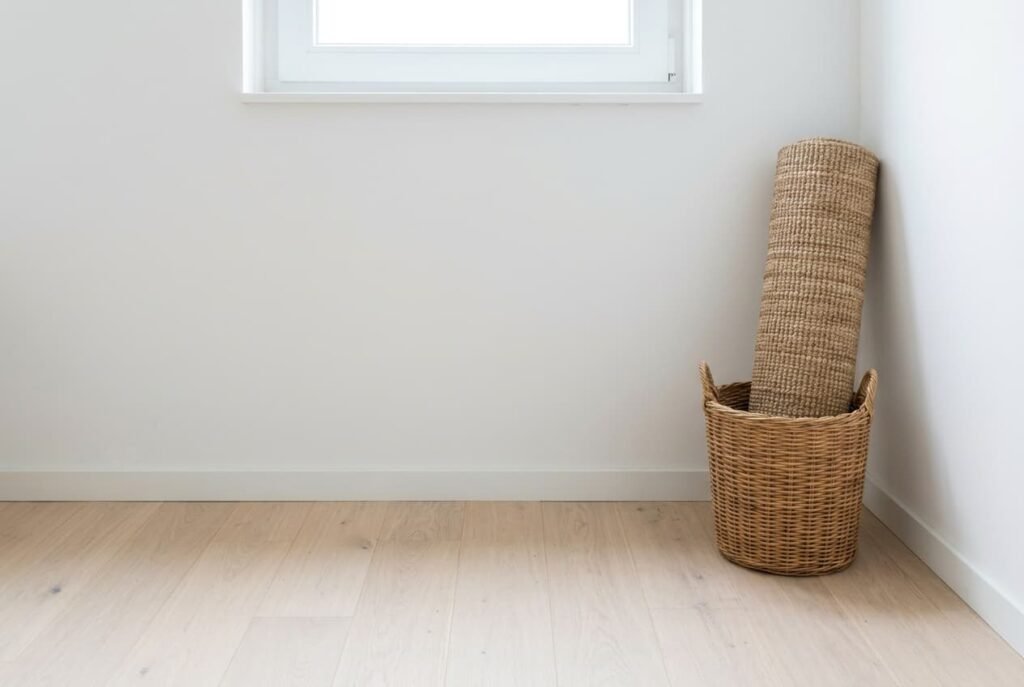
Floor leads, and the requirement exceeds the mat. Take a mat 70 cm across and 120 cm long. A full sequence of movements needs 20 cm per side, plus a clear 30 cm past the front edge. That gives a zone of 110 × 150 cm, or 1.65 m². Against the lounge’s 3.4 × 4.8 = 16.32 m², the zone uses 10.1%. The zone, rather than the mat, is the area you surrender, and a mat rolled into a basket 25 cm square gives most of it back between sessions.
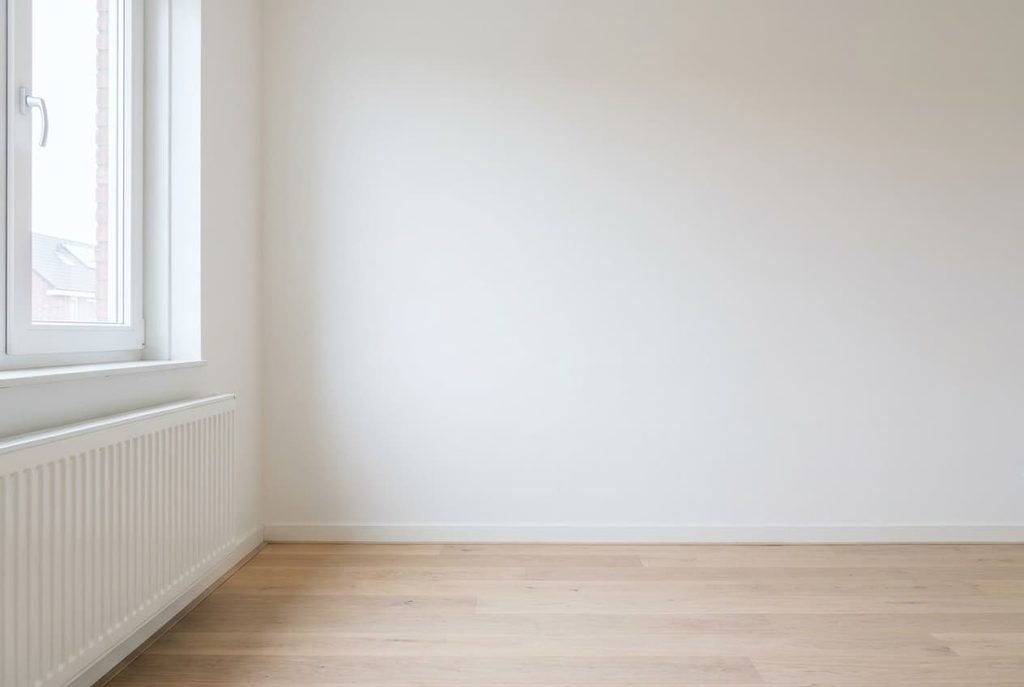
Clearance follows. The 30 cm beyond the mat’s front edge has to stay free up to the wall. If a radiator hangs on that wall, it puts a hot surface inside the gap. Move the zone until a clear 30 cm separates you from it. It’s the first reading worth taking with a tape. Floor-length curtains belong outside the zone too.
Quiet is the third measurement. Television sound loses 6 dB whenever the distance doubles. A set reading 60 dB at a distance of one metre gives 54 dB at two metres and 48 dB at four. That extra 6 dB at two metres is audible just when you want stillness.
The direction you face decides which walls are available.
Four Places for Prayer or Meditation in the Room
Four places are compared for a prayer or meditation corner, starting with the zone, then the gap in front, then the noise. Looks only settle a tie.
– East wall, north of the window: the 110 × 150 cm zone fits, and a 30 cm strip stays free beyond the mat’s front edge. The radiator below the window lies 130 cm away. Household traffic follows the south side, 220 cm from the zone. The television at the far south end is 4 m off, at about 48 dB. This is our pick. A low shelf and the basket fit beside the zone without touching it.
– Middle of the floor, facing east: the zone fits only after the coffee table and two chairs are moved. Moving them costs about 3 minutes per session, which is 15 minutes over five sessions. The route towards the window also crosses the zone, and the household interrupts you.
– Beside the radiator: the mat’s front edge ends 20 cm from a hot surface, inside the 30 cm limit, and the curtains fall into the zone. A hot surface that close is no place to kneel.
– End of the hall, facing the front door: the hall is 90 cm across, short of the 110 cm needed, and the door lies only 40 cm beyond the mat. Each arrival cuts through the gap.
Four Mistakes That Take the Calm Out of It
Most spoiled attempts at a prayer or meditation corner repeat the same four errors. Each is easier to prevent than to repair, and many corners look big enough until the zone is taped out.
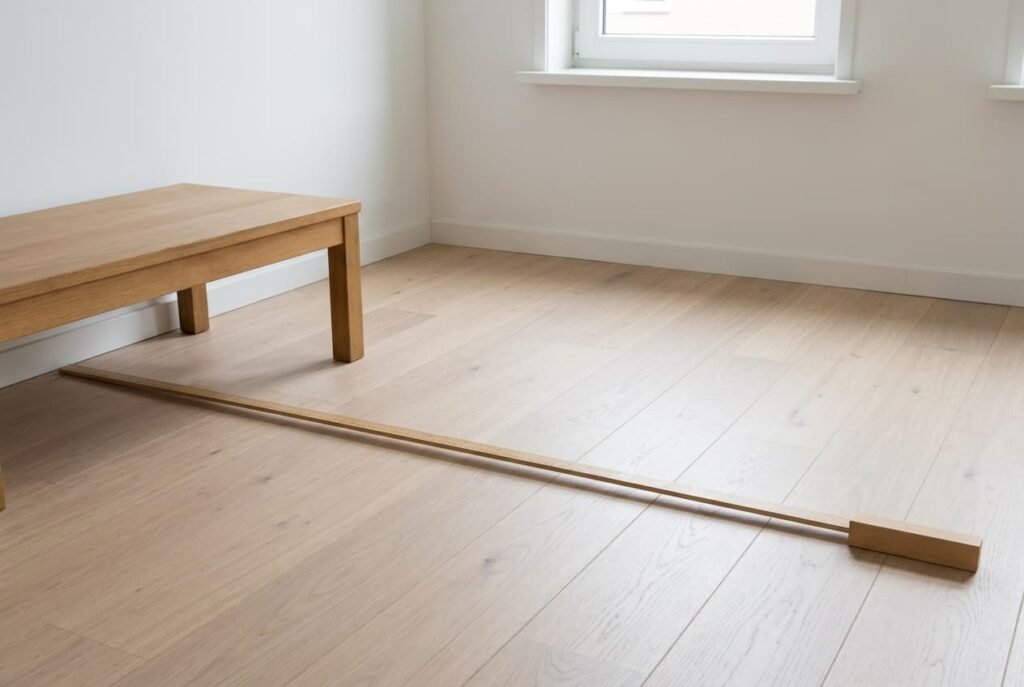
Sizing the space to the mat alone. A mat of 70 × 120 cm covers 0.84 m², while the zone is 1.65 m², nearly double. Space sized to the mat leaves elbows against a bookcase and the front edge hard against the skirting. Mark the full 110 × 150 cm before deciding.
Choosing the quietest room by instinct. A bedroom corner may be calm and still fail the zone test. A 280 × 330 cm bedroom containing a bed 160 cm wide leaves a strip 120 cm across. That passes the 110 cm needed by 10 cm, until a wardrobe door swings 60 cm into it. Then the strip has no side margin left.
Leaving the zone in the walkway. A route that clips the zone puts every passer-by inside your practice. Keep 150 cm between the zone and the walking line that links door and sofa. In our lounge that line passes 220 cm from the chosen spot, well clear.
Hiding the mat where fetching it is a chore. A mat kept in a far cupboard takes 40 seconds to fetch. Five sessions a day spend 200 seconds on the errand. A basket beside the zone cuts that to 5 seconds a session, or 25 seconds a day, and the habit survives busy weeks. You’ll also notice that a mat within reach gets used.
Walk the planned route with your arms full before you commit.
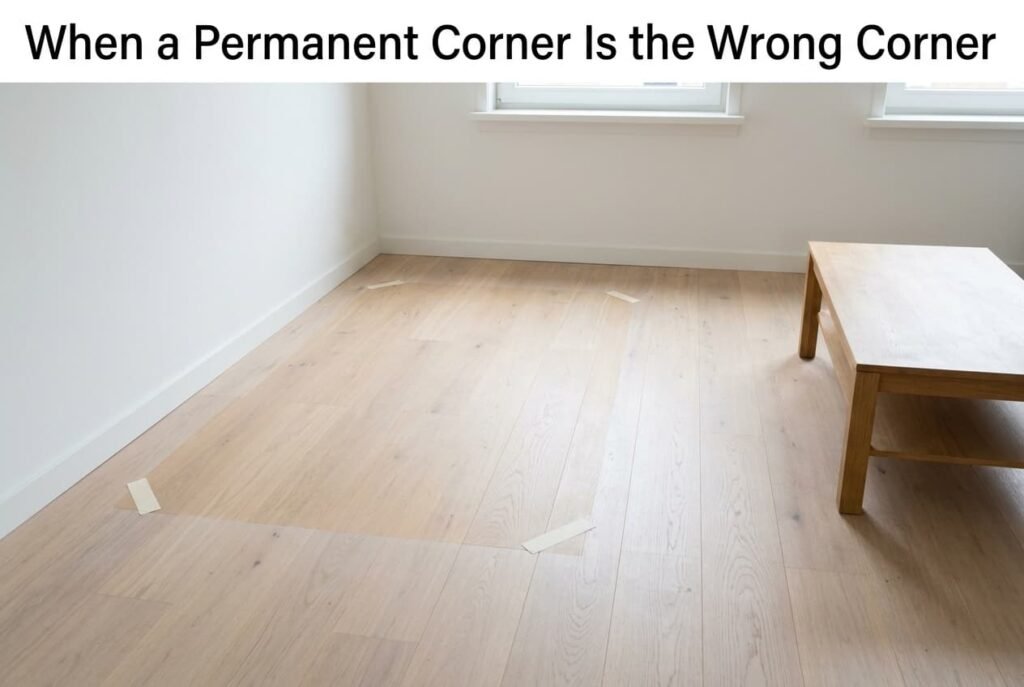
When a Permanent Corner Is the Wrong Corner
Standard advice makes a prayer or meditation corner permanent. A rug and a shelf are added. In a small rental the arrangement looks calm and quietly wastes floor. Five sessions of five minutes add up to 25 minutes, which is 2.6% of a waking day of 16 hours (25 ÷ 960). For the other 97.4% of those hours the 1.65 m² sits unused in a lounge which must also hold a sofa and a dining table.
I’d defend a zone that exists only while you use it. Mark its corners with two small floor marks or a rug edge, keep the mat rolled in its basket and slide the coffee table back afterwards. Setting up takes about 15 seconds. The room serves everyone else all day, and the corner stays calm because nothing in it is fixed.
A fixed corner earns its floor in one case. A house with a spare room, or else a hallway wide enough, can give the zone over to your practice all day, and the 10.1% then costs nobody anything. In a lounge that must also serve a household, the flexible zone wins.
Three Checks Before You Commit
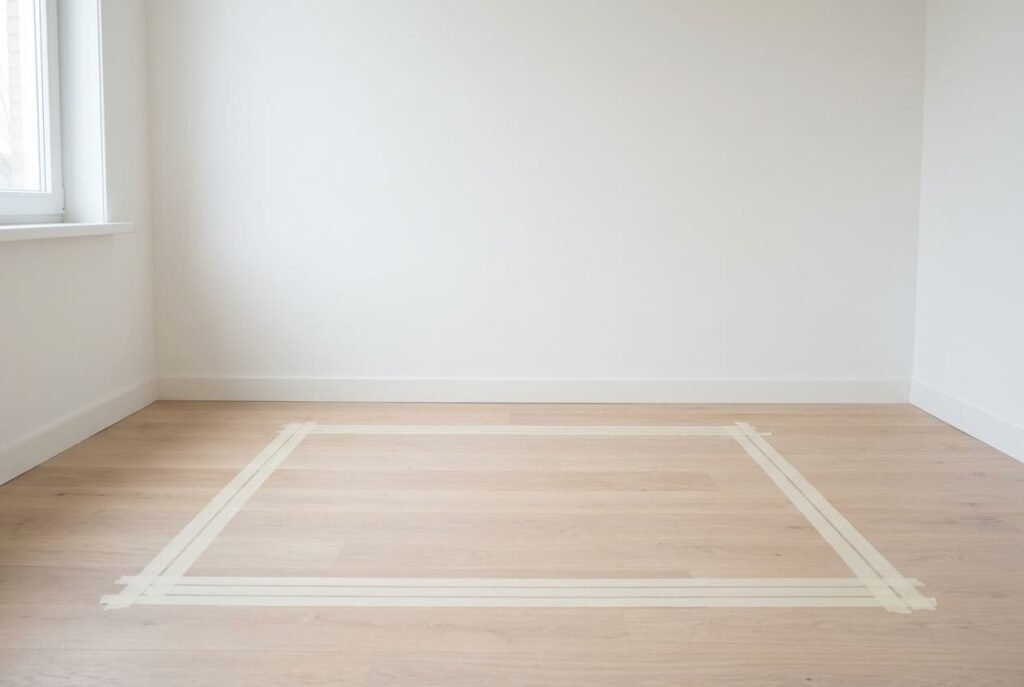
1. Run tape across the floor along the east wall to mark the 110 × 150 cm zone, with a 30 cm strip beyond the mat’s front edge. Walk the household’s usual route past it. The tape must never sit on the walking line linking door and sofa. Keep the tape down until tomorrow.
2. Roll the mat out and move through your full sequence of positions. Check that your hands and head stop short of the wall. Then check the radiator and the curtains separately. Furniture legs must stay 20 cm clear at each side.
3. Sit in the zone for ten minutes when the household is busiest. Count the interruptions from the television, and then those from the kitchen or the door. Two or fewer in ten minutes means the spot is calm enough. More points to the second-best place on the list.
A corner like this rewards a measured zone more than any purchase. Settle the footprint first and the noise second. Keep the basket where your hand falls naturally, and give the mat a regular place. If the numbers fail in one spot, try the next on the list before you change the furniture. A small room can hold stillness when every measurement is checked before anything moves.
Questions Readers Keep Asking
How much floor does the corner need?
About 1.65 m² for a 70 × 120 cm mat, which is a zone of 110 × 150 cm with 20 cm at each side and 30 cm in front. In a 16.32 m² lounge that is 10.1%. A rolled mat in a 25 cm basket takes almost nothing between sessions.
Which wall should the corner face?
The one your practice sets. Check that wall for a radiator. Then look for a door or curtain near the mat’s front edge, and for furniture legs inside the 20 cm side margin. If the facing wall fails, move the furniture before you give up on the wall.
What light and colour suit the corner?
Soft, indirect light with the window beside or behind you. Glare then stays out of your eyes. A plain pale wall in front keeps the view still. A lamp at about 60 cm height with a warm bulb of roughly 2,700 K can replace the ceiling light for evening sessions.