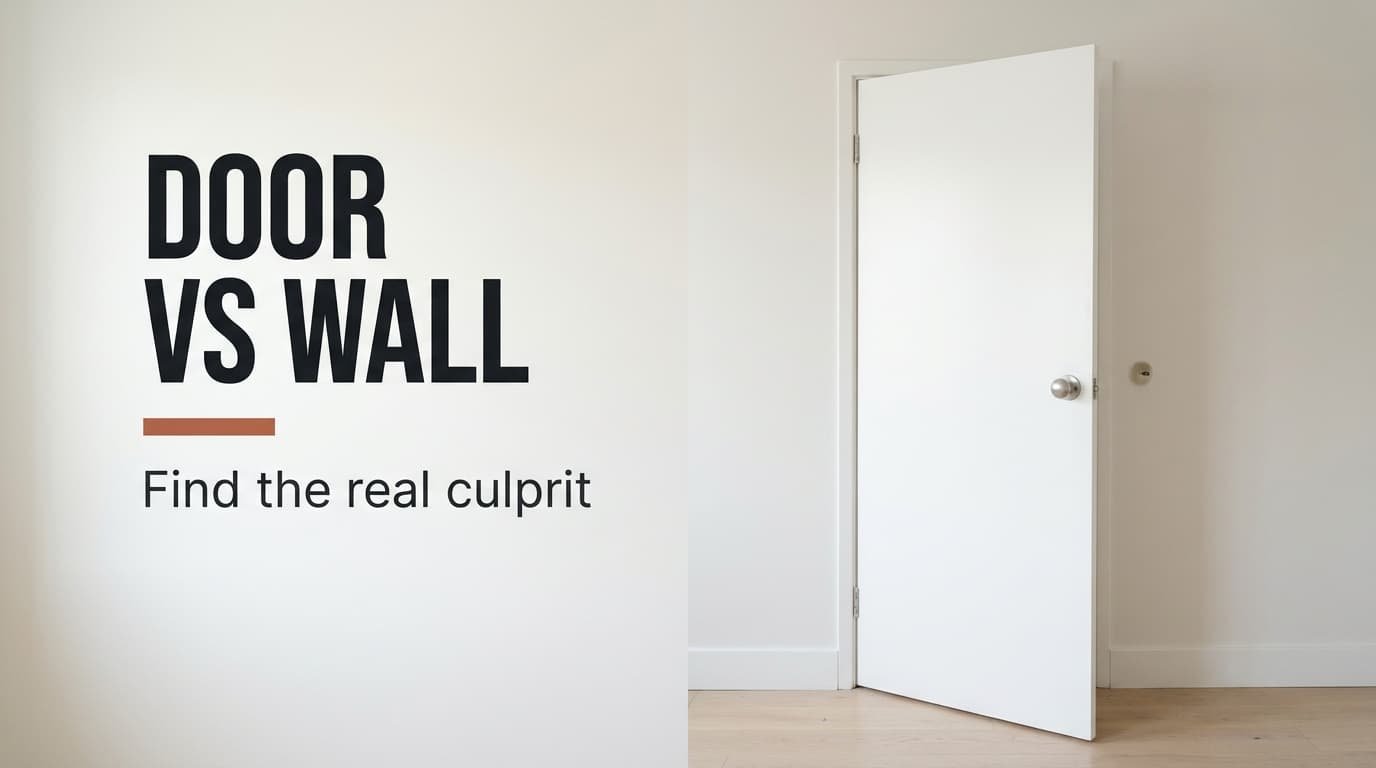
Many people blame a heavy hand for a door that dents the wall, yet the usual culprit is the knob. It juts 6.5 cm out of the leaf and meets the plaster before the door reaches a right angle. The test door is an 83 cm bedroom leaf in an Utrecht flat, where the hinge line sits 4.5 cm off the hallway wall. Ten minutes with chalk will show which kind of fault you have. Next come four remedies. The first costs nothing, the last is a carpenter’s visit, and each attacks a separate link in the chain. These numbers describe one flat. Check them against yours before you spend anything.
Why a Door That Dents the Wall Does It at the Knob
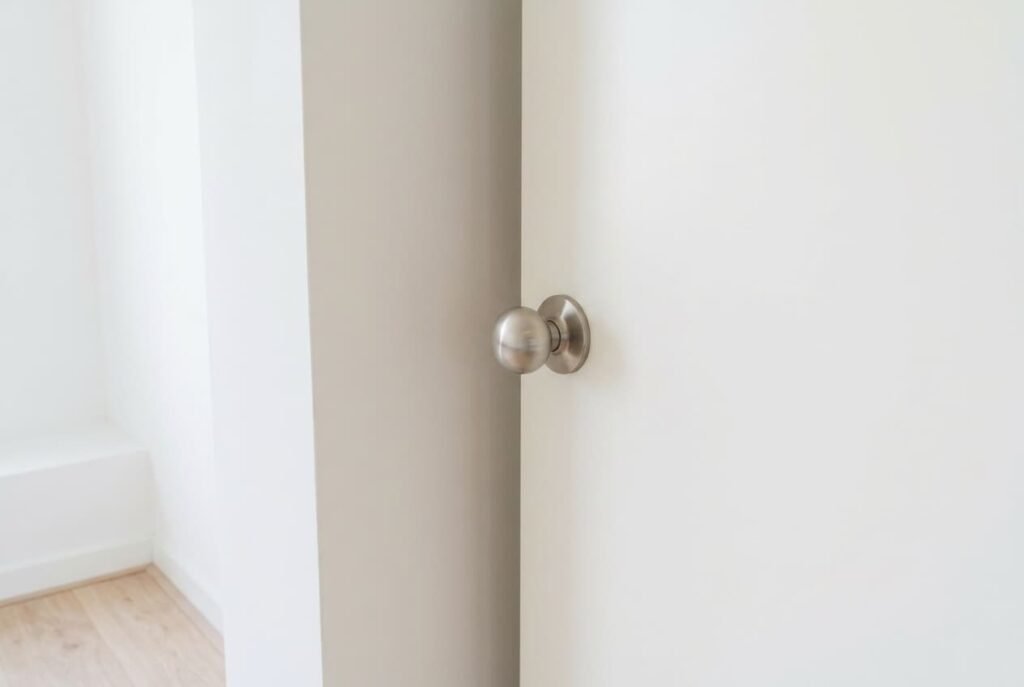
Follow the leaf as it swings round its hinge line. The knob sits 77 cm from that line, 6 cm in from the free edge. It juts 6.5 cm out of the face. At 90° the face of the leaf stands 4.5 cm off the wall, a gap smaller than the knob’s reach. The knob therefore arrives at about 88.5°, before the door has finished opening. At 85° the clearance is still 4.7 cm, and at 80° it’s 11.5 cm.
Speed decides how deep the mark goes, because the energy grows as the speed squared. Treat the leaf as a uniform plate of 20 kg, an assumption for a hollow bedroom door. Its resistance to turning about the hinge line is then 4.6 kg·m². A knob moving at 1.5 m/s carries about 8.7 J into the wall. Twice that speed would deliver four times the energy. The contact patch is perhaps 1.5 cm², about as big as a fingernail. The whole load lands on a tiny spot of paint.
A door that dents the wall is mostly a matter of geometry, with speed deciding the depth.

Confirming Which Version of the Problem You Have
Find washable chalk and a tape measure. Keep the door closed until each test starts.
Rub a little chalk on the knob, then ease the door open at walking pace until it stops. A mark on the paint means the knob arrives before the leaf comes to rest, which makes the reach too long. Measure how high the mark sits above the floor. Ours sits 100 cm up and is round, 1.4 cm across.
A scuff low down, about 8 cm above the floor, points to a sagging leaf, because the dropped corner meets the wall first. Check for sag by holding the knob and lifting gently. A free edge that rises more than 2 mm shows play in the hinges. Ours moves by 1 mm, well under that limit. Run each test twice, since a single pass can leave a mark too faint to see, and sweep the torch along the wall in a raking beam to catch it.
A chalk mark at knob height points towards remedies two to four; a low scuff or play in the hinges sends you to the screws first.
Four Fixes for a Door That Hits and Dents the Wall
Cut the speed of the swing: this attacks the energy figure from the second section, and it costs nothing. Rest a hand on the edge of the leaf as it opens and let it settle against the wall at walking pace. Halving the speed from 1.5 m/s to 0.75 m/s cuts the energy from 8.7 J to 2.2 J. The habit has a weak side: the household. Guests and children ignore the habit, as does a gust through an open window, and the knob still touches the wall, only more gently. A note taped by the handle can help until the habit sticks.
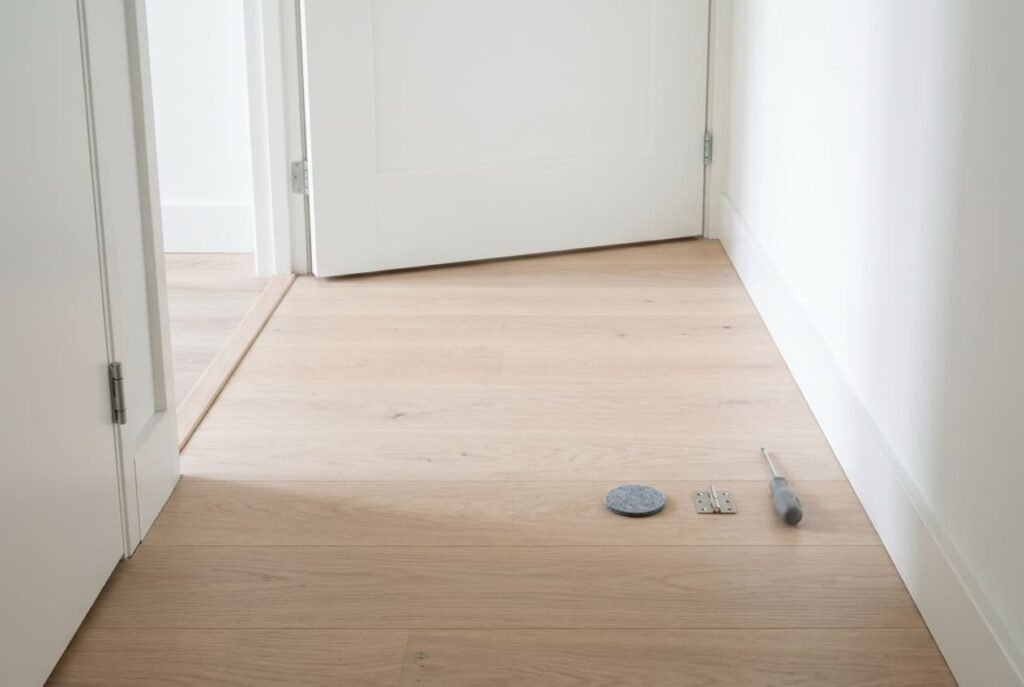
Hold the leaf at 86° with a hinge-pin stop: this keeps the knob off the wall altogether. At 86° the knob stands 3.4 cm from the paint, which gives a dent nowhere to form. It clips onto the hinge and limits the opening angle, which needs no screws in the floor and suits floating laminate. Fitting is quick and cheap. The hinge itself is the limit, though. Open the door to 86° and hold it there while you set the clip. A door flung at the stop sends the full 8.7 J through the pin and the screws, and loose screws let the leaf wander.
Spread the hit with a wall pad: here the contact area is the target. A self-adhesive felt or rubber disc 4 cm across, stuck to the wall at knob height, offers 12.6 cm² to share the load, against the knob’s 1.5 cm². Pressure on the board falls to about 12% of what it was. Cost is very low. Every swing still knocks the pad. Peeling it off painted plasterboard can lift a layer of paint. Try the glue on a hidden corner first. To place it, hold the door at 88°, where the knob almost touches, and mark its height on the wall with a pencil.
Have a carpenter swap the hinge side: this changes the geometry itself. Hung on the opposite jamb, the door opens towards a wall 31 cm from its new hinge line, and the knob doesn’t arrive until about 109°. At 90° it still stands 24.5 cm from the paint. This brings the largest bill. The landlord must sign it off in a rental too. The leaf also opens towards a different side of the room, which can hide whatever hangs on that wall.
What Your Own Hallway and Door Frame Allow
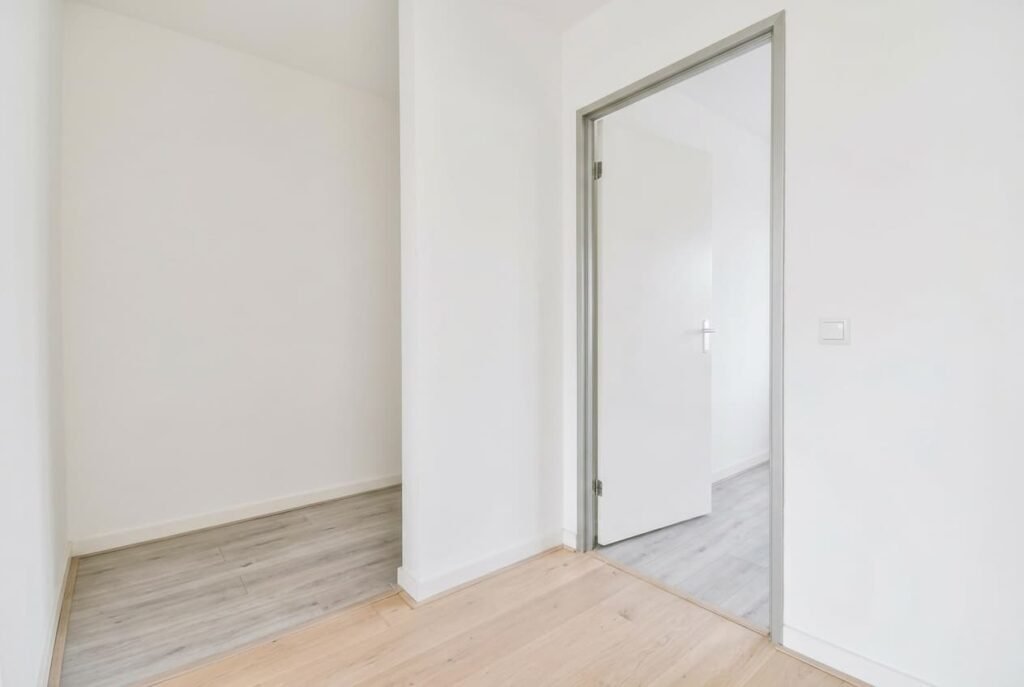
Our hallway makes a door that dents the wall close to certain. The wall is painted plasterboard, 12.5 mm thick, on a metal frame. A steel door frame sits flush with it, which fixes the hinge line at 4.5 cm from the wall. Nobody can move that frame; only the leaf and its fittings can change. The floor is floating laminate over screed, and the tenancy forbids drilling into it, which rules out a floor stop.
On the latch side, the return wall stands 31 cm from the jamb, and a light switch sits on it at 105 cm. After a hinge swap the open leaf would hide that switch, and you’d have to reach round the door to find the light. That drawback is why the swap comes last, and why the hinge-pin stop suits this hallway best.
The Fix That Doesn’t Work
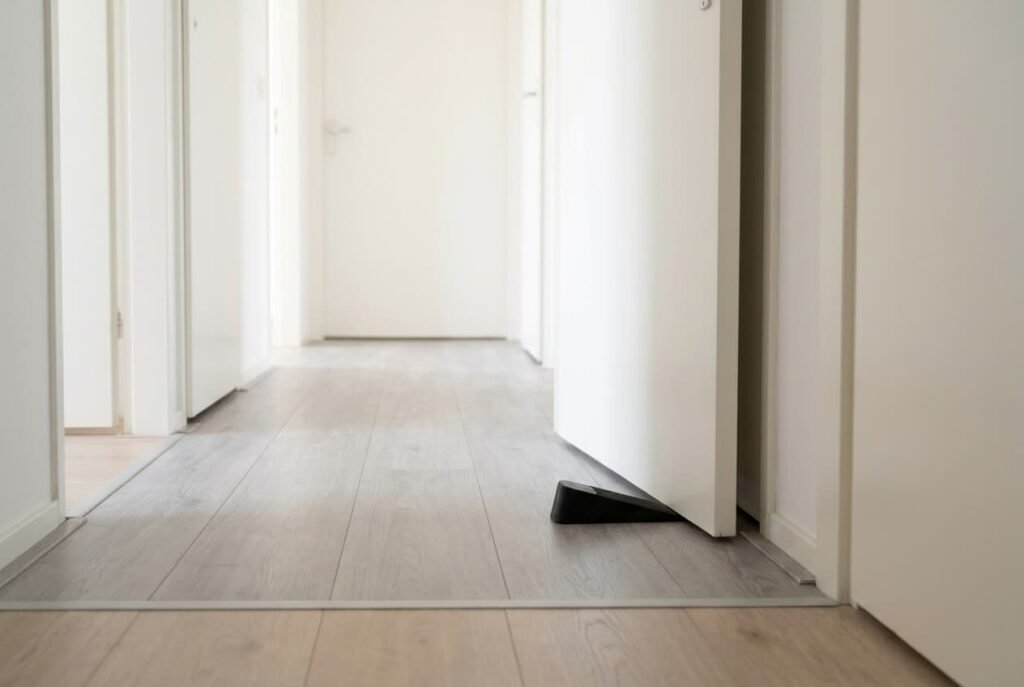
A rubber wedge under the foot of the leaf is the usual first purchase, and it misses the cause entirely. The wedge acts at floor level, 100 cm below the knob, which leaves the knob free to swing on towards the wall. On laminate it also slides, and the leaf then rides up the slope and strains the hinges. A foam sleeve over the knob adds thickness. The knob then arrives sooner and still carries a similar load. Even a wedge that grips only presses on the lower edge. The leaf can still flex a few millimetres at the knob end under a firm shove. Neither product changes the geometry or the speed, and both can hide the problem for a month before the paint marks again. If a door that dents the wall has already marked the paint, leave them on the shelf.
Tonight, rub chalk on the knob and open the door slowly. The mark, or its absence, tells you where to start. Try the free fix for a week, then check again with fresh chalk. Buy something only if a mark remains, and keep the carpenter for last. Jot the result down for comparison with the next check. Most dents stop within the first two steps.
Questions Readers Keep Asking
Can I repair the dent in the wall myself?
Yes, if the dent is shallow and the paper layer isn’t torn. Fill it with a light ready-mixed filler, let it set, sand it flat, then repaint the whole panel so the repair blends in. Fix the cause first. Otherwise the knob returns to the same spot within weeks, and the repair is wasted.
How much will the fixes cost?
The free fix costs only habit. A hinge-pin stop and a felt pad are both small purchases, and together they cost less than a takeaway meal. The carpenter’s hinge swap is the big bill, plus the landlord’s permission in a rental. Most readers stop at the second or third step.
What is the most common cause?
A round knob that juts far from the leaf, on a door hung close to a side wall. That pairing leaves only a few centimetres of clearance at 90°. One chalk test finds it quickly, and a stop set at 86° usually ends the problem.