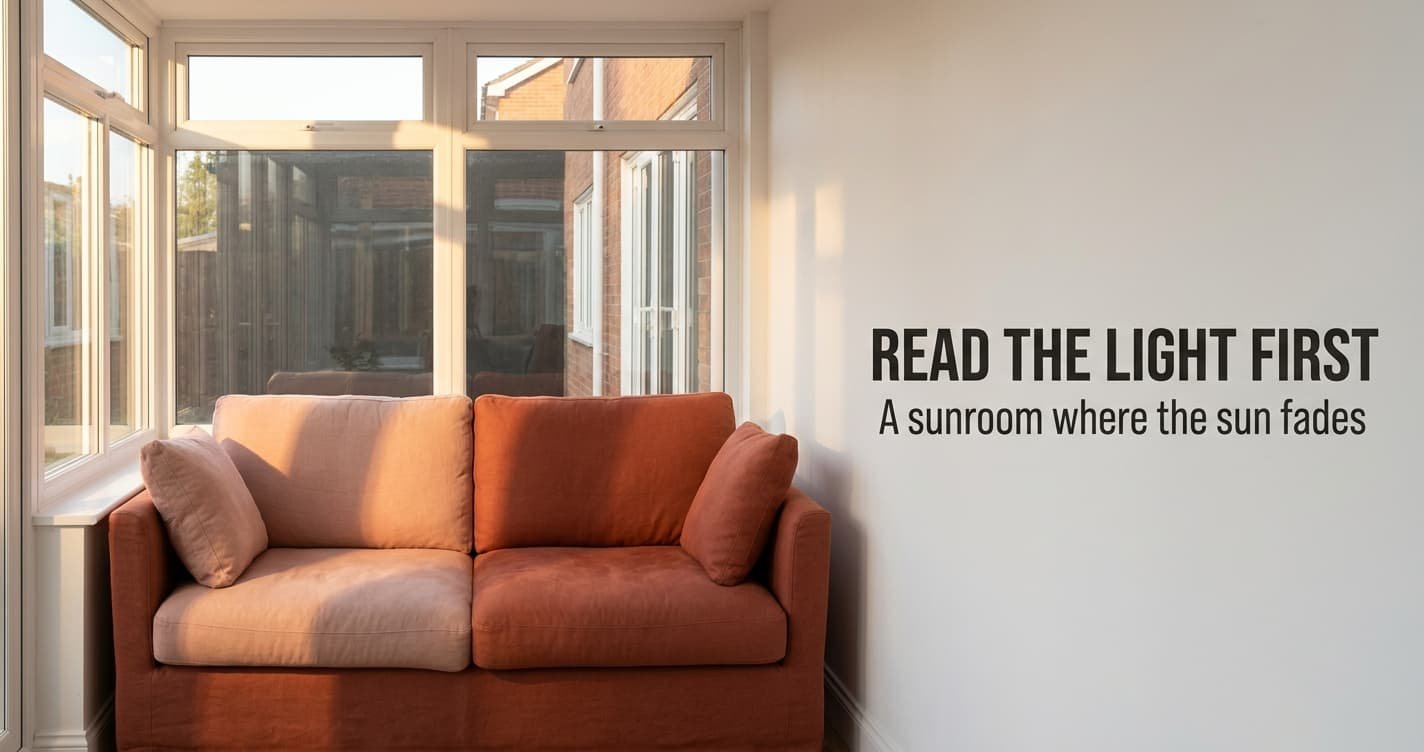
Why does the sofa nearest the glass go pale while the one against the wall keeps its colour? Because fading is a running total of light, and the glass wall is where that total grows fastest. This guide walks through how to fix a sunroom where the sun fades everything from the cushions to the books, in four steps that run from free to professional. The room measures 330 by 420 cm, with a south-west glass front 210 cm high. Whether a given fabric is covered by a guarantee is a question for its maker’s sheet.
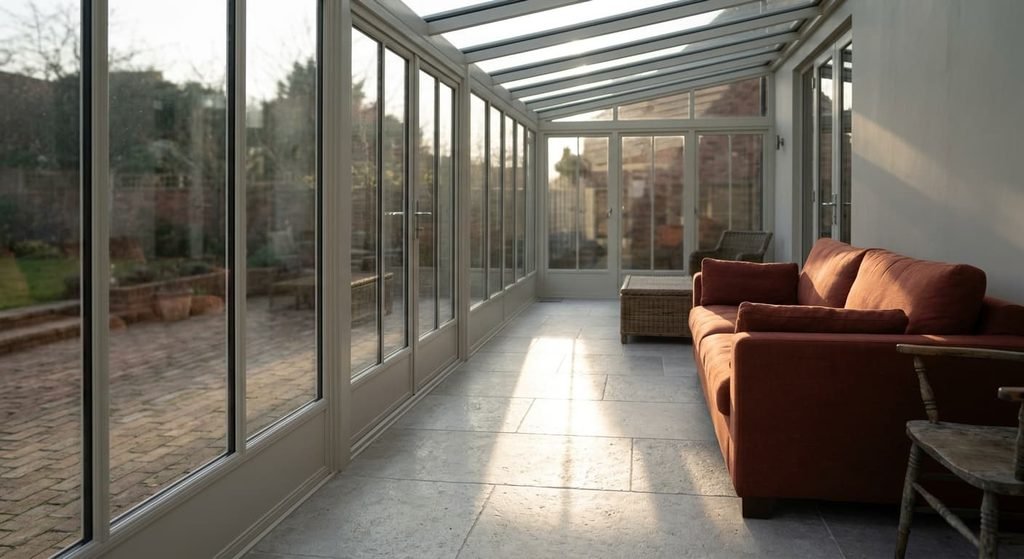
Where the sun fades a sunroom, and why
Fading is a dose. A dye absorbs light, and each time it does, a few of its molecules break. The colour you lose roughly follows the total light a surface receives, which is strength multiplied by hours. Halve the strength and the same loss takes twice as long. A cushion in the beam for three hours a day collects four times the light of one in the beam for forty-five minutes.
Light does most of the work here, and heat plays a smaller part. A cool, bright day fades a fabric about as surely as a hot one. Nothing resets the total either. Every clear hour adds to a sum that only goes up.
A sunroom stacks the odds. This one has a glass front of 420 by 210 cm, which is 8.8 m², and a glazed roof above it. Two results follow. Fading is uneven, because only the pieces in the beam collect the high dose. And it is slow, so a room can look fine for a year and then show a clean edge when a picture is lifted. Dyes also fade at different speeds, so a printed pattern can shift its balance of colours rather than just pale.
Three checks for a sunroom where the sun fades things
Three checks tell you which version of the problem you have. None needs a tool.
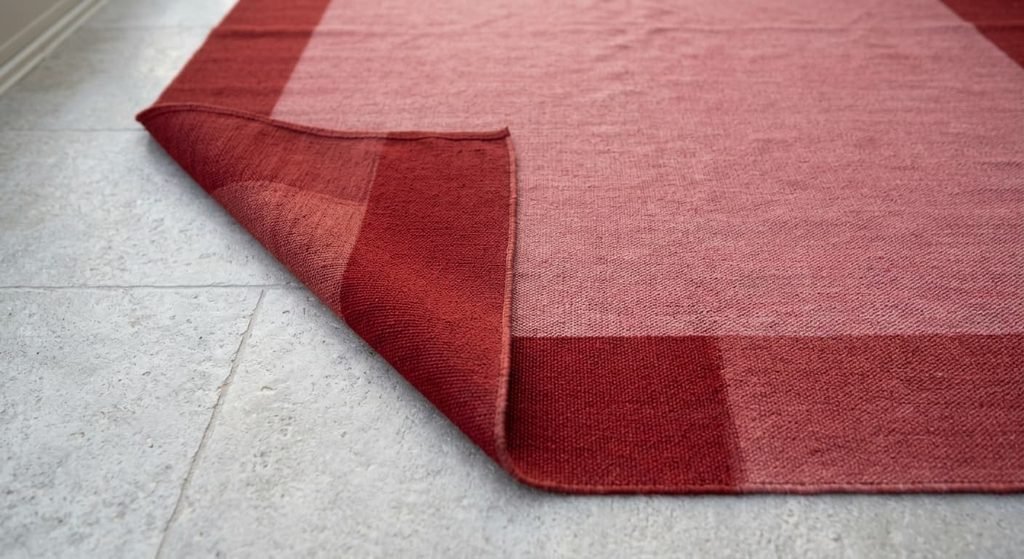
First, find a tide mark. Lift a picture or a book that has stood in one place for a year, or fold back a rug corner, and compare the colour behind it with the colour around it. A clear edge means a high dose. Second, read a gradient. Look at a cushion or a curtain with one face to the glass. A pale face and a rich back point to the beam. Even paleness all over points to a room that is simply too bright. Third, log the beam. At 10:00, 13:00 and 16:00, note which pieces stand in direct sun.
Two or three pieces in the beam at one hour point to fixes 1 and 2. Paleness everywhere with little in the beam points to fixes 3 and 4.
Do the log on a clear day, since cloud blurs the beam and hides what you’re looking for. Note the date, so you can compare it with a second log in another month.
The log decides which fix comes first.
The four fixes, from free to professional
Fixes that cost nothing or little
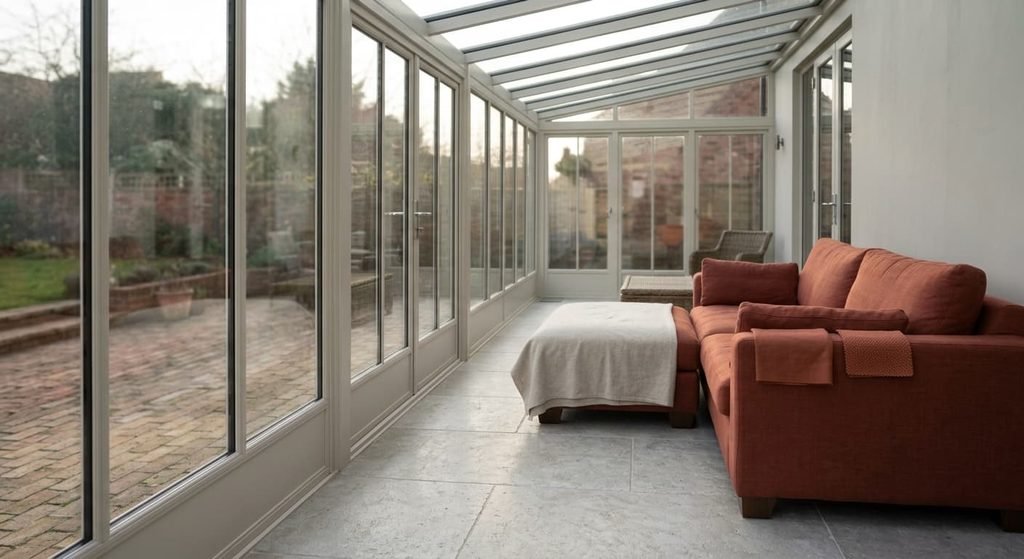
Move what fades out of the beam. This answers the hours. Use your log: take each piece that stood in the beam at two of the three visits to the nearest spot that stood in none. Turn cushions and the rug end to end every month. Rotating leaves the total alone and spreads the loss, so no single patch pales by itself. Swap pictures and books with pieces from the dark side of the room in the same way. It costs nothing. One catch: the beam shifts with the season, so repeat the log in a second month. The room may also have no beam-free spot big enough for the sofa.
Put a throw over what can’t move. This answers the exposure you can’t avoid. A cotton throw or a washable loose cover takes the light, and the fabric underneath keeps its colour. It costs little. Put it where the log shows the beam landing, usually the seat nearest the glass. The cover itself will fade and need replacing, so pick one in a colour you can live with at half strength.
Fixes that need money or a professional
Re-cover in a fabric coloured through. This answers the dye. Solution-dyed fibres are coloured before they are spun, so the colour runs through the thread instead of sitting on its surface. Check the lightfastness rating on the maker’s sheet, where a higher number means slower fading, and ask for the highest on offer. It is the largest purchase of the soft options. The frame stays and only the cover goes. The limit is that it helps only what can be re-covered. A wooden table or a printed rug stays as it was.
Have film fitted to the glass. This answers the light itself. A film on the glass filters part of the short-wavelength light that does the most damage, and it does so for every surface in the room at once. A glazier does the work, and decides whether your glass accepts it, since the film maker’s sheet lists the glass types it suits. It slows fading without stopping it, because visible light still fades dyes. It can also tint the view slightly. Ask the glazier how the film’s maker rates it, and whether fitting it changes the glass warranty.
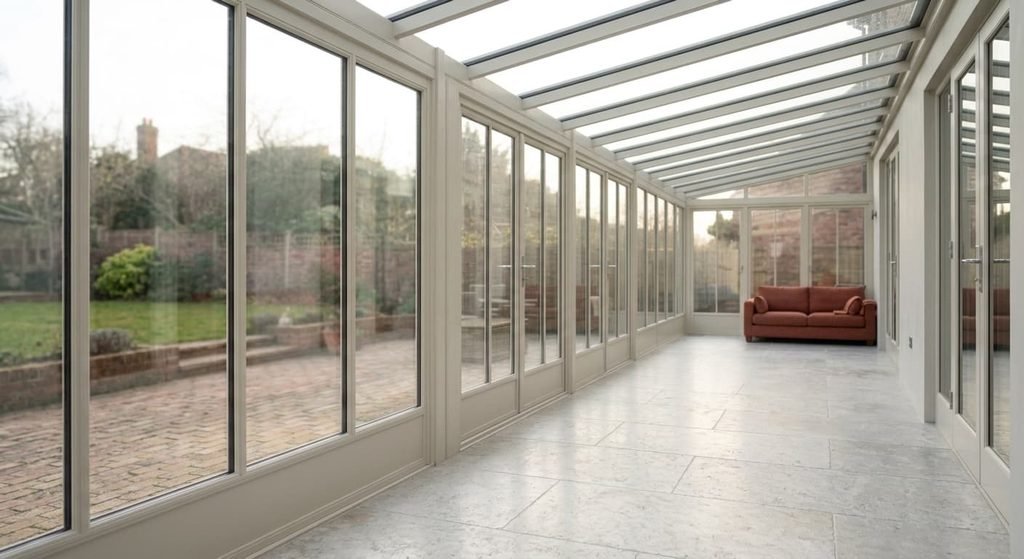
What this room’s glass means for you
In a sunroom where the sun fades fabric the glass front and its south-west aspect are fixed. No fix here removes the sun, and a sunroom with no sun would have no reason to exist. What the four steps change is the dose. Each step takes some of it away: moving, covering, re-covering, filtering. They stack. A room that uses all four fades far more slowly than one that uses none.
Four things are yours to choose: the sofa’s position, its cover, the fabric under it, the film on the glass. Three are not: the 8.8 m² of glass, its direction, the roof above. If the log shows the beam reaching every seat all afternoon, the honest answer may be to keep the furniture that fades least in that part of the room.
Fixable and fixed are two different lists.
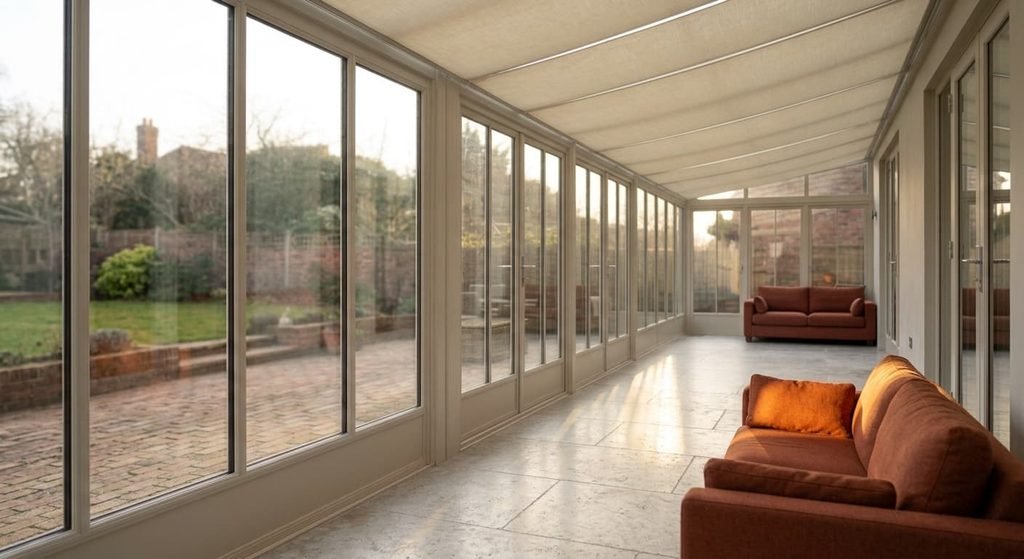
The fix that doesn’t work
Drawing the blind when the sun is highest is the standard tip for a bright room, and it misses the target here. Comfort picks that hour, but the beam sets the dose. In this south-west room the beam reaches the sofa late in the afternoon, when the sun is low and comes straight through the glass front. A blind pulled at 13:00 covers the roof while the sofa sits in shade anyway.
A second habit fails for the same reason. Turning a pale cushion face down hides the fade without slowing it, and the other face starts to pale in turn. The dose is still arriving. Only the log, and the steps that follow from it, change how much of it lands.
Run the log again with the blind down. If the pieces still stand in sun at 16:00, the blind is down at the wrong hour.
Work through them in that order: move, cover, re-cover, filter. Stop at the first one that brings the log under control. A sunroom where the sun fades everything is rarely fixed by a single purchase made in a hurry, but it is often fixed by the two cheapest steps. I’d start with the log: it costs nothing and tells you which step your own room needs first.
Questions readers keep asking
Is a sunroom where the sun fades everything fixable?
You can slow it, not stop it. A sunroom where the sun fades everything is built to let light in, so the dose never reaches zero. Moving pieces out of the beam and covering the ones that can’t move are the cheapest steps, and they often do most of the work.
Is it the heat or the light that fades fabric?
Mostly the light. Heat plays a smaller part, so a cool, bright day still fades a cushion. That is why a blind pulled for comfort doesn’t always protect the furniture. Look at where the beam falls and at what hour, then fix that.
What is the cheapest way to protect a faded sofa?
A washable cover or a cotton throw. It takes the light in place of the sofa fabric, and you replace it when it fades. Move the sofa out of the beam first if the log shows a free spot, since that costs nothing.