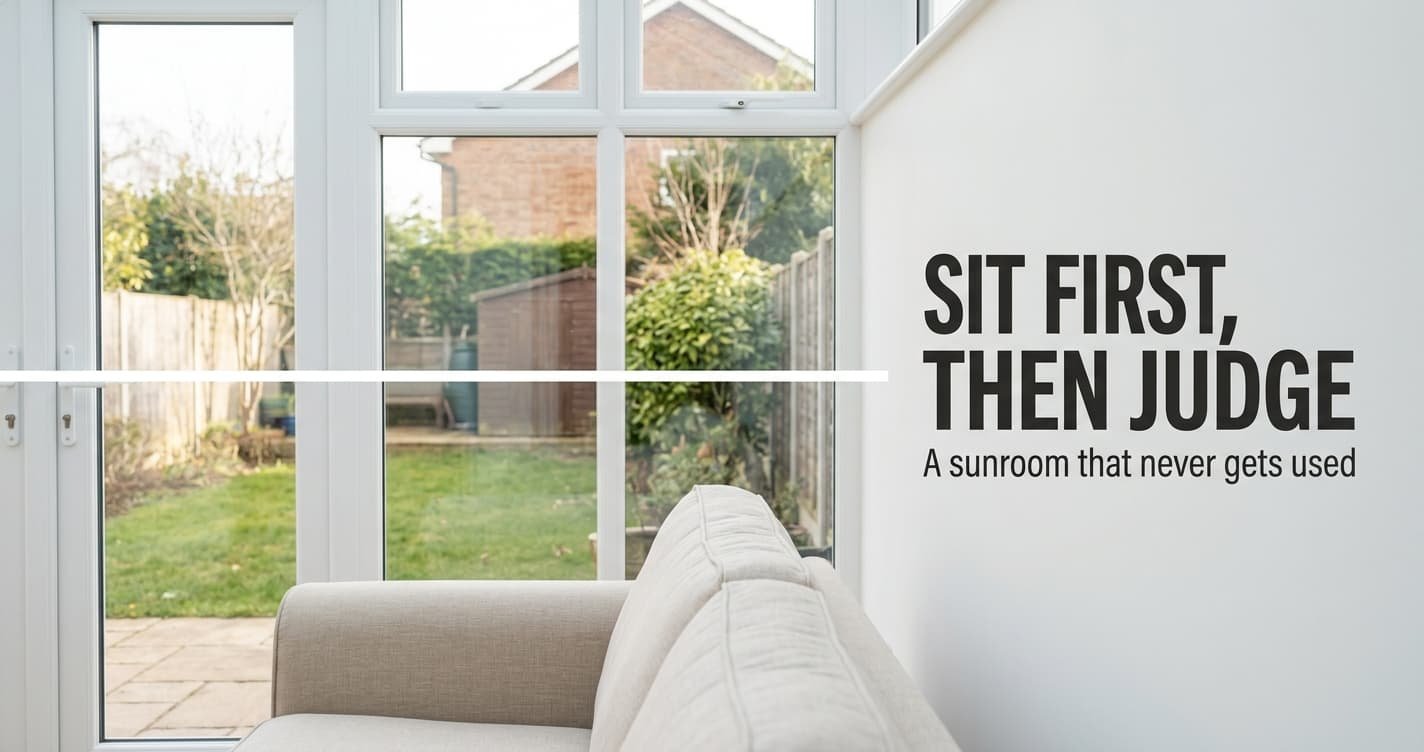
A room gets used when its first minute is easy, and a loved sunroom can fail that minute in three quiet ways. This is why a sunroom never gets used even when everyone says they love it: the eye line, then glare, then the row. Each fault can be checked from a seat in one afternoon. The room measures 350 by 440 cm and has a glass front 210 cm tall, crossed by a glazing bar at 110 cm. Suspicion falls on the layout. The family’s taste and budget are cleared, and temperature belongs to your builder.
Why a sunroom never gets used, even when it is loved
People decide in the first minute. They walk in and look for a seat. Once seated they settle in or leave. Three things decide it: what the eyes meet, whether faces can be seen, and whether the seats face anyone. A loved room can fail all three, because love is given from the doorway, where the view is perfect. Use happens from a seat, where it is not.
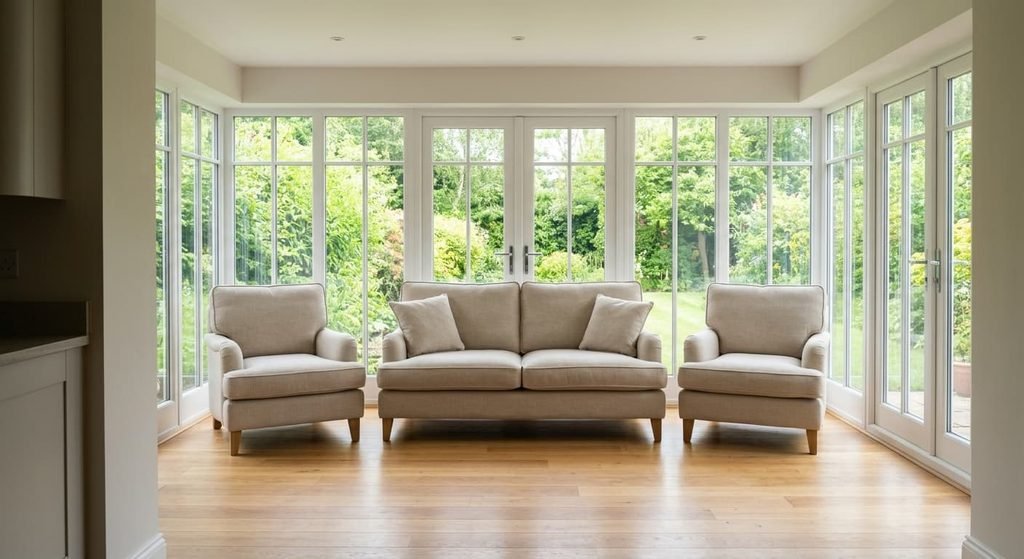
The numbers show the gap. A seat 42 cm high puts a seated eye at about 110 cm, which is exactly where this room’s glazing bar sits. The first thing a sitter meets is a strip of white frame. The garden is far brighter than any face in front of it, so the person opposite turns into a dark shape. And seats in a row along one wall can’t see each other without a 90° turn of the head.
The usual misdiagnosis is that the room is too warm or too cool. It leads to a heater or a fan. Yet if the room stays empty on a mild day, temperature isn’t the cause. A new appliance would only add another thing in the way.
Three checks for a sunroom that never gets used
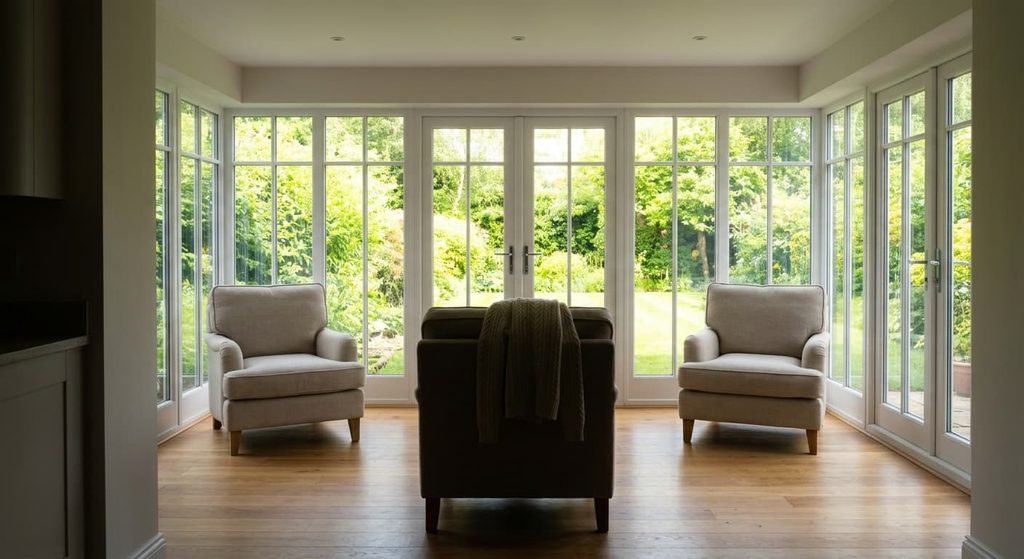
Three checks work best on a mild, bright afternoon, taken from a seat rather than from the door. First, name your eye line. Sit as you normally would. Look straight ahead and name the first thing at the centre of the view. A frame bar or a sill points to a scale fault. Second, look for a face. Put a cream jumper on a seat that has the glass behind it, and look at it from the seat across the room. If it reads as a dark shape against the glass, that points to a contrast fault. Third, count the faces. For each seat, count how many other seats it can see without turning its head. Zero everywhere means a row, which is a placement fault. Do the second check at the hour you normally sit, since the brightness behind a face changes through the day. Do the first check twice: on the sofa, then on a chair, because the seat heights differ. Write the three results on one line before you move anything.
The sitter sees what the doorway never shows.
The faults, diagnosed
Scale: the bar at the eye line
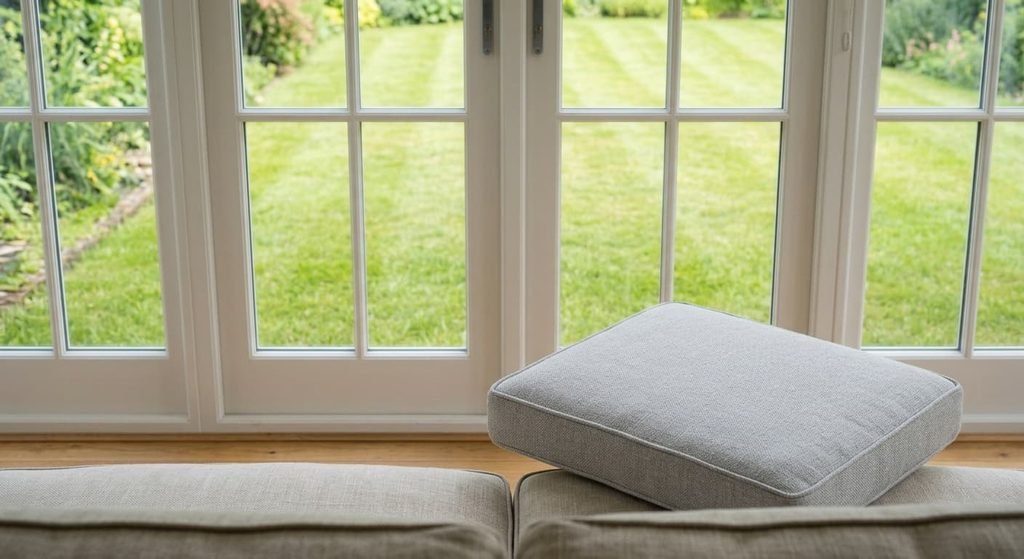
“Sit down and all you see is the window frame.” Scale is the cause. A sofa seat of 42 cm plus a relaxed seated eye height of about 68 cm above it puts the eye at 110 cm, level with a bar that spans roughly 107 to 113 cm. Take a loose 8 cm pad off the seat, and the eye drops to 102, which clears the bar at no cost. Next, put any chairs with seats near 34 cm on the glass side, and keep the sofa for the house wall. The purchase is a seat 50 cm high, which lifts the eye to 118. Either direction works. Staying at 110 is the only wrong answer, and it is the one most rooms are built around.
Contrast: the face that turns into a shape
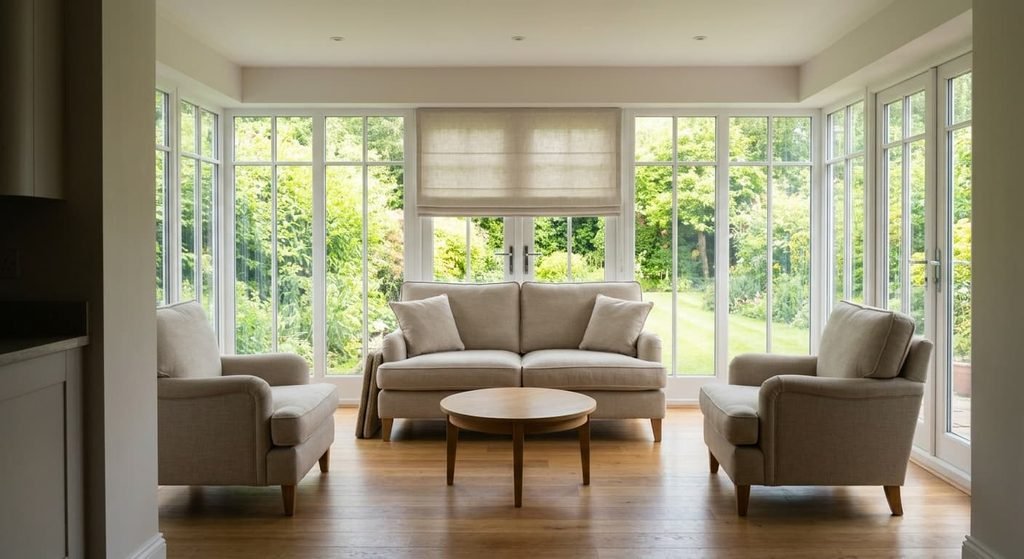
“You can’t see who you’re talking to.” Contrast is the cause. On a bright day the garden is many times brighter than the room, and the eye sets itself to the brightest thing in view. A face in front of the glass then reads as a shadow. Start with the free step: turn the seats so nobody sits with the glass directly behind their head. If the room allows it, move the group into the corner where the glass falls to the side. The purchase is a pale blind over the two panes nearest the seats, which softens the bright band behind the faces while the rest of the wall stays clear.
Placement: the row that looks outward
“Everyone just sits there looking at the garden.” Placement is the cause. Three seats in a line along the glass each see the view and a neighbour’s ear. Turn the two outer seats inward by 40° and the head turn needed to see a face drops from 90° to 50°, which costs nothing. Next, pull the seats into a loose U so their fronts sit within 240 cm of one another, a common working value for easy talk. A low round table 60 cm across in the middle of the U gives the eyes a centre. Buy the table only if the first two steps leave the group scattered.
What to settle before you buy another seat
When a sunroom never gets used, the next purchase is the moment to stop. Settle two numbers before the next seat arrives. Write the height of the glazing bar on a card, then your seated eye height. The seat you buy must put the eye at least 5 cm clear of the bar in one direction. In the shop, ask for the seat height and sit down before you ask about the colour. If the height isn’t printed, measure from the floor to the top of the seat cushion. A difference of 8 cm between two chairs is enough to move the eye clear of a bar like this one.
Then ask three questions. What will be at your eye line? Whose face will you see against the glass? Which seat can see which? Any seat that fails a question stays in the shop.
The purchase that won’t help
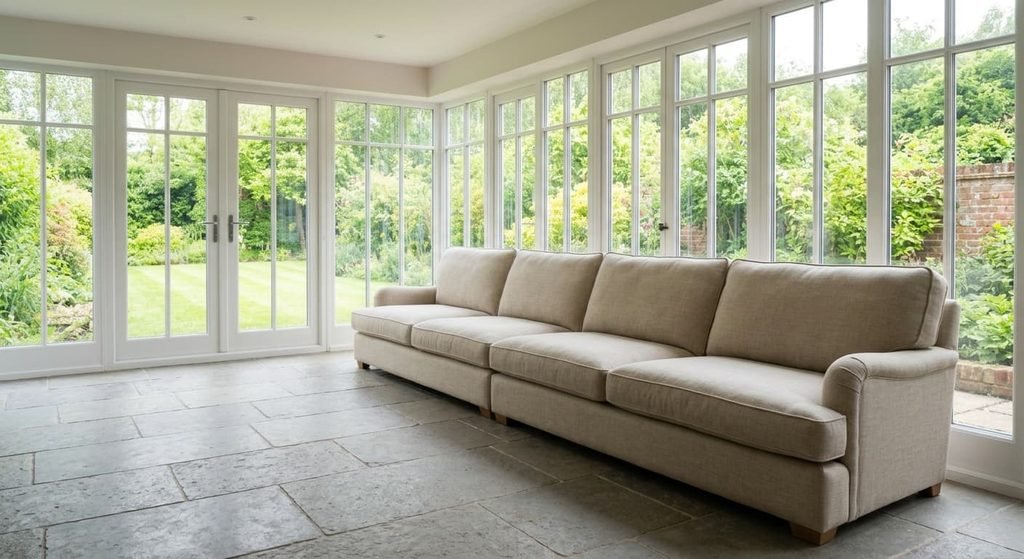
A bigger sofa is the common reflex when a sunroom never gets used, and it makes the three faults worse. Its 240 cm length and 100 cm depth take 2.4 m², against 2.0 m² for one of 200 by 100. It sits no higher than the old one, and it faces the same direction. It also adds 40 cm to the row, which pushes the outer seats farther apart and makes the turn to see a face wider.
More room to sit has never been the cause.
The cause was where the eye lands, what the face stands against and which way the seats point. Fix those and a smaller sofa works. Leave them and a bigger one sits empty at greater expense. Spend the effort on the angle of the seats instead, because turning them costs nothing and is easily undone.
A room gets used when the first minute is easy, and that minute holds three things you can measure: eye height first, then the brightness behind a face, then the angle of a seat. Check them from the seat before you check the catalogue, because a room that fails them fails whatever sofa you put in it. Fix one of the three and the room often changes within a day, since people go where the first minute is easy. I’d start with the eye-line check if time allows only one, because it takes ten seconds and names the fault most often missed.
Questions readers keep asking
Why does a loved sunroom stay empty?
When a sunroom never gets used despite being loved, the cause is usually at the seat, not in the room. Check the eye line against the glazing bar, the brightness behind a face, and which way the seats point. One of the three is almost always at fault.
What is the quickest fix for an unused sunroom?
Take a loose pad off the seat or turn the outer seats inward by about 40°. Both cost nothing and take a minute. Then sit in the seat for ten minutes and run the three checks again to see whether the room has changed.
Can you fix an unused sunroom without renovating?
Yes. All three faults sit at the seat: its height, its angle, the light behind a face. A rearranged room and one pale blind cover most cases. The glass and the bar stay as they are, and so does the roof.