Should a short worktop carry a wall knife strip or knife block? The block takes 17 cm out of a 120 cm prep zone, whereas the strip takes nothing from the worktop and asks for two holes in the wall. Fit the strip if you may drill and the zone is narrower than 136 cm, and choose the block when drilling is off the table. Edge care and cleaning matter next, and children’s reach comes last. Sizes here belong to a rented Dutch kitchen with a 240 cm run. Check each against your own kitchen before copying a number, and use a tape measure rather than an estimate.
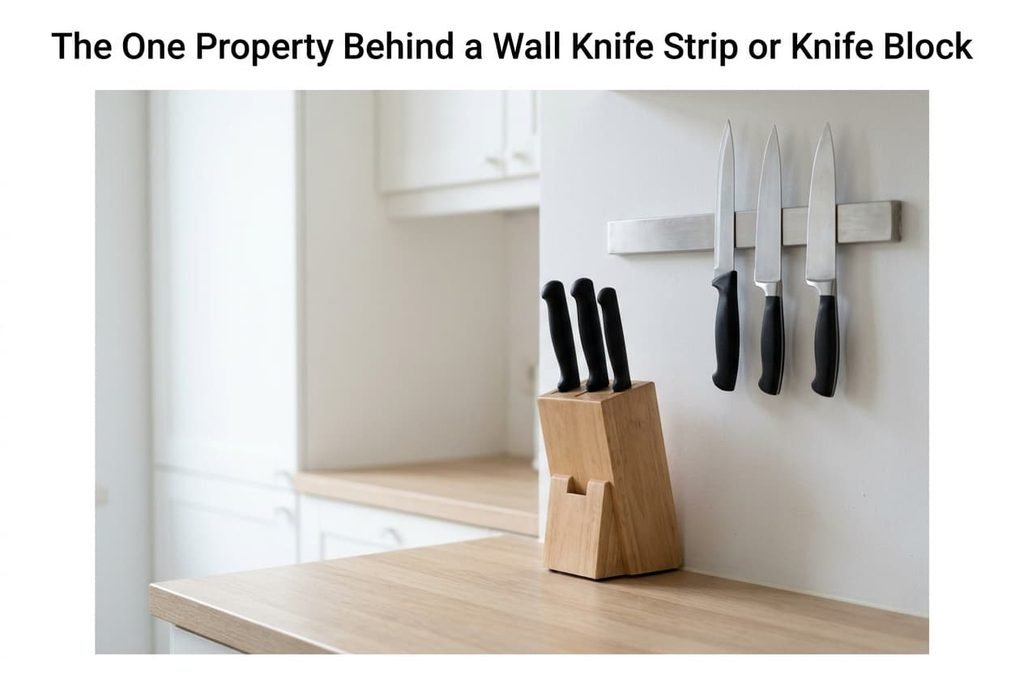
The One Property Behind a Wall Knife Strip or Knife Block
Each way of storing five knives spends something the kitchen has little of, and a block spends worktop while a strip spends wall. The example run measures 240 by 60 cm. The hob takes 60 cm and the sink another 60 cm, which leaves a prep zone of 120 × 60 cm, or 7,200 cm². To weigh a wall knife strip or knife block fairly, start from that leftover area.
A block with five slots stands 12 cm wide and 22 cm deep. It covers 264 cm². That looks like just 3.7% of the zone. Hands need 5 cm beside it to reach in, however, which makes the true cost 17 cm, or 14% of the zone’s width. Because the block is 22 cm deep, a board in front of it has only 38 cm to spread across.
A strip carries the same five knives on a bar 40 cm long, at about 8 cm each. It needs a patch of wall 40 cm across and 35 cm tall, which is 1,400 cm² above the zone. The space from worktop up to the cupboards measures 60 cm, leaving 25 cm in hand. Keep the bar 50 cm from the hob; grease and heat would otherwise coat it.
Five knives at roughly 180 g each weigh 0.9 kg, and that load is the bar’s job.
Wall Knife Strip and Knife Block Compared on Worktop and Wall
Each value here is drawn from our sample kitchen; a different zone or knife count moves the rows. Begin with the top two rows, which show the whole trade at a glance: the same five knives take either worktop or wall, never both. The remaining rows deal with the knives themselves and with life in a rented flat.
| Question | Wall strip | Knife block |
|---|---|---|
| Worktop taken | None | 12 × 22 cm, plus 5 cm of hand room |
| Wall taken | 40 × 35 cm above the zone | None |
| Where the edge rests | In open air, spine placed first | Against a slot wall, 20 cm of travel |
| Cleaning | One wipe along the bar | Slots a cloth can’t reach |
| Fitting | Two plugged screws, 6 mm holes | None |
| Edges in view | All five, at 130 cm | Hidden in slots, at 90 cm |
| On moving out | Two holes to fill | Goes with the tenant |
Row five carries the real catch. A strip has to be fixed into the wall. For a tenant, that means asking first. Every other row favours the strip on a cramped run, yet that single permission can overrule all of them.
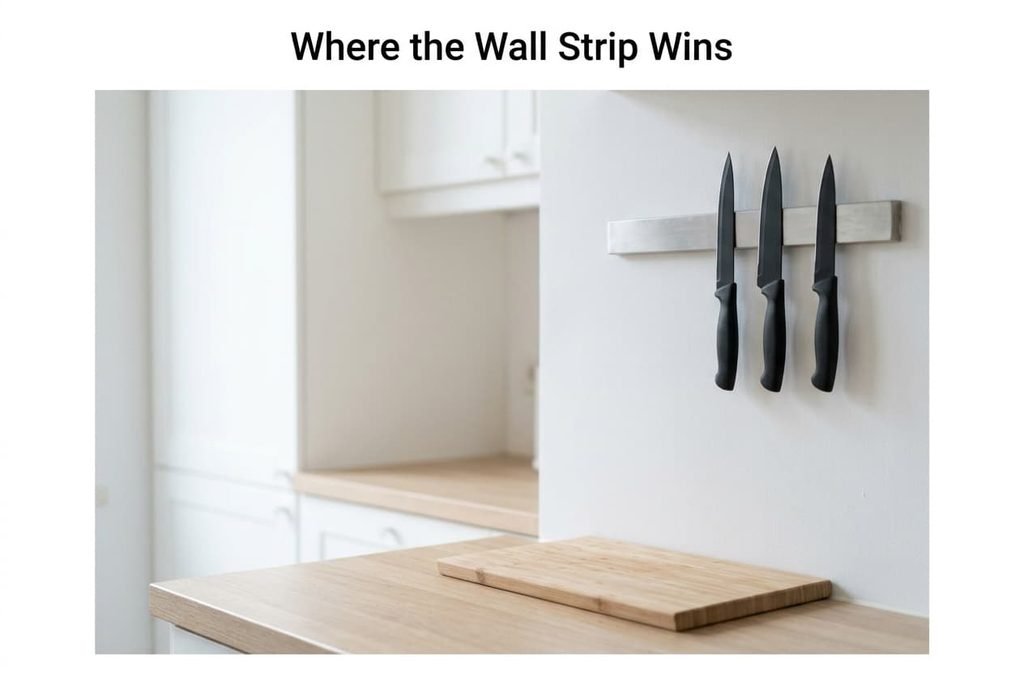
Where the Wall Strip Wins
The strip suits the shortest runs. Its cost is 1,400 cm² of wall that nobody was using, and it returns the 17 cm that a block would take from the zone. A board and a bowl stand together with no block to reach around, and for a wall knife strip or knife block that gain on a short run is the whole argument.
It also treats the knives gently. A blade is placed spine first and rolled onto the bar, and the edge touches nothing but air. A slotted block can drag the edge along a slot wall every time a knife goes in. Dull knives follow, and they need more force and slip more often.
A wipe cleans the bar in one pass.
Seeing every knife also saves the search for the right one. Plain limits remain, though. Ceramic blades fall off a bar that holds magnetic steel only, and the knives hang in view of anyone tall enough to reach them.
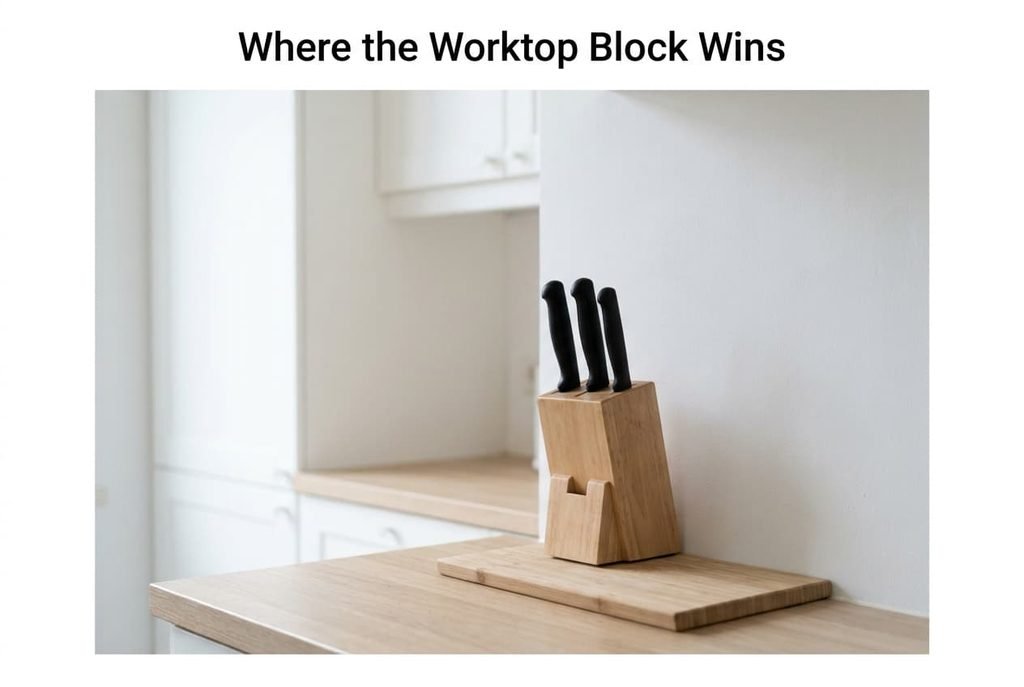
Where the Worktop Block Wins
No drilling is needed, and that is the block’s strongest point in a rented flat. Set it down, and the job is finished. It leaves with you on the final day, and the wall stays exactly as the landlord left it.
It also hides the edges. Five slots take the blades out of sight, and the block stands at 90 cm, a height most adults reach with a relaxed arm. Anyone looking for a spoon sees a wooden box rather than a row of exposed steel.
When the prep zone is wide, 17 cm costs little. At 160 cm it’s about 11%, and the block can stand in the rear corner behind the board. A wide run also makes drilling less tempting, since nothing forces the choice.
The costs sit in the slots. Cloths don’t reach into them. A knife put away wet leaves moisture inside. The slots also fix the sizes you can store, and a new 25 cm blade may not fit at all.
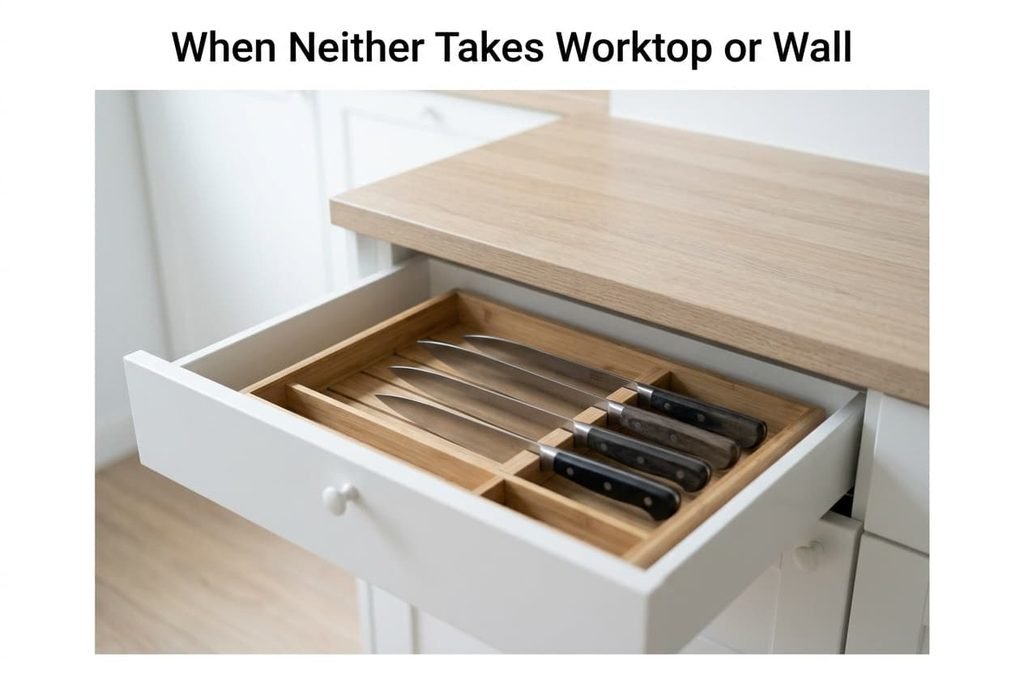
When Neither Takes Worktop or Wall
If a drawer is free, a third place beats a wall knife strip or knife block. A shallow tray measuring 40 by 25 cm inside a drawer holds five knives flat with their edges apart. It uses 1,000 cm² of space that was already yours, and it takes no worktop and no wall. The drawer loses 25 cm of depth, which is fine in a drawer 45 cm deep holding only cutlery and a peeler.
I’d try this before drilling or giving up a corner. The tray takes a minute to fit and leaves no mark, and it keeps the blades away from small hands. Its weakness is speed, since opening a drawer takes longer than reaching for a bar.
Your present arrangement may also be fine. If the knives already sit in a drawer, each with a blade guard, keep it. A guard stops edges touching. The only thing missing is a place to lift the knife from, and the drawer supplies that.
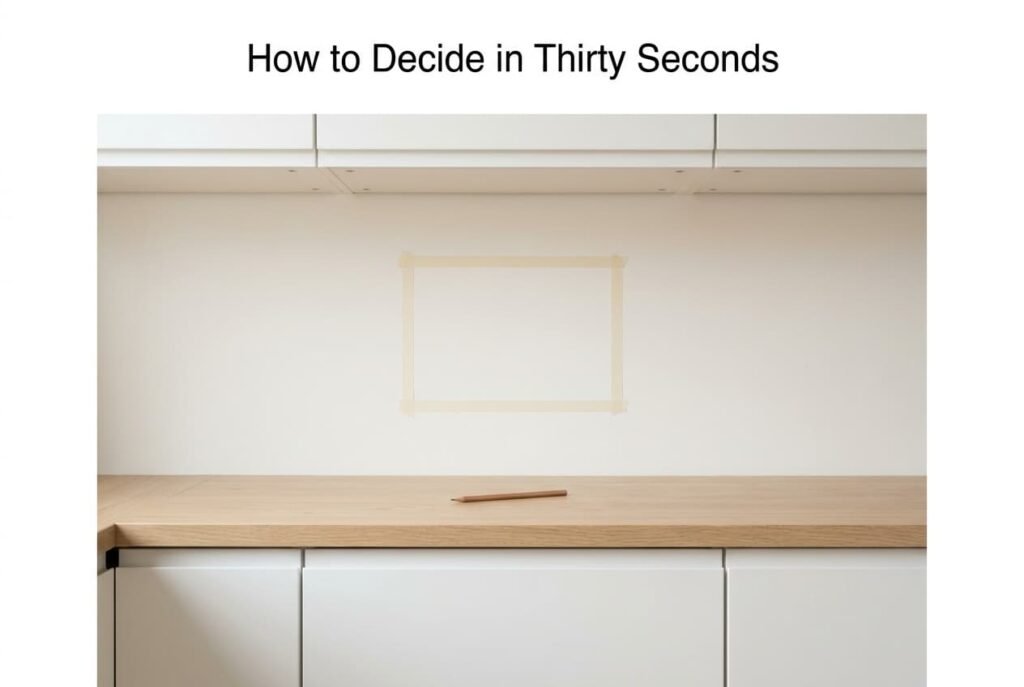
How to Decide in Thirty Seconds
A block takes 17 cm, and that stops being cheap once it passes one-eighth of the zone. One-eighth of the zone is 136 cm, since 17 × 8 = 136.
If you may drill and your prep zone is narrower than 136 cm, take the strip. Plug two screws into masonry rather than plaster alone, and place the bar above the board. The example zone is 120 cm, which puts it in this branch.
If drilling is forbidden, or the zone is 136 cm or wider, take the block. Leave 5 cm of hand room beside it and set it in the rear corner.
Measure the free stretch between hob and sink before ordering either, and note the figure in pencil beside the hob. Under 136 cm with the landlord’s agreement, the question answers itself. Tape the bar’s outline to the wall, then wait a full week. Anyone who bumps their head on it, or can’t find the board, will tell you. That feedback beats any plan.
Questions Readers Keep Asking
Does a strip or a block wear knives faster?
A block usually does, because each knife slides along a slot wall every time it’s stored. A strip lets the edge hang in open air once the spine goes on first. Either way a good board matters more than the storage. Ceramic blades don’t suit a strip at all.
Which is easier to keep clean?
The strip. One wipe along the bar removes splashes and dust. A block’s slots collect crumbs and moisture where a cloth can’t follow, and the only cure is to tip it upside down and shake. If a knife goes in wet, the slot stays wet too.
Which suits a flat with a young child?
The block hides the edges but sits at worktop height, and the strip shows them but sits higher. Neither is childproof. A drawer tray behind a child latch keeps edges furthest out of reach. If you choose the strip, mount it high. If you choose the block, keep it toward the rear of the worktop.