Feather and foam are the two usual fillings for a cushion insert, and a sofa used every evening shows how differently they age. Feather feels soft and sinks, then wants plumping. Foam holds its form and asks for nothing. The test case is a Zwolle flat with three back cushions measuring 50 × 50 cm along a 200 cm sofa, each leaned on for four hours a night. Feather or foam cushion inserts are compared in a table, then one at a time, followed by a free alternative and a choosing rule. All figures here are samples, and you’ll want your own measurements.
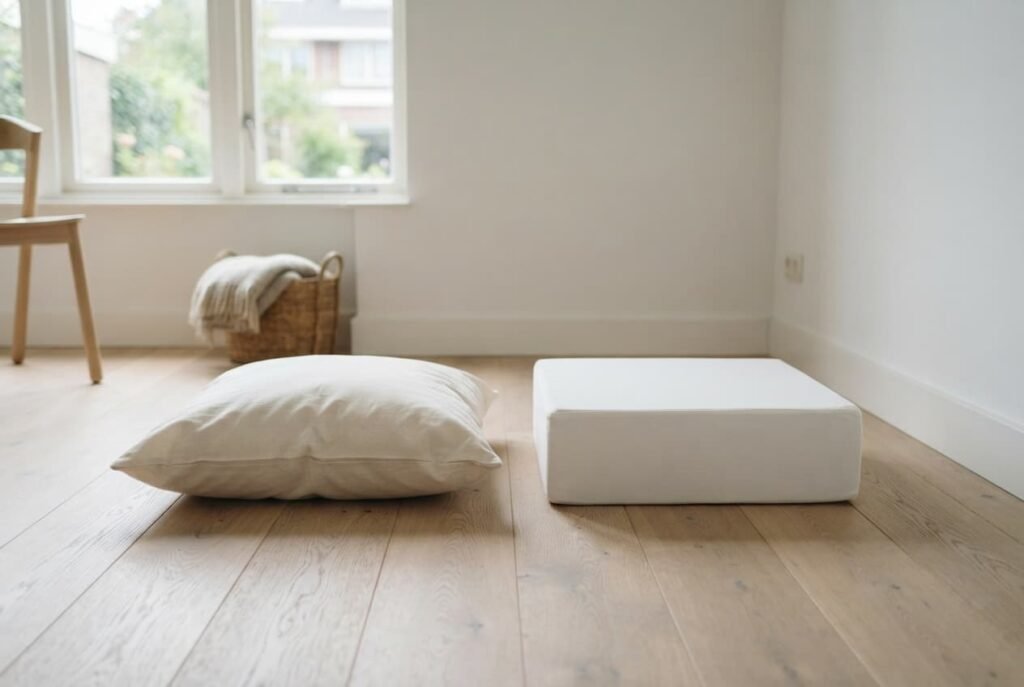
What Sets Feather or Foam Cushion Inserts Apart on a Busy Sofa
Both fillings rely on trapped air. Feather is a loose heap of soft plumes with air between them. A leaning back squeezes that air out, and the cushion stays flat until somebody fluffs it. Foam keeps its air inside a solid web of tiny cells, and the cells refill as soon as you sit forward. Over an evening, feather changes shape while foam hardly changes at all.
Weight follows the same split. In this sample, a feather insert holds roughly 0.5 kg of filling. A foam block of 50 × 50 × 10 cm at 30 kg/m³ weighs 0.025 × 30 = 0.75 kg, which makes foam half as heavy again, although either is easy to carry.
Two measures matter on a sofa that’s used daily. One is how much thickness each insert holds after four hours of leaning. Feather starts at 20 cm and settles to about 12 cm, while foam starts at 10 cm and settles to 9.5 cm. The other is the effort needed to restore it: feather wants about 20 seconds of plumping per cushion, and foam wants none. A ruler and kitchen clock are enough to take both.
Foam or Feather Cushion Inserts Compared Row by Row
Take one of your own cushions plus a tape and kitchen scales, then check each row against it. The values describe this sample sofa only. Weigh the cushion, press it hard for ten seconds and note how fast it recovers, since that single trial says more than any label on the packaging.
| Point | Feather insert | Foam insert |
|---|---|---|
| Filling weight, per cushion | about 0.5 kg | about 0.75 kg |
| Thickness when new | 20 cm | 10 cm |
| Thickness after four hours | 12 cm | 9.5 cm |
| Upkeep each day | plump for 20 seconds | none |
| Shape on the sofa | soft and slouchy, with a slump along the top edge | square and firm, with sharp corners |
| Inner case | tightly woven, to hold quills in | plain lining |
| Cleaning | follow the care label or hire a professional, and dry it right through | wash the cover and spot-clean the block with a moist cloth |
For feather or foam cushion inserts, thickness after an evening divides the two most clearly, with 8 cm lost against 0.5 cm. Weigh the rows you’d mind most after years of nightly leaning. A tighter case or a longer wash can fix most of the others, and no fabric can bring back lost thickness.

Where Feather Wins on a Sofa for Slouching
A feather insert suits someone who sinks into the sofa and wants a soft landing for the head or lower back. Under pressure the plumes slide aside and the cushion shapes itself to the person. A cushion that settles from 20 cm to 12 cm still gives yielding support. At 0.5 kg it’s also easy to toss onto the floor on a film night.
Plumping brings back about 18 cm in 20 seconds.
Three cushions take a minute each evening, which most households fold into the usual tidying. Feather also looks relaxed. A full insert gives the cover that gentle slump that foam never produces.
Some drawbacks come with it. A cushion left alone for a week stays flat and the cover wrinkles. Quills can work through a loose weave, which is why a tightly woven inner case matters. Washing is awkward too, because a wet insert that isn’t dried right through can smell stale. Many makers advise a professional clean, and the label has the final word.

Where Foam Wins When the Sofa Gets Daily Use
A foam insert suits someone who sits upright and reads, or who works on a laptop and wants identical support each evening. It settles by only 0.5 cm in four hours, which means the shape you set up in the morning is the shape you lean on at night. Nobody has to plump anything.
Foam keeps a square outline and holds the corners of a snug cover taut. It also helps with posture, since the firm block pushes back at the lower spine while the seat does the rest.
Dense foam endures. A block at 30 kg/m³ or more usually stays supportive for years, whereas a lighter foam softens sooner. To test one, press a fist into it and hold for 10 seconds. If the dent takes a full minute to fill, the foam is tiring.
Two drawbacks apply. Foam is firm, which stops the head sinking in as it does with feather. It also holds warmth against bare arms on a hot evening, and the block can’t be adjusted once bought.

The Third Option Is the Insert You Already Own
Test the old inserts before you spend anything.
Press a cushion flat with both hands, then let go. If it regains its form within 3 seconds, the filling has a lot of life left. If it stays flat for 10 seconds or more, the filling is spent.
A tired feather insert often recovers after an afternoon in fresh air by an open window and a thorough shake. A flat foam block rarely recovers, though turning it over spreads the wear. Swap the cushion from the seat that gets most use with one from the far arm, and the wear evens out.
When feather or foam cushion inserts are already on the sofa and they pass the press test, leave them in place and buy nothing. A new insert only earns its keep once the old one fails twice within a fortnight, and each repeat takes under a minute.
Which to Pick: Feather or Foam?
Feather or foam cushion inserts divide most sofas into two branches. Each branch has a downside to accept up front.
If you sink into the sofa and like a soft landing, pick feather. It shapes itself to your head and back as you settle. Accept a minute of plumping each evening, and choose a tightly woven case that holds the quills in. Expect the cover to wrinkle on any night when plumping gets skipped.
If you sit upright and want the same support every day, pick foam. It keeps about 9.5 cm of thickness through the evening and needs nothing beyond a cover wash. Accept a firmer feel and a block that can’t be adjusted. The square corners keep a snug cover looking fresh.
Before buying either, borrow one cushion of each kind for a week. Measure each with a ruler before and after an evening, and write both thicknesses on a note. The note shows which one you kept reaching for, and you can keep it until the next time a cover wears out. Judge them on your tiredest evening, because a cushion that suits you when rested can still disappoint.
Questions and Answers
How long should a cushion insert last?
A dense foam block at 30 kg/m³ or more can serve for years of daily leaning. Feather can last even longer, yet it only looks good with regular plumping. Judge both with the press test, because a cushion that stays flat after 10 seconds has lost its filling.
Can I wash a cushion insert at home?
Foam shouldn’t go through a machine. Wash the cover and spot-clean the block with a moist cloth. Feather is riskier, because any moisture left inside can turn stale. Follow the care label, and dry the insert thoroughly before refilling the cover.
Which suits a sofa where a dog likes to jump up?
Foam usually suits a dog household better. It springs back after paws and weight, and a snug cover keeps hair out of the corners. Feather can work if you plump daily and the inner case is tightly woven, because claws can catch a loose cover.