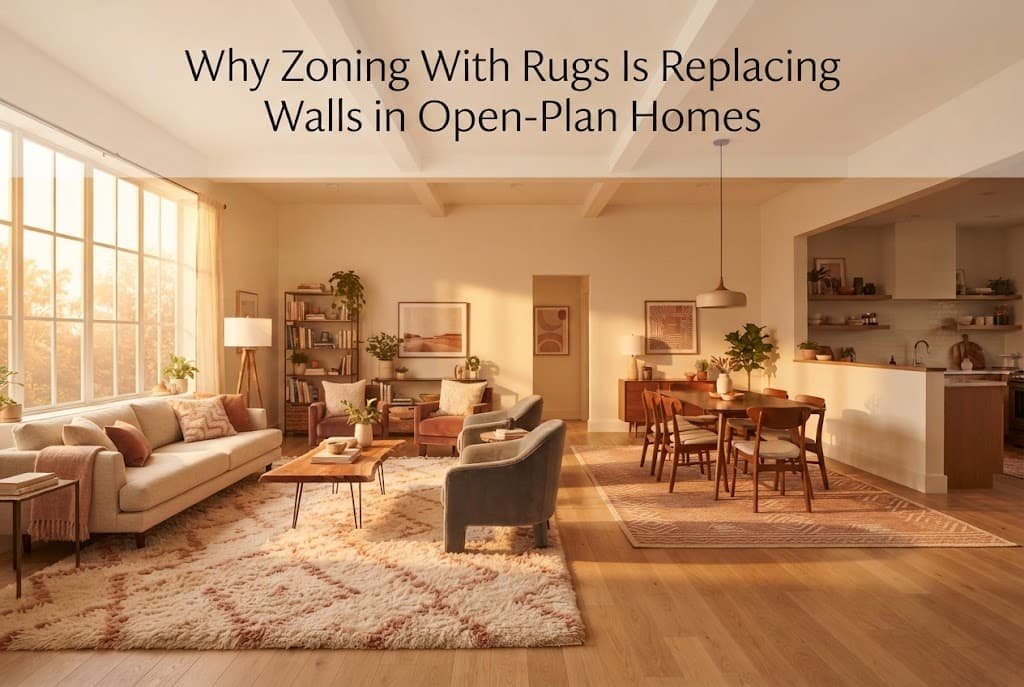
Rugs keep steadily displacing physical walls as the tool of choice for dividing open-plan spaces into functional zones, for a reason grounded in measurable spatial perception, not seasonal taste alone – and understanding that specific reason tells you whether it’s genuinely worth adopting or just the current version of a cycle that will eventually pass entirely. The shift is real and checkable in how flooring boundaries affect perceived space division, not simply a matter of one zoning method being more fashionable than another.
What actually changed
The measurable shift is a move away from partial walls, half-height partitions, and other physical structural dividers toward using a rug’s edge as the primary signal of where one functional zone ends and another begins. Where a physical partition creates an unambiguous, permanent boundary regardless of how the space is actually being used at any given moment, a rug boundary creates a softer, more easily reinterpreted division that shifts with the furniture placed on and around it.
This isn’t purely aesthetic preference – it’s a direct property of how the human eye reads floor-level boundaries as zone markers, which is why the technique keeps recurring across different design eras rather than being tied to one particular decorating trend alone.
Lighting choices have shifted alongside rug-zoning specifically, with distinct pendant or floor lamp placement over each rug increasingly common rather than relying solely on uniform overhead lighting across the whole open space. This compounds the same boundary-marking mechanism further – a dedicated light source above a zone reinforces the rug’s visual signal that this specific area serves a distinct function, rather than the zoning relying on the rug alone to do that work.
Why it keeps coming back specifically now
The continued popularity of open-plan layouts in general – removing walls for light and flow – has created an ongoing practical problem that rug-based zoning directly addresses: a large undivided space genuinely benefits from some form of functional definition, but adding back a physical wall undermines the exact openness the layout was designed to achieve in the first place.
For most of the last several years, this specific tension between wanting genuine openness and needing some functional definition has been increasingly common in newly built and renovated open-plan homes, which is a concrete structural reason rug-zoning’s popularity tracks the broader open-plan trend rather than purely following showroom styling alone.
This distinguishes the current cycle from earlier uses of rugs as room dividers, which were often driven primarily by a particular design movement’s aesthetic preferences rather than by an actual structural tension between openness and function. The underlying mechanism is the same regardless of cause, but a technique genuinely driven by an actual spatial problem tends to persist considerably longer than one driven purely by a design movement’s popularity, since the underlying tension doesn’t simply disappear once the associated aesthetic eventually falls out of favour.
What this actually changes in a room
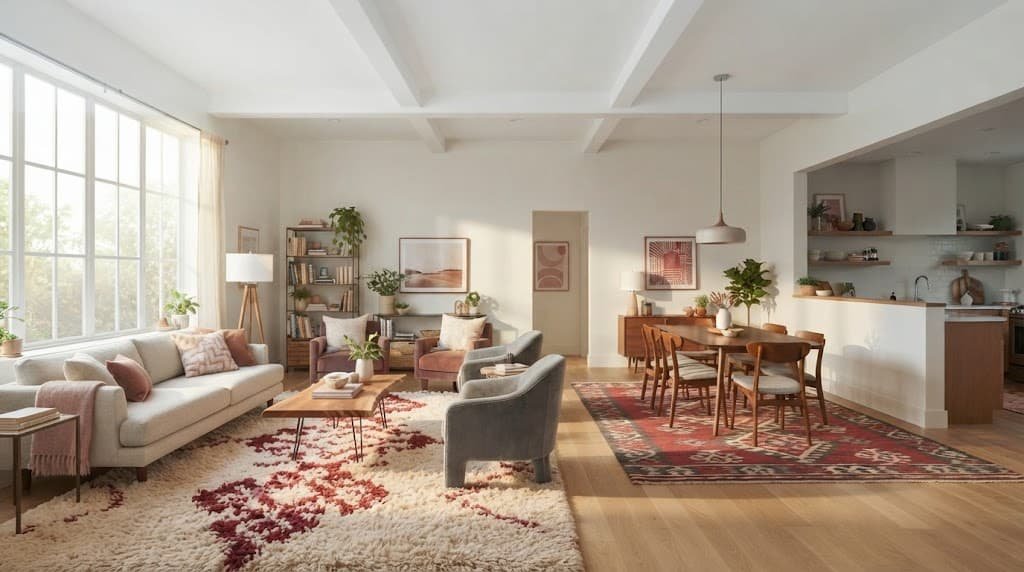
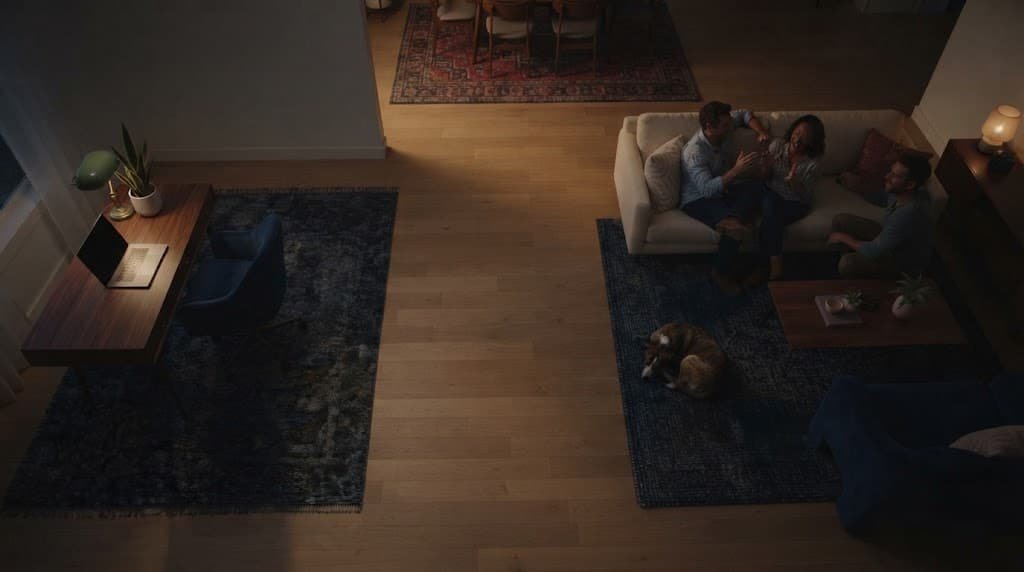
A rug boundary creates a measurable visual cue that the eye reads as “this area serves a different function” without physically blocking sightlines or light the way a wall does, which is the specific mechanism behind rug-zoning preserving an open-plan space’s core benefits while still providing functional definition. This isn’t a subjective impression – it’s the direct result of floor-level colour, texture, or pattern change signalling a boundary to the eye in a way empty, continuous flooring doesn’t.
Rug placement also affects furniture arrangement logic specifically, since furniture naturally tends to be arranged relative to a rug’s edges rather than floating without any anchor. This compounds with the zoning function directly – the rug doesn’t just mark a boundary, it actively organises how furniture within that zone relates to the boundary itself.
Where this trend genuinely holds up
The visual-boundary mechanism behind rug-zoning’s effectiveness doesn’t depend on current taste, which is why it’s a reasonable longer-term choice specifically for open-plan spaces where physical walls have already been deliberately removed. A space genuinely committed to an open layout benefits from this zoning method regardless of which decade’s aesthetic currently favours the specific rug styles being used.
This is a genuinely different situation from most decorating trends specifically because the mechanism is measurable rather than purely stylistic. A trend based purely on which specific rug pattern happens to be popular shifts in and out of favour without changing anything structural about how a room actually functions; the boundary-marking effect itself remains constant regardless of whether the broader aesthetic built around it happens to be currently fashionable.
Where the verdict should stay negative
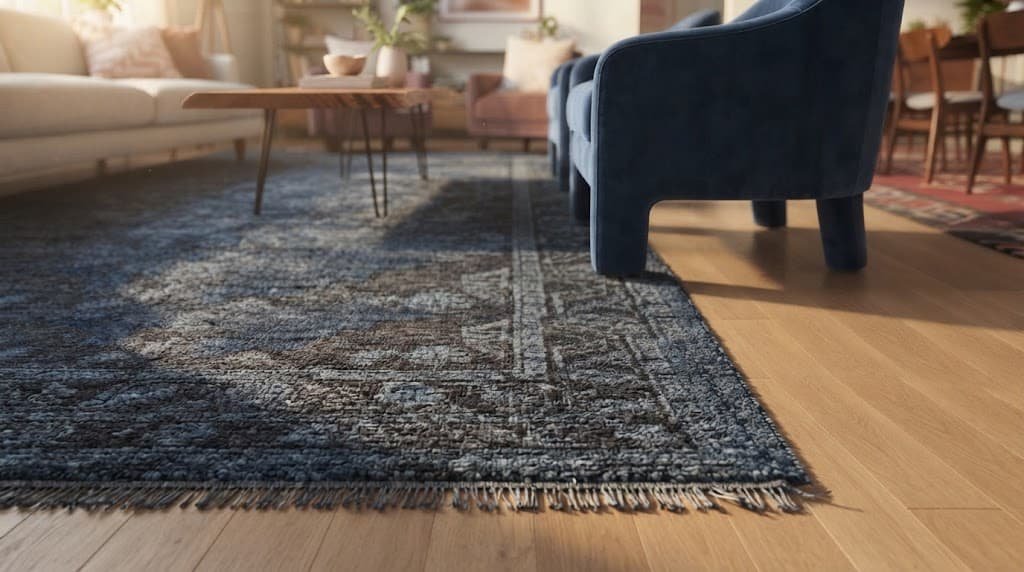
Rug-zoning genuinely isn’t worth relying on as the sole functional divider in a space with a specific acoustic or privacy need, despite how consistently it’s marketed as a universal open-plan solution.
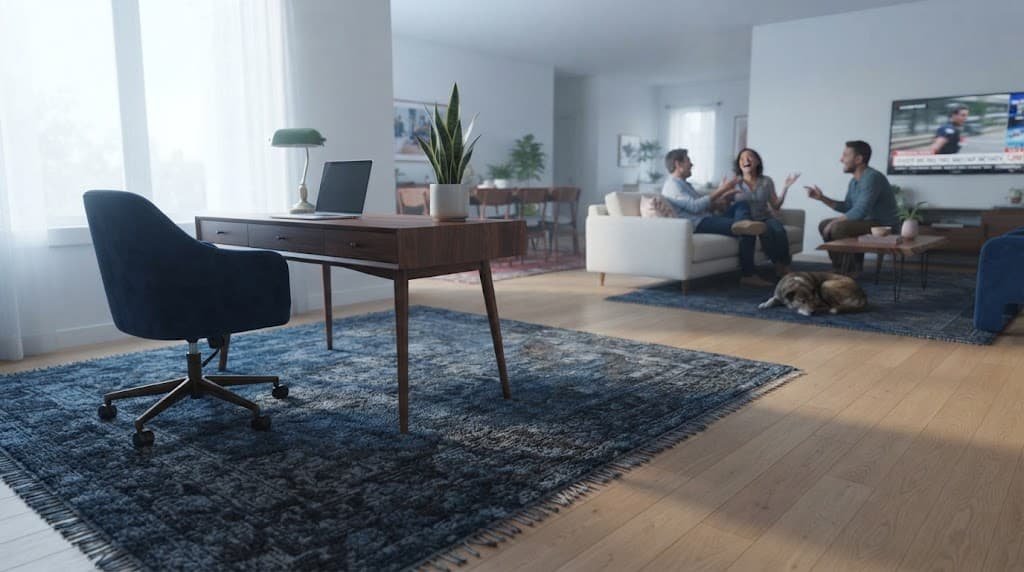
In a scenario where genuine sound separation or visual privacy between zones matters – a home office needing quiet during calls, a space requiring a closed-off area for specific activities – the visual-boundary mechanism that makes rug-zoning work for casual functional definition simply doesn’t address acoustic or privacy needs at all. Relying on rug-zoning alone in this specific scenario, purely for its current popularity, addresses none of the actual underlying requirement.
What people get wrong when adopting it
The most common mistake is choosing a rug primarily for its individual pattern or colour appeal while ignoring whether its actual size and shape genuinely correspond to the functional zone it’s meant to define. A rug too small for the furniture arranged around it fails to create a convincing boundary regardless of how attractive the rug itself looks, since the mechanism specifically depends on the rug’s edges aligning meaningfully with where the zone’s furniture actually sits.
A second common mistake is using dramatically different rug styles across adjacent zones without any connecting element between them, which can create visual fragmentation rather than considered zoning. Some degree of coordination – a shared colour note, a similar level of pattern complexity – between adjacent zone rugs helps the overall space read as intentionally divided rather than randomly assembled from mismatched pieces.
A third mistake is treating the transition between two zoned rugs as unimportant, leaving a large expanse of bare flooring between them that reads as its own undefined third zone rather than a clean boundary between the two intended ones. Keeping the gap between adjacent zone rugs relatively modest helps the eye read the space as two clearly defined areas rather than two islands separated by an ambiguous middle ground.
Questions readers keep asking
Does rug-zoning actually work as well as a physical wall for defining spaces?
For visual and functional definition specifically, yes, it’s a genuine and measurable technique – though it doesn’t provide the acoustic or privacy separation a physical wall does, which matters for some specific use cases but not for general functional zoning in a shared open space.
Is rug-zoning just a temporary trend that will look dated soon?
The underlying visual-boundary mechanism it addresses doesn’t depend on current taste, which suggests genuine longevity specifically for open-plan spaces – though specific rug styles chosen within the broader technique can still date in the usual way any decorating choice eventually does over time.
Can I use rug-zoning in a home that isn’t fully open-plan?
Yes, though the effect is less pronounced in a space that already has some physical division, since the mechanism is specifically most valuable where no other functional boundary already exists. In a partially divided space, rug-zoning works more as reinforcement than as the primary defining boundary itself.
Does the rug’s colour matter as much as its size and placement?
Size and precise placement matter considerably more for the actual zoning mechanism itself – a correctly sized rug in a neutral colour still creates a functional boundary, while a beautifully coloured rug that’s too small or poorly aligned with the furniture around it fails to define the zone regardless of how visually appealing the colour choice is on its own.