Why does a speaker that sounds big in the shop sound boomy in a bedroom? Because the room sets the bass. The first criterion for a Bluetooth speaker that sounds good in a small room is balance: how even the sound stays at the volume you really use, close to a wall. A speaker that stays even when quiet passes. One that needs volume to sound complete doesn’t.
The reader here lives in the United Kingdom, in a bedroom or study of about 3 by 3.5 m under a 2.4 m ceiling. The speaker sits 1 to 2 m away at low to moderate volume. It names no products and no prices.
Why a good Bluetooth speaker sounds bad in a small room
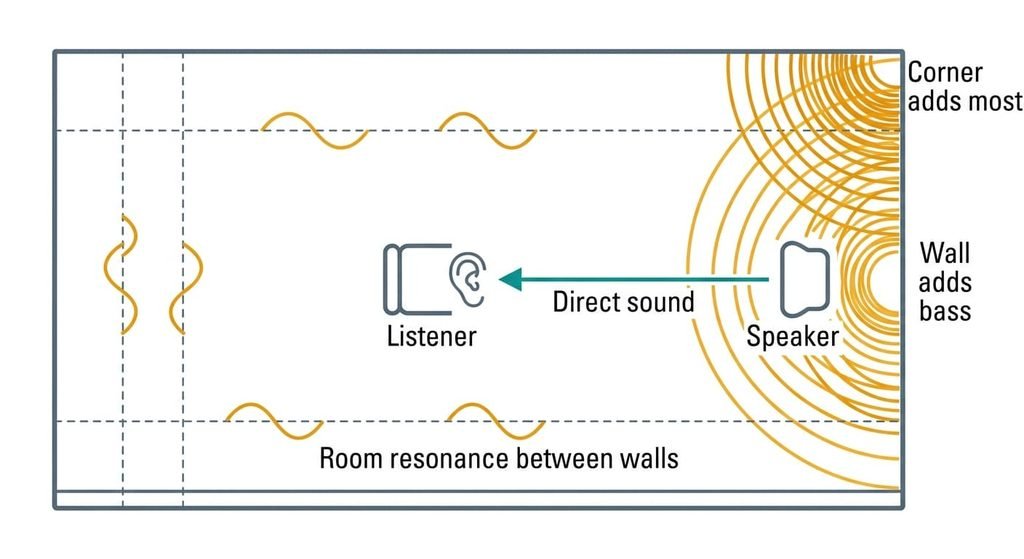
A small room works against bass in a way a shop floor doesn’t. Sound travels at 343 m/s, and a room resonates at the frequencies whose half-wavelength fits between two surfaces. For the 3.5 m wall, 343 divided by 7 gives 49 Hz. The 3 m wall gives 57 Hz and the 2.4 m height gives 71 Hz. Those are bass notes, so a speaker that pushes energy into that band makes some seats boom and others thin.
At 1 to 2 m the sound you hear first comes straight from the cabinet, before the walls add their share. The speaker’s own tone therefore arrives unaltered, and the room colours what follows.
Placement adds more. Each wall near the speaker adds bass, and a corner adds the most. Quiet listening makes it worse, because hearing is less sensitive to low notes at low levels. Makers lift the bass to make a small cabinet sound full, and that lift overshoots near a wall.
What decides the choice of a Bluetooth speaker that sounds good in a small room is how even the balance stays at your listening volume, beside a wall.
Everything below hangs from that.
What to look for in a Bluetooth speaker that sounds good in a small room
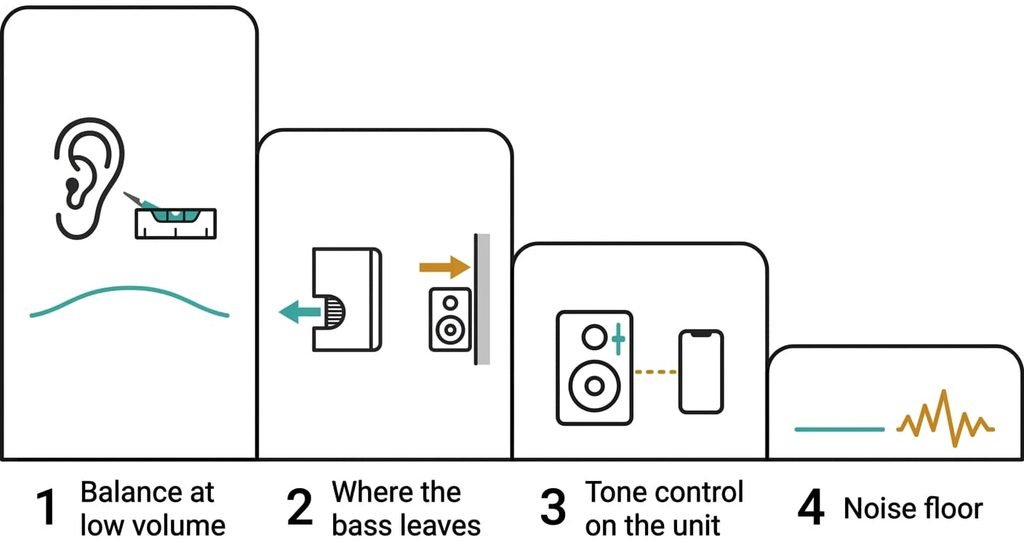
1. Balance at the volume you’ll use. This is how natural a voice sounds, and how clear a bass line stays, with the speaker turned low. Day to day, it decides whether you keep turning up to find the bass and down again when it booms. Judge it with a spoken-word track at your late-evening level, from your normal seat. Good looks like a voice with no hollow chest and a bass line you can follow note by note. If it’s wrong, you’ll fight the volume every night.
2. Where the bass leaves the cabinet. A tuned vent and a second passive diaphragm both lift bass, while a sealed box keeps it tighter. The position of the opening matters near a wall. Day to day it decides whether moving the speaker five centimetres changes the whole sound. Look at the photos for the vent and read the manual for a stated distance from the wall. A vent on the front or side is a good answer. One facing the wall is a warning, and boom from it is something no setting fully removes.
3. A tone control that lives on the speaker. It lets you trim bass when you move the unit from a shelf to a corner, in about ten seconds. Ask where the setting lives: on the speaker, or only in a companion app. Good means a control that works without the app. If it’s wrong, the day the app stops being updated you keep the factory sound for good.
4. The noise floor, which most buyers skip. A speaker with no music playing still makes a faint hiss. In a quiet room at night it’s the loudest thing you’ll hear. Switch it on with nothing playing, put your ear a metre away and listen for a steady hiss. Good means silence. A hiss can’t be fixed later, and a bedroom hears it every night.
What the box oversells
Three numbers dominate the box, and each changes little in a small room. The peak power figure comes first. There’s no single way to measure it, which makes it cheap to print. Doubling the power adds only about 3 dB, a change you barely hear. It takes ten times the power to sound about twice as loud, so a jump from a small printed figure to a large one buys less than it looks. A small room never needs the headroom a party does.
Battery hours come second. They sell a speaker for gardens, but in a room it sits within reach of a socket, and a bigger battery adds weight and a part that ages. The figure leads the box because hours are easy to compare across boxes. The claim of 360-degree sound comes third. Spreading sound in every direction suits open space, and in a small room it sends more of it into the nearby walls, whose reflections blur a voice. I’d ignore all three.
Which criterion moves for which listener
A night listener in a bedroom should lift the fourth criterion to first place. Daytime noise hides a hiss, and at midnight it’s the loudest thing in the room. Balance stays second, since a quiet speaker with uneven tone is still the wrong one.
At a desk 60 cm from the speaker you hear mostly direct sound, so the second criterion drops. Push that desk against a wall and it stays in play.
A corner shelf is the hardest placement of all. Anyone with no other spot should treat the second criterion as a fixed requirement and the third as the repair.
In a flat where the speaker has to cover kitchen noise, test the first criterion louder. The balance must hold at a higher level, and the fourth matters less because other noise masks the hiss.
What to walk away from
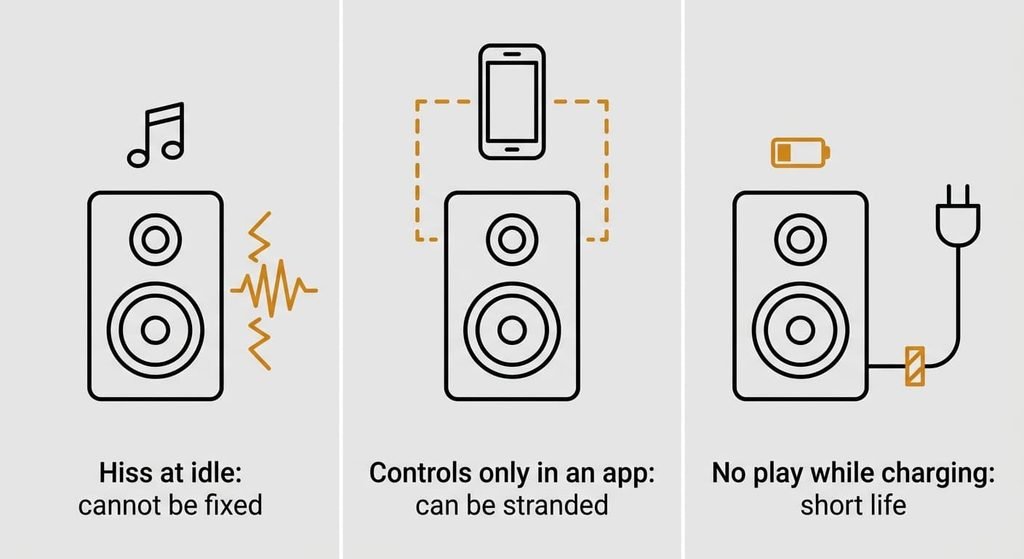
Walk away from a hiss you can hear at idle. It comes from the electronics, so no later setting can remove it, and a bedroom hears it every night. Walk away from a speaker whose volume and tone live only in an app. If the app disappears, you’re stranded with a speaker you can’t adjust. A volume or tone control on the cabinet can’t disappear that way.
A speaker that can’t play while charging and has a sealed battery also goes. In a room it lives on the mains, and the battery is the first part to wear out. When it does, the whole unit goes with it.
Size is the purchase not worth making. A Bluetooth speaker that sounds good in a small room is judged on balance rather than volume. A larger driver moves more air and excites the same 49 to 71 Hz resonances harder.
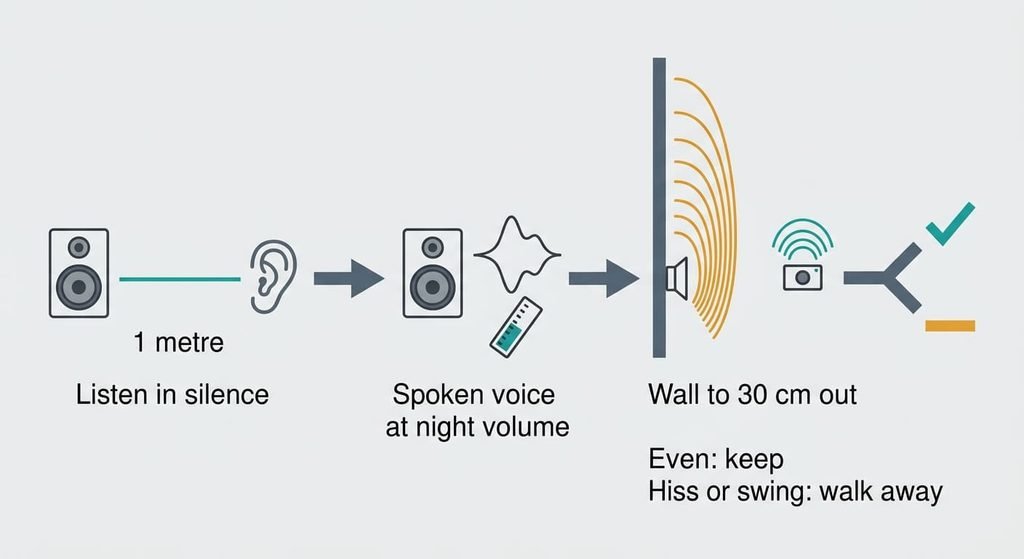
The two-minute check before you commit
Begin by listening in silence. Switch the speaker on with nothing playing and listen from a metre away. A steady hiss ends the check. Then play a spoken-word track at your late-evening level. If a voice sounds hollow or boomy, stop there.
Put the speaker with its back 5 cm from a wall, then 30 cm out. A big swing in bass points to a rear-facing vent. Finally, check whether the tone control works without the app. Online, the check becomes the product photos and the manual’s wall distance. Add a line about playing while charging, and treat a hidden vent as an answer too.
To find a Bluetooth speaker that sounds good in a small room, begin with balance at your own volume, and let a hiss at idle end the search. Extra power and a bigger battery can be bolted onto any speaker for little. A quiet room and a spoken-word track will tell you more in two minutes than the box does.
Questions readers keep asking
Does a higher wattage make a Bluetooth speaker louder in a small room?
Only a little. Doubling the power adds about 3 dB, a change most people barely notice, and a small room fills at modest levels anyway. Wattage figures also have no single measuring standard, so two speakers with the same number can differ. Judge how clean it sounds at your own volume instead.
Does paying more get a better Bluetooth speaker for a bedroom?
Rarely. Spend for balance and a low noise floor. Battery and power rarely deserve it. The cheapest tier that passes the silence and spoken-word checks is enough for a bedroom, since each step up buys mostly volume you won’t use. If two pass, take the one with its controls on the unit.
What do people regret when buying a Bluetooth speaker for a small room?
The regrets follow from the design. A big speaker that sounded full in the shop booms beside a bedroom wall. An app-only control or an idle hiss can’t be fixed afterwards, and a sealed battery that wears out first takes the whole speaker with it.