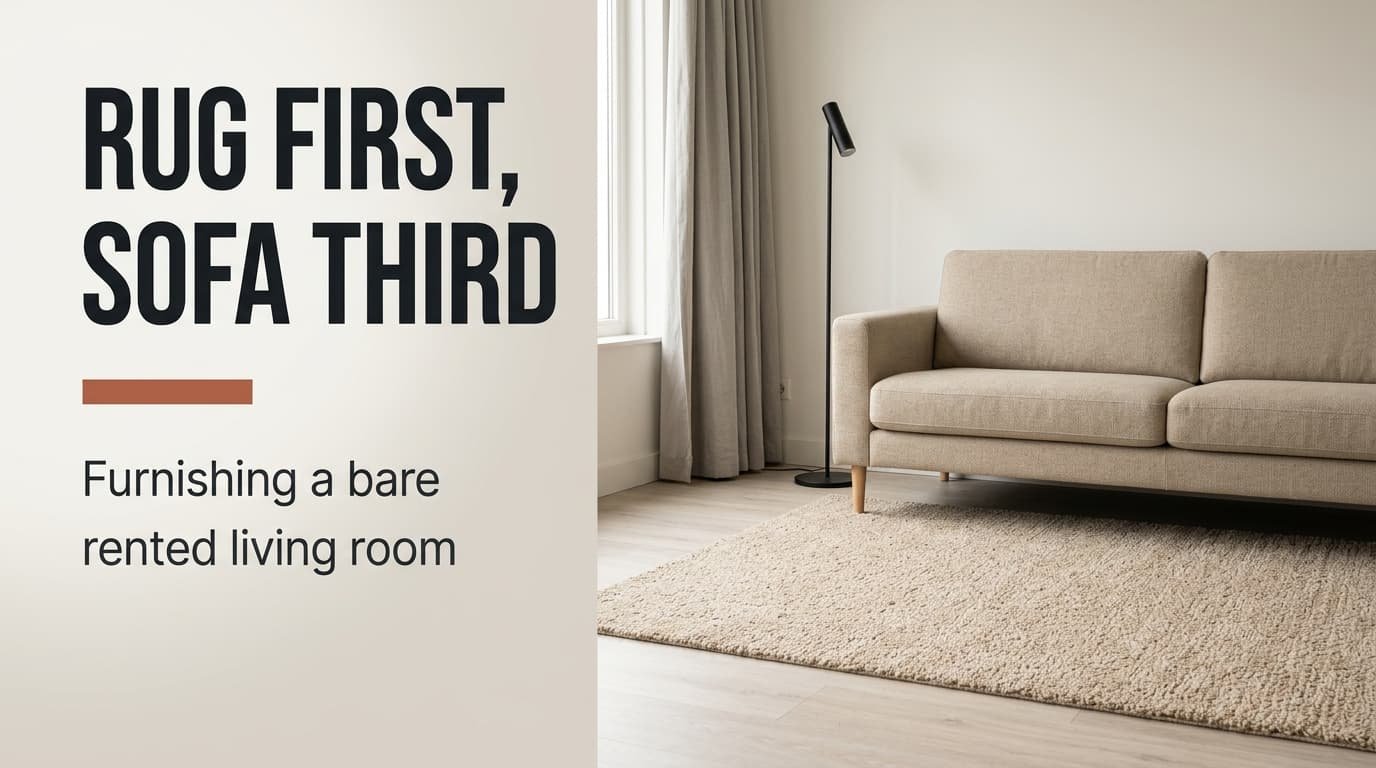
Which does more for furnishing a bare rented living room: the sofa or the rug? The rug, by a margin you can calculate. An empty room rings like a stairwell, and the cheapest cure is soft area on the floor. Most buying guides start from looks, which puts the wrong piece first.
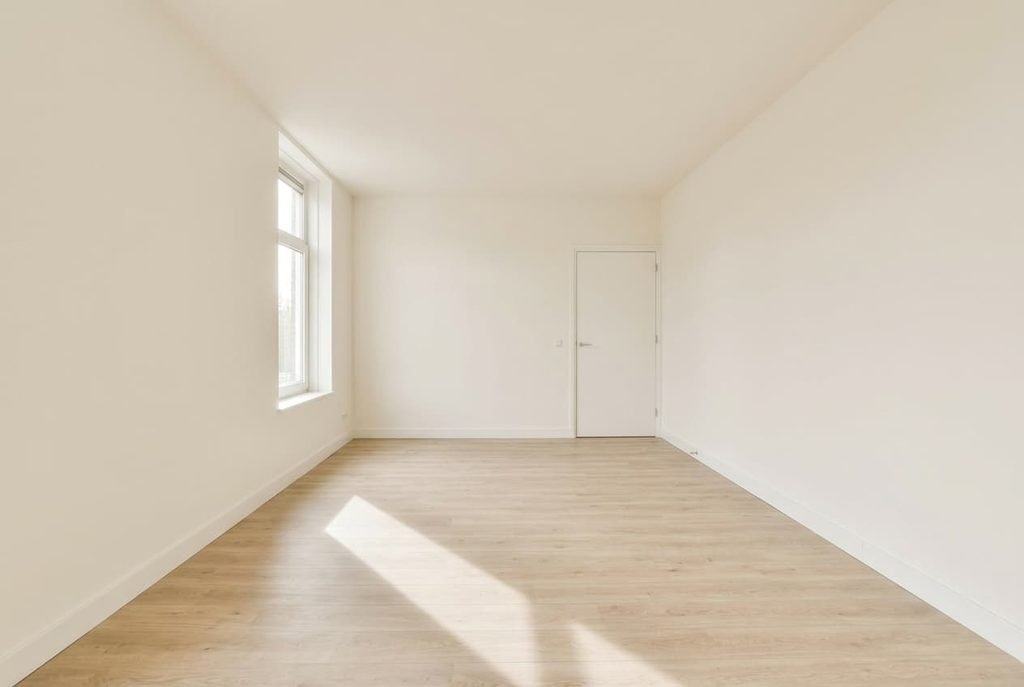
Our room is Dutch: 4.2 by 3.6 m, with a ceiling at 2.5 m. It has plaster walls and a laminate floor. One window faces the street. I’ve left prices out because they go stale, so every piece is judged on size and build. Use your own measurements in the sums.
The rule that decides furnishing a bare rented living room
The rule is to buy in the order of absorption each piece adds among the pieces you can place without a drill. Echo is measured as reverberation time, the seconds a clap takes to die away. Sabine’s formula gives it as 0.161 times the room’s volume divided by its total absorption. Absorption is counted in sabins, which means area multiplied by a coefficient between 0 and 1.
Our room holds 37.8 m³ and has 69.2 m² of surface. Hard plaster and laminate absorb about 4% of the sound that meets them, so the room totals 2.77 sabins. The clap then lasts 0.161 × 37.8 ÷ 2.77 = 2.2 seconds, which is a stairwell. A living room feels comfortable below 1 second, so each purchase is ranked by the sabins it adds.
Sound comes first for a practical reason. Looks can wait a month. An echo shows up the moment you speak and makes television and conversation harder alike. Every sofa and every rug also absorbs by the same physics, whatever the taste behind it.
Treat the sums as a way to rank pieces. They ignore leaks through the window and door, and they give each surface one flat number.
The buying order for the living room, piece by piece
Each entry gives its size and its place in the order. A tier and the fault to look for follow. That keeps furnishing a bare rented living room a matter of checks you can make in a shop.
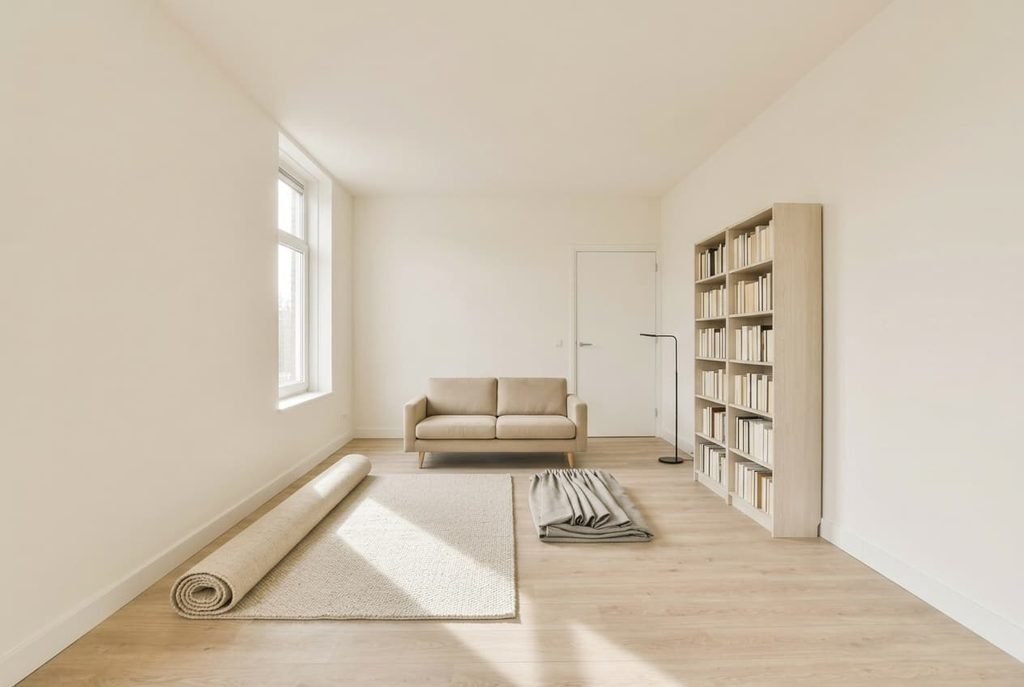
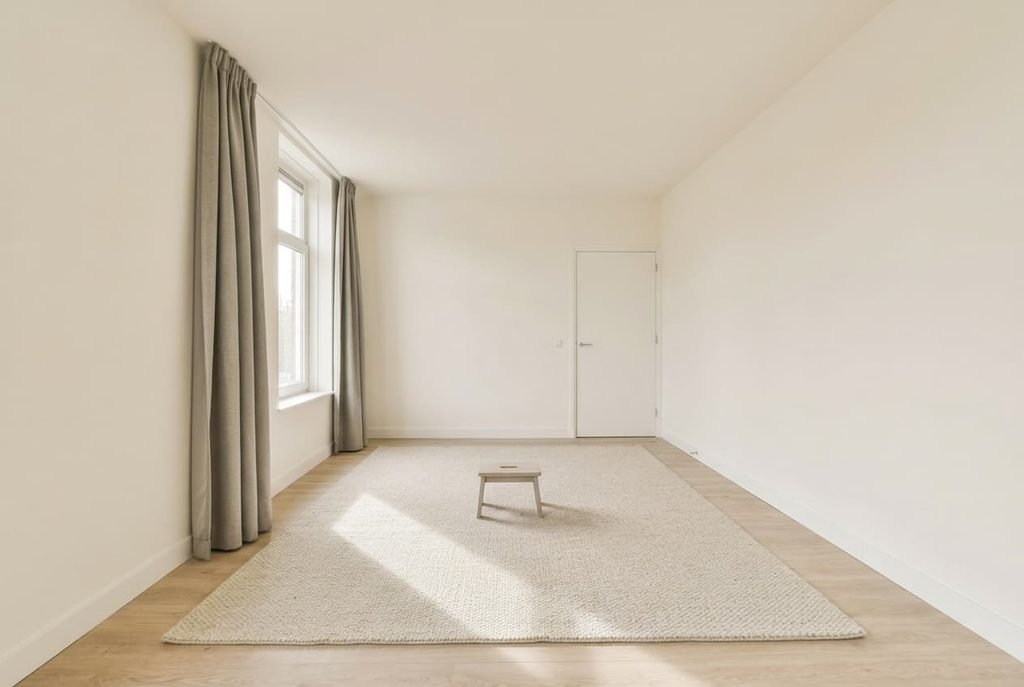
1. A rug measuring 2 × 3 m, with a 12 mm wool pile on a felt underlay, bought first because it adds 1.26 sabins and needs no drill. That’s 6 m² × (0.25 − 0.04), and it cuts the clap from 2.2 to 1.5 seconds. Lay it so the sofa’s front legs stand on its edge. Tier: MID. The pile flattens under sofa legs, and the underlay stops the rug creeping. Watch for a 5 mm pile, which absorbs far less than a 12 mm one.
2. Curtains with a heavy lining, sized to cover a 240 by 240 cm window wall. They add 1.50 sabins, more than the rug, but the rail needs a drill and your landlord’s yes, so they take second place. Tier: BUY CHEAP, as you can judge a lining and a hem by touch in the shop. Watch for a single thin layer, which gives about half the absorption.
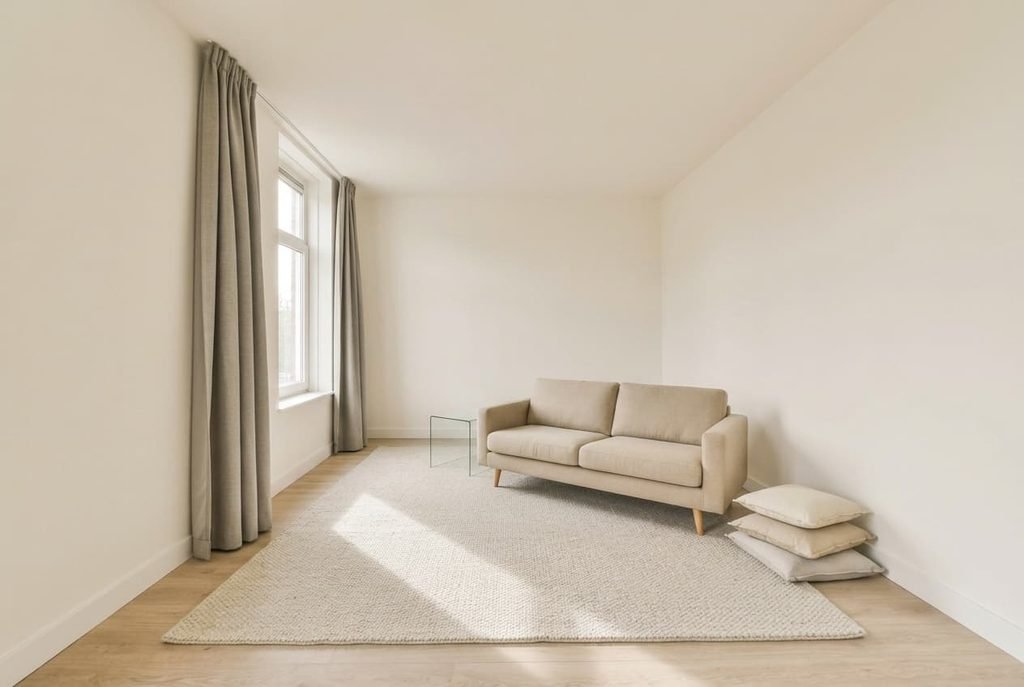
3. A 210 cm sofa on a frame of solid beech with glued corner blocks. It adds 1.08 sabins and needs the rug’s position fixed before it can stand on it. Tier: BUY ONCE. The frame takes every sitting for years and hides inside the upholstery. Watch for a particle-board frame, which splits where the leg screws go in. A seat depth of 55 cm suits most people.
4. A bookcase 90 cm wide and 200 cm high, with books on every shelf. It adds 0.47 sabins, a small gain that keeps it fourth, and its spines break up the flat wall behind the sofa. Tier: MID. Shelves carry their load every day. Watch for a 3 mm back panel, which lets the whole case rack sideways.
5. A floor lamp 150 cm tall with a 2 m cable. It adds no sabins and has to wait for the sofa’s final position and a socket within reach. Tier: BUY CHEAP. Nothing inside a lamp matters beyond the cable. Watch for a 1 m cable, which strands it away from the sofa arm.
Where the money goes, and the piece to scale down
Spend on the sofa frame. It’s the one piece you can’t inspect once it’s in the room, and every other item here can be replaced in an afternoon. Pay for corner blocks and hardwood before you pay for fabric, since a fabric can be changed with a cover.
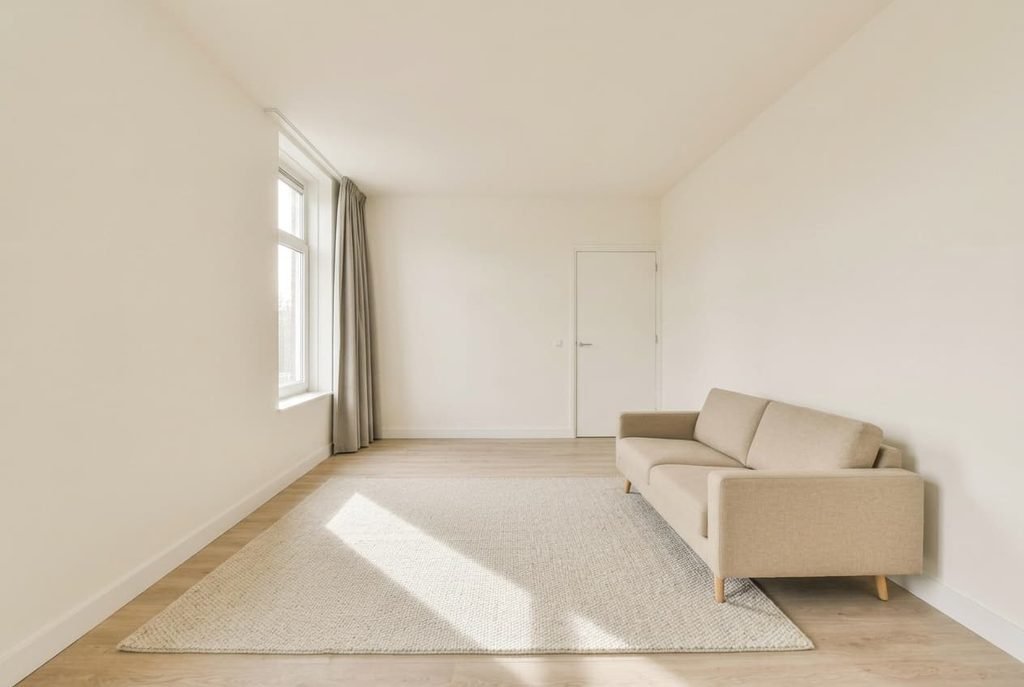
Then scale the sofa itself down. A 160 cm two-seater makes the better purchase when furnishing a bare rented living room, and the sums back it. It carries 2.3 m² of fabric and adds 0.83 sabins, so the room ends at 0.96 seconds in place of 0.92. Nobody hears 0.04 seconds.
The 50 cm you save buys an armchair’s worth of floor beside it. A two-seater also turns a stairwell corner in a rental block, and a 210 cm sofa doesn’t always.
I’d defend the smaller sofa against the usual habit of buying the biggest one the wall allows. A sofa is the slowest item on this list to replace, so it should be the one that fits whatever you might move into later. Rentals end, and a 160 cm frame fits the next flat as well.
When furnishing a bare rented room, where this order breaks
Measure your room before you trust the order. Multiply length by width by height for the volume. Add the floor and ceiling to the four walls for the surface. Multiply that by 0.04, then divide 0.161 × volume by the result.
A small room of 3.2 by 3.0 m starts at 1.9 seconds. The rug and curtains alone bring it to 0.81, so you can stop there and the sofa can wait. A larger room of 5.5 by 4.0 m starts at 2.4 seconds and still sits at 1.18 after the first three pieces, so it needs a second rug or a fuller bookcase.
A carpeted floor means you drop the rug and promote the curtains. With a 2.8 m ceiling, the first three pieces leave 1.0 second, which is the point where speech turns easy.
The width of wall beside the window decides whether the curtains in position two can hang at all.
What to skip entirely
A gallery wall of frames tops the skip list when furnishing a bare rented living room. Glass fronts absorb about as little as plaster, so ten frames add nothing, and each one needs a drill. A glass coffee table is hard and flat, so it adds reflection. Wait until the sofa has settled. Throw cushions give a tenth of a sabin together, which makes them a comfort and not a fix. A second rug layered over the first adds a little, but it trips people at the edge. Skip a thick foam pad under the rug, because the felt underlay already does that job. Skip a sideboard too, since its 45 cm depth narrows the walkway between entrance and window.
Everything here waits until the room sounds right.
The order puts the rug first and the curtains second, with the sofa third, because the early pieces do the most for the room, and they’re the easiest to replace. I’d choose that order over sofa-first. A bare living room is a sum of surfaces, and the rug is the biggest term you can add today. Measure the room this weekend, work out the clap time, and then choose what to buy. A shop can wait while the numbers get written down.
Questions readers keep asking
How many pieces does a first living room need?
Five pieces cover a first room. The rug and curtains come first. The sofa follows. A bookcase and a lamp come last. Only the sofa is bought once. The rug and the bookcase sit in the middle tier, and a sixth piece usually adds looks and no sound.
Should you buy the sofa before the rug?
Buy the rug first. It adds 1.26 sabins against the sofa’s 1.08 and needs no drill. It also gives the sofa its place to stand. The order lets you test the room’s sound for a week before deciding on a long sofa that fills the wall.
How can you judge a sofa before buying it?
Lift one front corner and listen for creaking, then check the frame for glued blocks at each corner. A solid beech frame stays quiet and square. Particle board flexes and splits at the leg screws. Bring a tape measure and check the seat depth, since comfort depends on it.