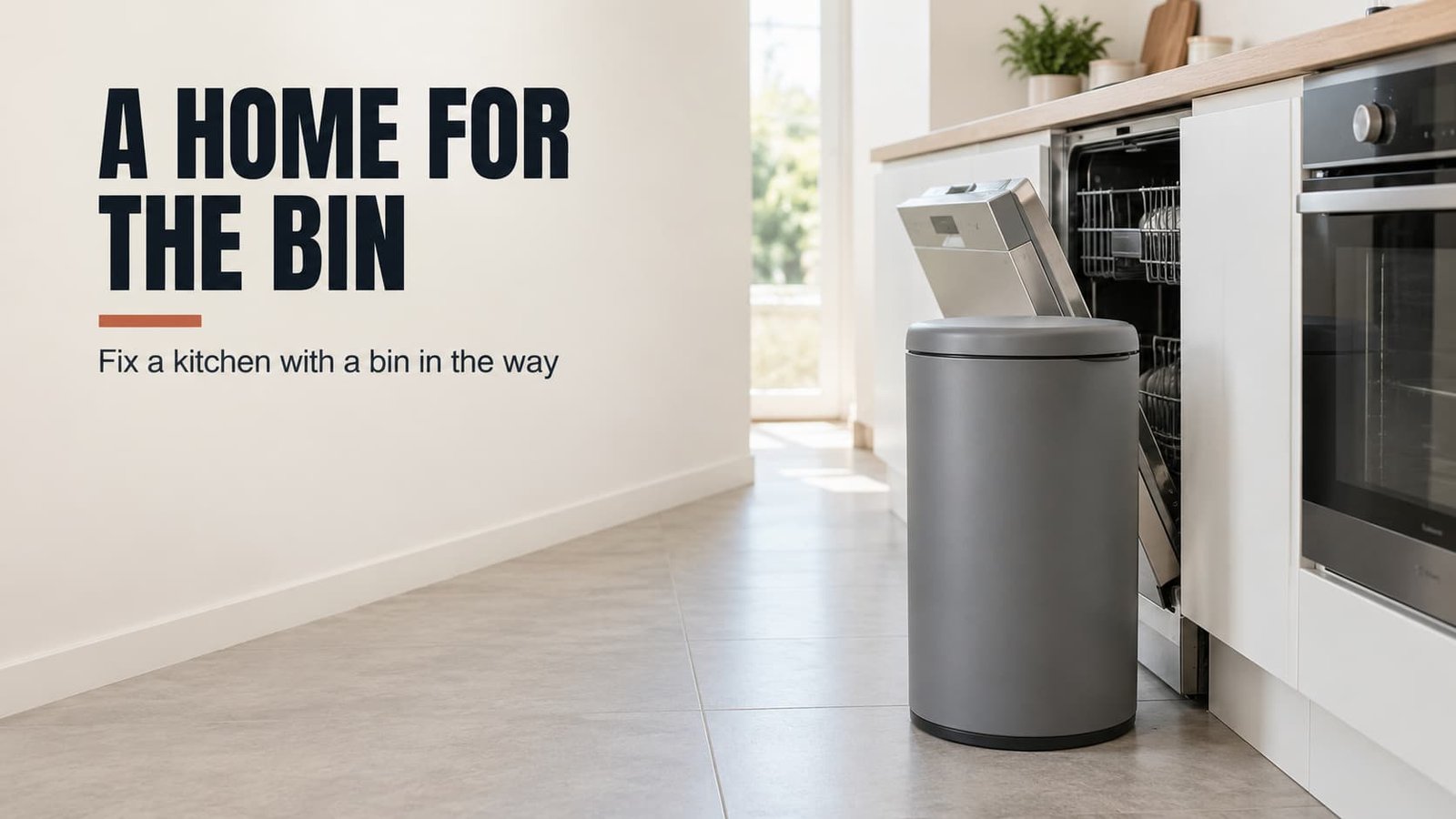
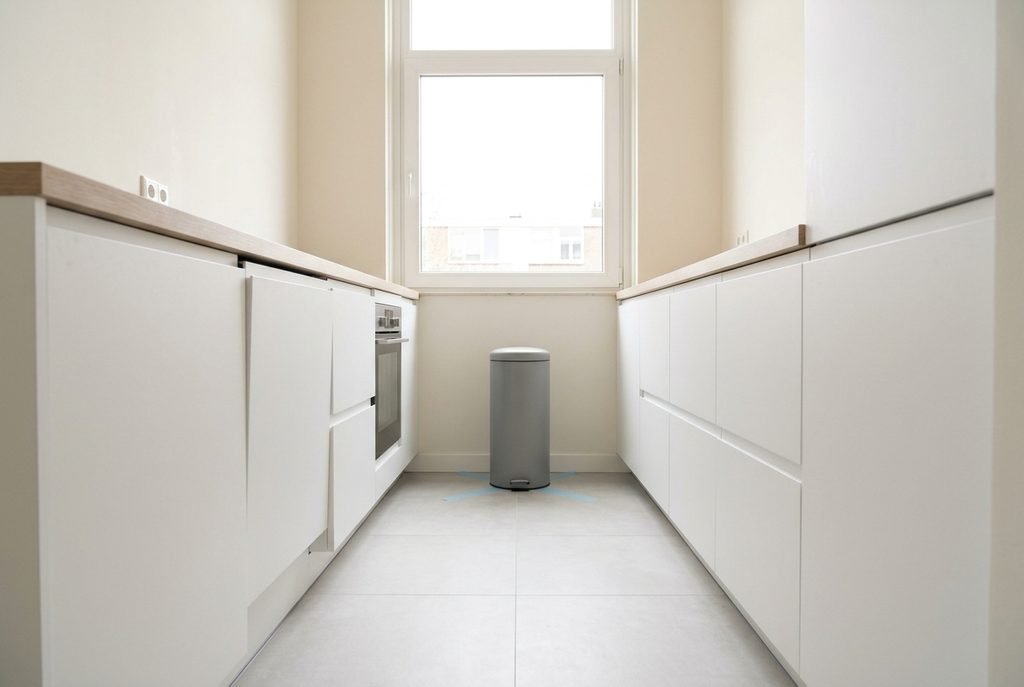
The round grey bin by the dishwasher covers 1.1% of the floor and is moved 12 times a day. Each move is small, which is why nobody fixes the cause. Counting is the cure for a kitchen where the bin is always in the way, and the sections below do the counting. The model kitchen is Dutch, 240 by 360 cm, with a run of units 60 cm deep along each long wall and a 120 cm aisle between. Four people cook in it. Tallies and walking distances are assumed figures, so replace them after your own count.
What is actually happening in a kitchen where the bin is always in the way
A 40-litre bin is a cylinder 35 cm across, so it covers 0.096 m² of an 8.64 m² floor. That sounds trivial. The trouble is where it stands: in the aisle at the corner of the run, where three fronts open into its space. The dishwasher opens twice a day. Once a day the oven opens, and the pan drawer three times. A bin in front of them has to go away and come back for every opening.
That gives 6 openings × 2 moves, or 12 moves a day, which is 4,380 a year. At 4 seconds a move that adds up to 17,520 seconds, or 4.9 hours. The bin is not large. What counts is how many door openings a day it has to dodge.
The aisle serves doors and people at the same moment, and the bin takes a share too. With the bin in place it drops from 120 to 85 cm. A person carrying a 60 cm tray still passes with 25 cm to spare. An open dishwasher door projects about 70 cm. Nobody passes it at all. The bin never causes a blockage on its own; it turns a tight moment into a stuck one.
Confirm which version of the bin always in the way you have
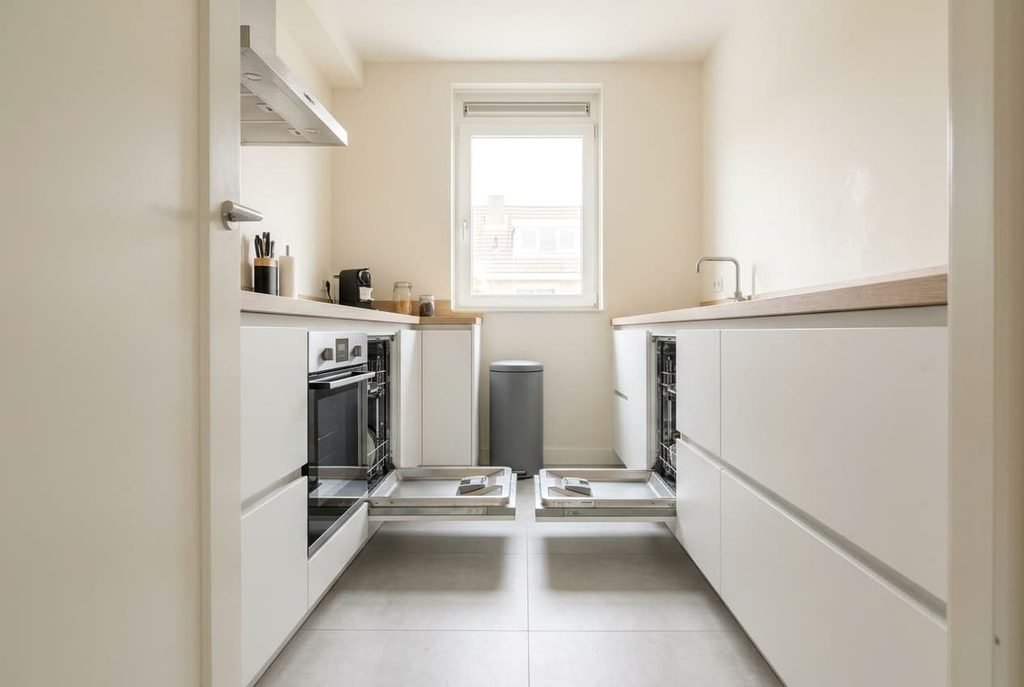
Three quick tests tell the versions apart. Tally every move of the bin for one ordinary day, using a pencil mark on the back of a receipt. Six or more marks means the doors are the cause. A lower count points elsewhere.
Next, carry a large pan across the aisle while the dishwasher stands open. If you must wait or turn sideways, the aisle is the version you have, since 120 − 70 − 35 leaves 15 cm.
Last, pace from your chopping spot to the bin. Here the distance is 1.9 m, so a round trip is 3.8 m. Count the bin trips during one dinner. If you make 15, that’s 57 m of walking, and over 312 dinners a year it comes to 17.8 km.
Most kitchens show all three, and the fixes below run from the cheapest to the dearest. Work down until the tally falls to zero, and mark each move as it happens so the count stays honest.
The fixes, in order
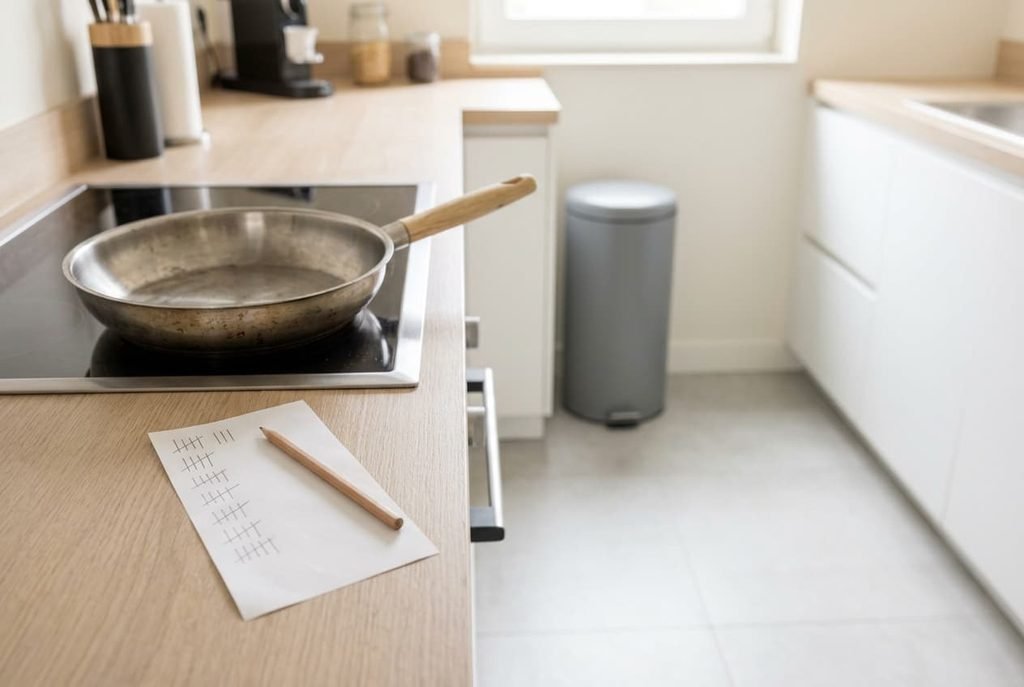
Shift the bin to the dead end by the window, which addresses the door moves. The bin then sits outside every opening, so the 12 daily moves fall to none and the 4.9 hours a year disappear. In a kitchen where the bin is always in the way, this move is free. It has a price in walking, though. The window end is 3.0 m from the chopping spot, so a round trip becomes 6.0 m. Fifteen trips make 90 m per dinner, or 28.1 km a year, which is worse than before.
Add a lidded counter caddy for peelings, which addresses the walking. Assume a dinner for four produces 2.4 L of peelings and scraps, and the caddy holds 3 L. Empty it once a dinner, and the 15 trips shrink to one. That’s 6 m per dinner, or 1.9 km a year, against 28.1 km. The caddy takes 20 by 15 cm of worktop. It only works together with the first fix, and it needs emptying before it turns unpleasant.
Fit a pull-out in the base unit beside the sink, which addresses the footprint. Two 18-litre bins take 36 L, against 40 L now. At 12 L of waste a day that fills in 3.0 days, against 3.3 for the round bin. A round trip drops to 0.6 m, so 15 trips make 9 m per dinner, or 2.8 km a year. It needs a purchase and an afternoon, and the unit must leave room for the sink’s trap. Opening the front becomes one more door event, but a single hand handles it.
Mark the bin’s home with tape, which addresses the drift. A bin that’s moved every day wanders a few centimetres at each return, and by the weekend it stands somewhere new. A 40 cm square taped on the boards, which is the bin’s 35 cm plus a small margin, gives it a place to come back to. Use four short strips at the corners and check them after a week. The tape doesn’t cut the number of moves. It only keeps the bin from migrating into the aisle between them, which suits the first fix best.
What this kitchen’s own layout means for you
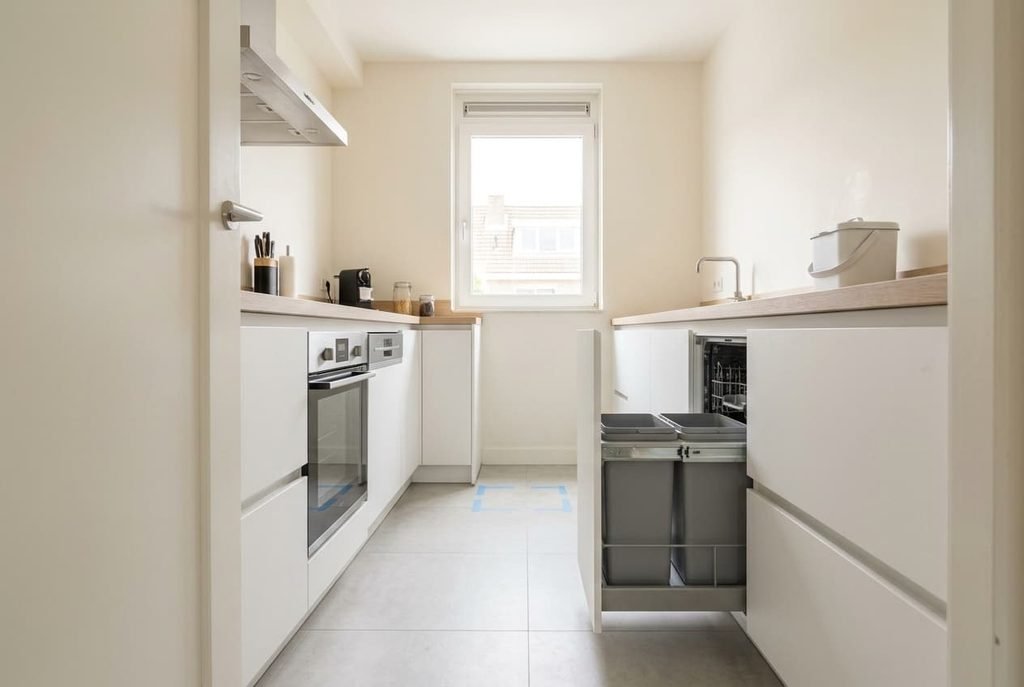
In a kitchen where the bin is always in the way, the room offers no extra width. The aisle stays 120 cm wide, with a dishwasher door 70 cm long. The remaining strip when it is open is 50 cm, which holds a 35 cm bin with only 15 cm spare.
That is why the bin always seems to be where somebody wants to stand.
Two fixed features set the options. The unit next to the sink is 45 cm wide, with an internal width of 41 cm. Two bins that are 19 cm wide each fit side by side with 3 cm to spare. The far end by the window is the only floor no front claims, so a floor bin has just one legal home. If your sink unit is narrower than 41 cm inside, drop the pull-out from the list.
The fix that doesn’t work
A slimmer tall bin is the popular purchase, but it targets the wrong measure. A rectangular 40-litre bin that measures 25 by 45 cm turned with its narrow side to the aisle takes 25 cm of width, not 35. The aisle gains 10 cm and now measures 95 cm with the bin in place.
Those three fronts still open into its space, so the moves stay at 12 a day. Footprint grows too, from 0.096 m² to 0.113 m², or 17% more floor. In a kitchen where the bin is always in the way, the narrow side only changes how it feels when you squeeze past.
A bin on wheels is the same story. Wheels reduce the effort of a move and leave the count untouched, so 4,380 moves a year stay 4,380 moves a year.
Count the openings, not the centimetres.
Tackle the doors first, since no spare floor exists. Move the bin out of the three openings, then shorten the walking with a caddy. A kitchen where the bin is always in the way needs a fixed spot where the bin lives. Tally the moves tomorrow, and mark its home tonight. A pull-out can wait until you have seen the numbers, so do the count before you spend anything.
Questions readers keep asking
How close should the bin be to the chopping spot?
Within a step or two of where you prepare food. In this kitchen a round trip of 0.6 m beats one of 3.8 m by a wide margin. If the bin has to live further away, a small caddy on the worktop takes the peelings and cuts the trips.
Can I fit a bin on the back of a cabinet door?
Yes, when the hinges allow it. A full 10-litre bin of wet scraps can weigh about 5 kg, so check the hinge rating on the maker’s sheet. A pull-out in the base unit carries the weight on runners instead and leaves the door free.
Is a pedal bin better than one with a plain lid?
Only for your hands. A pedal saves one touch, yet the floor gains nothing, because the pedal bin takes the same 35 cm of aisle. The footprint and the moves decide whether a bin is in the way, and the lid style doesn’t.