A mirror hung at standing height makes you stoop to see your own face. That one height, measured while seated, sequences the purchases for a dressing table corner in a small bedroom. The example room measures 260 × 330 cm, so 8.58 m², and the corner uses a wall stretch of 100 cm. You need five things, and the first two deserve the careful spending. The other three can be modest, and one of them can be borrowed from furniture you already own. All sizes in this example are assumptions, so compare them with your wall before buying anything.
What decides a dressing table corner in a small bedroom
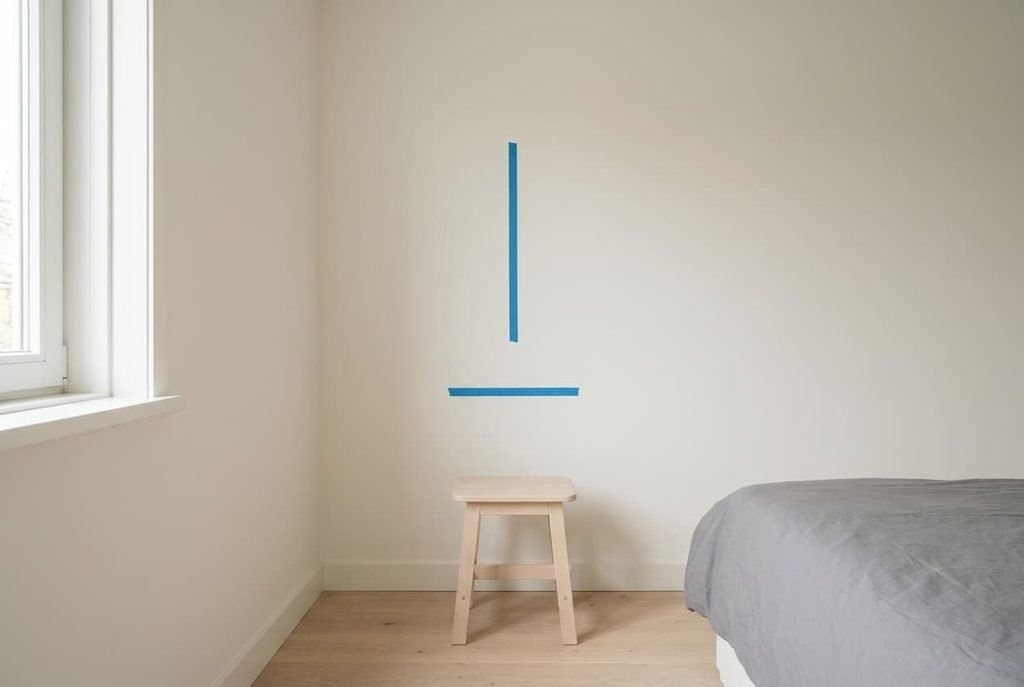
Half the guides start with the table, and that gets it backwards. Everything else hangs from one measurement, so the seated eye line decides where the mirror and the light go, and how high the table top sits. Assume a seat 45 cm tall and a seated eye about 70 cm above it. That puts the eye at 115 cm from the floor.
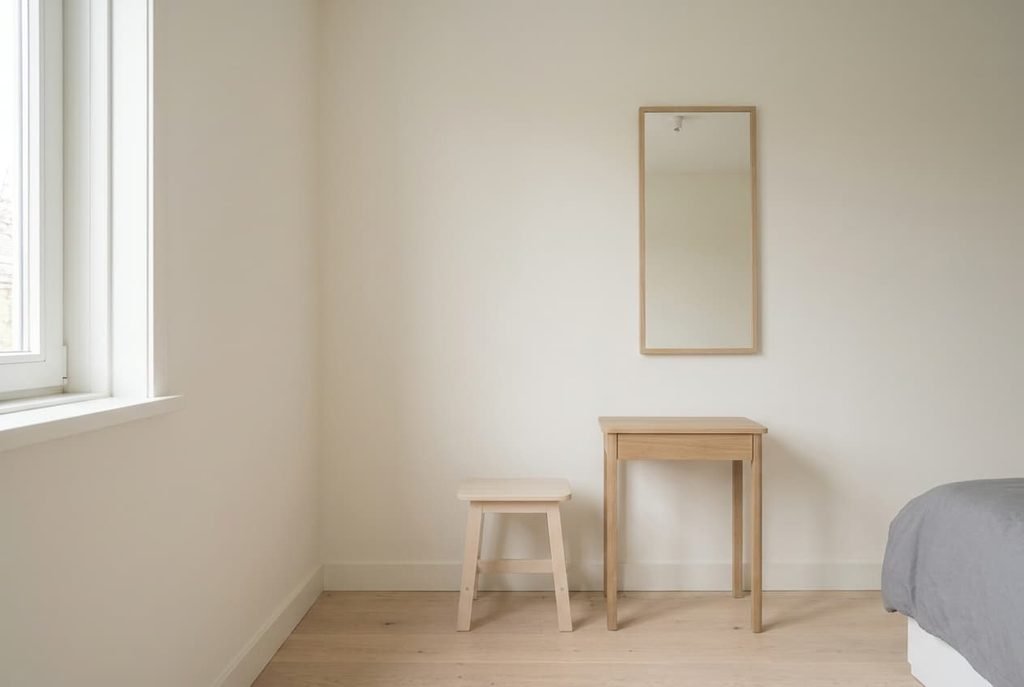
From that figure the rest follows. A mirror of 50 × 70 cm centred at 115 cm spans 80 to 150 cm. It clears a table surface set at 75 cm with a 5 cm gap for a tray lip. Lights at eye height stand 70 cm apart, so each one sits 10 cm beyond a mirror edge and lights the face from the side.
The floor cost is modest. The table of 100 × 40 cm and a stool zone 60 cm deep cover 100 × 100 cm, which is 1.0 m², or 11.7% of the room. If your room is bigger, the share shrinks. If it’s smaller, the corner still fits on one wall.
Seen from the doorway, the whole corner reads as a single rectangle.
Five items for a small dressing table corner in the bedroom
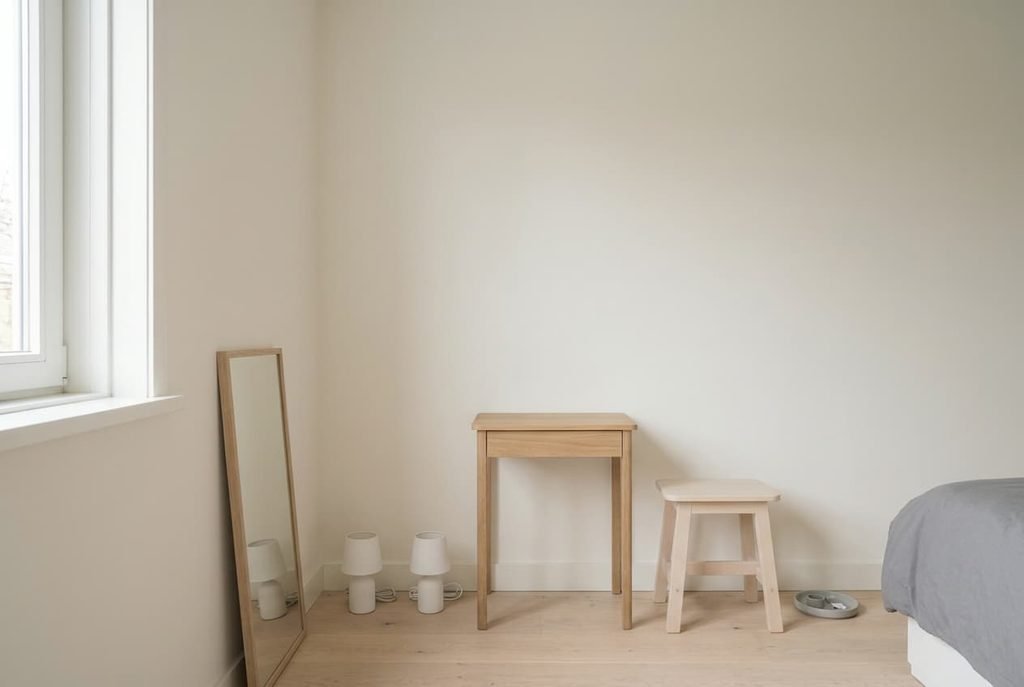
1. Mirror, 50 × 70 cm, flat glass, centre at 115 cm: first in line, since every later size is read off its centre height. It must also be wide enough to show both shoulders from 50 cm away. Tier: BUY ONCE, because thick glass with a true flat back keeps your face undistorted for decades, whereas a thin bowed pane never will. The fault to test for: hold a straight window frame in the reflection and tilt the glass. If the line bends, return it.
2. Light, a pair of lamps with warm-neutral bulbs at eye height, 70 cm apart. Next, since light reaching the face from both sides removes the shadows that an overhead fitting casts under the eyes. Tier: MID, because the lamp body is cosmetic while the bulb’s colour rendering does the real work, and a good bulb costs little more. The fault: a bulb with a low rendering index turns skin tones grey and undoes the whole arrangement.
3. Table, 100 × 40 cm, surface at 75 cm, with a knee gap of at least 60 cm. The gap lets your legs slide under so you sit square to the glass. Third, since it forms the base of the arrangement and the work surface for everything small. Tier: MID, because a top of 18 mm or thicker doesn’t flex under your elbows. The fault: a thin top bows at mid-span, so press the front edge before you commit.
4. Stool, seat 45 cm high, no back so it tucks fully under the table. Fourth, because its seat height feeds the eye-line sum. Tier: BUY CHEAP (a flat seat on four legs has nothing to wear out). The fault: legs of uneven length rock, so stand it on a flat floor and press each corner.
5. Tray, 30 by 20 cm, no deeper than 4 cm. Last, because the tray shows how much room really remains. Tier: BUY CHEAP (a tray contains nothing that can fail). The fault: a deep tray hides things at the bottom and invites a heap, and a heap defeats the purpose of a tidy corner.
Where to spend less: the table
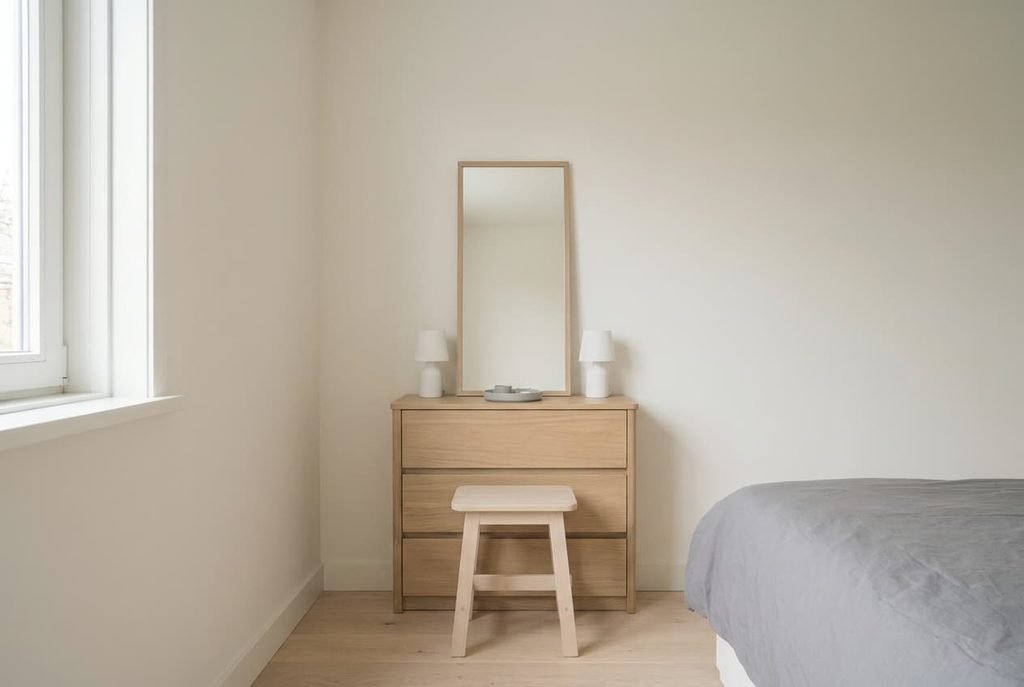
Cut the table. A chest of drawers you already own can do its work, and its top at 80 cm replaces the 75 cm table. It also changes the sum. A 50 cm seat now puts the eye at 120 cm, so the mirror centre moves up 5 cm and spans 85 to 155 cm.
A chest top you already own can serve as the surface, even though it has no knee gap. You’ll lean forward about 30 cm, which suits a routine of 10 minutes and tires you after 30. The chest top, 80 cm by 45 cm, offers 3,600 cm² where the table offered 4,000, roughly 10% less.
The saving is one whole purchase and about 0.4 m² of floor, because the chest is already standing there. Move the mirror and lamps up by the same 5 cm, and keep the chest’s own contents away from the top so the surface stays clear. Whoever owns a chest of drawers can build a dressing table corner in a small bedroom at the cost of one mirror and two bulbs. The trade is comfort on long mornings.
Where the corner usually goes wrong
A dressing corner fails in a few predictable ways. Each one comes from skipping the eye-line sum, and none costs much to avoid.
The mirror hangs too high. Centred at 150 cm, it frames the ceiling. Your hairline fills the glass, so you tilt your chin up to find your face. Move the centre to your seated eye height and the problem disappears.
Light and height carry most of the load.
Light comes only from above. A ceiling fitting casts a shadow beneath the brow and nose, and no table position changes that. A pair of lamps at eye height does the job.
The corner faces away from the window. Daylight then lands on your back and leaves your face in shade. Turn the table to face the glass, or sit side-on to it. Does the room have its only window in the wrong place? Then the lamps carry the whole load. Anyone fitting a dressing table corner in a small bedroom beside a badly placed window should treat the lamps as the main source and daylight as a bonus.
What to skip
Skip a second storage unit. A dressing corner needs one tray of 30 by 20 cm, which holds about a dozen small items. A drawer unit adds 0.36 m² of floor, about 4% of the 8.58 m² room, for things you’d find in the tray anyway.
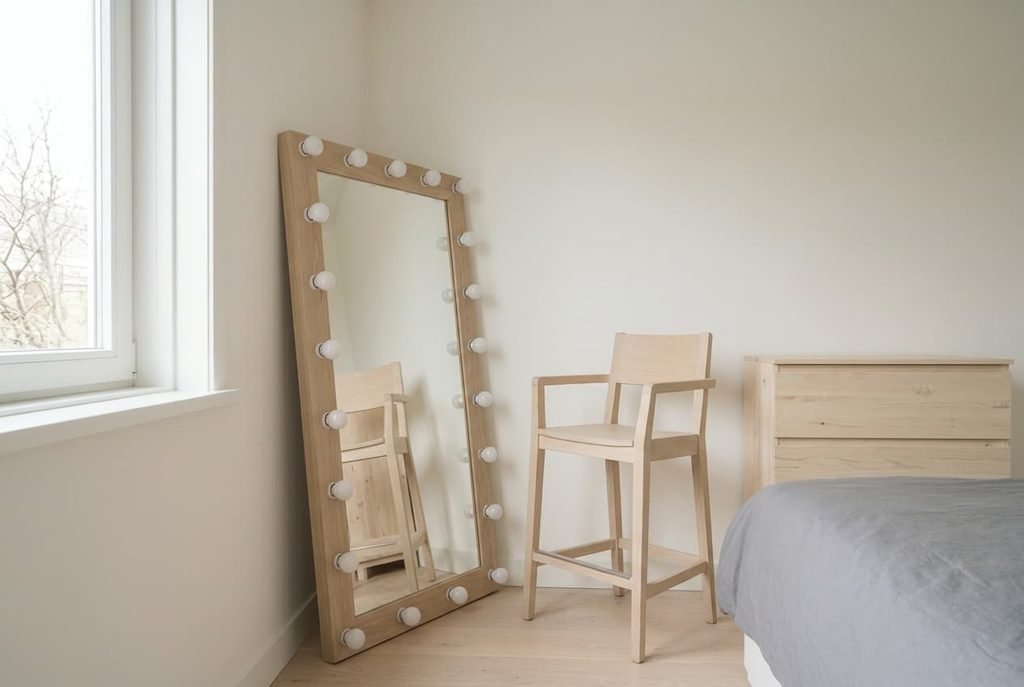
Skip a larger mirror too. Beyond 50 × 70 cm you pay for glass you never look at, and the weight makes it harder to fix in a rented flat. Skip any stool with arms or a back, since it won’t tuck under and blocks the walkway by 30 cm.
Skip a mirror with bulbs built into its frame as well. The bulbs sit along the rim of the glass and can’t be moved to eye height 70 cm apart, so the light still falls from the wrong angle.
Spend on the mirror and the eye line first, then on the lights. Put those two right and a dressing table corner in a small bedroom works even with a plain table and a cheap stool. Buy the rest only after the first two have proved themselves in daylight and at night, and you’ll avoid paying twice for the same fix. A week of using the corner will tell you more than another hour of browsing.
Questions readers keep asking
How many pieces does a dressing corner really need?
Five at most. Two items work on sight, which means the mirror plus the lamps. The other three are practical: a table, then a stool, then a tray. Fewer works when a chest top replaces the table. More usually means storage you won’t use, and the floor it takes comes straight out of walking space.
What should I buy first if money is tight?
The mirror, because it sets the eye line that everything else follows. It’s the one item worth buying once and keeping. Use whatever surface and seat you already own for now, and add the lamps next, since light changes the result most.
How can I judge a mirror before buying?
Check three things. Thick glass resists bowing. A flat, evenly silvered back avoids dark spots. And a straight line in the reflection should stay straight as you move your head side to side. If a doorframe bends in it, the face will bend too.