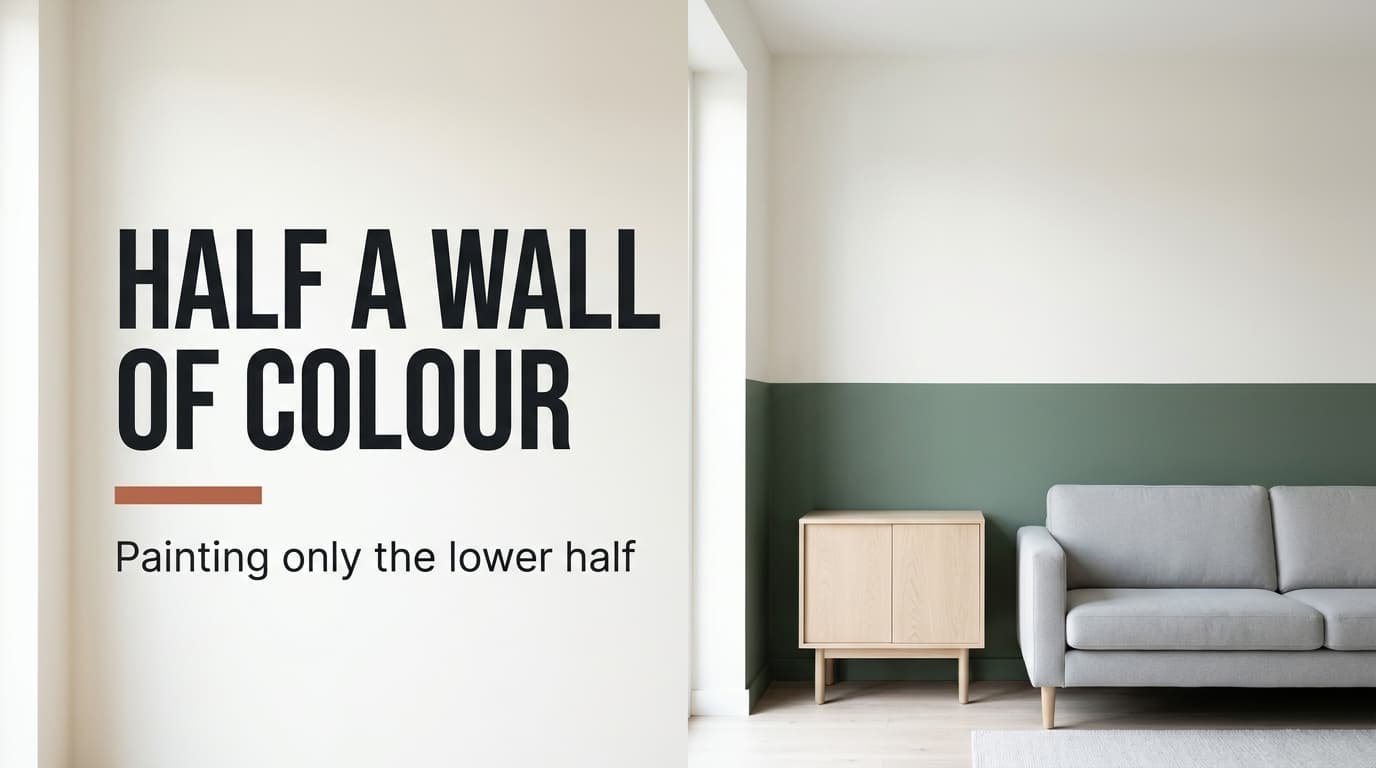
A Dutch living-room wall with 380 cm of width and 250 cm of height gives you 9.5 m² of surface to paint. Painting only the lower half covers 4.75 m² of it, up to a line at 125 cm. The paler upper half stays as it is. You’ll meet this look in more rented flats now, though this page carries no market data to size the shift. It sticks to geometry. The text names no brands or showrooms and offers no forecasts. Each figure is a rounded guess, and a tape measure will test it in your own room.
Where Painting Only the Lower Half Came From
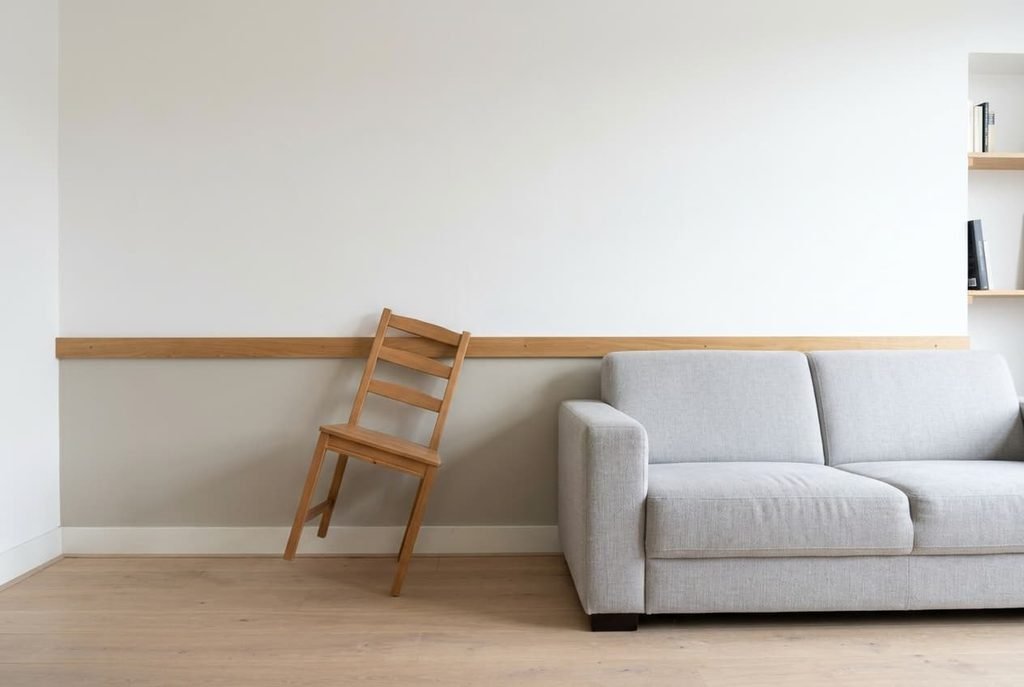
Heavy chairs knocked plaster walls long before paint was easy to buy. Builders answered by fixing a rail or a panel at chair-back height, so the knocks landed on something replaceable. The lower band of a wall took the wear, and it earned a tougher finish of its own for that reason.
Modern rented flats have thin walls and washable paints, so the protective job fell away. The band lived on as decoration, and several pressures have brought it back. Rooms shrank, and furniture now sits hard against the walls. Leases often ask for the original colour on moving out. The knocks themselves haven’t changed, since a dining chair tipped back by 20 cm still strikes the wall at about 90 cm. A wall of 250 cm is also awkward to paint in one go when you don’t own a tall ladder.
A band at 125 cm answers all of that. It meets the furniture at the height where the knocks happen. It asks for half the paint.
Nothing beyond a step stool and some masking tape is needed.
Three Measurable Changes on a 380 cm Wall
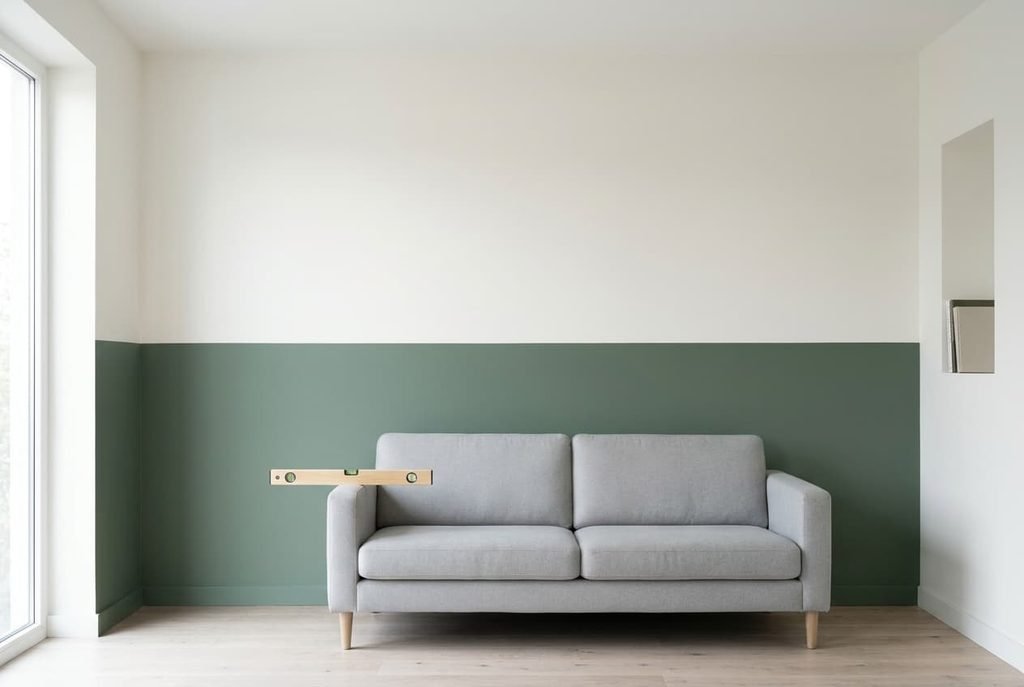
Painting only the lower half changes three numbers on a wall of that width. The area to paint halves, falling from 9.5 m² to 4.75 m². At an assumed 10 m² per litre and two coats, that’s 0.95 litres instead of 1.9. The pale upper half needs no work at all. If your lease wants the original colour back, you repaint 4.75 m² on the way out and not 9.5. The saving arrives when a tenancy begins and again when it ends. Fewer square metres also means fewer trips up the step stool.
Marks are the second change. Scuffs from chair backs and bags gather between about 20 and 110 cm, a strip 90 cm tall. On a one-colour wall that strip belongs to a surface you can only fix by repainting everything. After the change it lies inside a 125 cm band. You can wipe or repaint the band without matching anything above it.
A new edge arrives third. A line of 380 cm at 125 cm has to run level within about 2 mm, or the eye finds the wobble at once. Taping it takes roughly 15 minutes per wall with a spirit level. Peel the tape within a day while the paint is still slightly soft, since waiting a week can lift the top coat with it. The line also sits 40 cm over the top of a sofa that’s 85 cm high. It clears the furniture and shows in full from the doorway.
Which Households Suit a Two-Tone Wall
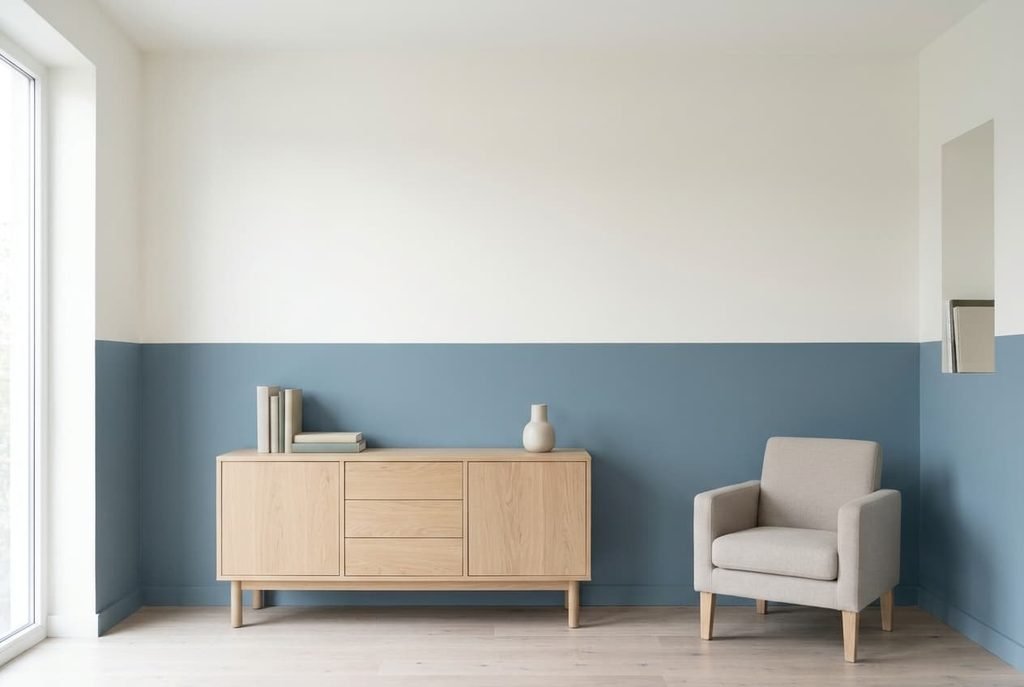
The look suits walls that furniture already lines. A sofa or a sideboard covers the lowest 80 to 90 cm. What you see of the band is the strip between furniture and line. That strip is 35 to 45 cm tall and reads as a deliberate frame, with the furniture as its base.
Renters gain most, since half the area means half the repainting when a lease wants plain walls back. A landlord’s inspection then checks 4.75 m² of paint instead of a whole wall. Families gain next, because the marks of a busy week sit inside a band that tolerates wiping.
A household with a wall of tall bookshelves gains little, since the shelves hide the band entirely. Someone who rearranges furniture every few months gains little as well. Move a sideboard and it exposes the bottom edge of the paint, and the line stops making sense.
Two cases should wait. A room with a ceiling above 280 cm makes a line at 125 cm look low. You’d want it nearer 140 cm, which changes the arithmetic above. A wall that’s mostly window leaves too little surface for a line to read as a line. Measure the solid stretch before buying paint, because under 150 cm of unbroken wall a band struggles to look planned.
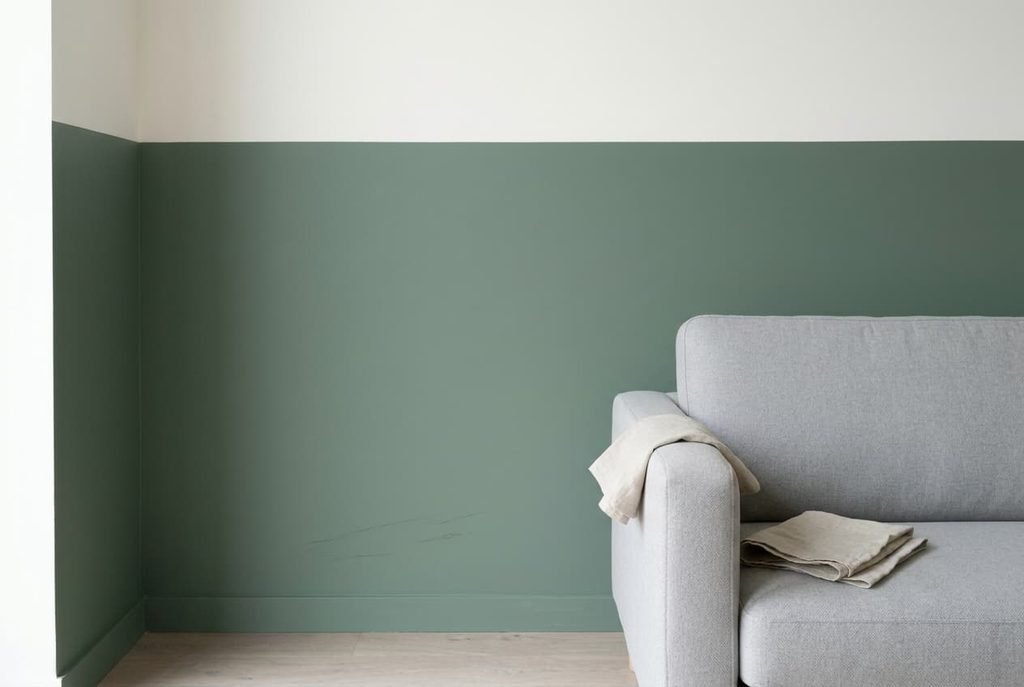
Only the Lower Half Painted: Is It Worth It?
Painting this band pays off where furniture lines the wall and the lease asks for repainting. You spend half the paint for most of the visual change. Where shelves or windows cover the surface, the band is a pleasant extra that adds a taping job and an edge to maintain. Tall shelves covering 150 cm of a wall 380 cm wide leave only 230 cm of band on view. The line stops short at both ends.
Upkeep matters too. A band darker than the wall above hides marks better, though it shows dust more clearly on a matt finish. A colour only a few shades deeper than the upper wall is kinder. The line then reads softly, and a slightly wobbly edge matters far less.
Gentle contrast with a low-effort edge makes the safest starting point.
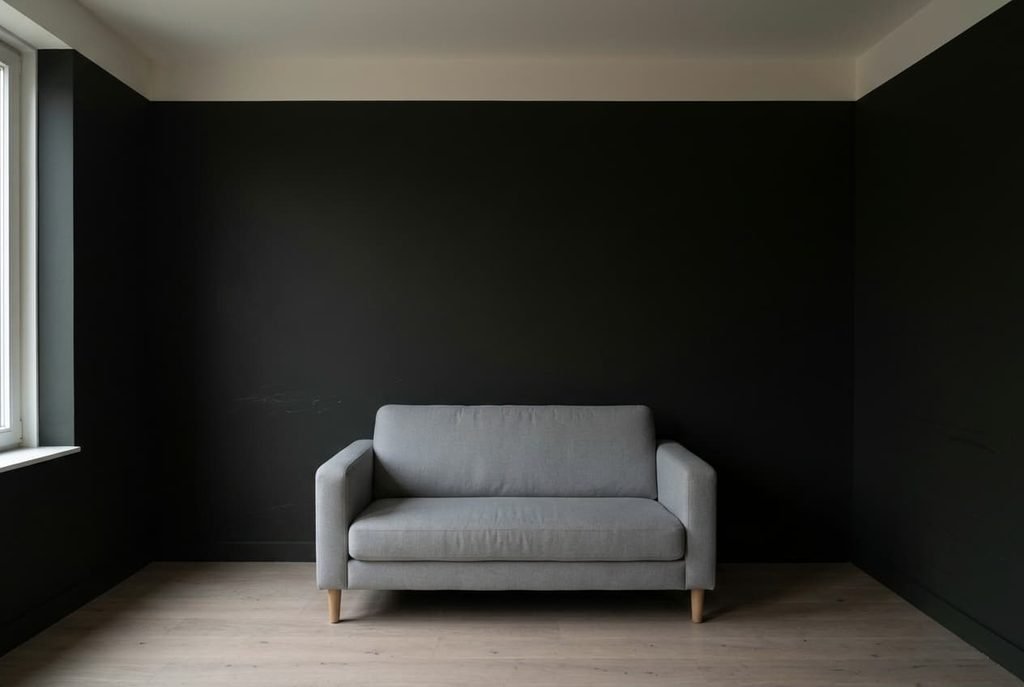
The Extreme Version Nobody Needs
Some rooms push the idea much further. They paint a band up to 180 cm on all four walls, in a near-black shade, which turns 72% of the wall surface dark. In a room of 380 × 450 cm that means a band 1,660 cm around and 180 cm tall. That’s about 30 m² of dark matt paint under 11.6 m² of pale.
We don’t recommend a near-black band at 180 cm on every wall. A dark matt finish returns far less daylight, and the pale strip left above is only 70 cm tall. A door leaf is wider than that. The result is a box with a thin lid, and the room feels shorter than it is. Even a gentle band at 125 cm on all four walls of that room covers 20.75 m², well beyond the single feature wall most people begin with. The sensible version of painting only the lower half stops at 125 cm, in a shade a few steps from the wall above it.
A Tape Test Before You Buy Any Paint
Run masking tape across the wall at 125 cm and check it with a spirit level. Mark a pencil dot every 50 cm first, because a sagging tape line is the commonest flaw. Pin a dark bedsheet to the wall under the tape for a week. Look at it once at noon and once at 8 pm, because lamp light changes how deep a colour feels.
If the sheet still looks good in both lights, buy a tester pot. Paint a patch of 40 × 40 cm just under the tape. The patch shows how the colour sits against your skirting boards.
Painting only the lower half is easy to test and hard to undo once the full band is done, so let the sheet decide first. The trial costs a week and a bedsheet, and everything comes down in seconds should you change your mind. Half a wall of paint is a modest commitment, though it deserves a week of looking before you open the tin.
Questions Readers Keep Asking
Should I keep my plain walls or change them?
Keep them if shelves or windows cover most of the surface, because a band would barely show. Change them where furniture lines the wall and your lease may ask for repainting later. Try the tape test first. A week with a sheet pinned up gives better evidence than a photograph, and it costs almost nothing to try.
Who gets the most from this look?
Renters and families with small children get the most. Renters repaint half the area when moving out, and families wipe marks off a band instead of repainting a whole wall. People with tall bookshelves or mostly glazed walls gain little, since the band would stay hidden behind the shelves or break up around the window.
How long will a painted band last?
A band takes the same wear as any wall, so a washable matt finish usually holds for several years of weekly wiping. The line itself rarely fails if the tape was clean. Touch up chips with a small brush, and expect to repaint only the band, which is half a wall.