Why does our ceiling look lower in the evening if the tape measure still reads 250 cm at any hour? Nothing in the room has shrunk. Only the light has moved, and the eye gauges how tall a room is by the surfaces it can still see. That’s why a flat that feels airy at noon can feel like a lid by nine. We follow one living room in Zwolle of 420 by 340 cm. It has a pendant and two table lamps, and its curtains hang from a rail at 215 cm. All figures below are rough estimates, so measure your own.
Why Does Your Ceiling Look Lower in the Evening
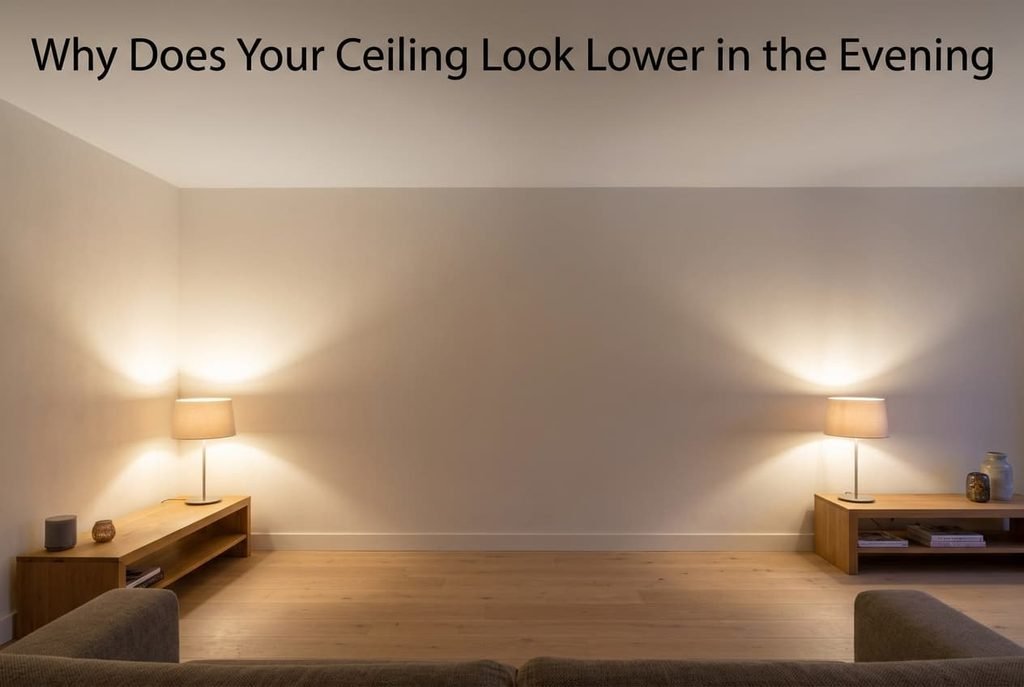
By day the window floods the room with light that bounces off the floor and walls up to the ceiling. Take a white ceiling that returns 85% of what reaches it and pale walls that return 70%. With 110 lux on the ceiling and 150 lux on the walls, the ceiling shows about 30 cd/m² and the walls about 33, a ratio of 0.9. The two read as equals, and the eye finds the wall’s upper edge easily.
After dark, two 400 lm lamps with drum shades stand at 65 cm and push most of their light out and downwards. The walls get about 55 lux, or 12 cd/m², and the ceiling about 7 lux, or 2 cd/m². The ratio falls to 0.15. That makes the ceiling a sixth as bright as the walls, and a surface this dim sinks into shadow.
The glow also stops short. A lamp at 65 cm throws its fan roughly 105 cm upward, which lights the wall to 170 cm, only 68% of its height. Many people blame the warm colour of the bulbs, since the room went amber at the same moment.
Colour hardly enters the sums, and brightness decides.
Does the Ceiling Seem Lower in the Evening? A Visual Checklist
Do these checks after dusk, once the curtains are drawn and the lamps are on. Begin with the join between wall and ceiling, and look for that line from your usual armchair. When it has vanished, the ceiling is much darker than the walls, and the second fault below is yours.
Now cross the room and spot where the brightest patch of plaster stops. Measure that height with a tape. Anything under 190 cm in a 250 cm room means the lit band stops too low, which is the first fault. Light that dies at 170 cm leaves the upper third of the wall in shadow.
Last, check the curtains. Measure up to the rail, which is at 215 cm here. Closed fabric then cuts the wall at 86% of its height and leaves a 35 cm strip above it. A rail within 40 cm of the ceiling turns that strip into a lid, and that’s the third fault. Most rooms fail one check clearly and another slightly. Don’t be surprised if two of them ring true.
Three Faults, Ordered From Free to Purchase
Find which fault makes your ceiling look lower in the evening, then follow the steps in that paragraph from the top. Every fault has a separate cause, and the steps in each climb from nothing spent to something bought.
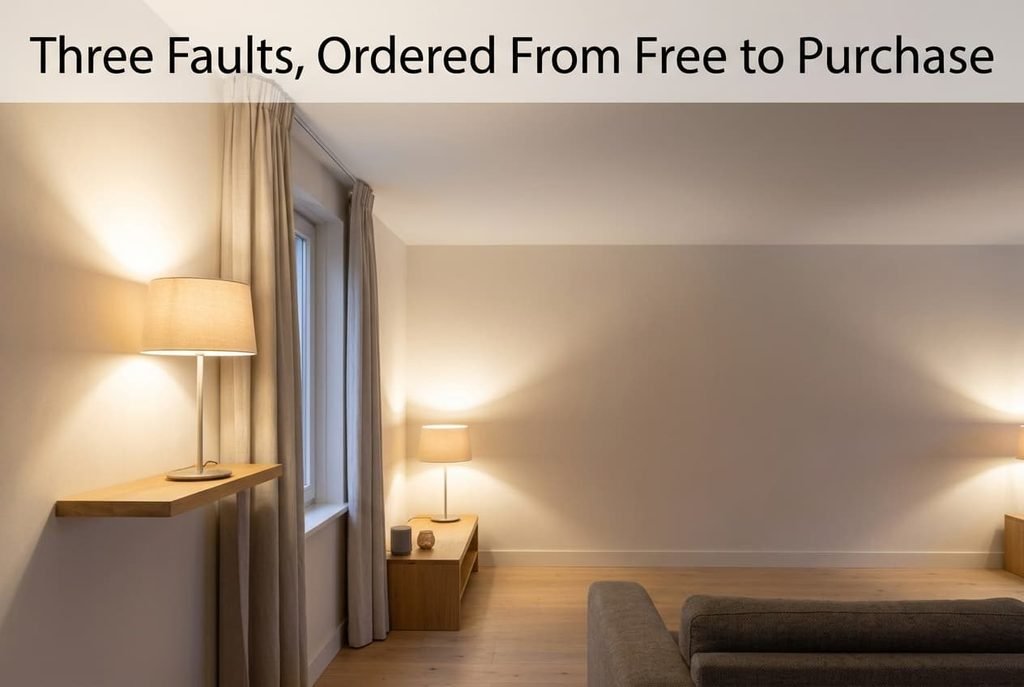
“The room glows only to head height” comes from a low band of light. Both lamps stand at 65 cm, and their glow dies at 170 cm. Lifting one lamp onto the bookshelf already standing at 110 cm is free, and it carries the band up to 215 cm, or 86% of the wall. Rearranging means carrying the second lamp to the opposite corner, giving each end wall its own band. Buying means an uplighter of 600 lm, the one item here that reaches the ceiling directly. Mind the lead, since a lamp raised onto a shelf often drags its cable across the doorway. It’s a small detail that decides whether the arrangement lasts.
“The ceiling has gone dark while the walls stay lit” is the 0.15 ratio at work. A pendant with a fabric shade, lit at its lowest setting, adds about 3 lux up there and lifts the ratio to roughly 0.2 at no cost. Shifting the sofa lamp into a corner lets two walls reflect light upward, which nudges the ratio higher again. Fitting a translucent shade in place of one opaque drum sends around 15% of the lamp’s output, 60 lm, to the ceiling. That is worth about 4 lux and a ratio near 0.3. Confirm the dimmer matches the bulb, because a mismatch makes LEDs flicker. A pendant that won’t dim low enough gives no benefit here.
“The curtains cut the wall in two” comes from the rail at 215 cm. On pencil-pleat tape, hooking the heading into the highest pocket row lifts the fabric about 5 cm for nothing, putting the edge at 220 cm. Raising the rail by 15 cm demands fresh screw holes, and in rented homes the owner’s consent comes first. With the hooks already lifted, the edge then climbs to about 235 cm. A ceiling-mounted track with longer curtains takes the edge up to the ceiling line itself, which removes the lid completely and leaves nothing for the eye to stop on.
How to Keep the Room Tall After Dark
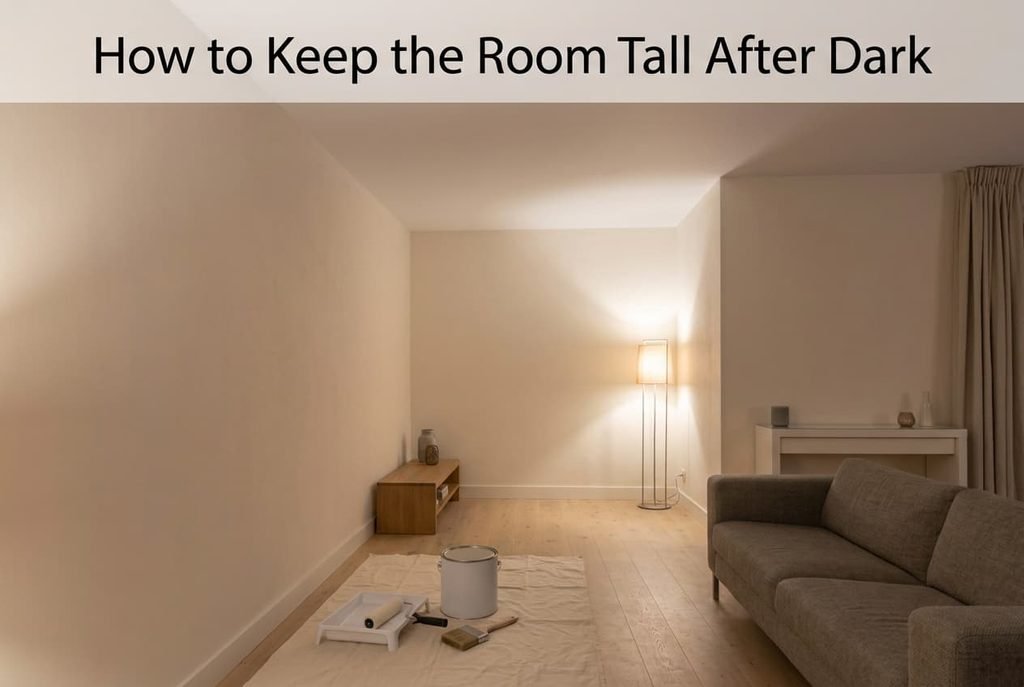
Before any new lamp arrives, run it through three quick tests. Does its light reach above 190 cm? Some of it should land on the ceiling as well. And nothing new should cross the wall below 230 cm.
Say you add a floor lamp at 150 cm with an open shade. It clears the first test because its fan reaches the ceiling, and it clears the second. Framed prints at 140 cm leave the ceiling untouched, which makes them harmless. A dark roller blind stopping at 200 cm fails the third test and creates a fresh lid. Whenever you notice the ceiling look lower in the evening again, repeat the checks before buying anything.
A tall floor lamp in the corner passes all three.
Repainting the Ceiling Is Not Worth It
People who watch their ceiling look lower in the evening tend to reach for a paint tin, and the tempting cure is a brighter white for the ceiling, because that surface looks the dimmest. The arithmetic disappoints. Lifting reflectance from 85% to 92% takes the ceiling from 1.9 to 2.1 cd/m² at 7 lux, a gain of 8%, and the ratio to the walls only moves from 0.15 to 0.17.
Paint multiplies whatever light arrives, and after dark hardly any arrives. A gloss finish does harm, since it mirrors each lamp as a hot patch and spreads nothing. A second coat looks diligent, yet at 7 lux every white ceiling comes out close to the same dim grey.
Time spent on a lamp position pays far better. Raising one lamp by 45 cm lifts the lit band by the same 45 cm and costs nothing.
The cause is the spread of light, and the room’s size plays no part. Lamps at 65 cm leave the top 32% of the wall dark. The pendant stays off, and closed curtains lay a dark edge across the wall at 215 cm. Start with the free steps and compare after each change. Shoot the room from the armchair at 9 pm before the change and again after it, since a photo shows what memory smooths over. Keep your measured numbers beside the photos and run the checks again after any new lamp or curtain. When the join between wall and ceiling shows again at dusk, you’ve got the balance right.
Questions Readers Keep Asking
What actually causes the low-ceiling feeling after dark?
Brightness. By day the ceiling is nearly as bright as the walls, a ratio of 0.9. With two low lamps that ratio falls to 0.15, and the lit wall ends at 170 cm. The eye takes that border for the upper limit of the room, hence the descending ceiling.
Is there a quick fix for tonight?
Yes. Stand one lamp on a shelf at 110 cm and the lit band climbs to 215 cm. Switch the pendant to its lowest setting too, adding about 3 lux to the ceiling. Neither change needs more than a minute, and you’ll see the verdict from the sofa straight away.
Can I fix this without renovation?
Almost entirely. Lamp heights and shades change without tools, and so do curtain hooks. Raising the rail is the single job that calls for a drill, and a renter must get the owner’s permission. A ceiling track is the one bigger job, and it matters only when your rail measurement showed the third fault.