Five tools, bought in the right sequence, are enough to look after a small back garden, and the sequence counts for more than one product. Take a terraced rental in Haarlem whose back garden measures 400 × 600 cm, or 24 m². Paving covers 6 m² of it. The border and the lawn share the rest. The tenant owns no garden tool at all. Treat every figure as assumed, and count your own jobs before you buy anything. You’ll see which tools deserve a good one and which can be cheap.
What You Need to Look After a Small Back Garden Before Any Tool
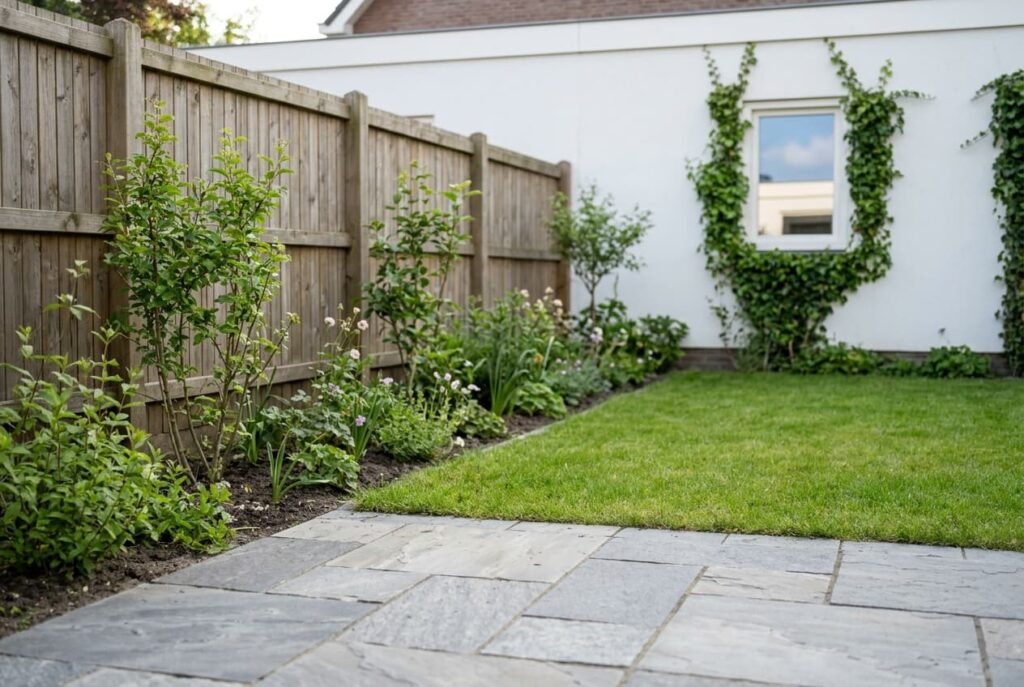
Garden work comes in countable jobs, and a count guides you better than a walk round the shop. The 6 m² border holds 12 shrubs, each pruned twice a year at about 15 cuts, which makes 360 cuts. It also takes 18 new plants a year: 12 arrive in 2 litre pots and 6 in 5 litre pots. In a dry week the border wants 10 litres per square metre. The tenant therefore carries 60 litres. Any tool that answers none of these jobs would only fill the corner.
Count the jobs your garden will give you this year, then let that count set the shopping list. A tenant who only prunes and sets out small plants needs only three purchases.
Storage is the second limit. The tenancy allows no shed. Everything has to stand in a corner 40 cm square behind the back door, up to 110 cm tall. Tools that don’t fit it end up lying on the lawn. A trowel left there is gone within a month, and a blade left out rusts in a week.
Weather adds a third limit. Assume eight dry weeks a summer, which means 8 × 60 = 480 litres, or 60 trips with an 8 litre can. That’s the rhythm you set when you look after a small back garden by hand.
Five Purchases to Look After a Small Garden, Costliest Error First
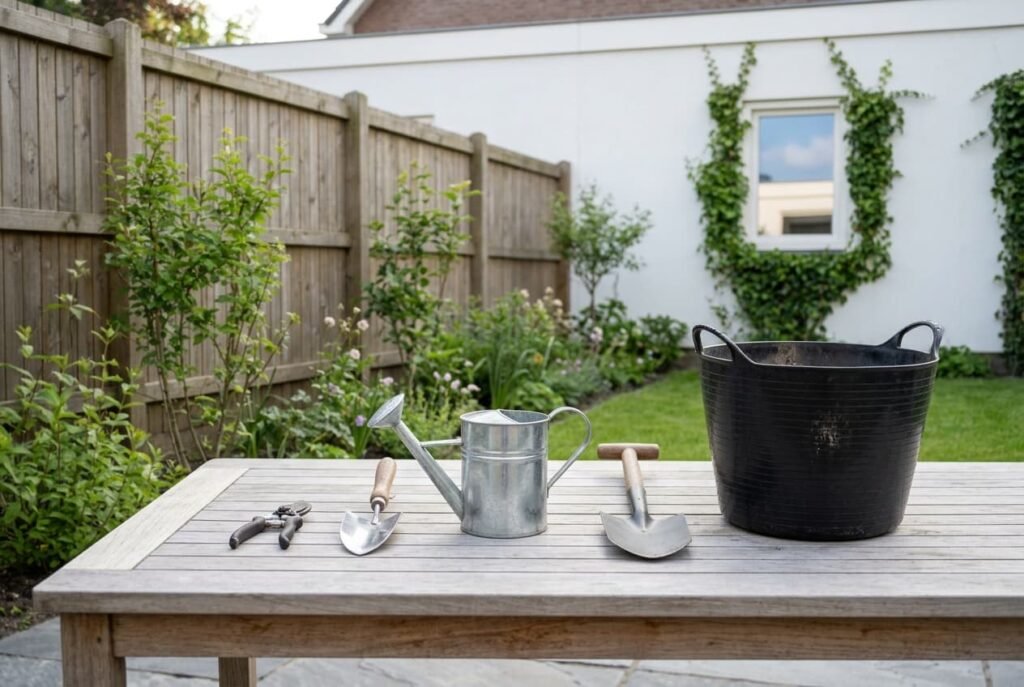
1. Bypass secateurs with a 20 mm cut capacity head the list, because pruning is the biggest job at 360 cuts a year. The thickest stem in the border measures 12 mm. The capacity leaves a wide margin. Tier: BUY ONCE. A forged blade on a bolt with a locknut holds its edge and can be tightened later, whereas a pressed blade springs apart and crushes the stem. Close the blades empty and look at them side-on. A visible gap means the pair will bruise every cut.
2. A hand trowel with a 7 cm blade is next, since 18 plants mean 18 holes. Tier: BUY ONCE. A blade and shank formed from one steel strip can’t break at the neck, but a welded neck cracks the first time it meets a stone. Rest the tip on the floor and push on the handle with your fist. Flex under your weight means thin steel.
3. A watering can that holds 8 litres comes third. Choose a long spout and a rose that lifts off. The border’s 60 litres need 7.5 fillings, which rounds up to 8 trips, against 12 with a 5 litre can. Tier: MID. A body with a flat underside and no seam beneath it can’t leak at a weld, while a two-part can weeps there within two summers. Tilt it empty and check that the spout joint is wide and reinforced.
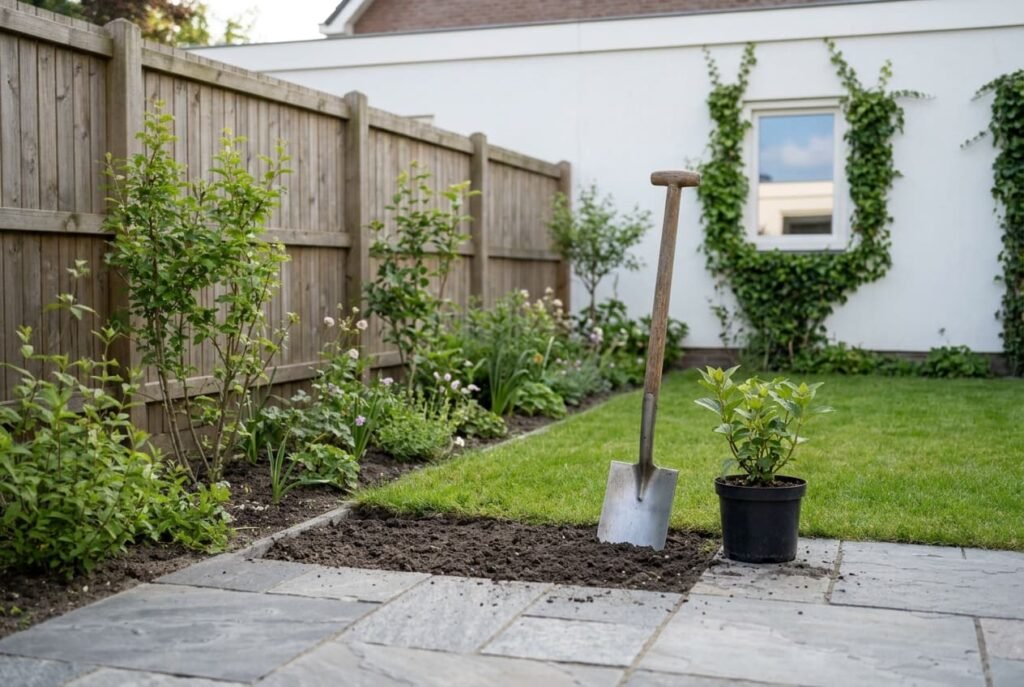
4. A border spade with an 18 cm blade is fourth, for the 6 holes in 5 litre pots. Tier: MID. A blade forged with a closed socket grips the shaft along 15 cm, but a strap fixing loosens within a season. Rock the blade while you hold the shaft. Any click will grow into a wobble.
5. A flexible trug of 28 litres finishes the list, for clippings. A pruning session leaves roughly 40 litres, which is two trips. Tier: BUY CHEAP. A shell made in one piece, with handles formed into the rim, has no joint to tear and nothing inside it to wear out. Lift it holding 5 kg of water and reject any trug whose rim bows.
Why the Spade Is the Item to Scale Down
When you look after a small back garden, the spade is the purchase you can most easily postpone. A hole for a 5 litre pot is about 22 litres of soil, and one for a 2 litre pot about 7. The trowel lifts 0.25 litres a scoop, which means 88 scoops at 3 seconds each, or 4.4 minutes. The spade lifts 2 litres, which means 11 scoops at 5 seconds each, or 55 seconds. That’s 3.5 minutes saved a plant, and 21 minutes over the 6 plants of the year. The trowel alone handles the 12 small pots. Each hole takes 28 scoops, about 84 seconds.
A borrowed spade costs one favour a year, as long as the six shrubs go in on the same autumn afternoon. Owning one puts 105 cm of handle in a corner that’s already full. It also asks you to buy a mid-tier tool for about twenty minutes of work.
Ask a neighbour on a dry day and hand it back rinsed.
If the loan turns into a monthly habit, count your holes again. Buy a spade then.
Habits That Keep the Tools Few
Two minutes after each job keep four tools working for years, and that habit helps you look after a small back garden better than a fifth tool would. Wipe the trowel and the secateurs before they go back to the corner, because wet soil starts rust overnight. Put three drops of light oil on the secateur bolt each spring. Run the rose under a tap once a season so it doesn’t clog.
Tip the can upside down on its rim so rain can’t settle in the base. Hang the trug on a hook, since a trug stacked under a bag bends out of shape.
Give each tool its own hook and label the spot. The next job then starts in ten seconds, where a search through the border takes ten minutes. Anything left on the grass meets a boot or a mower sooner or later, and a blade that has met a mower is rarely worth sharpening.
What to Skip
Skip the boxed ten-piece set, because most of a set that size stays in its slots in a garden this small. The hand fork and the weeder would take up a 30 by 40 cm shelf and see a few minutes of use a year. Two pieces earn their keep, and you’ve paid for ten.
A hedge trimmer tempts too. Our 6 m of low hedge takes 20 minutes with hand shears, twice a year, which is 40 minutes. A trimmer saves perhaps 25 of those and brings a battery that drains in the cupboard. A hose reel with a spray gun is no better, because the can already waters the border in 8 trips.
Leave out a lawn aerator and a soil tester as well, because neither answers a job on the list.
A good garden purchase asks for very little attention once it’s home. Stop buying when five tools cover the jobs you counted, and put the saving into secateurs that cut clean. Keep the receipts in the corner for twelve months. A tool that fails in its first season shows a fault and not wear. Jobs change when a border or a tenancy does. Repeat the count each spring, and update the list on paper.
Questions Readers Keep Asking
How many tools do I need to start?
Two tools: the secateurs and the trowel. Between them they cover pruning and planting, which fill most of a small garden’s year. Anything beyond that serves rarer jobs. Add each extra tool only when a task proves slow without it.
In what order should I buy them?
Rank them by the damage a bad purchase does later. Weak secateurs crush stems on every cut. They lead. The trowel follows when plants arrive, and the can when the weather turns dry. Hold back the spade and the trug until the first three prove their worth.
How do I judge a trowel in a shop?
Stand the tip on the floor and lean on the handle. A good trowel stays rigid and shows no bend at the neck. Check the join between blade and shank, because a weld there is where it fails. A blade and shank made in one piece, with a firm handle, will last.