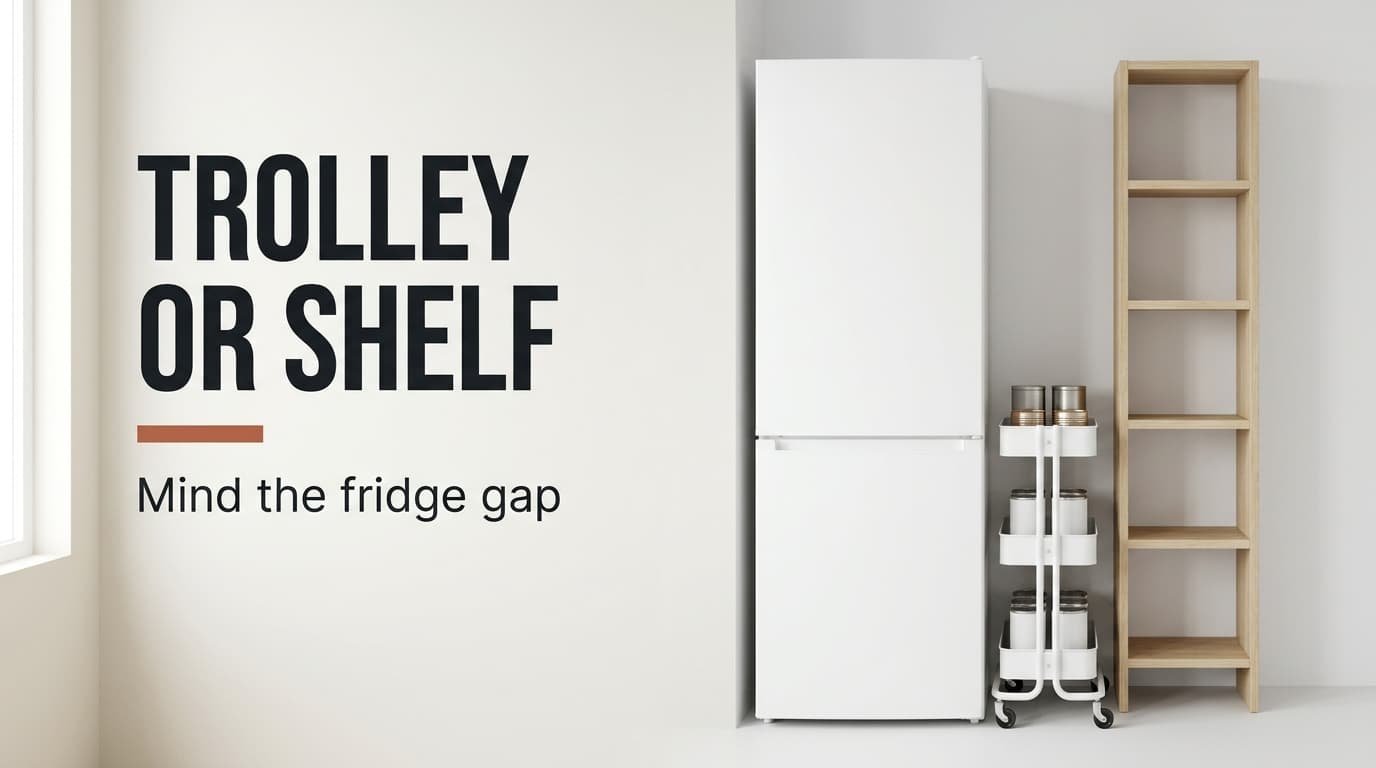
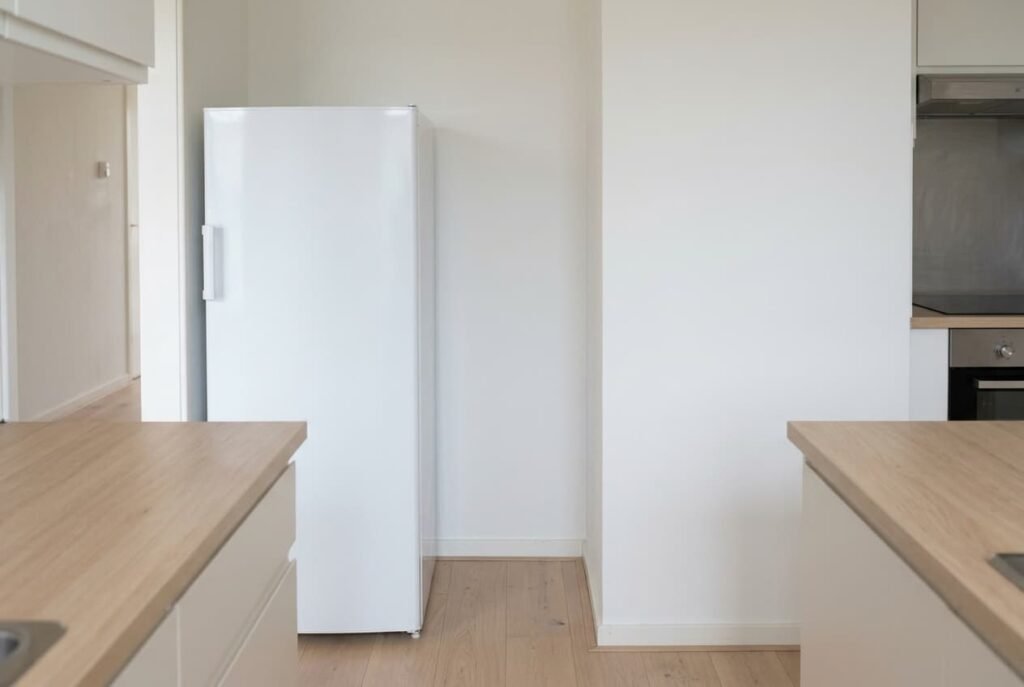
A narrow strip between the fridge and the wall is easy to waste. Fill the gap beside a fridge with a slim trolley and you can pull every shelf into the light. Fill it with a fixed shelf and you store far more, but you reach it blind. The choice turns on how much of your stock stays in view. Picture a Dutch kitchen where the strip is 60 cm deep and 20 cm across, and where the fridge manual asks for 2 cm of clearance on that side. The sizes below are sample assumptions. Replace them with numbers taken from your wall.
How a Slim Trolley or a Fixed Shelf Fills the Gap Beside a Fridge
Start with the room you really have. The strip is 20 cm across, and after the 2 cm of clearance only 18 cm remain. Measure it at the floor and again near the top, because walls in older flats rarely run square. The narrowest reading is your limit. A tape and two minutes settle what a shop listing can’t.
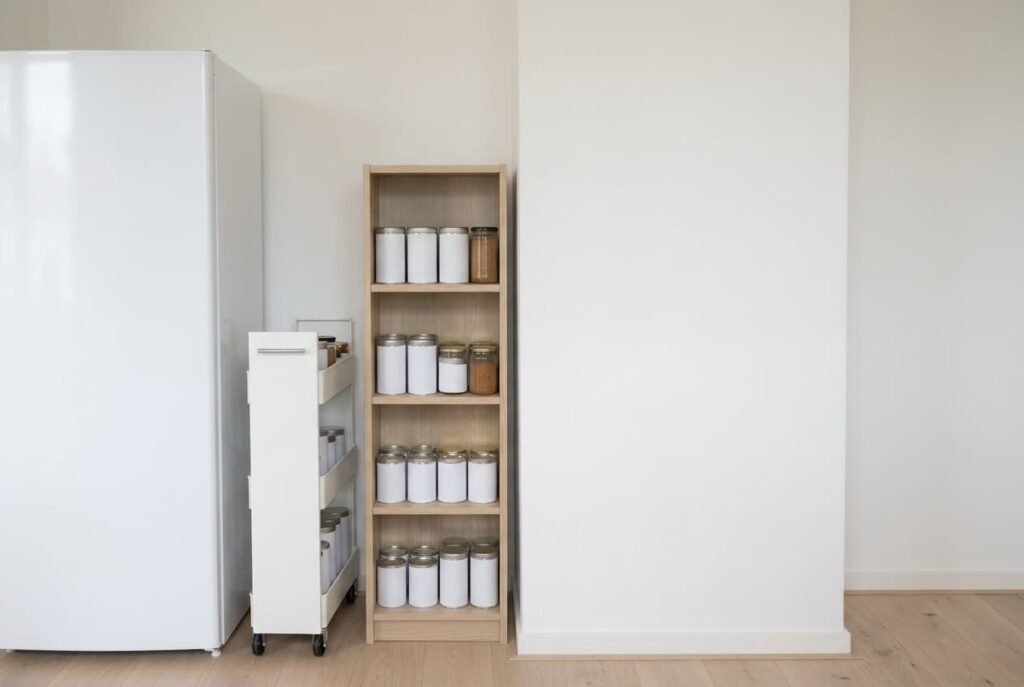
A trolley here means a three-tier frame on castors. It is 15 cm by 45 cm on the floor, with 28 cm of height on each tier. A fixed shelf means a five-level unit that stands on the floor and stays put. It measures 17 cm across by 55 cm deep. Both pass the 18 cm limit, though the shelf leaves only 1 cm to spare.
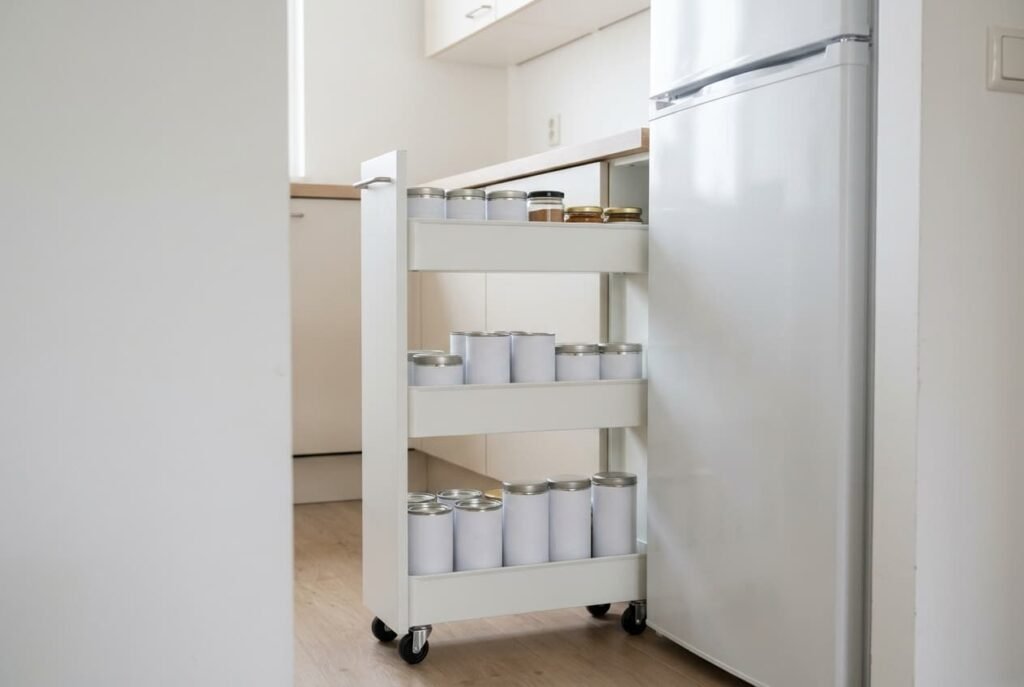
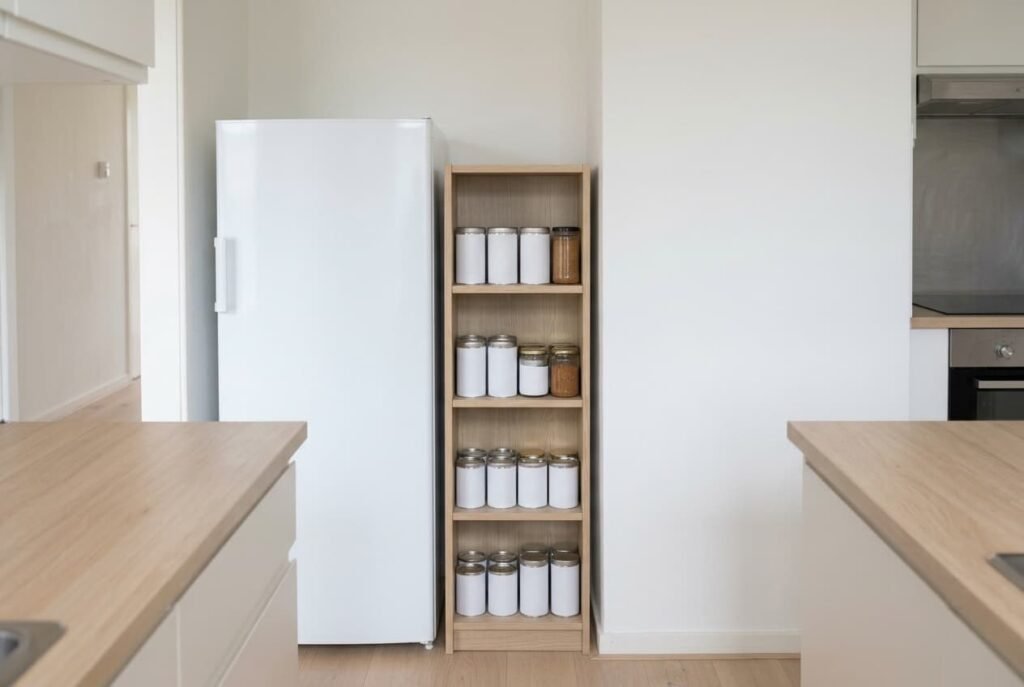
What separates them is how much of your stock you can see. A fixed shelf is open on its front face alone, while a trolley pulled clear of the fridge is open along its whole 45 cm side. Store packs 12 cm across in single file. The shelf holds four deep on each level and shows you the front one, which is 25% of what it holds. The trolley holds three on each tier, and all three show from the side. Nine of nine packs in view against five of twenty is the whole contest in one picture.
Slim Trolley and Fixed Shelf Compared Row by Row
Cut a length of card 60 cm long and 18 cm across. Lay it on your own floor, then mark each frame’s footprint on it before you spend anything.
| Point | Slim trolley | Fixed shelf |
|---|---|---|
| Packs 12 cm across in single file | 9, three on each of 3 tiers | 20, four on each of 5 levels |
| Stock visible at a glance | 100%, from the side | 25%, the front pack only |
| Frame width against the 18 cm limit | 15 cm, leaving 3 cm spare | 17 cm, leaving 1 cm spare |
| Aisle taken when in use | 45 cm while pulled out | none |
| Wiping the 20 × 60 cm floor strip | roll out and wipe, 1,200 cm² | reach under a board 10 cm up |
| Load rating (assumed) | 5 kg a tier, 15 kg in all | 10 kg a level, 50 kg in all |
The shelf holds 11 more packs, which is 20 against 9. The trolley shows every one of its packs where the shelf shows a quarter of its own. That trade runs through everything below, and it also decides how often you’ll bother to look. A stock you can see gets used before its date, while a stock you can’t see gets forgotten.
Where the Slim Trolley Wins in a Working Kitchen
The trolley wins on sight and on access. Pull it out and nine packs stand in a line along its side. Each date and label faces you. A stock check takes seconds, and you don’t buy a second tin of tomatoes you already own.
It also takes the stock to the cook. A cooking run of 2 m is two short steps, and the frame parks beside the hob while you work.
Cleaning the gap beside a fridge is easy because the strip comes clear. Rolling the frame out exposes 20 × 60 = 1,200 cm² of floor, and a wrung-out cloth covers it in a minute.
The cost shows in the aisle. With 105 cm between the run and the opposite worktop, a trolley pulled out by 45 cm leaves 60 cm. You can stand there, but nobody walks past.
Keep it parked in the strip until a meal actually needs something from it.
Renters gain too. The trolley needs no drilling, and 15 cm of width fits any strip of 17 cm or more. It moves house with you.
Where the Fixed Shelf Wins on Capacity and Calm
In the gap beside a fridge, the shelf wins on volume. Twenty packs against nine is 11 more, and at 0.8 kg each the full shelf carries 16 kg, which is 3.2 kg a level against a rating of 10 kg. A 5 kg bottle of oil sits on a level without a worry. The same bottle would use a whole tier’s rating on the trolley.
It wins on steadiness as well. A trolley is 15 cm across, which puts its edge 7.5 cm from the middle. Load the top tier to its full 5 kg and the centre of gravity rises towards 85 cm, which tips at roughly 5 degrees. Spread the load evenly and the figure is about 8.5 degrees. A bump from a door can reach that. The shelf has no such risk once one bracket holds it to the wall.
It also takes no aisle at all. The 105 cm stays 105 cm.
The cost is sight, since three more packs sit behind each front one. Write what stands behind each front pack on the board edge.
A Third Choice: Stand Flat Things on Edge or Leave the Gap Alone
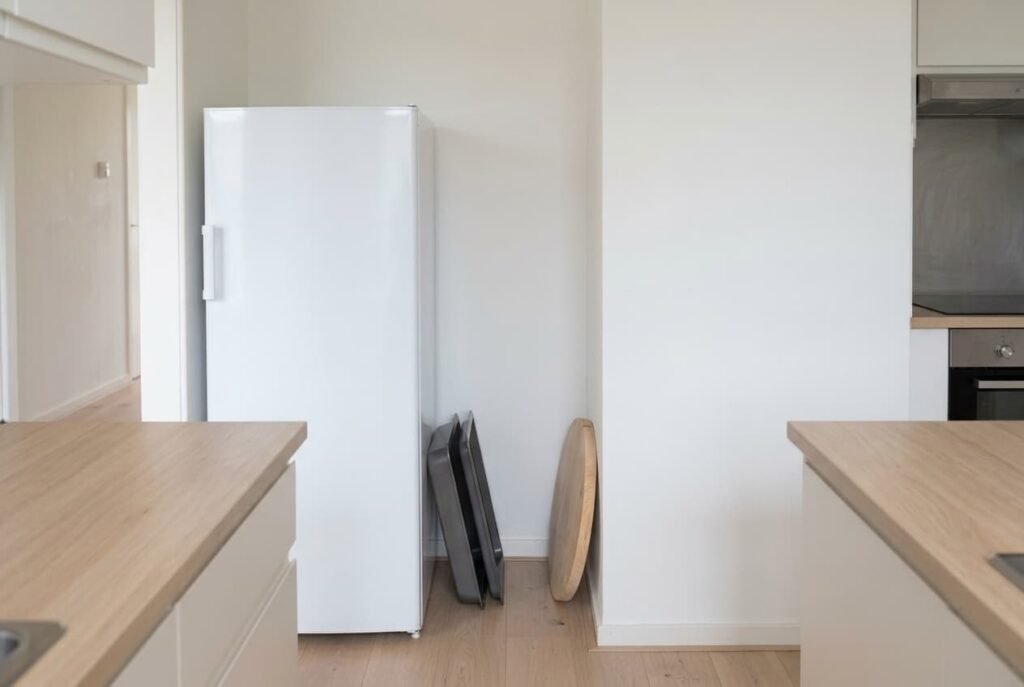
You don’t have to buy a frame. Baking trays and chopping boards are flat, and a flat item stands happily on edge in a strip this narrow. Six pieces 2.5 cm thick take 15 cm of the 18 cm limit, and they hold each other upright. Slide one out from the front when you need it. That puts the gap to work for things that otherwise lie in a drawer and take its whole depth. The trade is that you see only the edge of each piece. Keep this for things you grab by feel.
Doing nothing is an answer too. If the gap beside a fridge now holds a broom and your stock lives in a cupboard that works, an empty or half-used gap costs nothing and stays easy to clean. A new frame earns its place only once a cupboard overflows. Until that happens, the strip is better left to the broom.
Whichever route you take, leave the 2 cm the manual asks for beside the fridge.
Which Suits Your Gap Beside the Fridge: Trolley or Shelf?
Two checks settle most strips. Each one has a drawback to weigh up front.
If you cook from this stock daily and want to see every date, choose the trolley. Measure the aisle first and allow for the 45 cm the frame takes while pulled out. Keep the heavy packs on the bottom tier, which lowers the tilt. Check that the castors roll freely on your floor, since a lip at the door of the kitchen will stop a loaded frame.
If you buy in bulk and rarely look twice, choose the fixed shelf. Take your narrowest reading and subtract 2 cm: you need 17 cm or more. Then fit one bracket to the wall. Accept the hidden rows, and put a label on every edge.
Measure at three heights and keep the lowest reading. Write that figure on your card and carry it when you shop. If the card slides into the gap with a finger to spare, a frame of the same width will too. Keep the card on the floor over several evenings and note how you move around that corner, since habit often beats a plan drawn on paper.
Questions Readers Keep Asking
Which lasts longer in a narrow gap?
The shelf lasts longer under heavy loads because nothing moves. A trolley’s castors wear where they roll, though a set of good ones lasts for years. Check the castors and the tier joints once a year. A loose joint turns into a wobble that gets worse with use.
How do I keep either one clean?
Wipe the shelf boards using a lightly wrung cloth, and lift out whatever stands near the fridge side. Roll the trolley out each month and sweep the strip beneath it. Dust gathers on castors. Pick it out with a dry brush. Never leave a spill to dry.
Which suits a rented kitchen with an uneven wall?
The trolley, in most cases. It needs no drill, and it has 3 cm of spare width. The shelf needs a bracket and a straighter wall, and 1 cm of spare width is little if the gap narrows near the top. Measure at three heights and you’ll know.