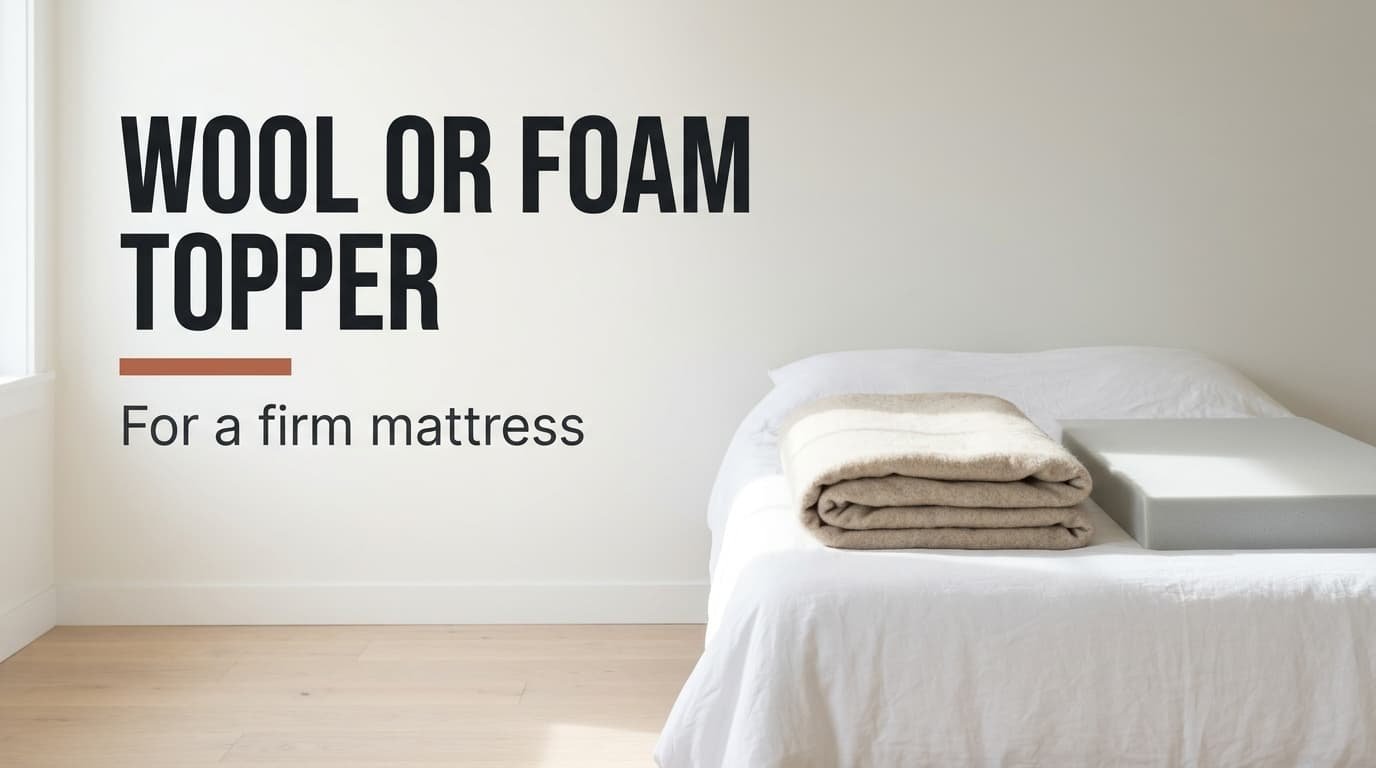
A mattress that feels too firm pushes back at the hips and shoulders, and a topper is the cheapest change to try before you replace the bed. Wool and foam soften it in different ways. Foam sinks around your body. Wool lifts and springs back. A table puts the two next to each other, and each material gets its own section. A free trial and a rule for choosing come last, which leaves you with a decision. Our test bed is a Dutch double, 1.4 m wide and 2 m long, and the numbers are samples that you should redo with your own bed’s measurements.
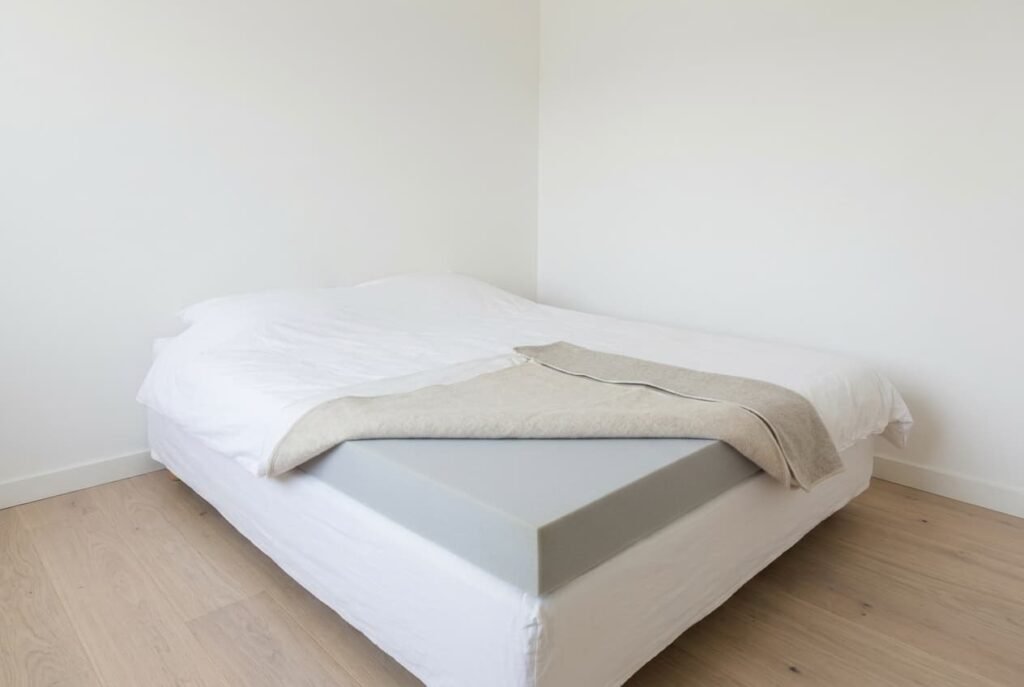
What a Topper Must Do for a Mattress That Feels Too Firm
The job is narrow. A topper has to soften the surface where your hips and shoulders press and keep your spine level. It must also stay put and fit under your fitted sheet. Two measures decide how well each material manages that on a mattress that feels too firm.
The first measure is how far your hip sinks into the layer before it reaches the mattress. On your side, you press through a hip patch of about 15 × 20 cm and a similar shoulder patch. On a firm mattress those two carry the weight while the waist hangs over a gap. In our example a 5 cm foam layer lets the hip drop about 2 cm, and 3 cm of wool lets it drop about 1 cm.
Heat is the second measure. You lie against the topper for roughly eight hours, and a layer that holds warmth turns a firm night into a hot one. Foam is a dense solid with little airflow, and it keeps the warmth near you. Wool takes up moisture and releases it again, which keeps the surface closer to the room’s temperature.
A topper adds height as well. A frame of 30 cm, a mattress of 22 cm and a 5 cm topper put the surface 57 cm off the floor, and your fitted sheet needs a pocket deep enough for 27 cm.
Wool and Foam Compared When a Mattress Feels Too Firm
| Point | Foam topper | Wool topper |
|---|---|---|
| Typical thickness | 5 cm | 3 cm |
| Weight for a 140 × 200 cm bed | about 5.6 kg at 40 kg/m³ | about 7 kg at 2.5 kg/m² |
| How it softens | the body sinks in and the foam holds the shape | the layer compresses and springs back |
| Warmth | holds heat close to you | takes up moisture and lets it go |
| Turning over | slow, because you push out of a hollow | easy, because the surface stays level |
| Cleaning | wipe the cover and never wash the foam | air it and wash the cover gently |
| Sheet pocket needed | mattress plus 5 cm | mattress plus 3 cm |
Each row can be settled with a ruler or kitchen scales. None of them turns on taste. Foam takes the softening row. Wool takes the warmth row and the turning row, and its sheet pocket can be shallower. Mark the rows your own bed is short of, then count how many fall in each column. On the label, look for a density of at least 40 kg/m³ on foam and a weight per square metre on wool. For a mattress that feels too firm, that short list is a more honest guide than any claim on a box.
Where Foam Does the Better Job
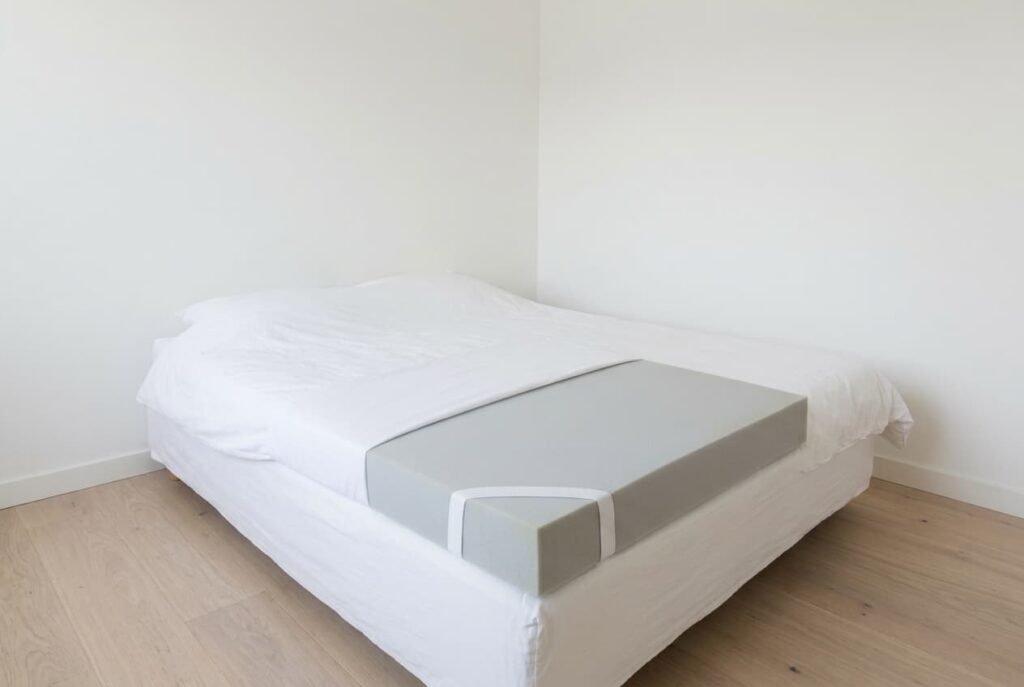
A foam topper suits a person whose complaint is pressure. The material compresses under the hip and shoulder and leaves the waist supported. The spine then stays straight on your side. A layer of 5 cm at 40 kg/m³ weighs 0.14 m³ × 40 = 5.6 kg on our bed, and that density is where durable foam usually begins.
Foam holds its position on a smooth mattress, which is a quiet advantage.
The heavy slab doesn’t shift, and a few elastic corner straps hold it for good. Foam of the right density stays level for years, whereas a light foam of 25 kg/m³ forms a hollow within a year. Pressing a hand into the slab for ten seconds is a fair check, since a dent that lingers for a minute means the foam is tiring.
Two limits apply. Foam holds heat, and a warm bedroom makes that uncomfortable. A deep dip also slows every turn, because you climb out of the hollow each time you roll over.
Where Wool Does the Better Job
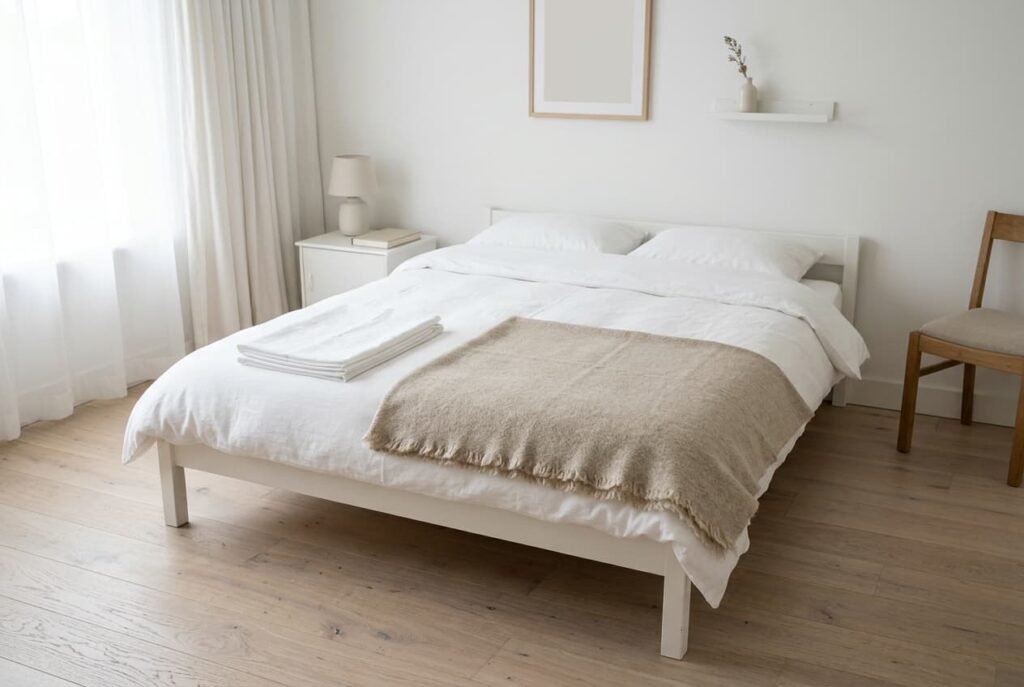
A wool topper suits a person who finds the bed hard and also runs warm. The fibres are crimped, which lets a layer of 3 cm act like a bed of tiny springs. It compresses under the hip and rises again as soon as you move, and there’s no hollow to climb out of.
Wool manages moisture too. It can absorb roughly a third of its weight in water vapour before the surface feels wet. On a bed shared by two people, that keeps the sheet drier through the night. A layer of 2.5 kg/m² weighs 7 kg on our double, which is heavier than the foam yet easy to shake out.
The limits are plain. Wool softens less than foam because it is thinner and springier. A very hard mattress may still feel hard under it. It also needs airing every few months and can’t take a hot wash. The fibres also compress over the years. Flip and shake the layer each season.
The Third Option Is a Trial With What You Own
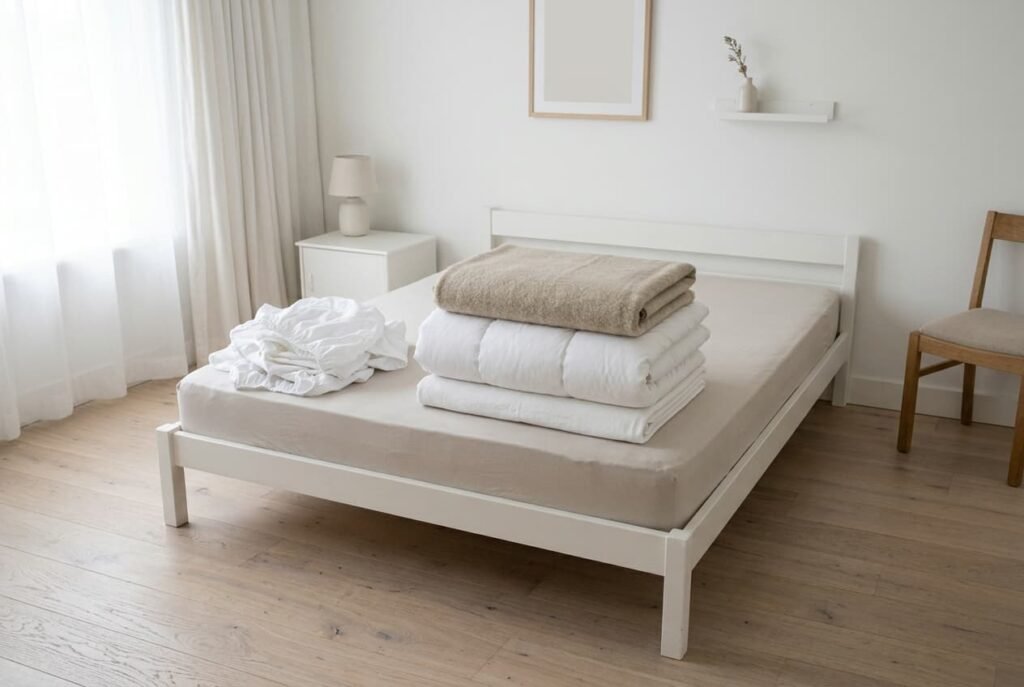
Before buying anything, rehearse the idea with blankets. Fold two spare blankets or a spare duvet across the mattress, tuck a fitted sheet over them and lie there for a fortnight. The stack comes to about 3 cm, close to the wool layer.
If the bed feels better, you’ve learned that a topper will help, and the folded layers tell you which thickness your hips want. If nothing changes, a mattress that feels too firm may have another cause. A rigid base with closely spaced slats gives the mattress no room to flex, and a frame with sprung slats can soften the feel at no cost.
The trial is free and fits into a quiet afternoon. It also keeps you from buying a thick layer for a problem that the base would solve, and your hips collect two weeks of honest evidence that no shop display can give.
Which One to Pick
Almost every bed ends up in one of two branches.
If you lie on your side and feel pressure at the hip or shoulder, choose the foam topper. It sinks around those two patches and keeps the waist supported.
If you run warm or share the bed with a partner who does, choose the wool topper. It lifts and breathes, and turning over takes no effort.
Where neither branch fits, the blanket trial is your answer. Whichever layer you choose, give it two weeks before you cut off the packaging, and judge it on the warmest night. A bed that feels right on a cool evening can still fail in July.
The right topper disappears into the bed within a week. Pick the layer that asks least of your body and of your bedroom. Measure your sheet’s pocket, and keep the receipt somewhere safe until the fortnight ends. If you still wake with sore hips after that, the mattress itself needs attention, and a topper won’t hide it. Measure the result against how you felt before the trial.
Questions Readers Keep Asking
Which one lasts longer?
Foam at 40 kg/m³ or above holds its shape for years, though a light foam forms a hollow within a year. Wool keeps its spring and only needs airing and a shake. Judge foam by the density figure on the label and wool by its weight per square metre.
How do I keep either one clean?
Use a washable cover on the foam and wipe spills straight away. Never put the foam itself in a machine. Air the wool every few months in a dry room and wash only its cover, gently. Heat and hard spinning leave wool fibres matt and stiff.
Which suits two people sharing a double bed?
Wool usually suits two people better. It handles moisture and stays level when one of you turns over. Choose foam only if both of you feel pressure at the hips and neither runs warm. A split foam topper, one half each, avoids the compromise.