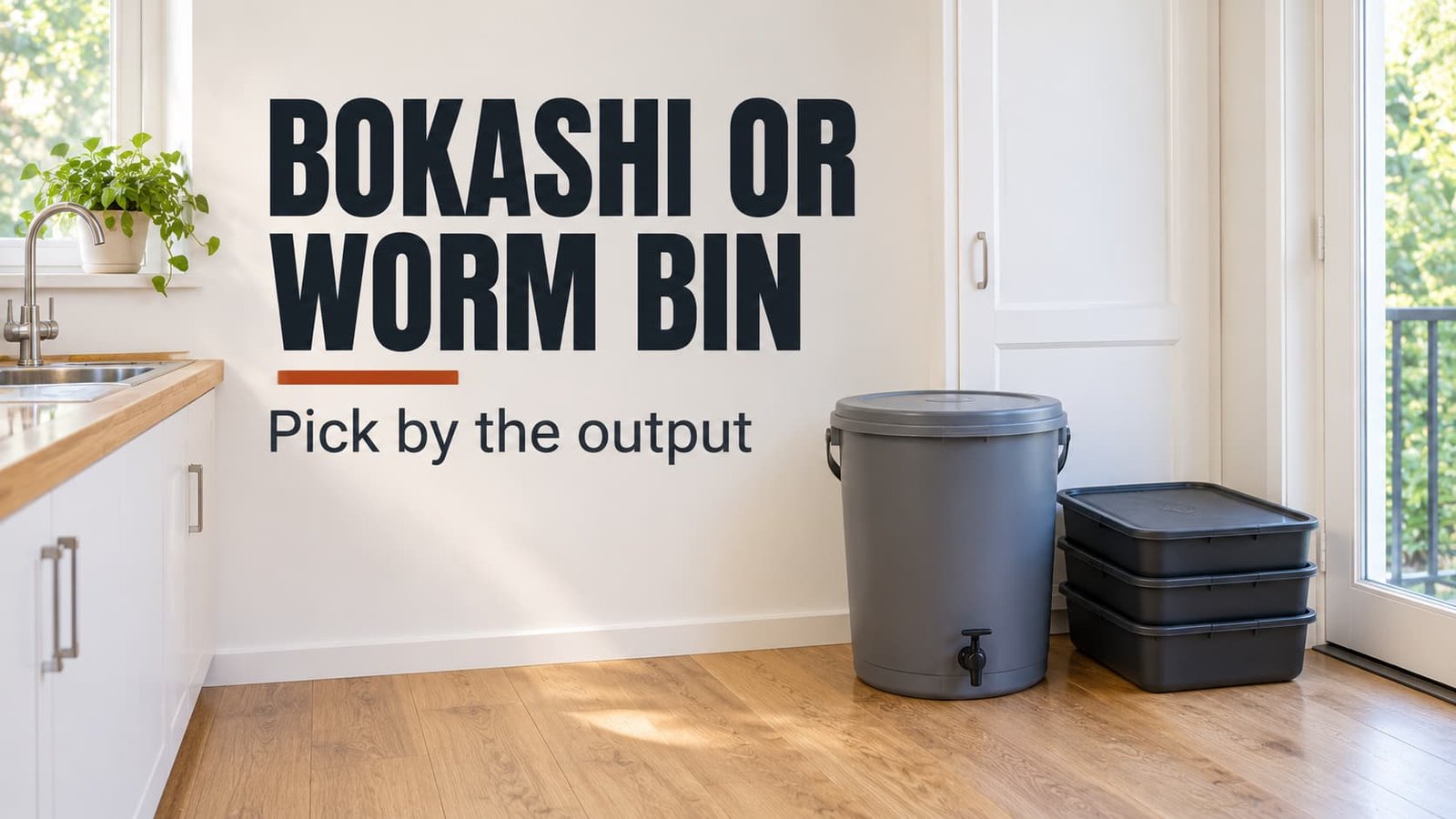
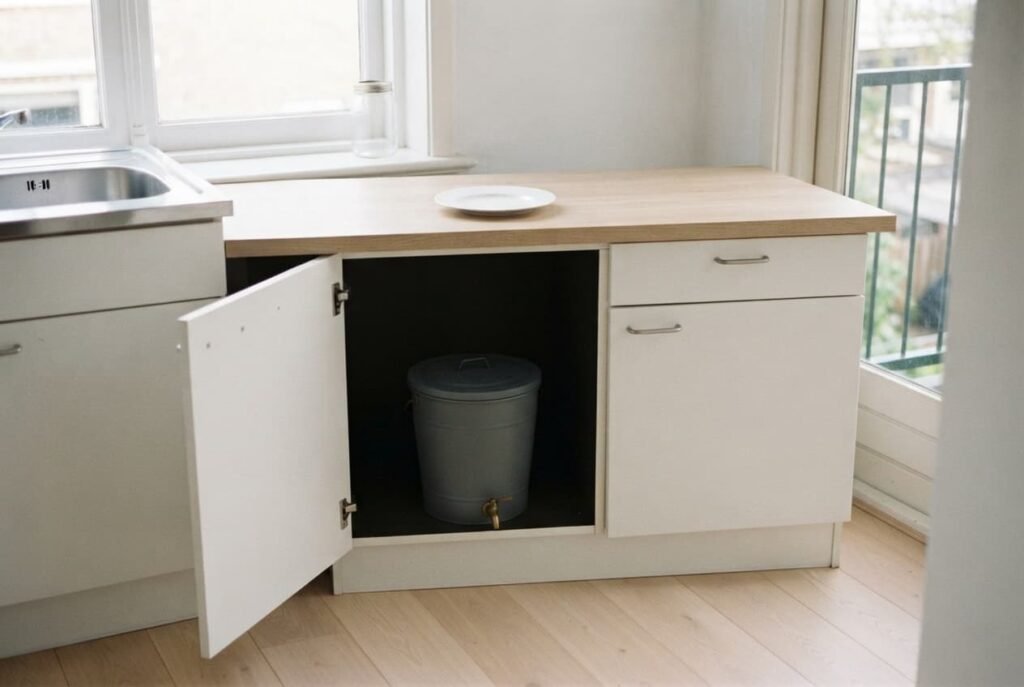
A bokashi bin or a worm bin can keep food scraps out of the rubbish in a flat, yet each asks for something different in return. One ferments nearly everything in a sealed bucket and hands you a wet product that needs somewhere to go. The other takes less, in a stack of trays, and returns crumbly compost. Our example: two adults in Zwolle, a 60 × 55 cm cupboard under the sink and about 3 kg of scraps a week. Both bins can live out of sight, which matters when the sink faces the sofa. Swap each number below for your own measurement, and let a kit’s instructions overrule it.
What Separates a Bokashi Bin From a Worm Bin in Daily Use
Three jobs decide daily use: what goes in, how the bin smells while it works and where the output ends up. The real difference is where the output goes, and a flat without a garden can’t skip that question.
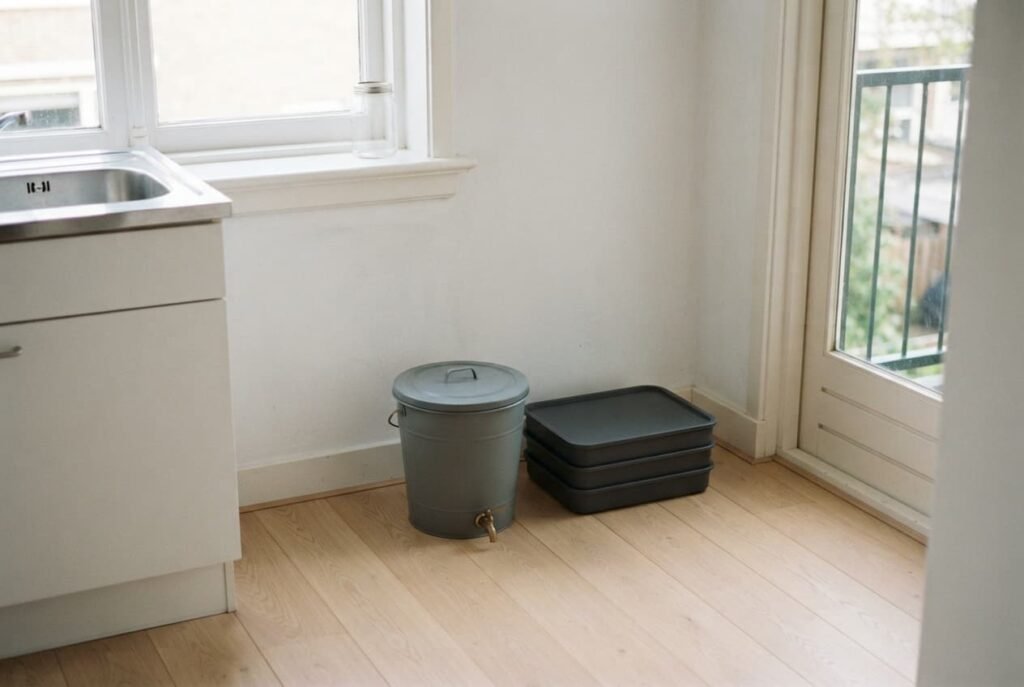
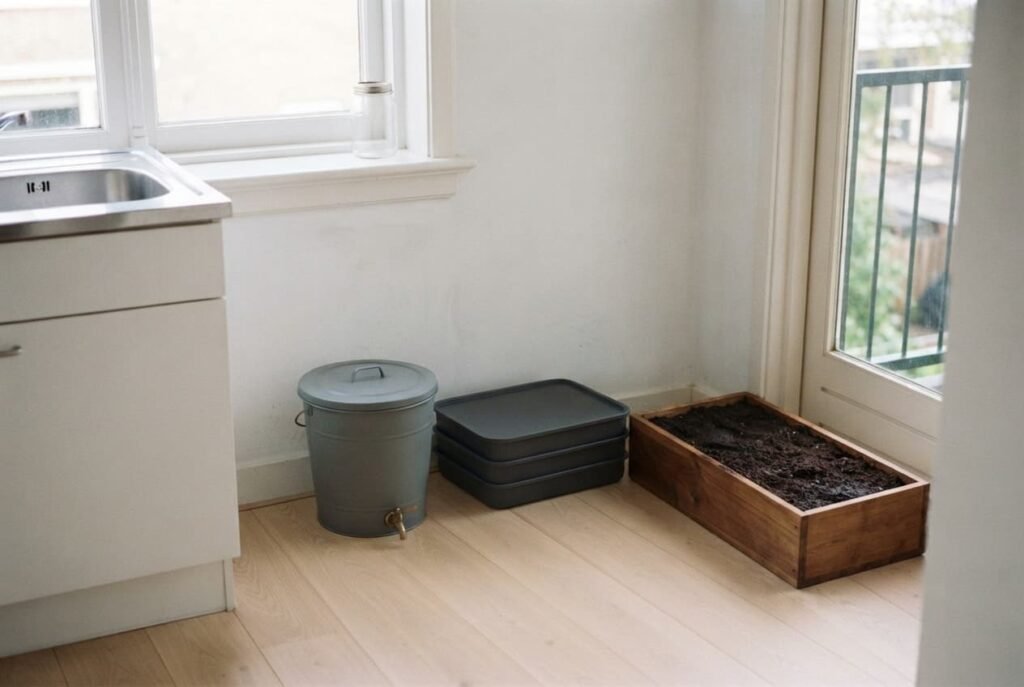
A bokashi bucket is a squat container that seals the scraps under a lid with a sprinkle of bran that carries fermenting microbes. With the air shut out, the scraps pickle instead of rotting. They keep their shape and turn slightly sour. A liquid drains through a tap near the base, and after about two weeks of rest the bucket holds fermented waste that still has to finish breaking down in soil.
A worm bin does the reverse, and it is taller than the bucket. Composting worms live in a stack of trays and eat raw scraps that arrive in small amounts. They need air, a bedding that feels like a wrung-out sponge and a steady 15 to 25 °C. The stack stands upright, and the lowest tray catches any liquid. Their droppings become crumbly compost that needs no further burying, and there’s nothing to carry out afterwards.
Choosing between a bokashi bin or a worm bin starts with how much you throw away and whether a patch of soil or a planter can take the output.
Both Bins Compared Row by Row
| Point | Bokashi bucket | Worm bin |
|---|---|---|
| Footprint (sample) | 28 cm across, covering 615 cm² | 40 × 50 cm, covering 2,000 cm² |
| Share of the 60 × 55 cm cupboard floor | 19% for one bucket and 37% for two | 61% for the single bin |
| What it takes | raw and cooked scraps plus a little meat or dairy where the kit allows | raw vegetable and fruit scraps in small amounts |
| Weekly capacity (sample) | all 3 kg | about 1.5 kg |
| What comes out | wet fermented waste and a liquid to drain | dark crumbly compost and very little liquid |
| Smell | a sharp sour note whenever the lid lifts and a second one when you drain the tap | faint and earthy while the bedding stays balanced and the lid stays on |
| Rhythm | press the scraps down after each addition and drain the tap every few days | feed little and often with a moisture check once a week |
Those figures describe only the sample bins in the Zwolle cupboard, and each kit’s instructions set the real limits on what it accepts. Capacity and output divide households most clearly, and they are the two rows to compare with your own bin and your own soil before you read the rest.
Where Bokashi Earns Its Place
Bokashi suits a household that throws away cooked leftovers and wants one answer for everything. The sample home sends all 3 kg a week to the bucket. A matt grey bucket 28 cm across covers 615 cm², which is 19% of the cupboard floor.
The bucket holds about 10 kg of pressed scraps, which is an assumption. At that rate the bucket fills in just over 3 weeks and then rests for 2. Two buckets in rotation therefore suffice, and together they cover 1,230 cm², or 37% of the floor.
Smell is brief. The lid lifts on a sour note that fades within seconds, and pressing the scraps flat with a plate keeps it down. Drain the liquid every few days and dilute it well before it touches a plant.
The output is the drawback, and it isn’t small. Each filled bucket delivers 10 kg of fermented waste. At an assumed 1 kg to the litre, mixing it one part to three with soil fills a planter of 40 L, such as one measuring 50 × 40 × 20 cm. Someone has to carry that load every 5 weeks.
Where Worms Earn Their Place
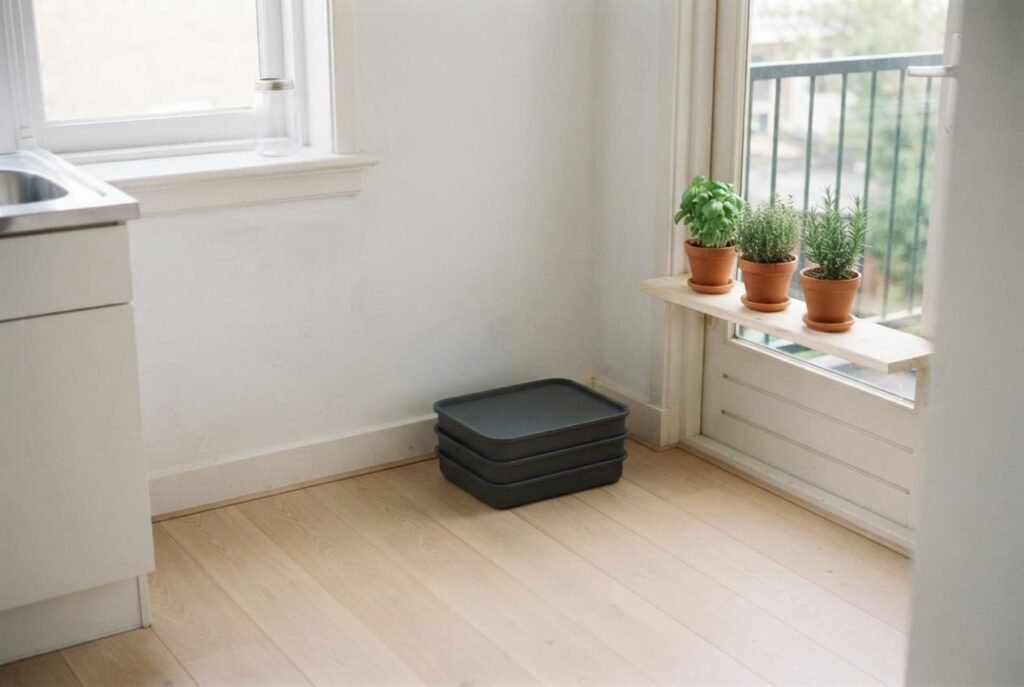
Worms suit a household that mostly throws away raw vegetable and fruit scraps and wants compost for a few pots. The bin has a 40 × 50 cm base of 2,000 cm², which takes 61% of the cupboard floor. If pipes cross the cupboard, the bin can stand in a hall corner or beside the balcony door.
Capacity is the first limit. The sample bin handles about 1.5 kg a week, half of the flat’s 3 kg, and the other half needs a second route. Cooked food and citrus peel unsettle the colony. Onion does too. Keep all three to tiny amounts.
Temperature is the second limit. Worms like 15 to 25 °C. Keep the bin away from radiators and sunny sills, because heat harms the colony fast. Uncovered scraps attract small flies. Bury each feed under the bedding.
The reward is a slow build of dark compost, enough over months that you’ll top up a handful of pots. Neglect sinks a bokashi bin or a worm bin alike, yet worms forgive a fortnight away better than a full bucket forgives a missed press.
The Caddy You Already Have
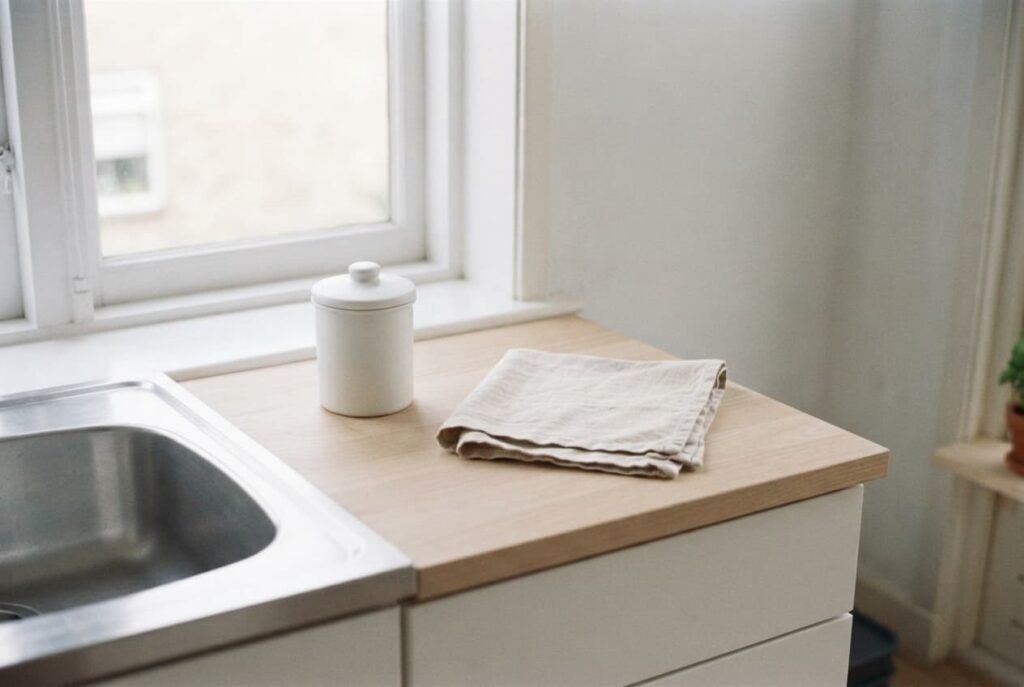
A lidded caddy that lives on the worktop needs no cupboard space and no weekly routine when it’s emptied twice a week into a food-waste collection.
Run it for two weeks before buying a bokashi bin or a worm bin. Weigh the scraps on a fixed day and write the figure down. A figure under 1 kg a week suits a caddy easily. A 5 L caddy holds about 3 kg when pressed down. That’s ample for the sample home’s 3 kg at 1.5 kg a trip, and it covers about 400 cm² of worktop, a 20 × 20 cm square. Rinse it after each trip and choose a model with a tight lid and a smooth inside, since crevices hold residue.
The condition is a place to empty it. Where your building or street has a food-waste collection, keep the caddy and use the collection. Where it has none, the caddy only moves the smell downstairs, and the question of a bin comes back.
Which to Pick: a Bokashi Bin or a Worm Bin
The decision rests on the output and the volume, the two rows that split the table. Each branch below follows from the figures above.
If you can bury the output, choose bokashi, because the fermented waste then has a destination every 5 weeks, such as a 40 L planter or a shared plot. In return the bucket takes all 3 kg, cooked food included. It asks only for bran and a press, plus a trip to the planter.
If you want compost for pots, choose worms, since nothing has to be buried. The bin handles 1.5 kg a week of raw scraps. A caddy or a collection must take the rest, and that extra trip is the cost of the smaller footprint.
Whichever branch fits, run it for one month before adding anything else. Note the weight of scraps in the first week and the smell on the day you open the lid. A month shows whether the routine suits your week, and a routine that suits your week outlasts an ambitious set-up. Keep the caddy in reserve in case it doesn’t, because switching later costs little.
Questions and Answers
How long does each bin last?
A bokashi bucket is a plastic container with a tap and can last for years. Lids and seals wear first. A worm bin lasts for as many years as its trays stay sound, and the colony renews itself while its conditions stay balanced. Neither gives out suddenly, because each shows wear slowly.
How much care does each need?
Bokashi needs a press and a sprinkle of bran after each addition. The liquid drains every few days, and a burying trip falls every 5 weeks in our sample. A worm bin needs small feeds and a weekly moisture check. Neither takes long on a typical day.
Which suits a small flat with no balcony?
Bokashi usually fits the cupboard better, because a bucket covers 615 cm² against 2,000 cm² for the worm bin. Its output still needs a destination off the premises, such as a shared plot. Where no such outlet exists, a caddy plus a collection suits a home with no balcony best.