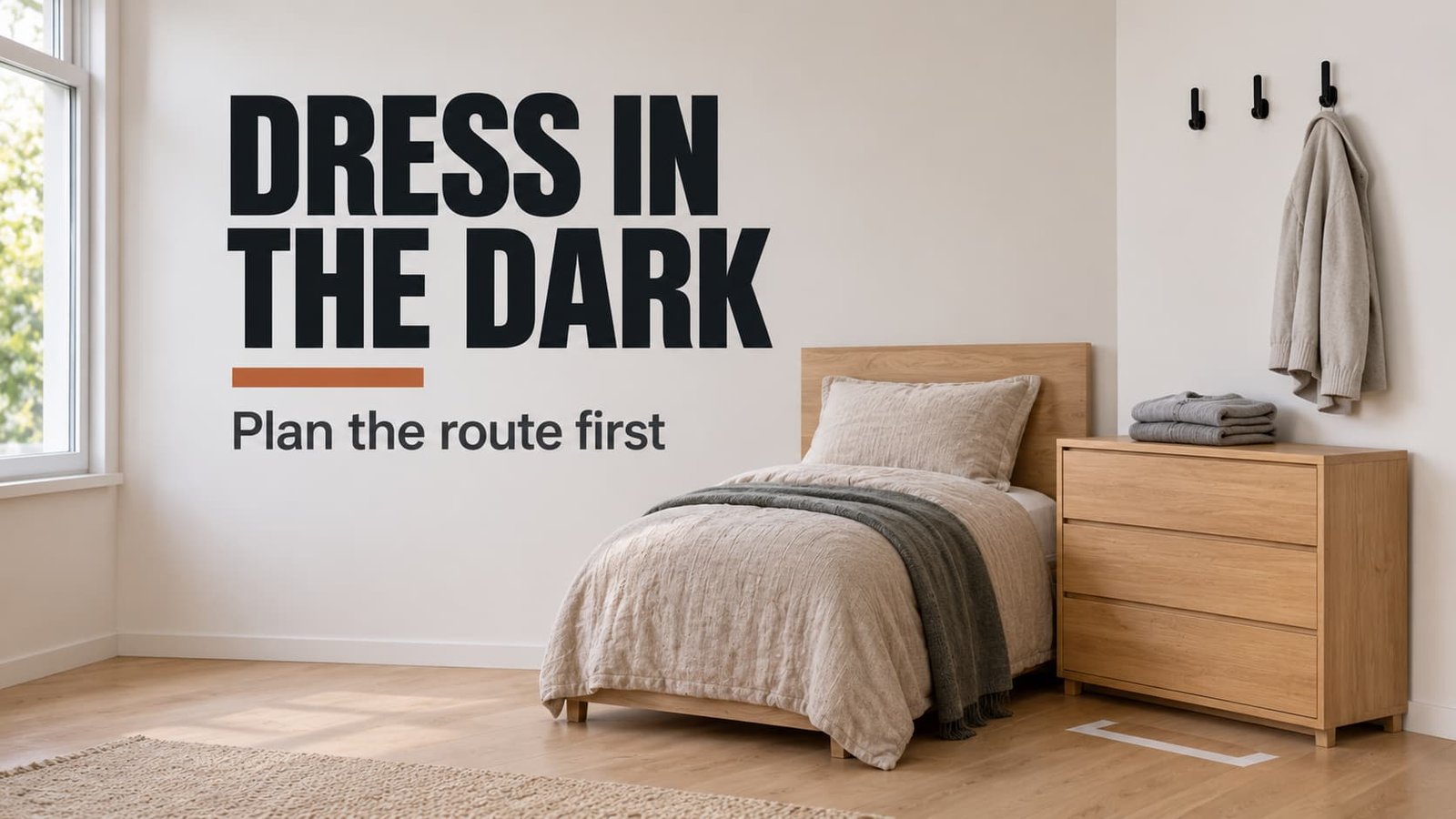
To get dressed in the dark you need three things: a clear route from the bedside, a patch of floor to stand on and clothes within arm’s reach of that patch. The bedroom followed here belongs to a couple in an Amersfoort terraced house, and its floor runs 330 cm across by 400 cm long. One partner leaves at five each morning while the other stays put. Painter’s tape and a free evening are the whole toolkit, and a torch stays in the drawer. All numbers below are working examples from a single room. Tape out your own room ahead of any furniture move.
How to Get Dressed in the Dark: What the Floor Must Offer
Darkness takes away sight and leaves memory and touch. The body remembers a route. Hips and elbows still need clearance. A chair corner never announces itself. Because a hip measures about 40 cm and sways 10 cm to either side, the route needs 60 cm. Balancing on one leg to pull on trousers calls for a patch 90 cm by 70 cm. Clothes must lie within 70 cm of that patch, a reach that needs no step.
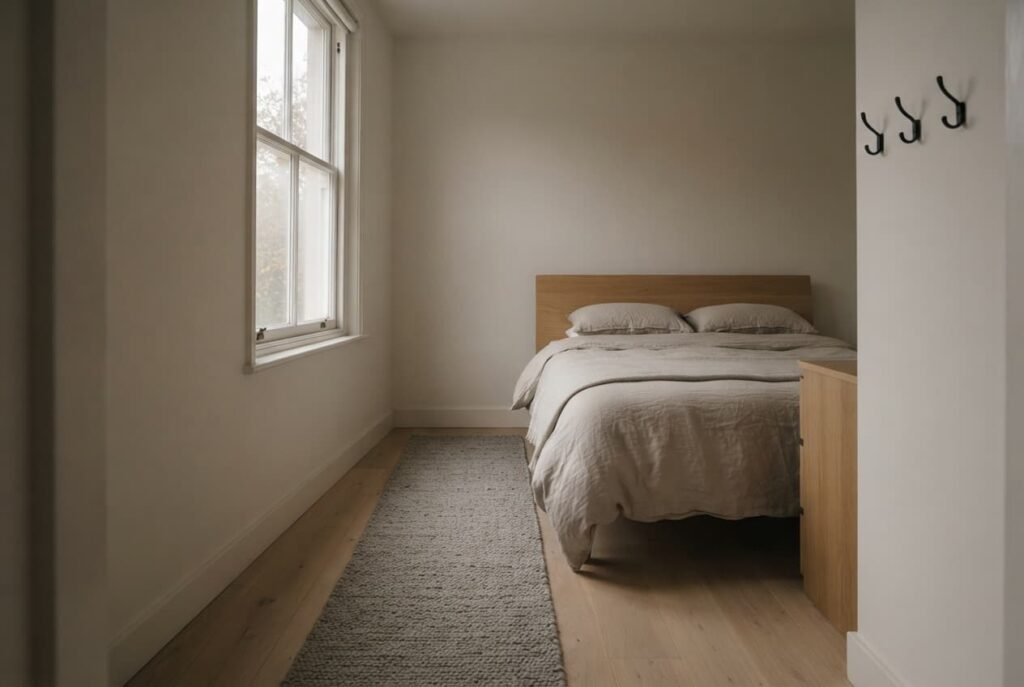
Now measure the room. Set the bed square against the head wall. It’s 160 cm across and 200 long, which leaves 85 cm at each side, since 160 + 85 + 85 = 330. The route fits with 25 cm of slack. The patch can’t, because 90 is more than 85. Length rescues it. The bed takes 200 of the 400 cm, leaving 200 beyond its end. Count 45 cm for the chest, 40 more for its pulled drawer and 60 for the person standing: 145 cm in all, with 55 cm to spare.
Length rescues a patch that width can’t.
Many couples keep the clothes beside the bed to shorten the walk, and that choice has an acoustic cost. Each doubling of the distance takes 6 dB off. Drawers 1.0 m from the pillow rattle about 10 dB louder than drawers 3.2 m away, which is where the foot wall puts them.
Four Layouts Where You Can Get Dressed in Dark Rooms
Each layout keeps a 60 cm route and a patch of 90 by 70, and none needs a lamp. Colours stay quiet, because pale surfaces read better in poor light.
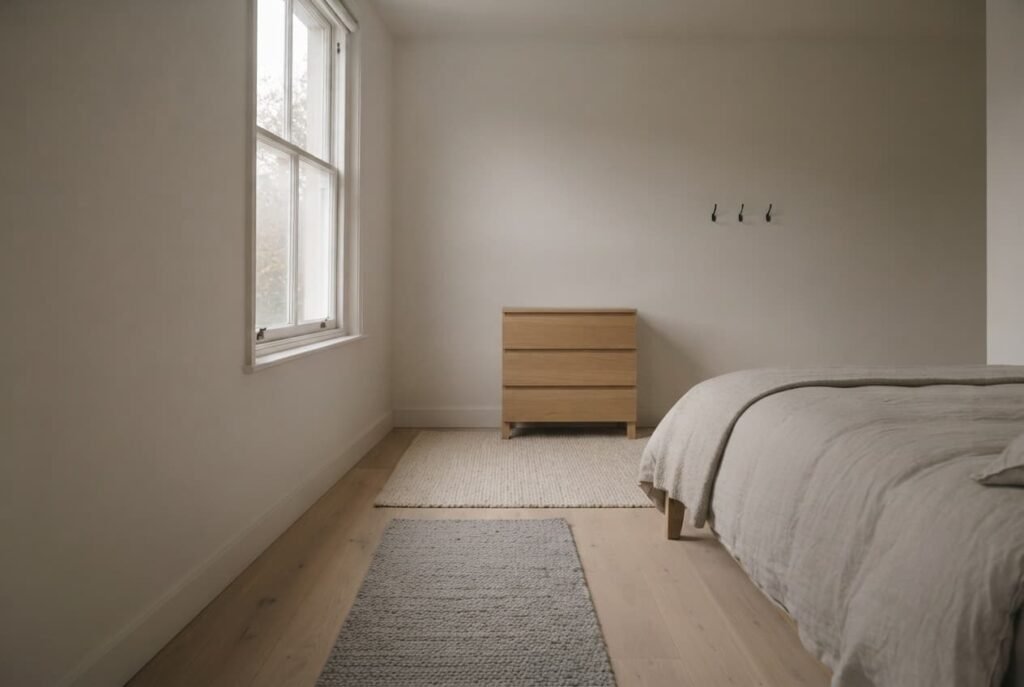
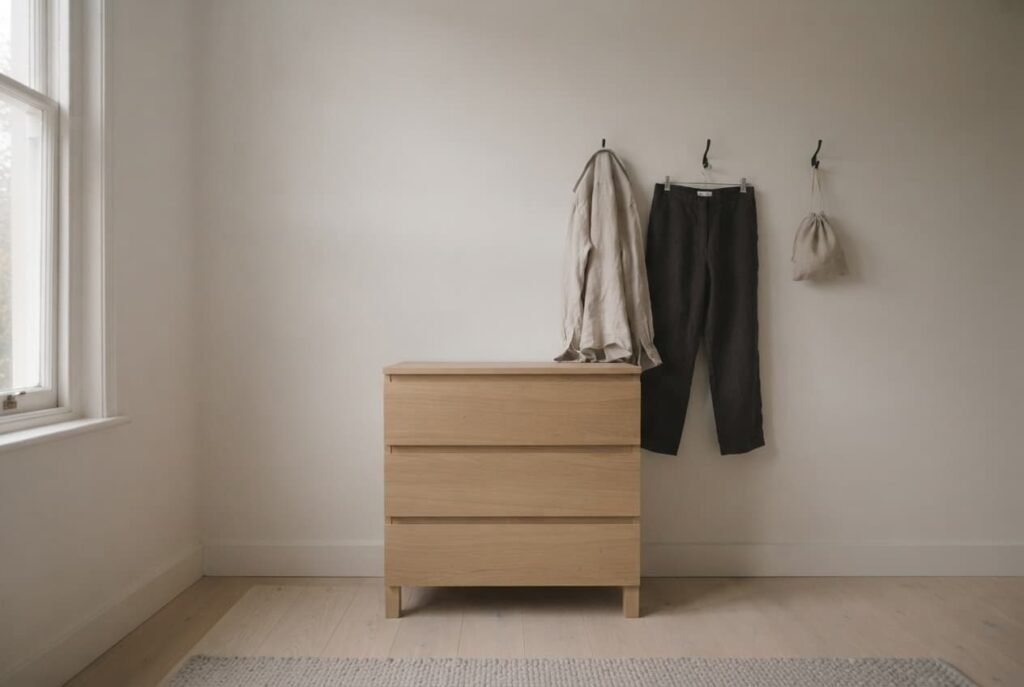
– Ours, 330 across by 400 long: the bed (160 across, 200 long) in oat linen is centred on the head wall. A pale oak chest measuring 80 across and 45 deep faces it on the foot wall, flanked by three plain black hooks at 150 cm. A grey wool runner of 60 by 200 covers the left side. The five o’clock route never crosses the partner’s half.
– Tight, 280 across by 360 long: a 140 by 200 bed leaves 70 each side. A slim chest measuring 70 across and 40 deep uses 140 of the 160 cm beyond the bed end and leaves 20. Walls stay warm white. The linen turns sage and the runner narrows to 50.
– Awkward, the door swinging 80 cm into the room’s foot area: re-hang it to open against the wall. If a lease forbids that, put the chest beyond the quarter circle the door sweeps, tucked into the foot wall’s far corner. Tape marks the sweep at once.
– Generous, 380 across by 460 long: a 180 by 200 bed leaves 100 each side. A matt grey wardrobe measuring 150 across and 60 deep stands on the foot wall, and a pale rug of 90 by 70 marks the patch. The extra width lets a bench take the socks.
Where Dressing Plans Go Wrong
Each fault below appears when nobody has tried to get dressed in the dark before building the plan. Cover your eyes for five minutes and you’ll find all four.
Parking the chest beside the pillow. Drawers rattle on their runners, and the partner hears every one. Moving the chest from 1.0 m to 3.2 m away cuts the sound by about 10 dB. The carry takes an evening. You lose the bedside surface, and a small shelf must take over for the glasses and the phone. Felt pads inside the drawer fronts quieten the rattle further.
Letting wardrobe doors swing across the route. A wardrobe 100 cm across carries two doors of 50 cm each. Opened, a door takes 50 cm from the 85 cm gap and leaves 35, well below the 60 you need. Sliding doors keep the gap intact. Hinged doors cost less but need the wardrobe to stand elsewhere, perhaps on the foot wall beside the chest.
Trusting a bare floor to stay silent. Boards that creak under a heel wake the other person at once. A wool runner of 60 by 200 deadens each step and gives the feet a stripe to follow. Fix it with double-sided tape so the edges lie flat and can’t catch a toe. Check the underside for grip before buying.
Hunting for clothes by touch. An outfit mixed together in one drawer takes minutes to untangle in the dark. Hang tomorrow’s clothes on one hook the evening before, with the top layer outermost, and keep socks in a pouch on the same hook. Ten minutes at night saves the fumbling at five.
When the Tidy Layout Is the Wrong One
The familiar plan sets matching tables beside the bed and a wardrobe along the head wall, putting every garment close to hand. It looks balanced and costs little. Nobody notices the noise while planning, because planning happens in daylight with the drawers shut. For the partner who stays in bed it is also the noisiest arrangement, because each drawer sits about 1.0 m from a pillow. Across 250 working mornings a year, a rattle at five becomes routine and not an accident.
The better plan is keeping every drawer at the foot wall. The early riser walks about 2 m further. That adds seconds, while the pillow side gains the 10 dB drop calculated above. Symmetry goes. Bedside tables shrink to lamp-sized shelves, and the wardrobe can’t line up with the head wall. A hook rail beside the chest holds the day’s clothes.
Some couples carry clothes to the landing the night before and get dressed in the dark out there. It works where a landing exists and the cold doesn’t bother you.
Elsewhere, the foot wall offers the same quiet without leaving the room.
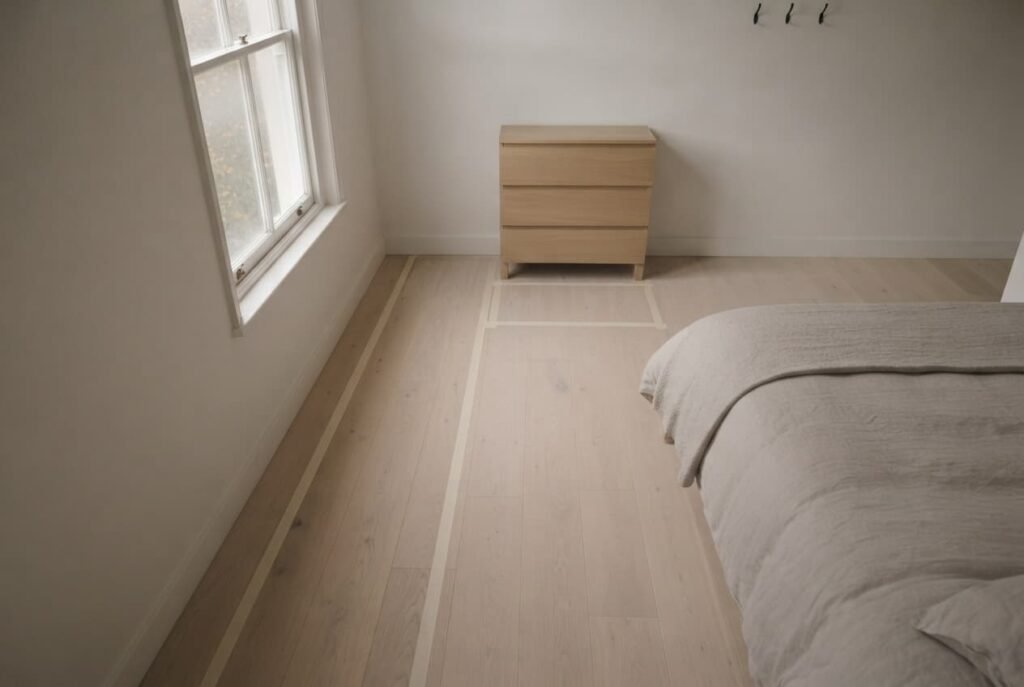
Three Tape Tests With the Lights Off
Run each test at night with every light off, the way you’d really get dressed in the dark. Tape every line before the lights go out.
1. Route: stick two lines of tape 60 cm apart, running from bedside to doorway. Walk the lane three times with your eyes closed. Any contact with furniture means the lane is too narrow. Ours leaves 25 cm of slack at the bedside.
2. Patch: tape a rectangle of 90 by 70 in front of the chest. Stand on your left leg and lift the right as if pulling on trousers, keeping both feet inside the tape. Wobbling over the line means the patch is too small.
3. Reach: stand in the rectangle and stretch for the top drawer handle and the first hook without stepping. Both should lie within 70 cm. If one doesn’t, move it closer before anything else.
Settle the dressing patch first and place the chest second. The runner and the hooks can wait until the tape tests agree, because a plan that misses by 5 cm will still miss whatever you buy. Then choose linen and a lamp over a single evening, and the room will be ready for the next early start. You’ll soon know which side each of you leaves from.
Questions and Answers
How large a chest of drawers can I fit?
One 80 cm across and 45 deep, in our room. It needs 145 cm beyond the bed: 45 for the chest, 40 for the pulled drawer and 60 to stand. A tighter room takes a slim chest of 70 by 40. Measure the foot space before buying, because a deeper chest eats into the standing room.
Where should the bed go in the room?
Centre it when both sides offer 60 cm or more. In a room where your side is the narrow one, slide the bed 25 cm towards the partner’s wall. Your gap grows to 110 cm and theirs shrinks to 60, which still meets the minimum.
What light and colour help in a dark bedroom?
Keep the bedside lamp off. Fit a dim warm light low beside the door, aimed at the floor, away from the pillow. A pale runner on a darker floor reads as a stripe in poor light. Matt surfaces avoid glints that catch the eye.