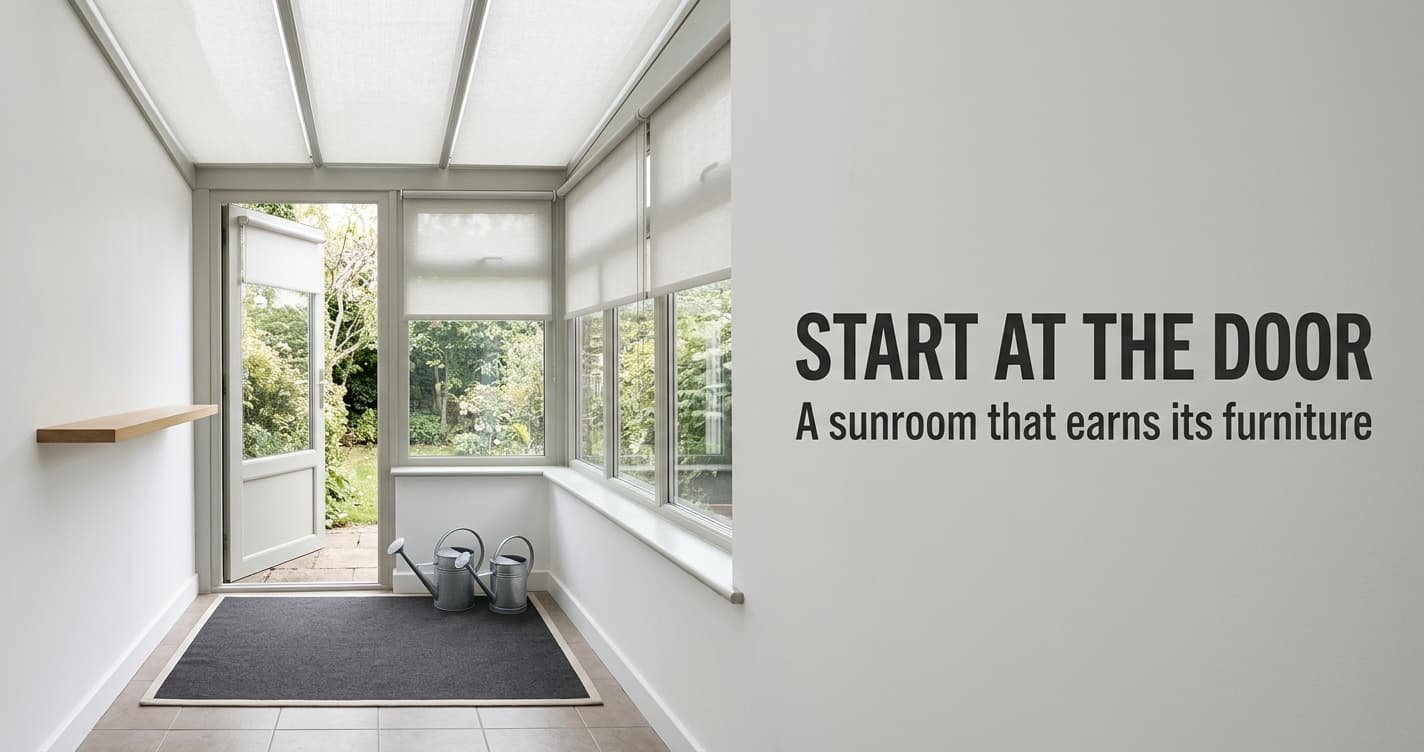
Why start furnishing a sunroom at the door instead of at the sofa? Because the room is a passage before it is a place to sit. This guide builds a sunroom that earns its furniture in five buys, ordered by how close each piece stands to the traffic. It assumes a room 280 by 410 cm with the garden door at one corner of the glass and the kitchen door at the opposite corner of the house wall. Prices are left out because they date quickly. Every buy ends with a check that needs only two watering cans.
The rule behind a sunroom that earns its furniture
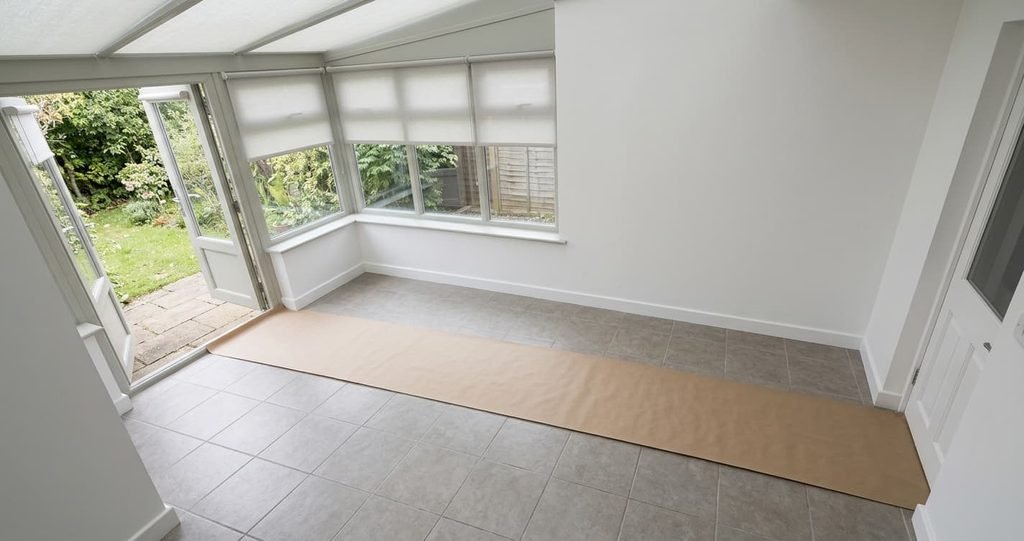
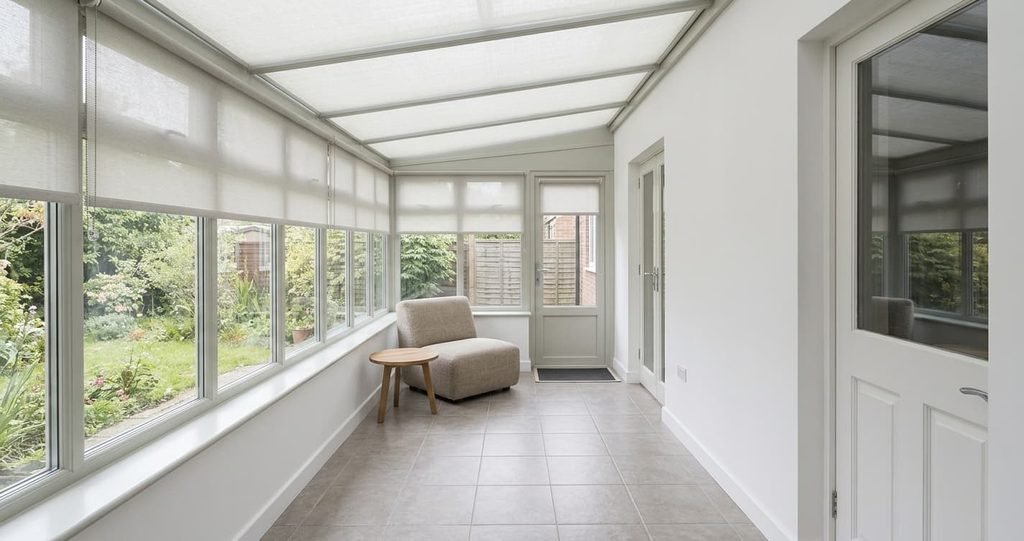
A sunroom with doors at opposite corners has a road running through it. Draw a line from the middle of the garden door to the middle of the kitchen door. On this plan it runs 4.2 m, and a strip 90 cm wide along it, the width of the door leaf, covers 3.8 m² of the 11.5 m² floor. That is close to a third of the room, and it has to stay empty. The rest falls into two quiet corners of nearly 4 m² each: one behind the house wall at the left end, and one in the glass corner at the right.
Furnish from the door inward, and leave the quiet corners for last. Pieces near the door take the most use, so they are the ones to place first and test first. A sofa bought before the road is known lands in the strip, and the road then bends around it for good.
The test is the same at every stage. Carry a full watering can in each hand along the strip, from one door to the other. If you brush anything with a knee or a can, that piece is in the road. Move it, or send it back.
The road comes before the furniture.
How a sunroom earns its furniture, piece by piece
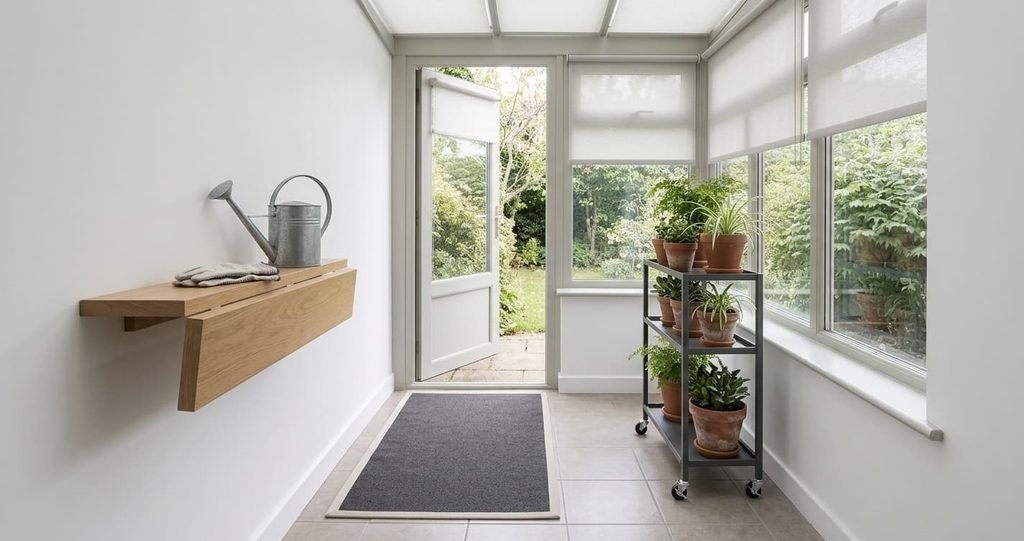
1. A washable mat, 60 by 90 cm, laid just inside the garden door. It comes first because soil enters at the door, and every later piece stands on the floor it protects. Lay the long side along the road. Tier: BUY CHEAP, since a cotton top on a rubber backing wears out within a season. A bad version has no backing, so it slides on the tile and a corner curls into the door leaf.
2. A drop shelf, 90 by 25 cm, fixed to the left end wall at 105 cm height, starting 100 cm back from the glass. It sits second because hands coming in from the garden need somewhere to put a can down. Without it the can goes on the floor or on a seat. Tier: BUY ONCE, since the fixing into the brick decides whether it holds a full can. A bad version is 45 cm deep, which juts into the strip and catches every sleeve.
3. A plant trolley, 40 by 90 cm, with locking castors, parked along the glass wall to the right of the strip. It sits third because plants arrive within a week, and loose pots are what the walk kicks over. The trolley rolls out to be watered and back. Tier: MID. The steel frame and the castors that lock are the parts that wear. A bad version has fixed legs and a frame that twists, so every turn of a pot is a lift.
The pieces that need a corner
4. One seat of about 70 by 80 cm, angled toward the garden in the glass corner at the right. It comes fourth because it alone asks for a corner, and by now the road has shown which are quiet. Tier: MID. The frame and the filling decide how long it stays comfortable. A bad version is bought first and set in the middle of the room, where it pushes the road into a bend.
5. A round side table beside the seat, 45 cm across by 45 cm high. It comes last because the seat’s arm sets its place, and a table placed any earlier is a guess. Tier: BUY CHEAP, since a top that takes cups gets marked first. A bad version is 60 cm across, which pushes a corner of the top into the strip.
Where to spend, and what to argue down
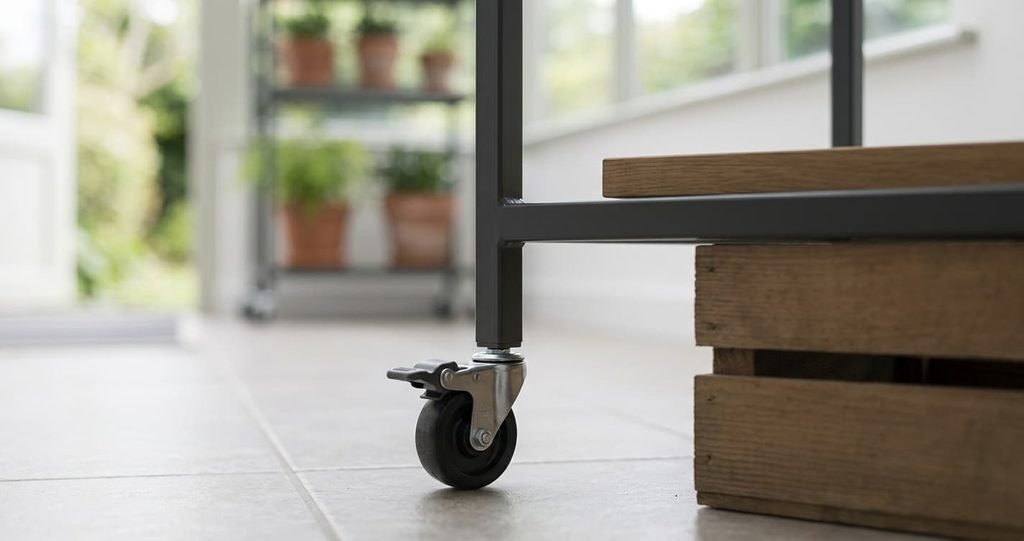
Spend on the two pieces that carry weight: the shelf’s fixing and the trolley’s castors. Both are hidden in use, and neither can be improved later without taking the piece apart. A shelf pulled out of the brick takes plaster with it. A castor that won’t lock lets a full trolley drift toward the door. Compare a trolley whose frame is welded with one that’s only bolted. The welded one stays square under a row of pots.
Argue the table down. Readers expect a table to be a purchase, yet a crate with a board on it does the same job for months. In a sunroom that earns its furniture, the table follows the seat, and the seat may shift once the room has taught you which corner is quiet. Wait until the seat has stayed put for a month. By then you’ll know the arm height and the reach to a cup.
The mat and the seat sit between the two. Both deserve a decent product without reaching for the best. The mat is cheap by design, and it is also the first piece you’ll replace.
Cheap pieces are cheap to be wrong about.
What this order assumes, and when it breaks
This layout assumes two doors at opposite corners. Put both doors on one wall, and the road shrinks to a strip along that wall that is 90 cm wide. It is as long as the gap between the doors. The far side then becomes one large quiet zone. Where a door swings into the room, start the strip at the edge of the swing instead of at the door. The leaf needs its arc, and no piece may sit inside it. The seat moves up the order, since its corner is already known.
A room with one door and no garden door breaks the rule differently. No soil comes in. The mat and the shelf drop out, and the seat moves to first place. A rented room breaks the second piece, because drilling is out. A free-standing shelf stands in, as long as it isn’t deeper than 25 cm. Whatever the layout, a sunroom that earns its furniture is still bought from the busiest spot to the quietest one.
What to skip entirely
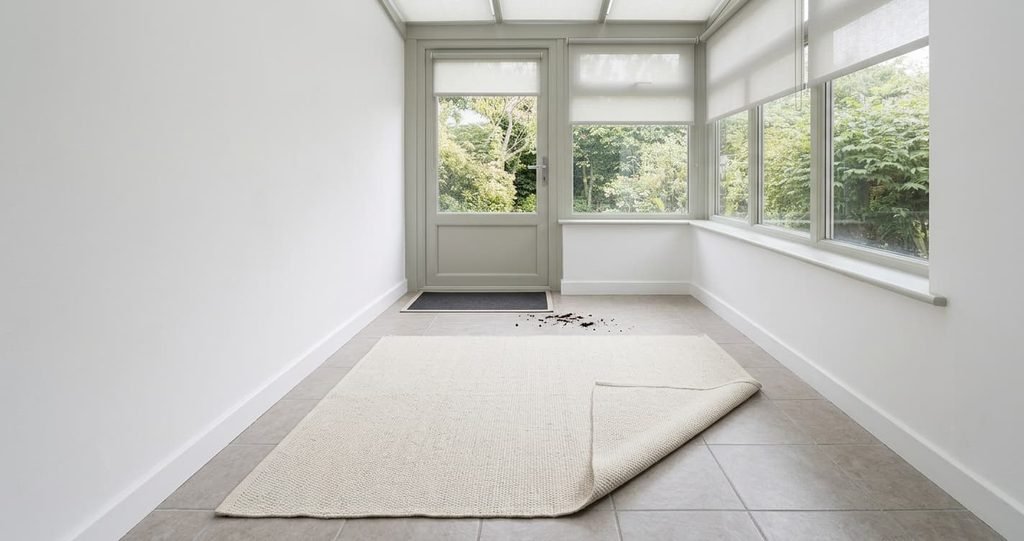
The large rug across the middle heads the skip list. A rug laid across the road curls at the edges and holds soil, and the mat already does the rug’s job at the door. Next comes the dining table with six chairs, which needs about 90 cm of clear floor on every side and cuts the strip in two.
A fitted bench along the glass wall is worth skipping as well. It fixes the seat before the quiet corners are known. A second sofa for guests is the last item, because folding chairs do that job and leave the floor clear the rest of the year. A feature piece such as a large sculptural lamp or an outsized planter should wait a year, since it lands where the road ends up.
The order is mat, shelf, trolley, seat, table. Run the watering-can walk after each buy, and purchase the next piece only when the last one passes. I’d treat the walk as the one test that matters, because a room that passes it never needs its furniture moved twice. Every piece beyond the door end is a guess until the road is clear. Anything beyond the fifth piece can wait for a season, and the floor you keep clear will show what the room wants.
Questions readers keep asking
How many pieces does a sunroom need to start with?
A sunroom that earns its furniture needs five pieces to start. The mat and the shelf come first, then the trolley, then the seat, then the table. Each one gets the watering-can walk before the next is bought, which keeps the road clear for good.
Should the seat come first in a sunroom?
Not when the room is a passage. The seat needs a corner, and the corner is only known once the road between the doors has been walked. Start at the door end with the mat and the shelf. Buy the seat fourth, and the corner picks itself.
How do you judge a sunroom shelf or trolley?
Judge the parts that carry weight: the fixing into the brick for the shelf and the castors and frame for the trolley. Load each with the heaviest thing you’d put on it. A shelf that flexes or a castor that won’t lock is the sign to send it back, whatever it looks like.