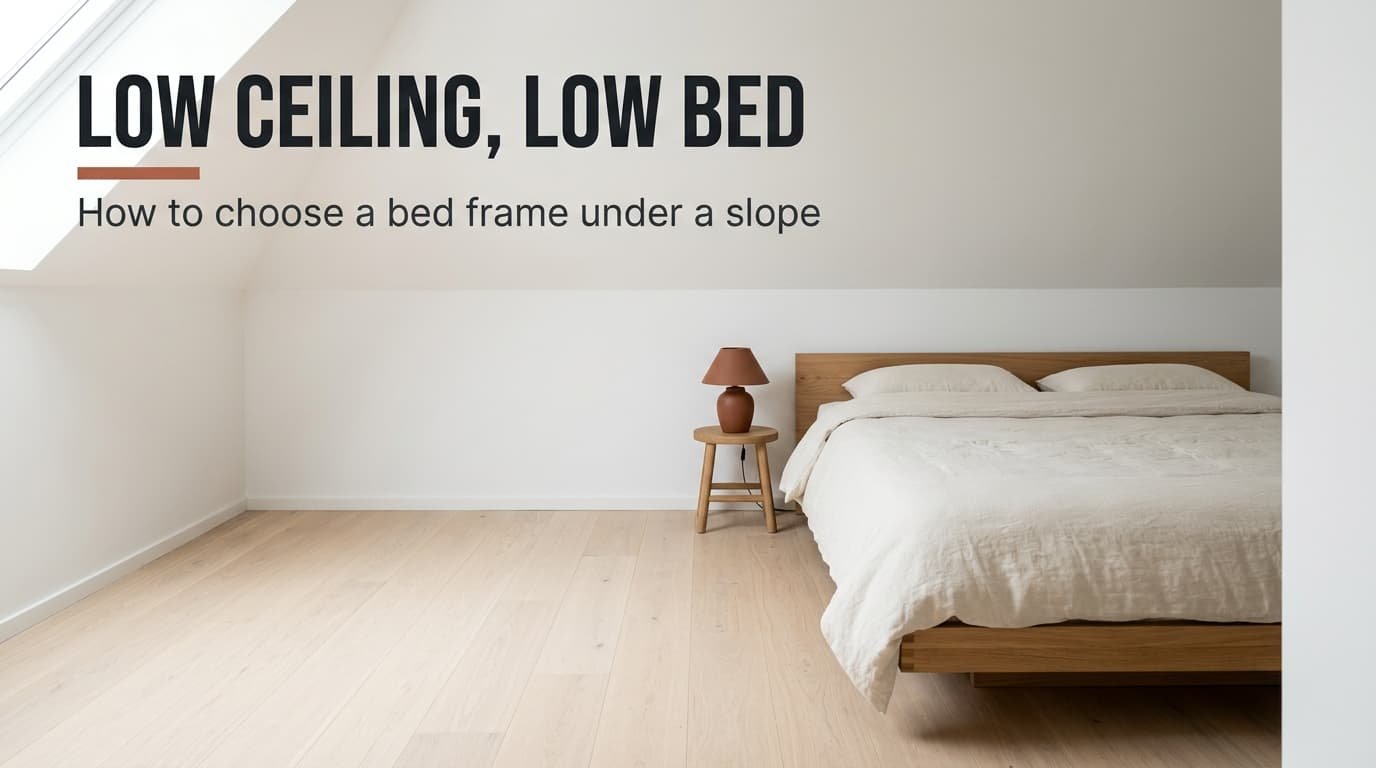
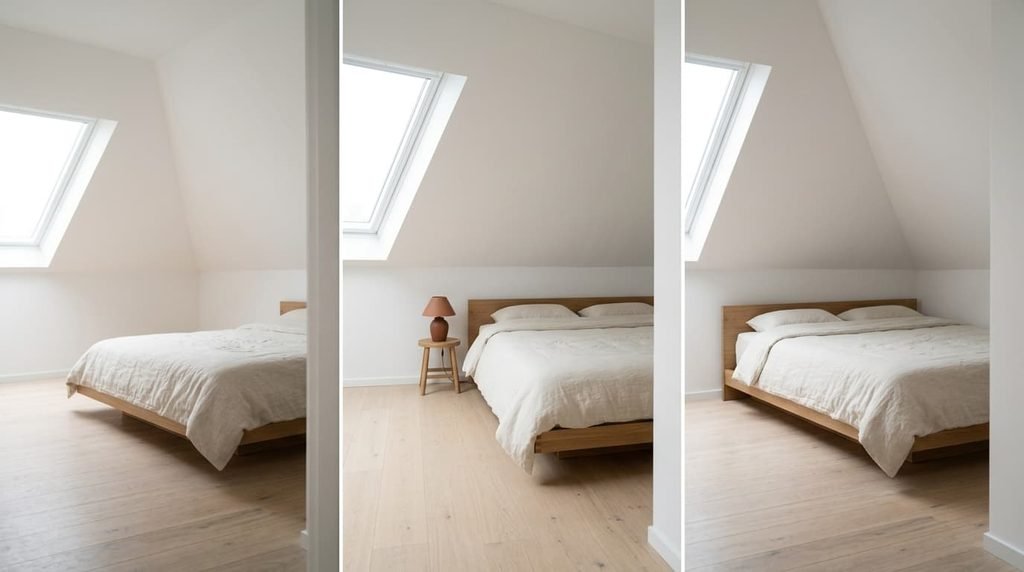
Buy the lowest frame your mattress allows, because every 10 cm of frame height pushes the bed about 12 cm further from the low wall. Choosing a bed frame for a low sloped ceiling is a sum before it’s a style. The lowest platform wins on floor space. The sums use the height you need to sit up and read, which is the measure you’ll notice every night. Five criteria follow in buying order.
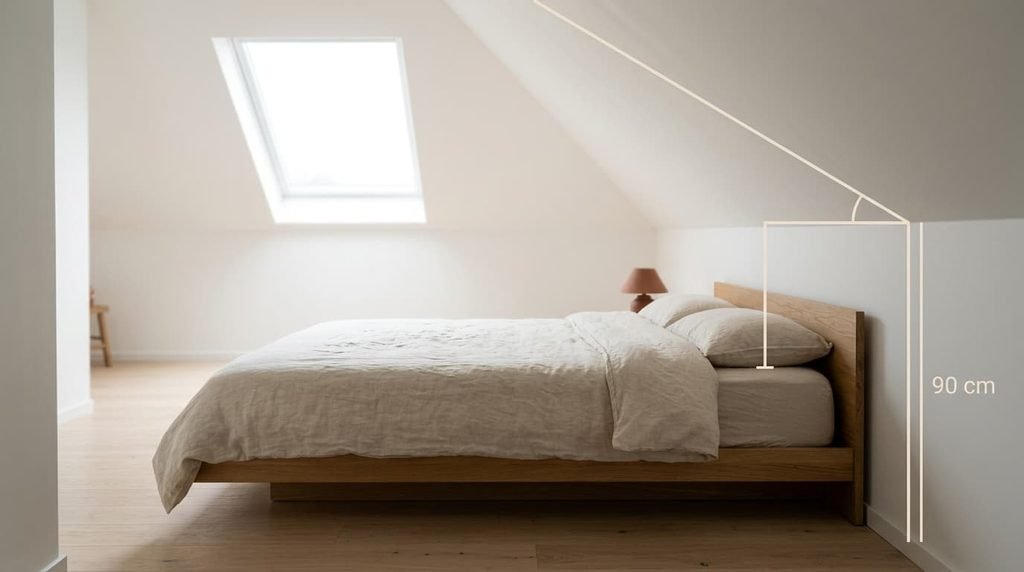
I assume a Dutch attic bedroom 270 cm wide, a knee wall of 90 cm and a roof at 40°. Replace those figures with your own measurements before you spend anything.
The rule behind a bed frame for a low sloped ceiling
Spend on whatever carries you and costs you floor. Save on whatever only decorates. The ceiling above your bed rises with distance from the knee wall. For a roof at 40°, height = 90 cm + 0.84 × the distance in cm. A reader sitting up with a book needs about 100 cm above the mattress top. That’s 90 cm of seated height plus a 10 cm margin.
Here the head sits 25 cm in from the bed’s edge. A 22 cm frame with a 22 cm mattress puts the top at 44 cm. The edge must then stand 39 cm from the wall. A 35 cm frame needs 55 cm and a 50 cm frame needs 73 cm. On a 160 cm bed, the first leaves a 71 cm walkway. The second leaves 55 cm, and the third only 37 cm.
A walkway under 60 cm is where the sum fails. People underestimate that clearance because a bed looks tidy against a wall. Rails of chipboard creak after a few months of use, while solid timber stays quiet for years. Taller readers should add their extra seated height to the margin, because each added centimetre costs about 1.2 cm of floor. Don’t trust a photo of a room: the slope hides height until someone sits up.
Buying a frame for the bed under a low sloped ceiling, in order
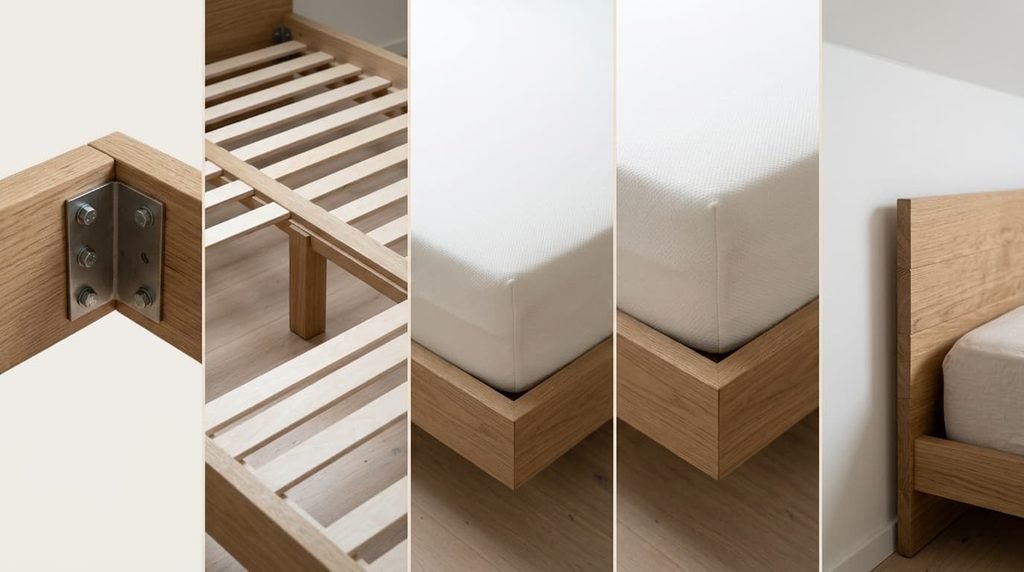
1. A low platform frame with its top 22 to 25 cm off the floor, solid timber side rails at least 30 mm thick and bolted corner brackets. It comes first because frame height fixes the sit-up line and decides where every later purchase can stand. Tier: BUY ONCE, because the rails carry two sleepers every night. A bad version has 18 mm chipboard rails on cam-lock fittings that work loose within a year.
2. A slatted base of at least 14 beech or birch-ply slats set 5 to 6 cm apart, with a centre rail on its own leg. It sits second since it must sit inside the rails. A base resting on top adds about 4 cm, which costs 4.8 cm of floor. Tier: BUY ONCE, as it holds the mattress up. A bad version has 8 thin slats and no centre rail, and sags by 2 cm in the middle within months.
3. A mattress 20 to 22 cm thick with firm edges. It sits third as thickness is part of the sum, and every extra 5 cm costs 6 cm of floor. Tier: MID, because comfort matters more than a few centimetres. A bad version is a 32 cm pillow-top, which adds 10 cm over a 22 cm mattress and takes 12 cm of floor.
4. A frame footprint within 3 cm of the mattress on every side. It sits fourth: a side ledge of 8 cm on both sides takes 16 cm from a walkway that has only 71 cm to give. Tier: MID, because it is geometry rather than materials. A bad version has a 10 cm ledge or wings on the headboard.
5. A headboard 4 cm thick or less, or a rail fixed to the gable wall. It sits last, as it has no say over the sit-up line. Tier: BUY CHEAP, because it only supports your back. A bad version is a 12 cm padded board on loose brackets, which rocks against the wall and shortens the 200 cm run.
Where the money goes, and what to argue down
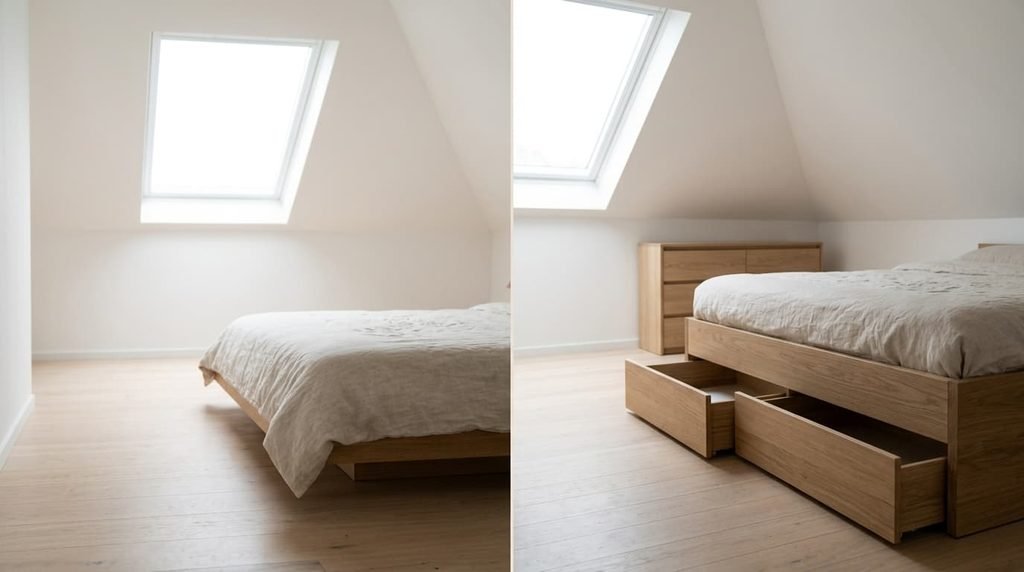
Put the money into the first two items, because rails and slats decide whether the bed is still firm in year five. Items 3 and 4 sit in the middle. A mattress can be replaced in eight years without touching the frame. The headboard is the smallest outlay, since it can be swapped in minutes. Argue the storage frame down, because any bed frame for a low sloped ceiling should earn its height. Don’t pay extra for under-bed drawers, even though the dead zone under a bed looks like free space. A storage frame also costs noticeably more than a platform, so you pay twice: once at the till and once in floor.
A 50 cm storage frame takes the edge to 73 cm from the wall instead of 39 cm. That’s 34 cm lost along a 200 cm run, or 0.68 m² of floor. Each drawer also needs a pull-out equal to its depth. That’s about 45 cm, and a walkway of 37 cm can’t give it.
The slope offers space of its own: a low chest of 70 cm height stands under the roof where nobody sits up.
When your roof isn’t this roof
The order assumes a 40° roof and a 90 cm knee wall. It also assumes a 270 cm room and a 160 cm bed. The best bed frame for a low sloped ceiling changes when any of those moves. At 30°, tan is 0.58, so each 10 cm of frame costs 17 cm of floor and the low frame matters even more. At 50° it costs 8 cm, so a mid-height frame may pass. A knee wall of 120 cm lets any frame pass, because the sit-up line moves 36 cm towards the wall.
If your room is wider than 270 cm, the extra width goes to the walkway. At 300 cm even the 35 cm frame passes, with 85 cm to spare. A single bed of 90 cm frees 70 cm, which can buy back a storage frame. Whether your roof is a straight pitch or has a bend near the wall depends on the house. I can’t see that from here. Stand a tape at the spot where your head will rest and read the ceiling height there.
What to leave off the list
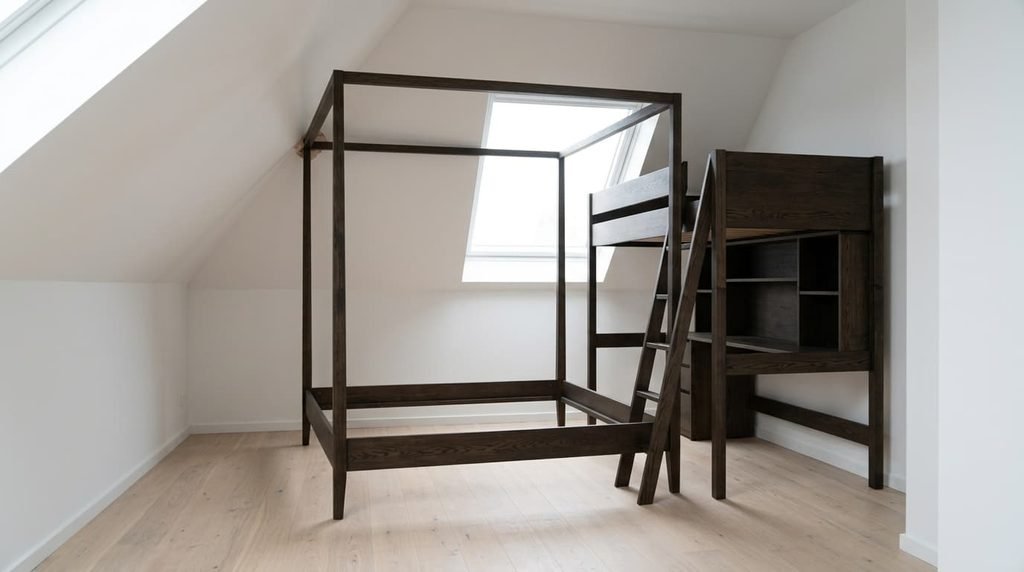
Skip a lift-up storage base. Its lid or mattress swings through an arc, and the slope takes away the height that arc needs. Skip a cabin bed or high sleeper too. Its mattress top sits at 120 cm or more. Sitting up then needs a ceiling of 220 cm, which the slope reaches only 155 cm from the wall.
A canopy frame carries posts about 200 cm tall, and the slope cuts through them 131 cm from the wall. Footboards on the walkway side narrow the gap again. Built-in side drawers fail the same test, since they need a 45 cm pull-out that isn’t there.
Anything tall waits until the roof proves you have the space.
Measure first. Buy the platform frame and the inset slat base next, then a 22 cm mattress. That order gives you the lowest top and the widest walkway. This weekend, stand a tape at your planned sitting spot. Subtract the mattress top and check that 100 cm remains. When it falls short, lower the frame before you move the bed. A bed frame for a low sloped ceiling is judged by its height, not its looks.
Questions readers keep asking
How many pieces do you need for a bed under a sloped ceiling?
Five criteria cover it. The low platform frame and the inset slat base carry the load and take most of the outlay. A mattress of 20 to 22 cm comes next. A footprint that matches the mattress and a slim headboard finish the set, and both cost little.
Should you buy the frame or the mattress first?
Settle the frame height first, because it fixes the top of the bed and the sit-up line. Then choose a mattress of 20 to 22 cm. A thick mattress added later takes 6 cm of floor for each extra 5 cm, so it can undo a good frame choice.
How can you tell a bed frame is well made?
Look at the rails and the base. Solid timber rails of at least 30 mm on bolted brackets stay firm, while chipboard on cam locks loosens. A base needs 14 or more slats and a centre rail with its own leg. If the middle of the base sags by 2 cm under a hand, walk away.