A paperback pushed 3 cm behind its neighbour is enough to make a whole row look careless, and from across the room you can’t say why. Why does a bookshelf still look messy right after you tidy it? Tidying fixes the order of the books. The eye judges the lines they make instead. The fault belongs to proportion, and taste stays out of it.
Our worked example is one compartment 80 cm wide and 33 cm high, with a depth of 28 cm, holding 30 books. Swap in your own numbers as you read, because each step below is a measurement you can repeat.

Why does a bookshelf still look messy? What the eye reads first
Most people blame the order of the books, and order is the one thing the eye can’t read from two metres. A spine’s title blurs beyond about a metre. Grouping by author is therefore invisible at the distance where you judge a room. What the eye does read is every edge that fails to line up with its neighbour.
Take our compartment. The 30 books come in seven heights between 19 and 31 cm. In the order you found them, the top edge changes height 29 times along 80 cm, which is once every 2.7 cm, and the gap above each book swings between 2 and 14 cm. That reads as a jagged skyline. The depths vary too, because paperbacks are 13 cm deep and art books 25 cm. Books pushed to the back wall leave a front line that wobbles by 12 cm.
Light from a side window makes the depth steps worse. Raking light throws a thin shadow beside every book that sits forward, and the eye counts those shadows as clutter.
Order is for the hand, and edges are for the eye.

How to tell why a bookshelf still looks messy
Stand in the doorway and squint until the titles blur. If the top of the books forms a jagged skyline, the fault is height. When the front of the row wobbles as you tilt your head to look along the shelf, the fault is depth. A shelf that looks busy even though both lines are straight has a contrast fault between spines.
Then take a photo and draw one pencil line along the top of the books and another along their front edge. An edge you can trace in a single stroke is fine, while an edge that needs six corrections is the culprit. Turn the photo to greyscale as well. If the shelf still looks like a busy pattern with the colour gone, the spines differ in brightness. Check at two times of day, because a window beside the shelf shows depth faults best in low evening light and hides them under flat morning cloud, so your own window position decides which you see.
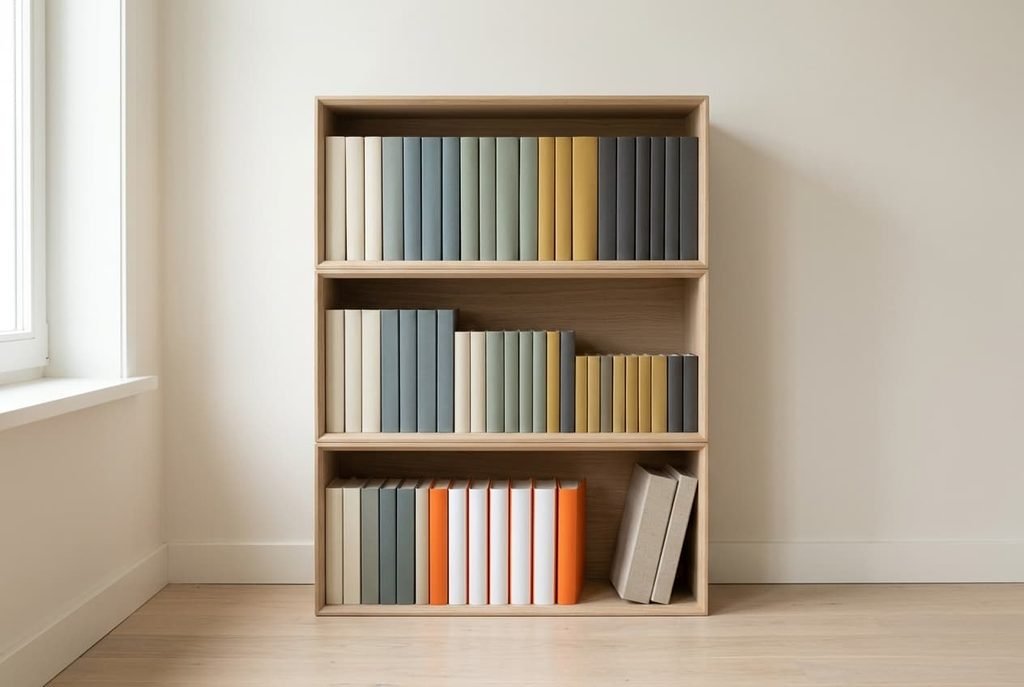
The faults, diagnosed
Why does a bookshelf still look messy? Three faults answer it, and each one links a symptom to a cause and a fix.
“The row wobbles when I look along it” comes from placement. Books of different depths sit against the back wall, so their front edges land anywhere across a 12 cm range, and the eye reads each step as a missed line. Pull each book forward until its spine sits within 1 cm of the shelf’s front edge. I’d defend that flush line against the habit of pushing books back to show the shelf’s depth, since the eye reads the front line and skips the empty space behind it. Check the result by holding a straight piece of card along the front edge, where no spine should sit more than 1 cm behind it. The fix costs nothing and needs a short pass along the row.
“The top of the books looks jagged” comes from scale. Seven heights shuffled along 80 cm make 29 steps, and the eye reads each step as a wobble. Sort the 30 books into three bands. Books of 19 to 22 cm go first and make a short band of 13. Those of 24 to 26 cm follow, and the tall band of 28 to 31 cm ends the run. That gives the top edge two steps in place of 29, with no more than 3 cm of variation inside a band. Subject order can survive inside each band, so you keep a logic only you can read. Put the tallest band at one end of the shelf, so the skyline steps down in one direction like a staircase. The fix is a rearrangement of about 20 minutes.
“It looks busy even though everything is straight” comes from contrast. A white spine printed in black, or a bright orange one, shouts louder than the mid-tone spines beside it, and eight of them scatter the eye across the shelf. Gather the loudest eight into the middle of one run so they read as a single block. Spines that match in brightness read as one tone even when their hues differ. A dark blue and a dark green sit comfortably together. If the block still looks busy, lay them on their sides in two linen-covered boxes about 30 cm wide. The shelf then shows one calm mid-tone surface in place of eight competing spines. This is the only fault that may need a purchase.
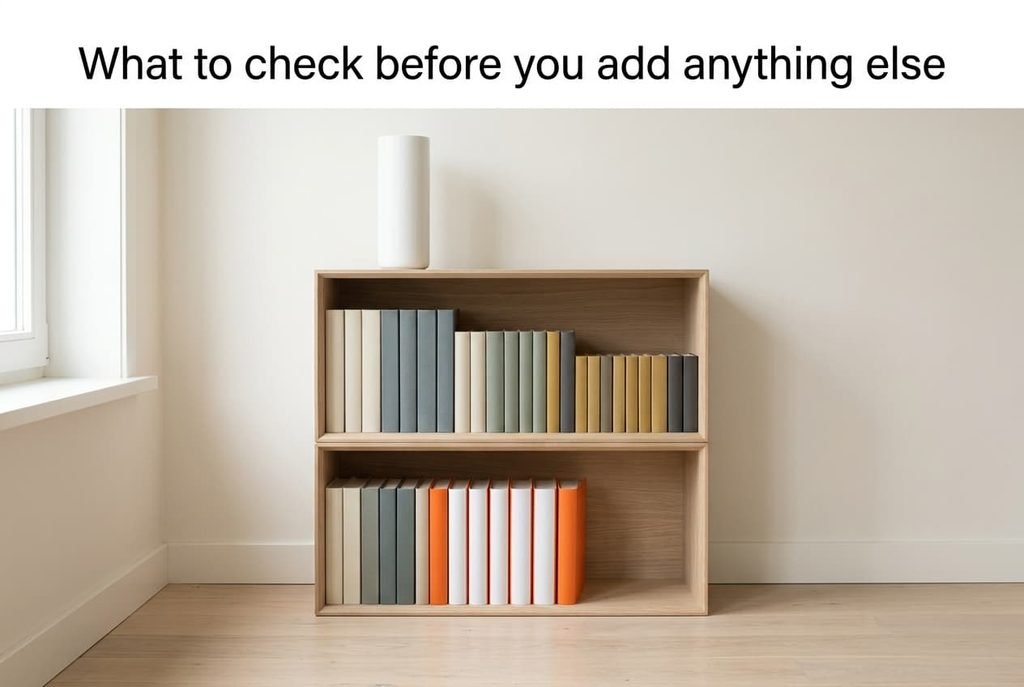
What to check before you add anything else
Why does a bookshelf still look messy a week later? New arrivals break the bands, so run three checks before one goes on the shelf. Does its height fall inside one of the existing bands, within 3 cm? Can it sit flush with the front edge? Does it leave the free width as one block, instead of cutting it into 1 cm gaps?
In our compartment, the 30 books fill 75 cm at about 2.5 cm each, which leaves a 5 cm sliver. A tidier plan keeps 22 books. They fill 55 cm and leave one block of 25 cm empty at one end. An object taller than the highest band, such as a 40 cm vase, belongs on top of the unit, because it can’t enter a 33 cm opening.
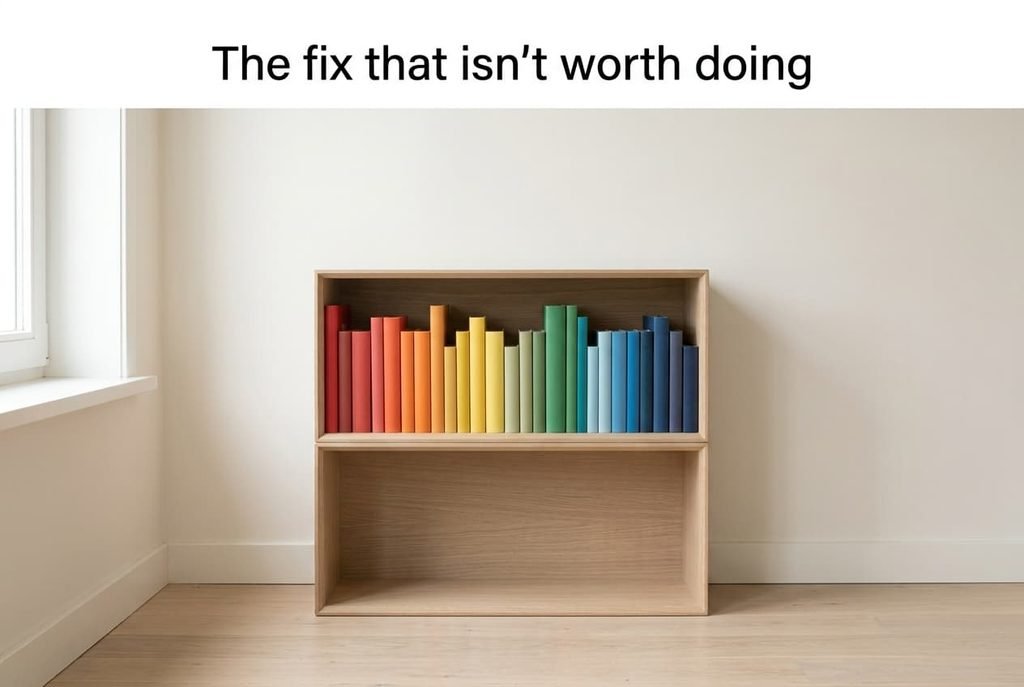
The fix that isn’t worth doing
Sorting every spine into a colour rainbow looks like the obvious cure for a busy shelf. It swaps the busy shelf for a different fault. A rainbow puts a hue change between most neighbours, so the contrast fault gets 11 steps in place of one block. It also shuffles the heights back into the same 29 steps you just removed. A related shortcut covers the shelf with a curtain, which hides the lines. The books stay as crooked as before. It also costs a purchase.
A rainbow fixes the colour and breaks the height.
The idea works only when the books share one height, such as a set of 30 matching paperbacks. Whether a colour block helps in your room also depends on how many hues you own and on the light that reaches the shelf, which I can’t see from here.
The shelf looks messy because the eye reads edges, and tidying only fixes order. Pull every book flush to the front, group the books into height bands and give the loudest spines a box. One check catches the fault fastest: stand 2 m back, squint until the titles blur and trace the top and front lines with your eyes. Why does a bookshelf still look messy after a tidy? Because the lines were never straightened first. Run that single check before you buy a bookend or a basket. Repeat it after each new purchase, since one extra tall book restores the jagged line.
Questions readers keep asking
Why do my books look uneven on the shelf?
Their edges miss two lines. One is the front edge and the other is the top edge. Books of different depths pushed to the back wall leave a front line that wobbles by as much as 12 cm, and seven different heights give the top a jagged skyline. Pull the books forward and group them by height.
What is the quickest way to make a bookshelf look tidier?
Pull every book flush with the front edge of the shelf. It needs one pass along the row and costs nothing. It also removes the wobbling front line, which is the most visible fault from across the room. Group the heights afterwards if you have 20 more minutes.
Can I fix a messy bookshelf without buying anything?
Yes. The front line and the height bands both come from rearranging what you own. Only the contrast fault may call for a purchase, such as two boxes for the loudest spines, and even that is optional if you move those books to the middle of one run.