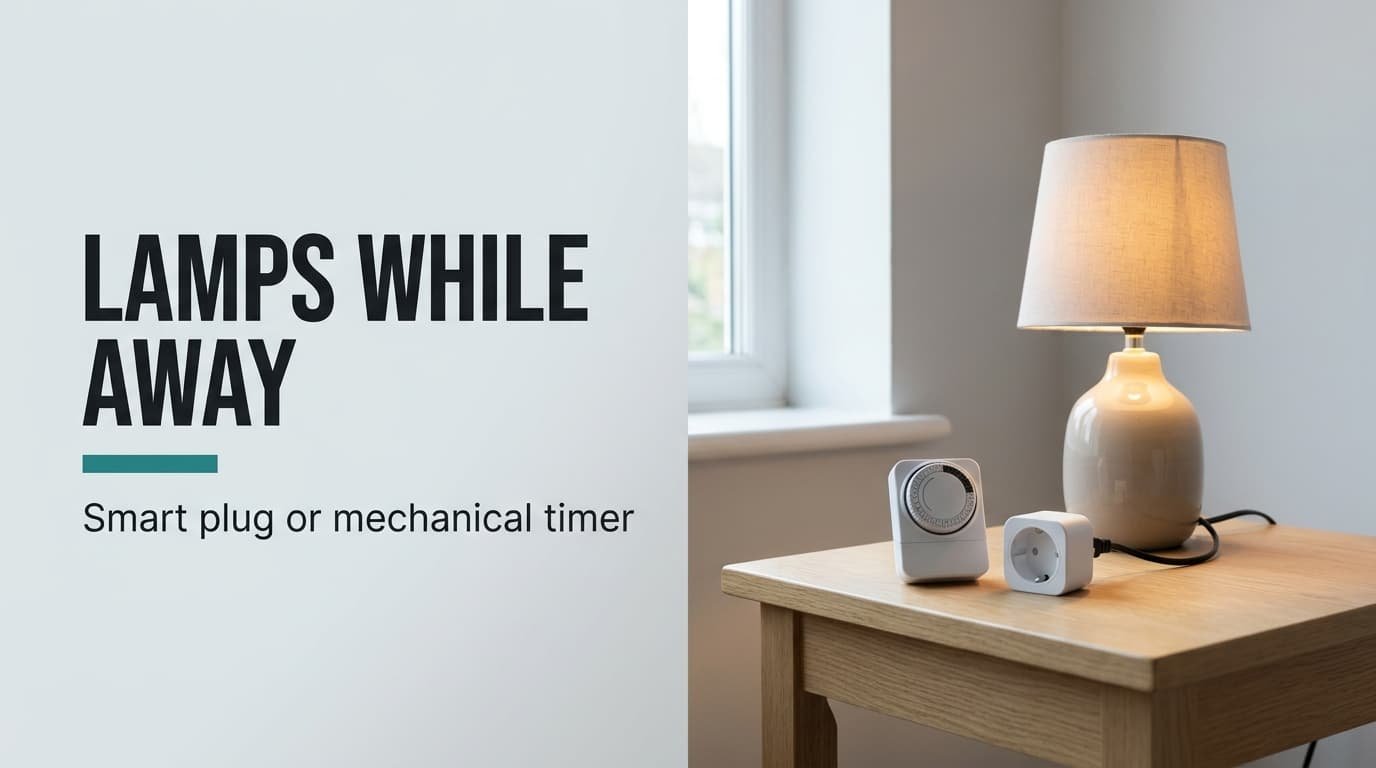
A pin on a dial timer says the lamp comes on at 16:45, and it says so on every evening you’re gone. That rigidity decides a smart plug or a mechanical timer. Take the timer for a short trip or a flat with no Wi-Fi, and take the plug once you’re away for more than ten days. The property to weigh is whether the switching times can change from one day to the next.
The flat in these sums is a rented UK one, and the trip lasts 14 days in October. All numbers are rounded assumptions, so swap in yours. Leave brands and prices aside, since both change quickly.
The one property that decides a smart plug or a mechanical timer
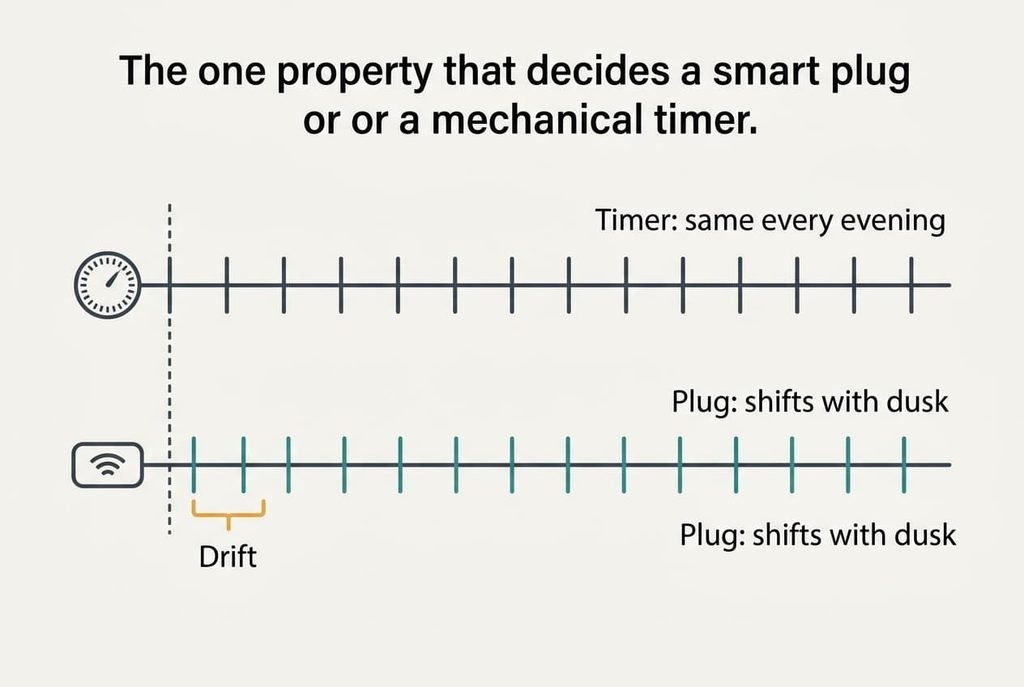
The property to weigh is whether the switching times can change from one day to the next. A dial timer carries 96 pins, one for each 15 minutes. The pattern you set repeats every 24 hours without change. Pin 16:45 to 23:00 and you’ve set 25 segments that run identically on all 14 evenings. A plug keeps its schedule in software, so each evening can differ. A random offset of 20 minutes either way gives every switch a 40-minute spread.
Fixed times fail a second way, because the day itself moves. Assume dusk comes 3 minutes earlier each October evening. Across 13 steps that adds up to 39 minutes. A lamp pinned to 16:45 on day one therefore comes on after the room has sat dark for 39 minutes by day 14. Set the timer for the middle evening. That splits the drift in two and leaves about 20 minutes of error either side.
A smart plug or a mechanical timer will light the lamp equally well, and only the plug changes its habits. The timer holds its own while the drift stays small, and every later section turns on that gap.
A plug can also run a separate weekend schedule, while the usual dial has a single 24-hour wheel and repeats the same times on a Saturday as on a Tuesday.
Head to head on a fortnight away
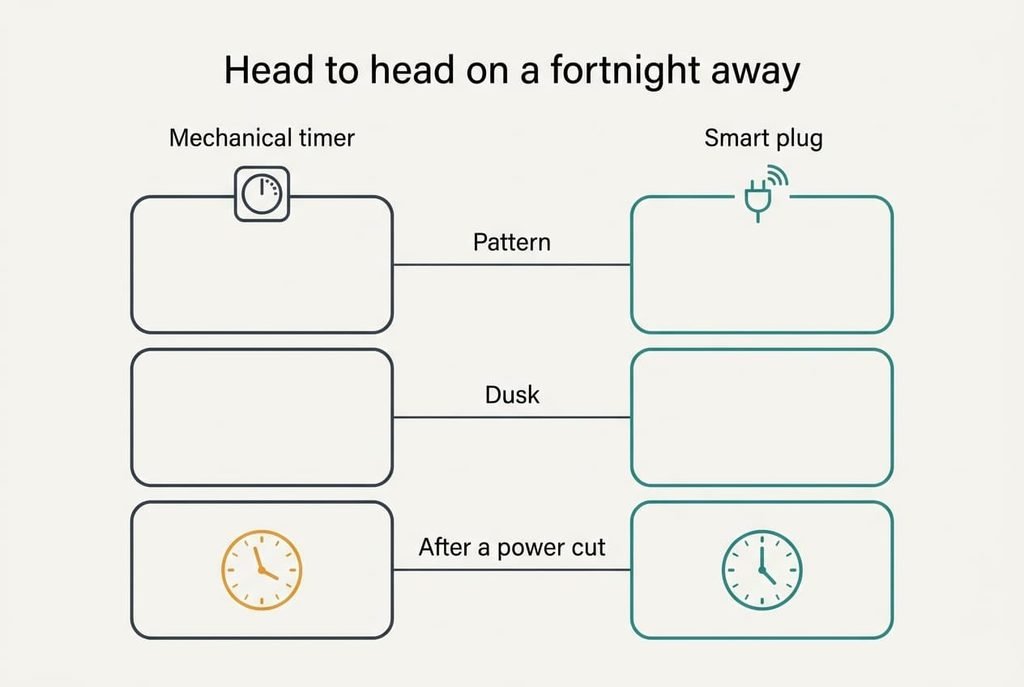
You can check most rows from the packaging, without plugging anything in. Neither option scores on all of them. Which ones count depends on how long you’re gone and whether the router stays on.
| Question | Smart plug | Mechanical timer |
|---|---|---|
| What sets the times | A schedule on a phone | Pins or a keypad on the unit |
| Can the pattern change daily | Yes, with random offsets | No, it repeats exactly |
| Does it follow dusk as days shorten | Yes, with a sunset setting | No, you reset it by hand |
| After a power cut | Re-syncs once the router is back | Clock stops and stays behind |
| What it needs besides itself | A router and a phone | A socket and a lamp |
| Standby draw | About 1 W | About 0.5 W |
| How it usually fails | A lost network connection | A worn pin or a stuck motor |
The power cut is where the timer springs its surprise. A dial timer with no reserve stops its motor during a 3-hour cut. It then runs 3 hours behind on every evening after, so a cut on day five puts the lamp on at 19:45 for the last nine. Nothing resets it until you’re home.
Where a smart plug wins
A plug wins when you’re away long enough for the day to move. Fourteen evenings hold 13 shifts of 3 minutes, and a sunset-linked schedule follows them without your help. Add a random offset and no two evenings match. It can also run a second lamp on its own offset, so two rooms never switch together.
It also reports back. A phone shows the plug as on or off, so a dead bulb surfaces on day one and not on day 14. A dial timer can’t tell you anything at all.
Two conditions apply. The schedule must live on the plug itself, since a schedule held only in an app stops when the app loses its connection. The router must also stay powered for the whole trip. If you normally switch it off, count its draw too. At an assumed 8 W over 336 hours that’s 2.7 kWh, many times the plug’s own 0.34 kWh at 1 W.
Where a mechanical timer wins
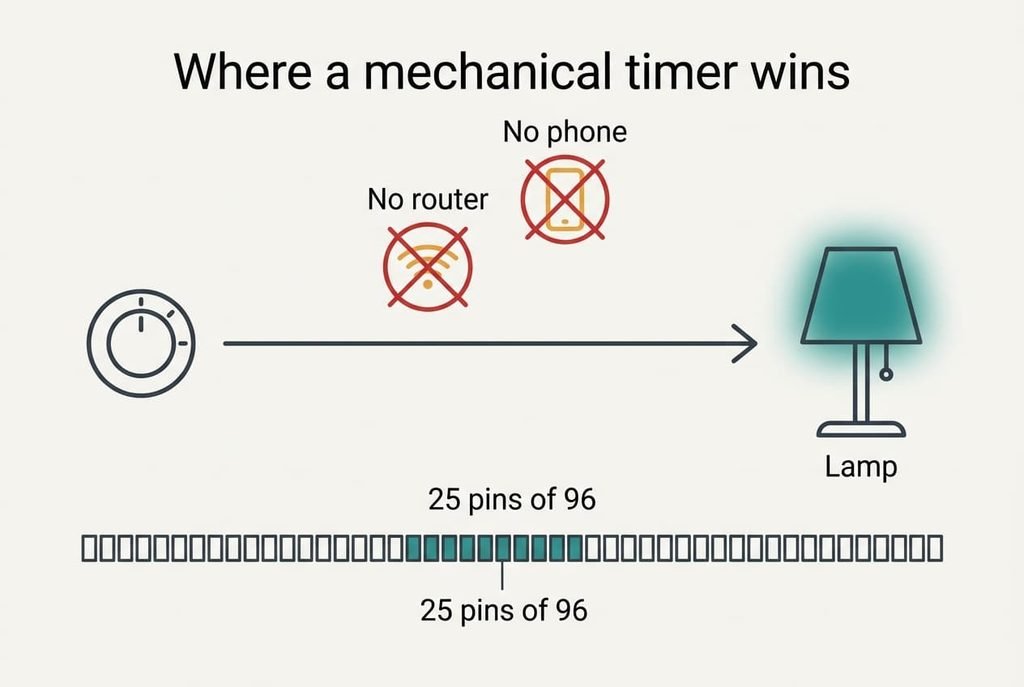
For a smart plug or a mechanical timer, the timer wins whenever nothing may go wrong at a distance. It needs only a lamp and a socket. Nothing in it connects to a router or a phone. Nothing can update a setting while you’re on a plane. A pattern of 25 pins takes five minutes to set. Its standby draw is about 0.5 W, so 336 hours cost 0.17 kWh, half of the plug’s figure.
It also wins where the network is weak, such as a holiday flat with one bar of signal. For a trip of ten days or fewer the drift stays at 30 minutes. Pinning the middle evening halves it to 15 minutes either way. Few neighbours would notice that. Pins work in 15-minute steps, which is coarse but ample, since nobody can tell 16:45 from 16:50 through a window.
Look for a power reserve on the packet. A small battery or capacitor keeps the dial turning through a cut. Without one, a 3-hour cut leaves a 3-hour error until you’re home.
When neither is right
A lamp with a built-in dusk sensor follows the day by itself, so it has no clock to drift and no network to lose. The price is a lamp lit from dusk until dawn. At 8 W for 14 hours that’s 112 Wh a night, or 1.57 kWh across 14 nights, against 0.7 kWh for the 25-pin pattern.
A lamp lit all night looks as odd as one never lit. If you want it off by midnight, the sensor lamp can’t do it because it has no clock. Pair it with a timer in the same socket and you’re back to the second option, with one more part to fail. It also repeats exactly as a timer does, only with the right start. That makes it a fit for two or three nights, when drift can’t build up. Nobody’s watching for a pattern then.
Test the lamp’s sensor in a dark cupboard before you leave, because a sensor facing a street light never sees dusk.
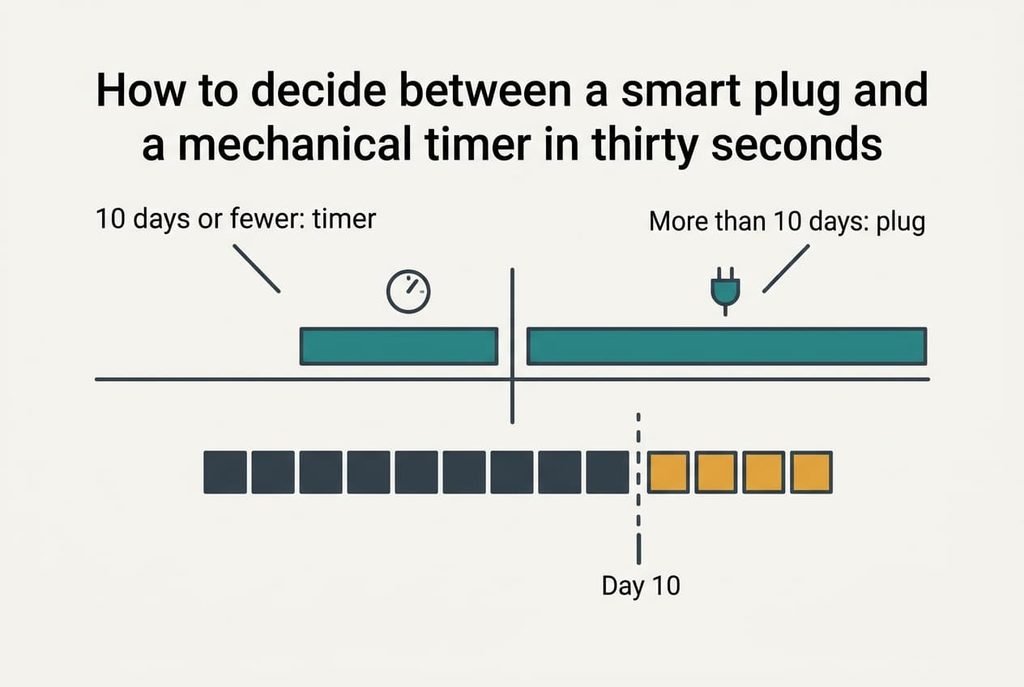
How to decide between a smart plug and a mechanical timer in thirty seconds
Count the days you’ll be away, then check whether the flat has a router you can leave on. Drift runs at 3 minutes a day, so ten days is 30 minutes and fourteen is 42. Anything past 30 minutes shows to someone watching, and anything under it passes unnoticed.
If you’ll be gone more than 10 days and the router stays on, take the plug and set a sunset schedule with a 20-minute random offset. If the trip is 10 days or fewer, or the flat has no dependable Wi-Fi, take the timer with a power reserve and pin it for the middle evening.
The plug changes its habits and the timer doesn’t, so how long you’re gone is the only question here. Short trips forgive a fixed pattern and long ones expose it. Choose between a smart plug or a mechanical timer once you’ve counted the days, and run it for three evenings before you leave. That rehearsal catches a wrong pin or a lost setting while you can still fix it.
Questions readers keep asking
How many lamps do I need to cover a short trip?
Two is plenty. Put one in a front room and one in a back room. Give each a different pattern, with start times 20 minutes apart. More lamps add little and double the standby draw. A single lamp that switches on and off alone is enough for a trip of a weekend.
When should I set it up before leaving?
A week before. Run the schedule for three evenings while you’re home and watch the first one switch on. A mistake found on a Tuesday evening costs you nothing. The same mistake found at the airport costs you the whole trip. Pin the timer for the middle evening, and check the router stays powered.
How do I judge a plug or timer in a shop?
Check three things on the packet: a stored schedule for the plug, a power reserve for the timer, and a stated load that exceeds your lamp’s wattage. A thin pack that mentions none of them probably lacks them. Skip any unit that doesn’t say where its schedule is kept.