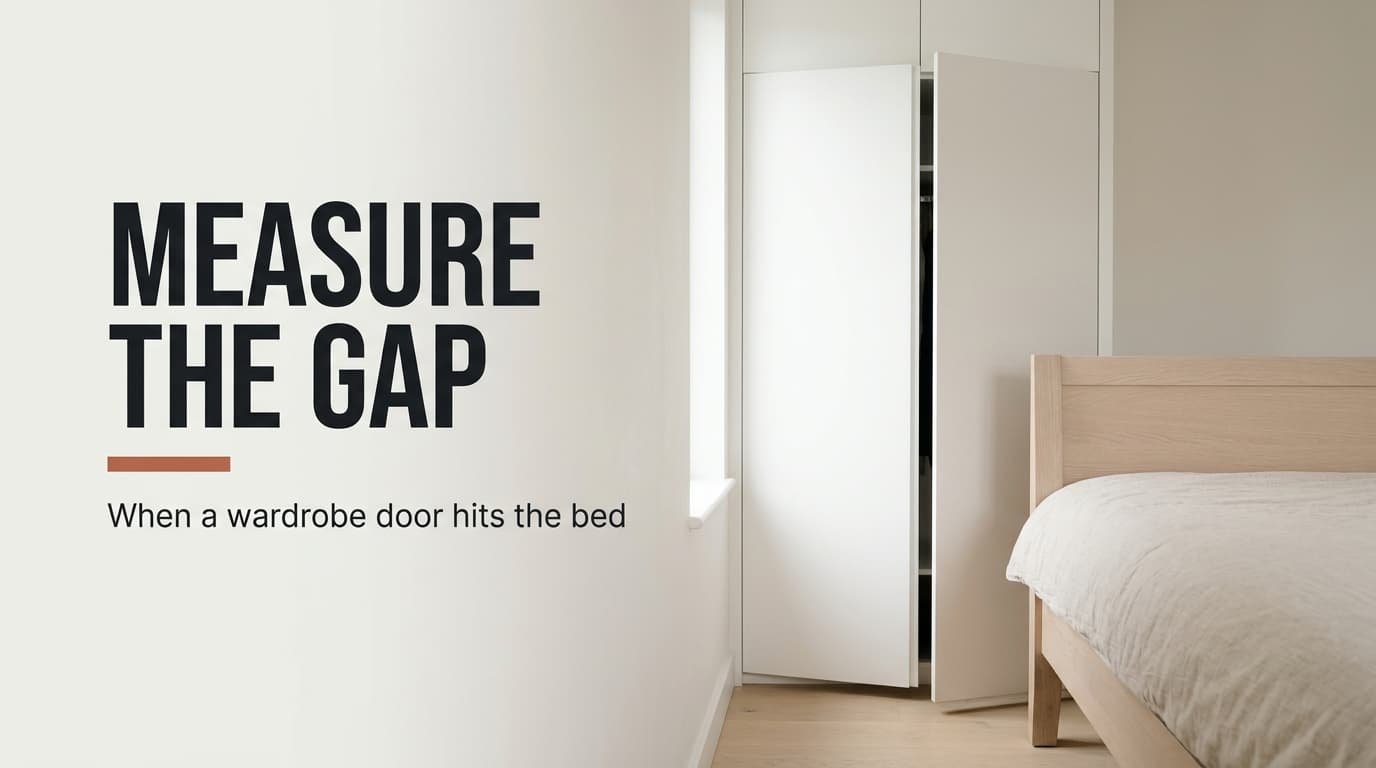
Every morning the left wardrobe door stops against the end of the bed with a knock, and you shuffle sideways to reach your shirts. In a bedroom where the wardrobe door hits the bed, the door isn’t faulty. It has 70 cm of room and needs 75. The model room is a Dutch bedroom of 330 by 290 cm. There those 5 cm leave each door stuck at 69° and hide 27 cm of the rail on each side. Count your own knocks across seven mornings before any purchase. All sizes are assumed, so measure yours. No brands or prices appear.
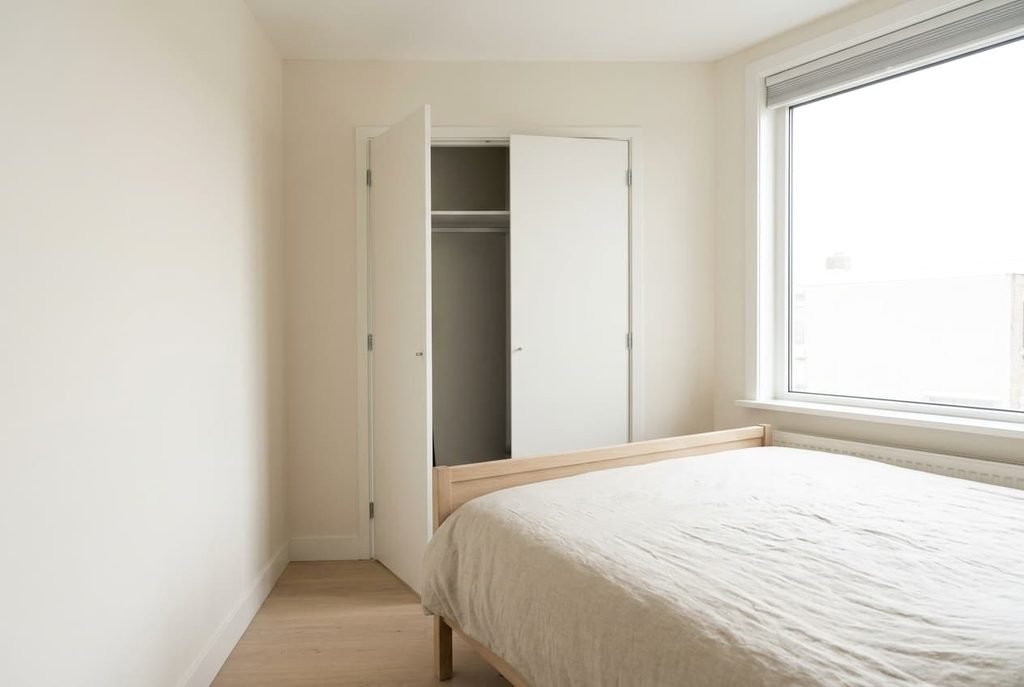
What is actually happening in a bedroom where the wardrobe door hits the bed
A hinged door sweeps a quarter circle as wide as the leaf. Our wardrobe sits in a niche 150 cm across and 60 cm deep, with two leaves of 75 cm. The bed is 160 by 200 cm, and its head touches the far wall. The gap from its foot to the wardrobe front is therefore 330 − 200 − 60 = 70 cm. A leaf of 75 cm swinging past a barrier 70 cm away stops when 75 × sin θ = 70. That gives θ = 69°. A full swing needs about 100°.
The stuck door also costs you reach. At 69° the free edge of each leaf stands 75 × cos 69° = 27 cm from its hinge. The two edges are 96 cm apart. That leaves 64% of the 150 cm rail in view and 27 cm shaded at each end. With eight openings a day, that’s 2,920 knocks a year. The size to compare is the clearance in front of the wardrobe against the width of one leaf, and the shortfall is 5 cm.
Bedding makes it worse. A duvet hanging 10 cm over the foot lengthens the obstruction to 210 cm. The gap shrinks to 60 cm and the door stops at 53°.
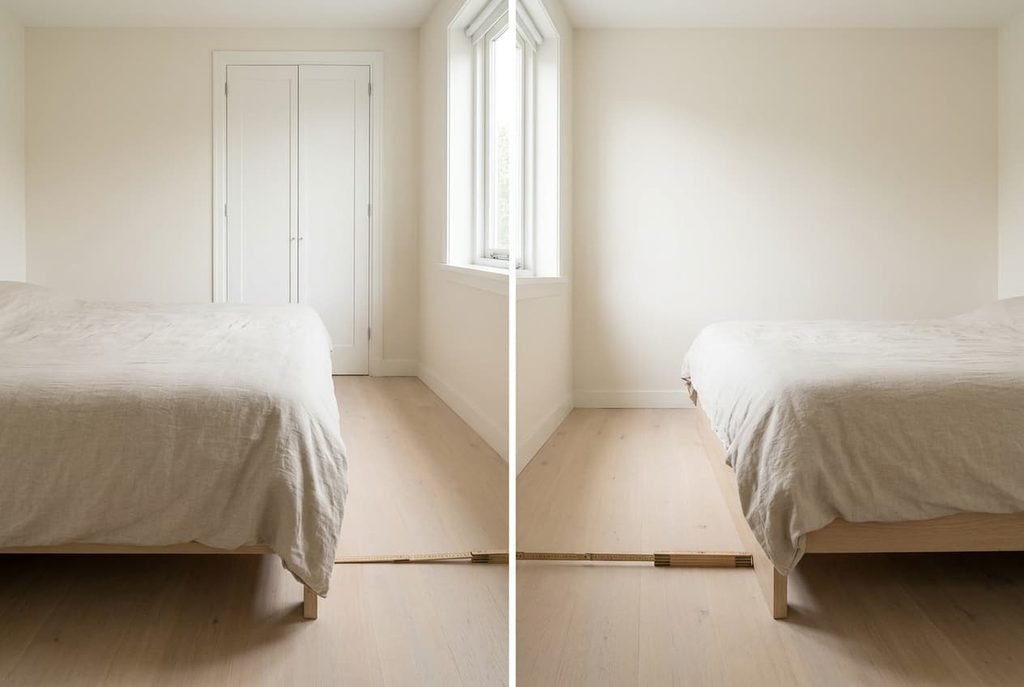
Confirm which version of a bedroom where the wardrobe hits the bed you have
Three quick tests separate the causes of a bedroom where the wardrobe door hits the bed. First, measure from the bed’s foot end to the wardrobe front and compare the result with the width of one leaf. A gap under 75 cm means geometry is the cause. A gap over 75 cm points to a stiff or sagging hinge instead.
Second, strip the bed to the bare mattress and open the door. If the door now clears, bedding is your version, because the mattress alone ends 6 cm short of the frame in our room. If it still stops, the frame is the version you have.
Third, push the closed door open slowly with a hand on its free edge. A leaf that scrapes the floor or leans out of square is a hinge fault, and nothing below will help until it’s fixed. Most bedrooms show the first two together. Work down the fixes in the next section until the knock stops, and note every hit on the door in pencil.
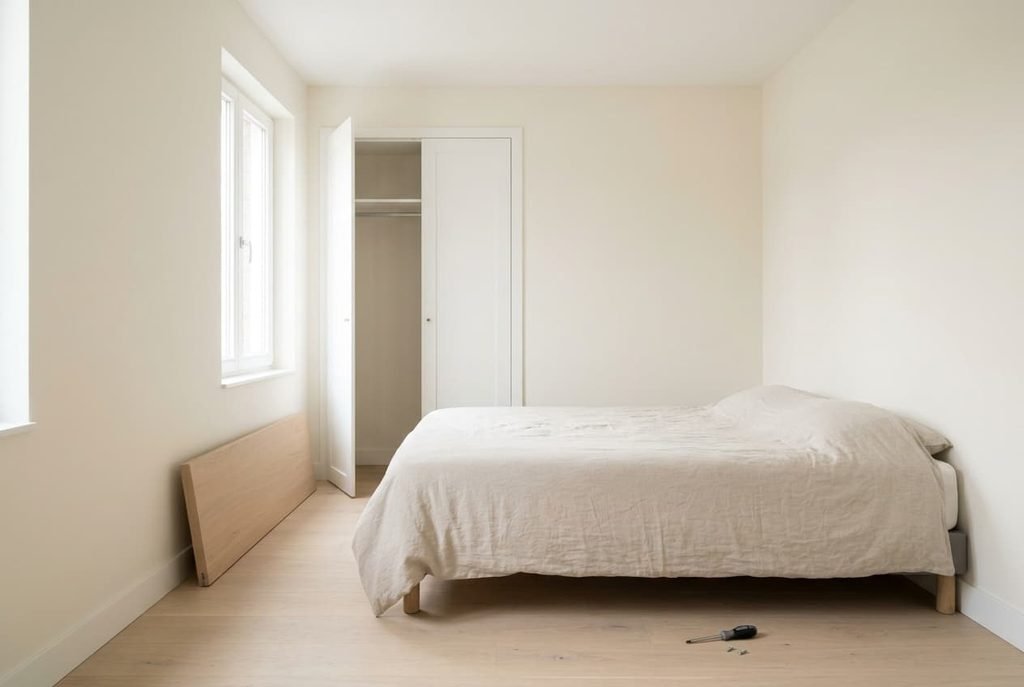
The fixes, in order
Take off the footboard, which shortens the obstruction. In a bedroom where the wardrobe door hits the bed, this is the cheapest move to try first. The door stops where the bed ends, so 6 cm less frame hands back 6 cm of swing. Without it the bed is 194 cm long, the gap grows to 76 cm and the leaf clears by 1 cm. It costs a screwdriver and 20 minutes, plus a safe place to store the board where it won’t get lost. The margin is thin, so a duvet hanging over the end undoes the gain at once. A solid frame without a removable footboard has to be swapped. Tuck the duvet in.
Turn the bed through 90° so that the long edge faces the wardrobe, which changes where the obstruction stands. The gap is measured from the bed’s foot end, and a turned bed’s foot end is its side. The bed then occupies 160 cm of the length. That gap becomes 330 − 60 − 160 = 110 cm, so each leaf clears by 35 cm. It costs an evening of moving furniture and fresh routing for the bedside cables, which now cross the floor to reach the sockets. The bed now uses 200 of the 290 cm width and leaves a strip of 90 cm for walking. The wall behind the headboard moves with it.
Swap the two leaves for four folding leaves of 37.5 cm, which shrinks the door’s own reach. Each pair hinges in the middle, so only half a leaf swings out: about 37.5 cm, well inside the 70 cm gap. It means buying a door set and giving up an afternoon to fit it. The niche must be square to within a centimetre, or the folds jam. The folded stack takes room, so assume 10 cm lost at each end and an opening of 130 cm out of 150, which is 87%.
Have sliding doors fitted, which removes the swing altogether. Two panels of 75 cm run on a track, and nothing leaves the wardrobe front, so the 70 cm gap stops mattering. It needs a fitter and a level floor, plus the longest wait of the four. Only one panel’s width opens at a time. You reach 75 cm of the 150, or 50% of the rail, and slide the panel across for the rest.
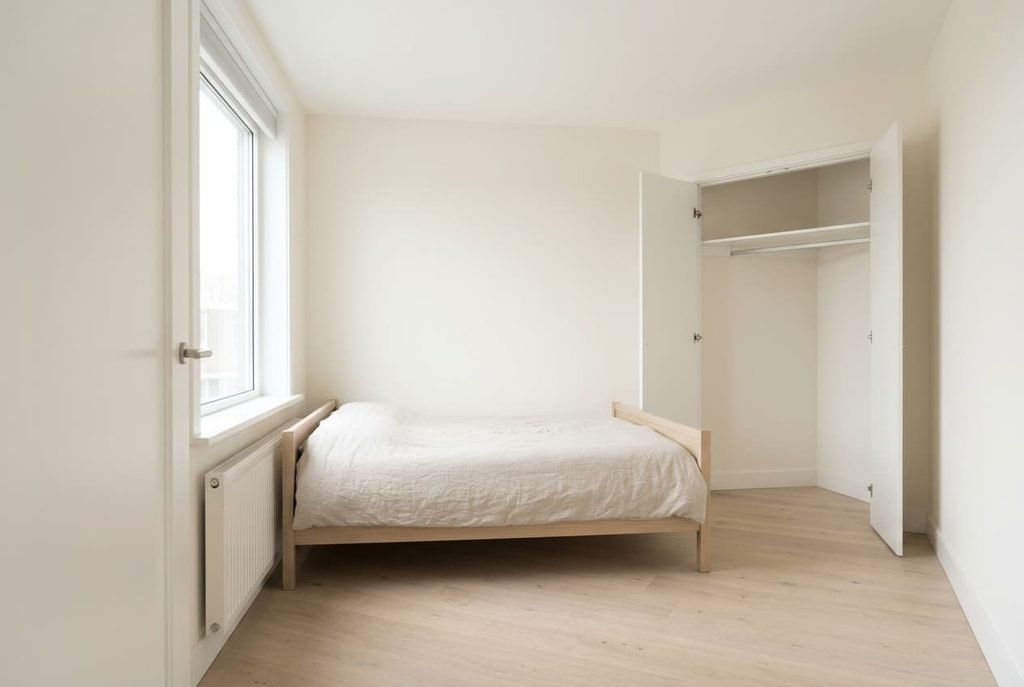
What this bedroom’s own layout means for you
Fixable and fixed things stay apart in this room. The bed and its footboard can change, and so can the doors. That niche can’t. The wardrobe stays 150 cm across and 60 deep, and a shallower unit of 50 cm is possible only if you rebuild the wall.
A second door matters too. The room’s own door on the long wall swings 83 cm into the room. Under the window on the opposite wall stands a radiator, 10 cm proud. After the bed turns, the walking strip is 90 − 10 = 80 cm, which is 3 cm less than that door’s arc. Turning the bed works here only if you rehang the door to open outward. Draw both arcs on the floor with tape and the overlap shows at a glance.
Check these two numbers on your own plan before you move anything.
The fix that doesn’t work
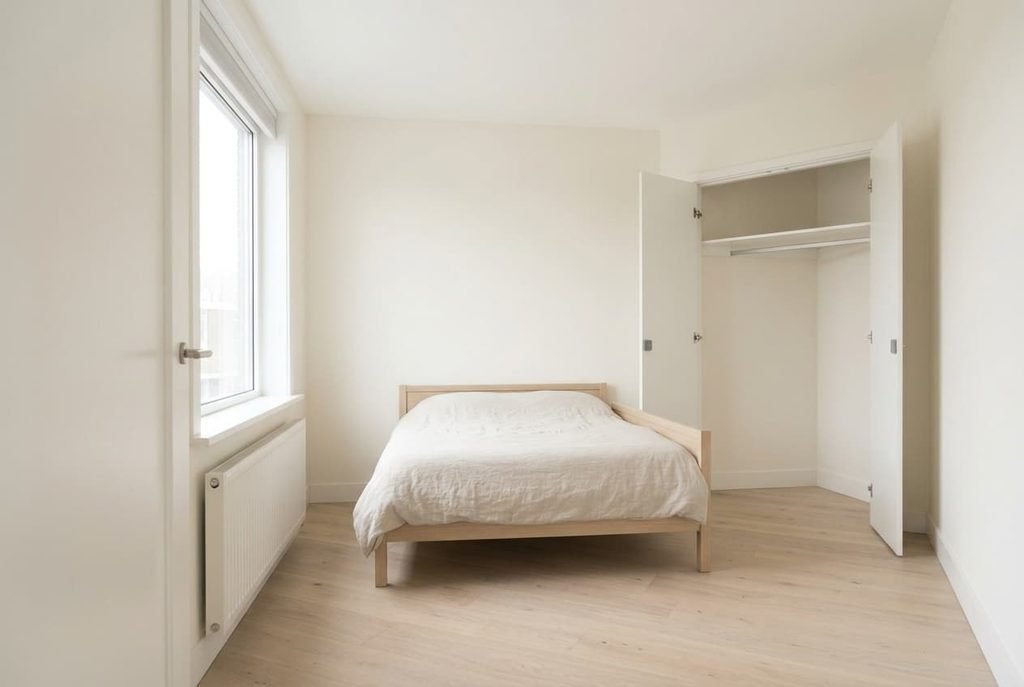
Replacing the bed with a narrower one is the tempting purchase, and it chases the wrong number. A bed 140 cm wide still reaches 200 cm along the room. The gap stays at 70 cm and the leaf still stops at 69°. The narrower bed spans 75 to 215 cm of the 290 cm width, which still lies in front of 140 of the wardrobe’s 150 cm.
Felt pads on the door edge make the knock quieter and leave the geometry untouched. Soft bumpers on the bed frame do the same. Both protect the paint and leave the stop angle at 69°, so the 27 cm shaded at either end of the rail stays shaded. A stronger pair of hinges only lets the door hit the bed with more confidence.
Gap length decides this, not bed width.
Begin with the free fix, then the turn. A bedroom where the wardrobe door hits the bed needs 5 cm back, and the footboard supplies 6. Measure the gap tonight and strip the bed tomorrow. Then test the door before you buy anything. Keep the 1 cm margin honest by tucking the duvet in each morning. Look at the angle the door reaches after a week.
Questions readers keep asking
How much clearance does a hinged wardrobe door need?
At least the width of one leaf, plus a few centimetres so a hand fits. In our room that’s 75 cm for the leaf and about 80 cm in practice. Anything under the leaf width stops the door short, and the shortfall is the number to chase.
Can I just reverse the hinges?
It won’t help here, because both leaves swing the same distance either way. Reversing the hinge side moves the free edge but not the gap. It only pays when one leaf has free floor beside it and the other doesn’t.
Do folding doors reduce the wardrobe’s usable space?
Slightly. The stacked leaves take about 10 cm at each end in our sums, leaving 130 of 150 cm open. For most rails that’s enough. Measure your widest item first, because a long coat on a hanger needs the full opening.