The deciding feature of a power meter that finds wasteful devices is how honestly it reads small loads, because most of the waste in a UK home hides below 10 W. Picture a household that wants to know which devices around the television quietly use the most across a month. A meter that shows only whole watts turns a 0.4 W charger into a zero. It turns a 4 W box into a 4 that might really be 3 or 5. This guide ranks four checks in order, then ends with a test of two minutes at the plug.
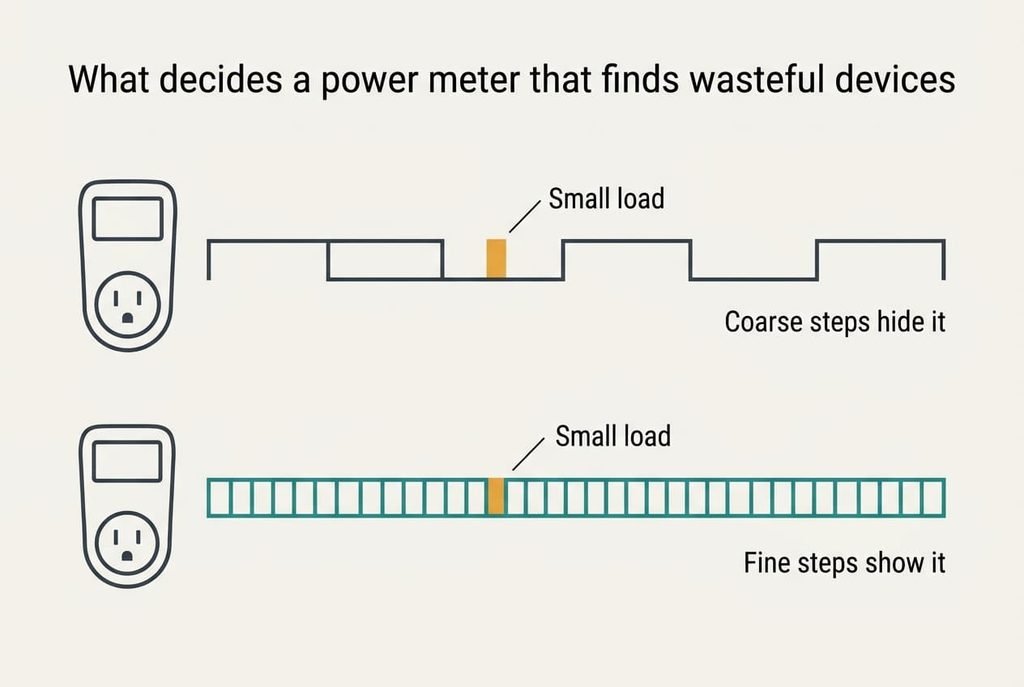
What decides a power meter that finds wasteful devices
Waste is small and constant, which is why it escapes notice. A box drawing 5 W all day and night uses 5 × 24 = 120 Wh daily, or 0.12 kWh, and that comes to about 44 kWh over a year. A kettle drawing 3 kW for three minutes uses 150 Wh, about the same as that box uses in a day and a quarter. The kettle feels dramatic.
The box does more damage over a year, because it never stops.
Small loads need a meter whose own error is smaller than the load. If the meter is out by 1 W, a 5 W reading is out by 20%, and a 0.5 W reading means nothing at all. The criterion that decides everything is the smallest load the meter reads without drifting or rounding to zero, because every other feature is wasted on a number you can’t trust.
That leaves out how the meter reports totals over time and how much it can carry. Those come next, and they matter less than the first check.
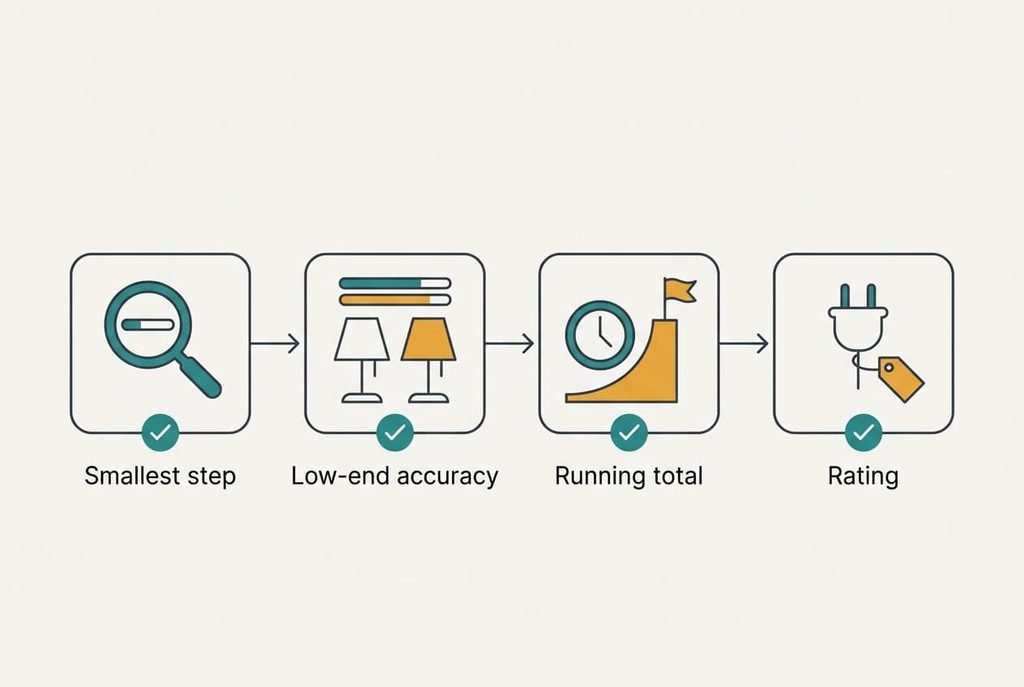
Four criteria for a power meter that finds waste in devices
1. Check the smallest step the display shows. Look for a figure that moves in tenths of a watt at low load, not whole watts. A box on standby at 0.4 W and one at 0.9 W both show as zero or one on a coarse display, so you would call two different devices equal. Day to day, that difference decides which plug gets a switch. Judge it by reading the box or the display while a small load is plugged in. If it’s wrong, every standby load looks identical and you stop looking.
2. Check how accurate it stays at the bottom of its range, which most buyers never test. Accuracy is often quoted for large loads, while the error at 5 W can be several times larger in percentage terms. Judge it by plugging in a lamp alone, then adding an identical one. The second reading should be close to double the first. If it isn’t, small loads will mislead you daily, and a 10% error on a 5 W box hides 0.5 W.
3. Check that it keeps a running total in kWh with the elapsed time beside it. A snapshot in watts misleads whenever a device cycles, such as a fridge that reads 2 W between runs and 80 W while the compressor works. A total over 24 hours tells the truth. Judge it by unplugging the meter for ten seconds and seeing whether the total survives. If it doesn’t, a tripped circuit erases a week of data.
4. Check the rating on its body and how it fits the socket. A UK plug carries up to 13 A, which is about 3 kW. A meter must be rated at least that high for anything you plan to test. Judge it by reading the label for the maximum load, then holding the meter against a power strip to see if it blocks its neighbours. If it’s wrong, a heater may overload it, and a bulky body wastes a socket.
The specifications that sound better than they are
A colourful app with cost graphs gets the heaviest promotion, and it adds the least. A meter that sends readings to a phone still measures with the same small circuit inside, so the graph can’t be more accurate than the figure it plots. Graphs also smooth data, which can hide exactly the small, steady loads you set out to find.
Promotion favours it for a reason: it photographs well and gives a screen to point at. Shop displays love it too, because a glowing graph looks like precision from across the room. The app also needs a wireless link and an account. A phone must stay close by, and any of those can fail. The cost setting is no better, since you type in your own rate and multiply anyway. A plain display and a reliable kWh total do the real job in any power meter that finds wasteful devices. A graph is a nice extra once the four checks pass.

Three readers and which criteria move
Someone clearing out an entertainment cabinet cares most about the first two criteria. Their loads are tiny and constant. Resolution decides everything there, with low-end accuracy backing it up. The rating hardly enters into it, because nothing in the cabinet comes near the limit of a plug.
Someone checking a fridge or a dehumidifier cares about the third. Those devices cycle, and a snapshot taken at the wrong moment is useless. A 24-hour total is the only figure worth writing down, since it averages the quiet stretches and the busy ones together.
Someone testing a heater or a kettle moves straight to the fourth. The rating on the body must exceed the load. The first three matter less, because the numbers are large and easy to read.
When to walk away
Pass on any model whose body shows no maximum load and no safety marking. A meter sits between a socket and a device, so it carries the whole current. An unmarked rating means you can’t tell what it will survive, and a power meter that finds wasteful devices has to say what it can carry. A glossy display doesn’t fix that. Neither does a long feature list on the box.
Leave behind a meter that shows only instant watts with no running total as well, since that tells you what a device draws now and nothing about a week. You’d have to sit watching it for a whole day to learn what a fridge uses, and you’d miss every overnight pattern. A total lets you plug it in and read the result in the morning.
If a display flickers between two numbers on a steady load, take that as a reason to distrust the meter.
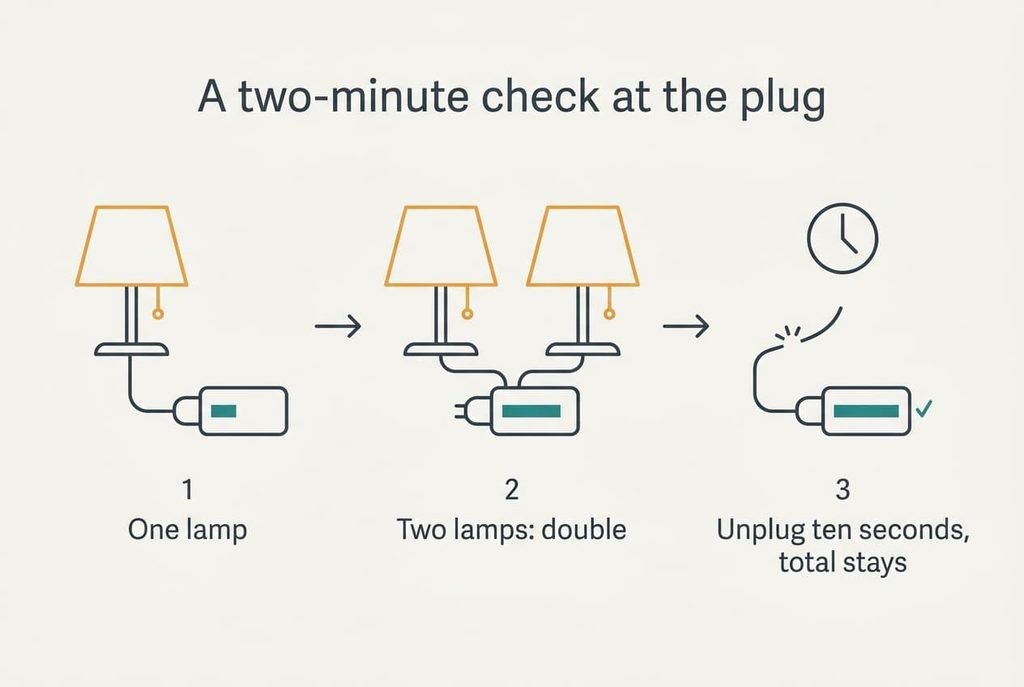
A two-minute check at the plug
Plug in one lamp with a known low rating, then add a second identical lamp, and watch the readings. Note the first figure, which should sit near the label value, and the second, which should be close to double. Then unplug the meter for ten seconds and plug it back in. The total should still be there, and the display shouldn’t reset to zero.
Finally, check the meter’s body for a stated maximum load. Jot down each outcome on a scrap of paper. A meter that passes every one has earned its place in the socket, and one that misses a check should go back.
When a power meter that finds wasteful devices passes this check, use it on one device a day for a week. Start with the biggest suspect, then move to the quietest. You’ll quickly learn which plugs deserve a switch, and that short list is the purchase’s real payoff. Repeat the lamp test yearly.
Questions readers keep asking
Do I need a meter that shows tenths of a watt?
If your goal is standby waste, yes. Most devices that sit on all day draw under 10 W, and whole-watt steps cut that into a few coarse bands. For checking a heater, whole watts are plenty. Pick the step size to match the loads you plan to test.
How much should I spend on one?
Spend relatively little, but not the least. The cheapest models often skip the low-end accuracy and the rating label, which are the two things that matter. Pay a little more for a clear display and a stated maximum load. Ignore apps and extra graphs.
Will I still use it after the first week?
Many people do, because every new appliance raises the same question. A meter earns its keep by finding two or three wasteful devices, and then it can be lent to a neighbour. Keep it in a drawer with a note of the lamp test, so you trust it each time.