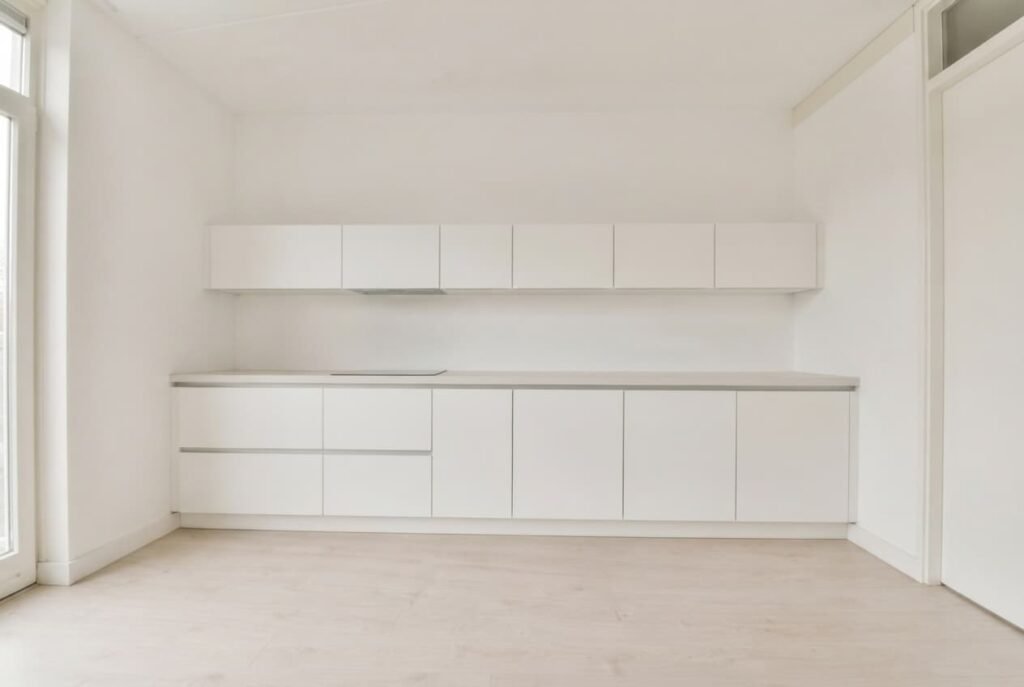
Clean worktops and tidy cupboards don’t stop a kitchen feeling unfinished when the strip above them has no job. Most people can’t name what bothers them. They only sense that the top of our kitchen wall units pulls the eye in the wrong direction. Three measurements explain the effect, and this guide turns them into a five-minute check and three repairs graded from nothing to a modest purchase. The sample is a Dutch flat kitchen with a 255 cm ceiling, units from 140 to 205 cm and a run of 270 cm. Your own kitchen will give other figures. Take a rule to it before choosing anything.
Why the Top of Our Kitchen Wall Units Looks Neglected
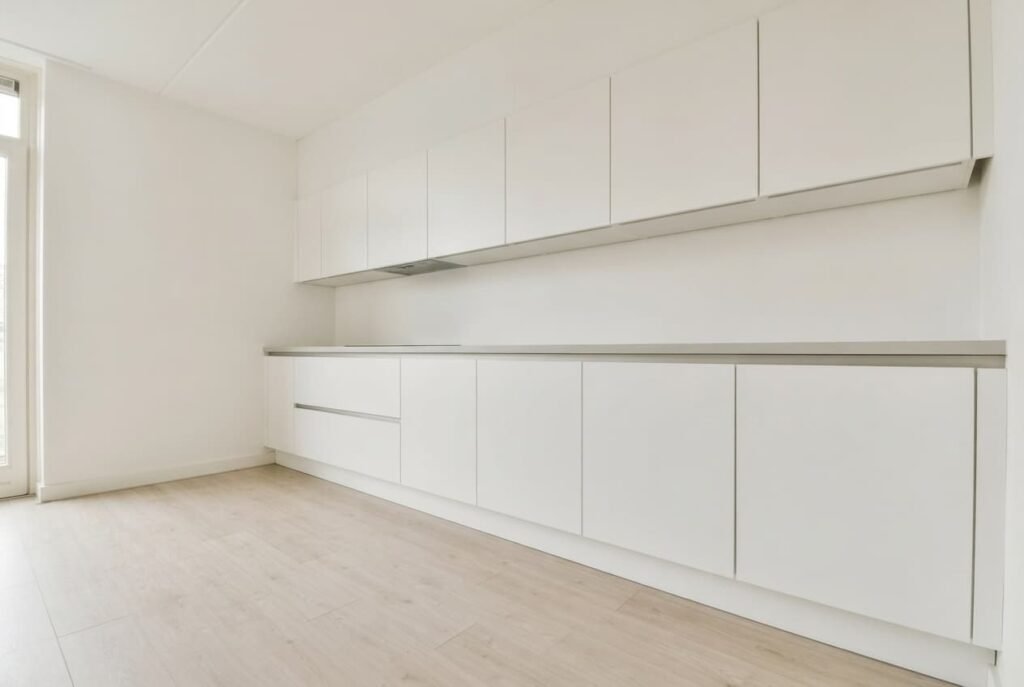
The eye reads the tops of the cupboards as a horizon and the wall above it as a second unfinished row. In the sample the band measures 255 − 205 = 50 cm by 270 cm, which is 13,500 cm² or 1.35 m². Each unit stands 65 cm tall, which means the band equals 50 ÷ 65 = 77% of a cupboard. That is too tall to pass as plain wall and too short to hold doors.
The surface adds trouble of its own. The tops are 35 cm deep, which gives 35 × 270 = 9,450 cm² of flat shelf above eye level. A standing eye at 160 cm only sees the front lip. Dust and grease gather out of view while anything stored there shows its upper outline, and those half-seen shapes make a tidy band look cluttered. A cloth passed along the tops each month hides the symptom without touching the cause.
Most people blame the dust or the cupboards. In fact the band has no assigned job, and fresh cupboards wouldn’t give it one.
A taller run of doors would only move the gap upwards.
A Quick Look From the Entrance
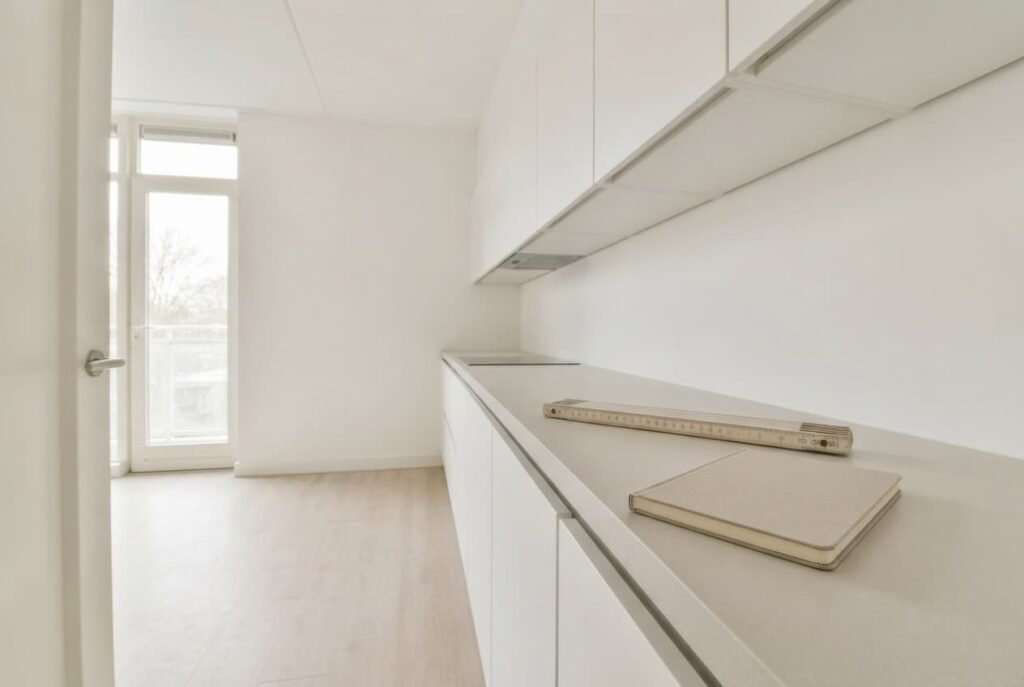
Start at the kitchen entrance with a rule and a notebook. Each answer points towards a fault described below. Use these five points to read the top of our kitchen wall units the way a surveyor would.
1. Measure the band from the cupboard tops up to the ceiling. The sample reads 50 cm. Under 10 cm looks like a shadow line, while a band close to cupboard height looks like a missing row.
2. Hold a pencil level with the top of the door frame. The sample frame is 205 cm and the units line up with it. Where they don’t, the room carries two horizons.
3. Count the items standing on top. The sample has 7 of them spread over 160 of the 270 cm. That is 59% of the run.
4. Compare the wall’s tone with the fronts and with the light falling on each. A cool 4000 K strip light next to a warm 2700 K ceiling lamp splits the band from the cupboards.
5. Switch off every lamp except the ceiling one. If the band sinks into shadow, it reads as a void.
Three Faults Behind the Top of Kitchen Wall Units
Each fault shows a different symptom, and each has a repair order that moves from free to rearranged to bought. Most kitchens show a pair of them at most.
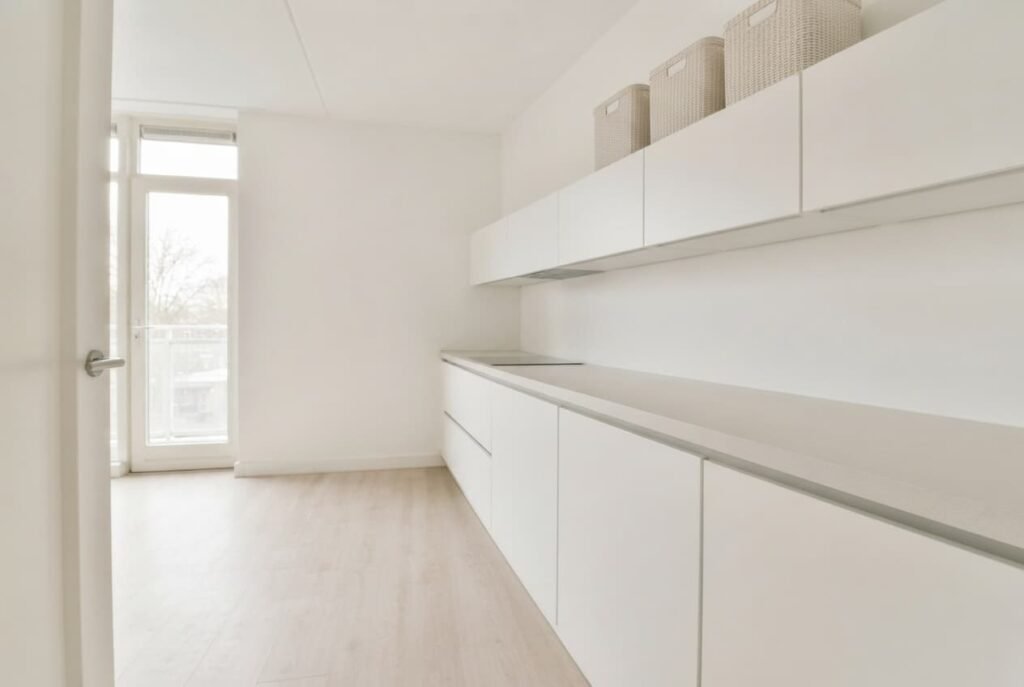
A band too tall to ignore keeps promising doors that aren’t there, because 77% of a cupboard looks like unfinished business. Costing nothing, the first move is to lift every item off the tops, which removes the half-seen outlines at once. Rearranging comes next. Line up three matching baskets of 30 cm height and 80 cm width along the middle. They fill 240 cm of the 270 cm run and 60% of the band’s height, and the strip then reads as one planned shelf. To close the gap for good, fit a filler panel 50 cm tall, finished to match the fronts. That costs a few boards and a day’s labour, and in a tenancy it needs the landlord’s consent.
A band that disagrees in tone shows up when a cool 4000 K strip under the units lights the fronts while the band sits in the warm 2700 K glow of the ceiling lamp. That jump in colour draws a line where no line exists. Switch the strip off for one evening at no cost, and compare how the band looks. Rearranging means tilting a ceiling spot a few degrees towards the wall. The band then catches the same warm light as the room. The bought step is paint matching the fronts. One small tin covers the 1.35 m² with some left over, and the band then recedes into the cupboards.
Objects without a focal point give the eye seven places to land, since seven items sit across 160 cm. Remove everything you don’t use monthly, which costs nothing. Three objects of 20 cm each take 60 cm, which is 22% of the 270 cm run, and the eye can rest between them. Next, centre one group on the middle unit and keep 60 cm bare at both ends. The purchase is one long box 25 cm tall that holds what remains and hides it. Each repair targets its own cause. Rarely does a kitchen need all three.
Planning Ahead Before the Units Arrive
Decide what the band is for before anyone orders cupboards.
On the plan, write the ceiling height beside the unit height and subtract. A result near 5 cm closes with a scribed trim. A result near 40 cm suits a row of boxes, and a result near 50 cm, as here, calls for a clear choice between boxes and a filler panel. Ask the fitter to set the cupboard tops level with the door frame, which keeps a single horizon in the room.
With an existing kitchen, mark the decision in pencil on the wall and photograph it. Treat the top of our kitchen wall units as part of the design from the first sketch, because a plan only helps when it survives the first dinner party.
A Repair Not Worth Making
Many owners cover the band with an assortment of mixed ornaments in the hope that variety will look deliberate. It is the weakest choice for the top of our kitchen wall units. Every item adds an edge, and the mix breaks the single line that the band needs. Trailing plants above a hob collect grease, and their leaves sit out of watering reach. The band ends up busier than before, and each object then needs dusting at a height few people can reach comfortably.
A second row of doors up to the ceiling tempts as well. It uses all 50 cm but costs the most, and the upper doors stay out of sight and out of reach. Nobody opens a cupboard they need a step stool to see into.
Measure the band tonight and match your numbers with a fault described above. Note the band height and the run length. Add the object count and both lamp temperatures. Change a single thing, then view the kitchen once more from the entrance at the same hour of the evening. If the room feels settled, stop there. A single no-cost change settles most kitchens, and a few want one more. One tin of paint or a trio of baskets often finishes it, and anything bigger waits until those have been tried and judged. Photograph the result next to your first picture, since the contrast shows whether the change worked.
Questions and Answers
What usually causes it?
A band with no clear job. At 50 cm it equals most of a cupboard, which makes the eye expect doors that aren’t there. Seven scattered objects and a colour jump between cool strip light and warm ceiling light then add edges, and an empty strip begins to look cluttered.
What is the quickest fix?
Clear the tops, then line up three matching baskets of 30 cm height along the middle. Both steps take well under an hour and cost nothing or very little. They remove the half-seen outlines and give the band one clean line, which settles the view in most kitchens.
Can it be fixed without renovation?
Yes. Baskets and paint involve no building work. Clearing the tops costs nothing, and most rented kitchens allow all three. The filler panel is the largest step, and in a tenancy it needs consent from the landlord. Putting a second row of doors up there counts as renovation and rarely repays the effort.