A bathroom sink that drains slowly is almost always squeezed at one spot, and that spot sets the pace for everything behind it. The sample is a 55 cm basin in a flat in Rotterdam, in a bathroom of 170 by 210 cm. A jug and a stopwatch reveal which narrow spot is yours. Four remedies come ordered by effort, running from a free wipe to a request to the landlord, and every one attacks a different cause. These figures belong to one basin. Swap in numbers measured at your own basin, since pipes differ.
Why a Bathroom Sink That Drains Slowly Keeps Doing It
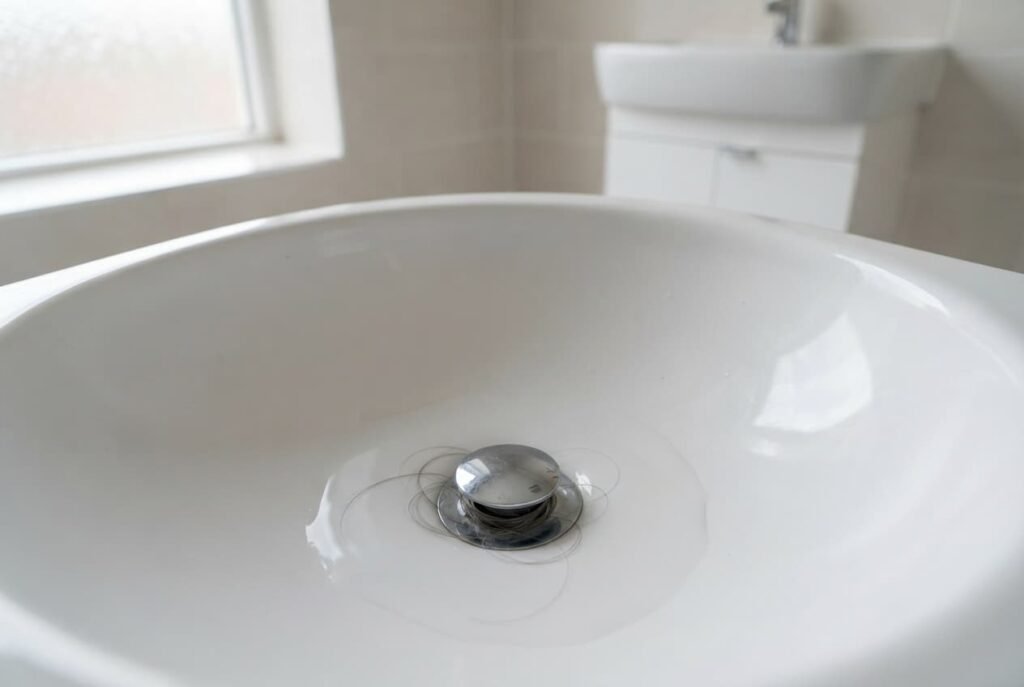
Water leaves through three parts in a row. It meets the gap under the stopper, then the straight tailpipe, then the bend that holds a seal of water. Hair and soap scum gather at all three. Flow can only move as fast as the tightest part allows.
Take a waste pipe 3.2 cm across inside. Its open area is π × 1.6² = 8.0 cm², and a full 6 litre basin empties through it in 30 s. Hair and scum then line the wall of the bend until a bore of 2.0 cm remains. That area is π × 1.0² = 3.1 cm², or 39% of the original. The same basin now needs 30 ÷ 0.39 = 77 s.
The stopper adds its own limit. When it lifts, water escapes through a ring as long as the pipe’s circumference, which is π × 3.2 = 10 cm, multiplied by the lift. A clean stopper rising 1.0 cm opens 10 cm², more than the pipe itself. One stuck at 0.5 cm opens only 5.0 cm², or 62% of the pipe, and 30 ÷ 0.62 = 48 s.
The narrowest point decides the whole time, because cleaning a wide part changes nothing while a tight one stays clogged.
Working Out Why the Bathroom Sink Drains Slowly
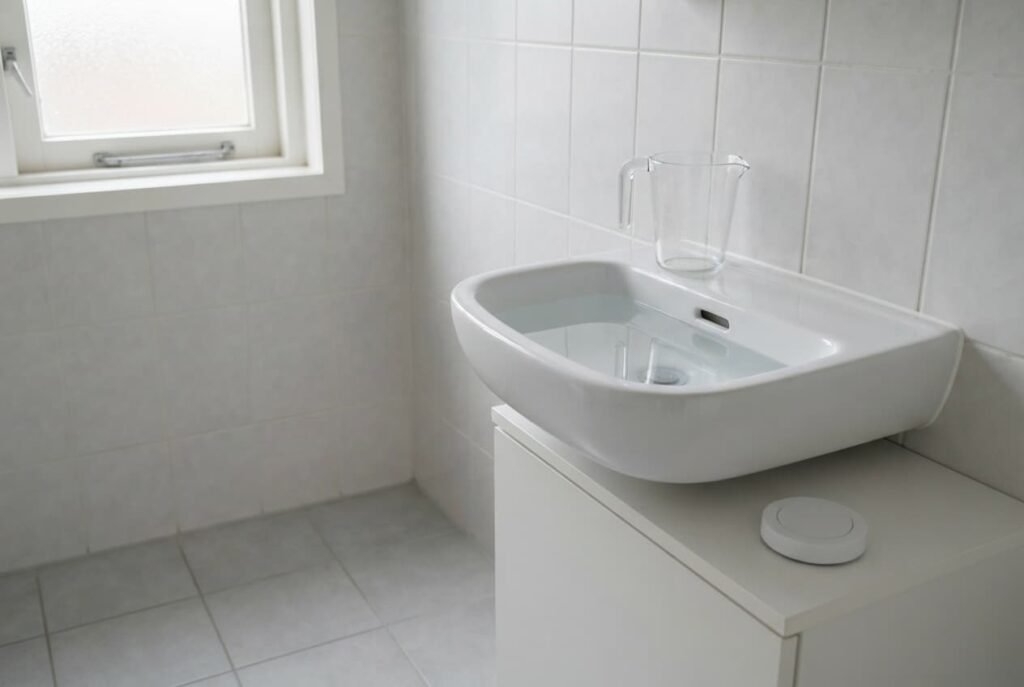
Fill the basin to its overflow slot with six jugs of 1 litre. Pull the stopper and time the emptying on a phone stopwatch. A reading near 30 s means the drain is sound and nothing more is needed. Write the time down, because every later step compares against it.
Run the test a second time with the stopper lifted out by hand and set aside. A household whose stopper alone is stuck sees the time fall from about 48 s to about 30 s, and remedy one is theirs. In the sample basin the time stays near 77 s with the stopper gone. The stopper was never the limit. That leaves the bend or the pipe and calls for remedies two and three.
A third pattern needs a different answer. If the basin empties well but the bath nearby also runs slowly, or the plughole gurgles, the trouble lies beyond this basin and remedy four applies.
The first two readings concern the sink itself.
Four Fixes From Free to Professional
Clean the stopper and its rod: this one is free and brings back the lift gap. Many stoppers lift straight out of the plughole, and others release when a small nut under the basin is turned by hand. Wipe off the hair that wraps the base and the pivot, working over a dry basin so the debris is easy to see. Drop it straight into a bag, since that’s the simplest job on the list. Refit it and check that it rises about 1.0 cm when the lever is pulled. Where it falls short: a clean stopper does nothing for a bend that has narrowed, and the sample basin still takes 77 s.
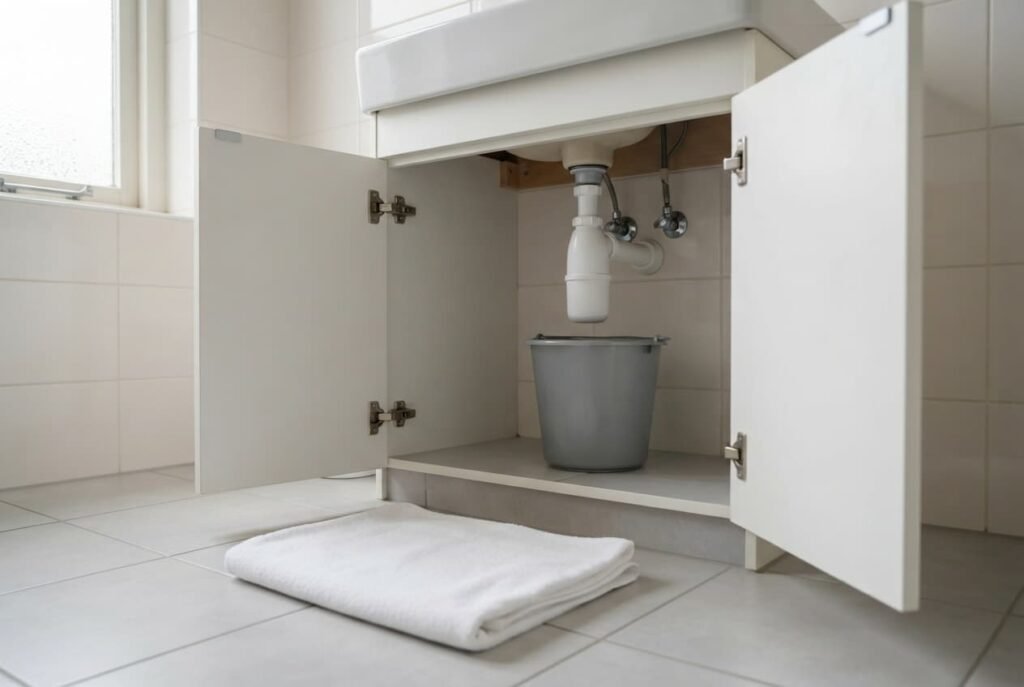
Empty the bend into a bucket: here the clogged ring is removed by hand. Place a bucket 25 cm tall under the bend, which sits 32 cm off the tiles, and unscrew the hand-tight collar. Tip out the grey paste and rinse the parts. Lay the collar and seal on a towel in the order they came off, which makes refitting simple. Then refit the seal. The bore returns to 3.2 cm and the basin to 30 s. You’ll spend only a cloth and some patience, because pipes don’t clear themselves. A cracked or flattened seal leaks after refitting, and a replacement costs little.
Fit a hair catcher and a drain strip: prevention works upstream. A fine mesh over the plughole stops hair before it reaches the pipe, and a flexible plastic strip with barbs pulls out what has already wound round the tailpipe. For a bathroom sink that drains slowly month after month, buy these ahead of anything else, since they cost slightly more than the free jobs. Empty the mesh each week and the strip lasts for months. They limit how fast the pipe narrows again, yet they can’t reach grease coating the inside of a pipe beyond the bend.
Ask the landlord to have the pipework checked: a plumber can look at the fall of the waste pipe and the vent behind it. A pipe that dips between the basin and the wall holds a pool, and the pool collects scum. A blocked vent makes the bend gurgle as air struggles to follow the water. Dearest of the four, it belongs on the landlord’s bill when you rent. It’s overkill if the bend was the culprit, which earns it the last place on the list.
What This Bathroom Allows
Above a cupboard 60 cm wide hangs the basin, and the bend lies at the back of that cupboard, 32 cm off the tiles. Your bucket must stand 25 cm tall at most, which leaves 7 cm to spare. Anything taller wouldn’t fit.
Each job here is shaped by the bathroom itself.
The cupboard door swings 90° and bangs against the towel rail on the right wall. Lift it off its hinges and rest it on the bath edge. Kneeling space is 40 cm deep ahead of the cupboard, enough for a folded towel on the tiles. The frosted window is small, which makes a head torch worth wearing. Clear the cupboard shelves before you start. In this bathroom a bathroom sink that drains slowly can be mended from the front. The vent and the wall pipe stay out of reach.
The Fix That Doesn’t Work
Pouring in a strong drain liquid is the common reflex. It burns a thin channel through the middle of the clog and leaves the ring on the pipe wall. The bore grows from 2.0 cm to only about 2.4 cm, and the basin then needs 30 ÷ (2.4² ÷ 3.2²) = 53 s. The liquid can also damage a rubber seal and sits in the bend where your next job will take you.
Boiling water has its own trouble. It softens the plastic joints on a waste pipe and does little to hair. A plunger on a basin pushes debris into the bend unless the overflow hole is blocked first. Pulling at hair with a bent wire tears the plastic of the stopper. A bathroom sink that drains slowly responds to removing the narrow spot, and extra force only moves the clog.
Run the stopwatch test tonight. The reading picks your remedy. Change one thing only, then time the basin again and write the number beside the first. Stop when it empties within 35 s. A line in your notebook each month shows when the ring is growing back, and most households need no more than a rinse of the bend each season. Keep the old stopper parts in a drawer in case a refit goes wrong.
Questions and Answers
Is a slow basin always fixable?
Nearly always. Hair at the stopper and paste in the bend clear in a single sitting, and a hair catcher keeps them away. Only a sagging pipe or a blocked vent needs a plumber. Five minutes of timing shows whether the stopper limits the flow. If it doesn’t, the bend or the pipework does.
How do the four remedies compare on cost?
Two remedies need only a cloth and a bucket. A hair catcher and strip add a few small items, comparable to a pack of batteries. A plumber costs more than all the rest combined, and a tenant would normally ask the landlord to pay. Begin with the free jobs.
What usually causes it?
A ring of hair and soap scum inside the bend. In the sample basin it narrowed the bore from 3.2 cm to 2.0 cm and stretched the emptying time from 30 s to 77 s. A stuck stopper ranks next, and the timing test separates the two.