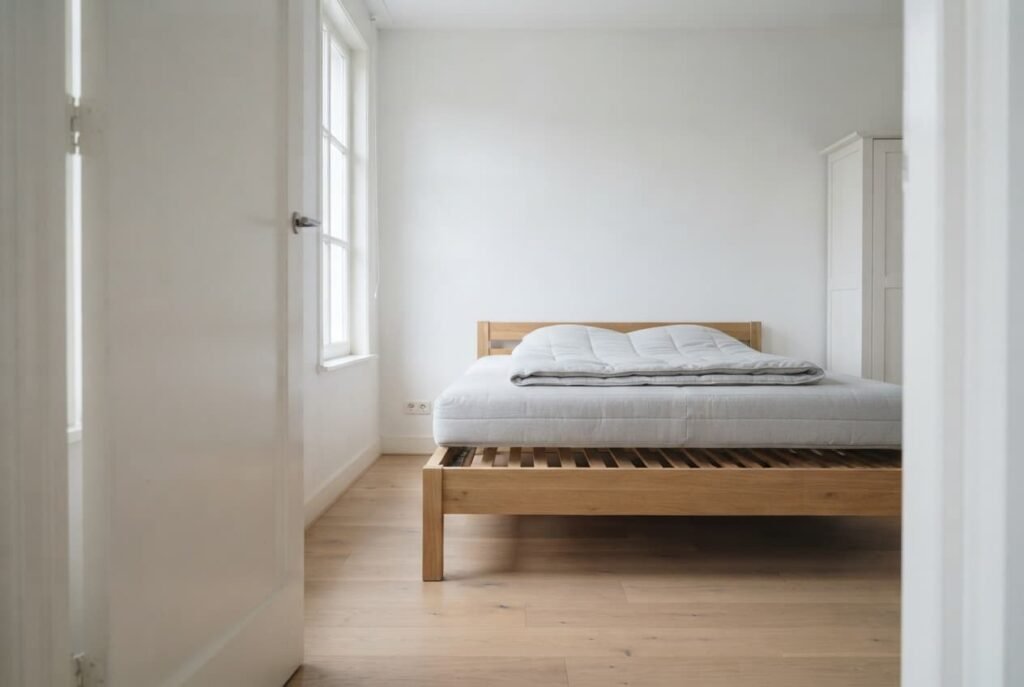
A mattress that keeps sliding is being walked towards the foot end, a few millimetres whenever someone turns over. Our test bed stands in Zwolle, in a rented bedroom 290 cm wide, with a double mattress on a slatted base. A two-minute push test separates three possible causes, and the reading you get decides where to begin, which saves buying anything blind. Four remedies come after it, climbing from an unpaid evening to a carpenter’s call, and no two share a mechanism. Each number describes this one bed, and yours will read differently. Measure it yourself before you lean on these figures.
Why a Mattress That Keeps Sliding Won’t Stay Put
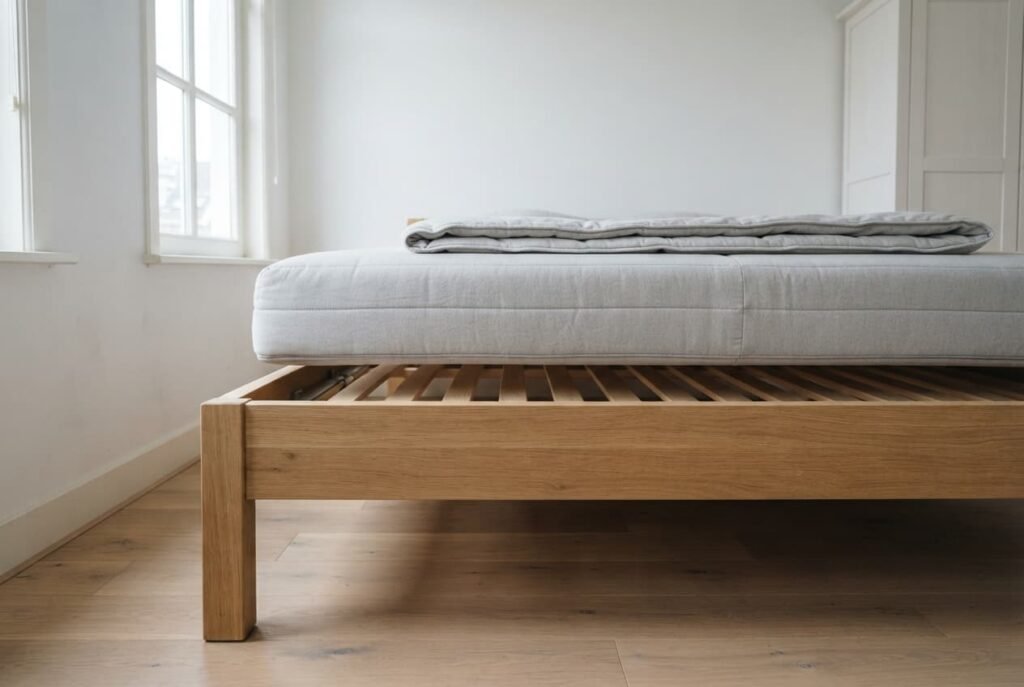
Friction alone holds a mattress on its slats. The slats are varnished wood and the cover is quilted fabric. No strap or lip links the two. Ours weighs 24 kg, which presses down with 24 × 9.81 = 235 N. A friction coefficient near 0.25 between cover and varnish gives a grip along the slats of 235 × 0.25 = 59 N.
Then comes the shove. Pushing off with a foot, or rising on one elbow, sends roughly 60 N sideways into the mattress. That matches the grip almost exactly, and nothing in the bed adds to it. A body lying on the mattress presses it down harder, yet that same body supplies the shove, and the shove wins near the edges where little weight rests.
Slats turn the slide into a one-way drift. They bend as weight crosses them and spring back as it leaves, and each turn lets the mattress advance a little while blocking its return. Ours crept 0.2 cm per turn. Six turns a night give 1.2 cm, and a week gives 8.4 cm, enough to leave the foot end hanging past the rail. Slat holders that have loosened add play, and a deck that rocks keeps feeding the creep.
Finding Why That Mattress Keeps Sliding
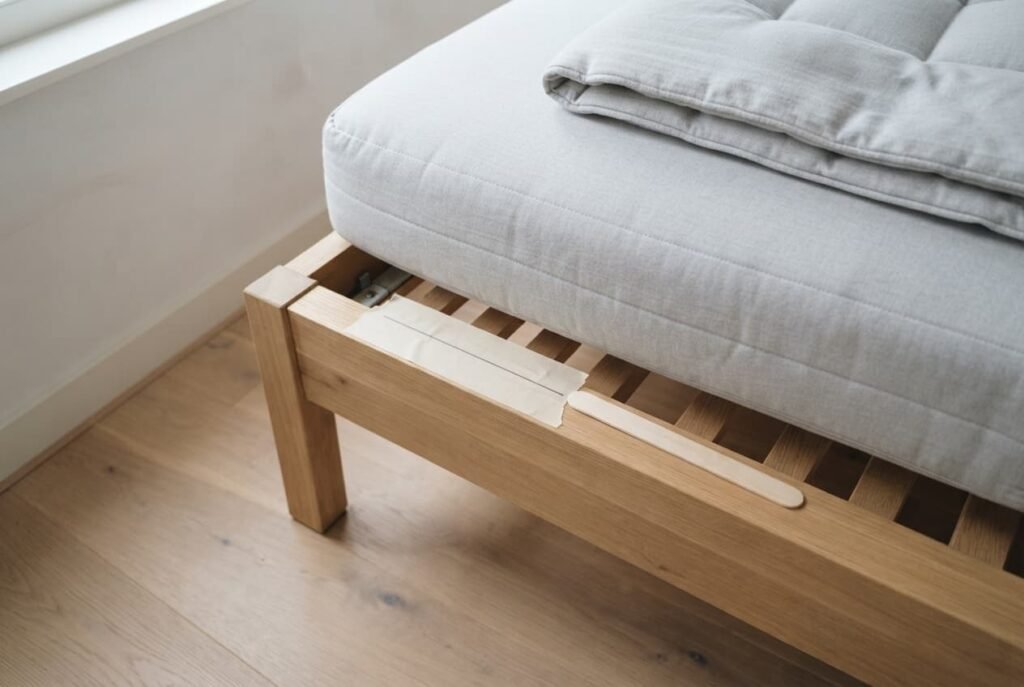
Strip the bed down to the mattress. Press a short piece of low-tack tape across the foot edge and onto the rail, then rule a pencil mark over the seam. Shove the mattress along its length with one flat palm, as if closing a drawer, and measure the mark against a ruler. Three readings are possible.
Reading one: the mark splits by 1 cm or more under that single shove. Grip is poor, and the cover is skating on the varnish. Remedy two answers it, and remedy one may help.
Reading two: the mark survives your palm but splits overnight. Draw it again at bedtime and measure it at breakfast. The deck itself is walking the mattress, which points to remedies one and four. For a mattress that keeps sliding in small steps, this is the likelier culprit.
Reading three: tape and mark stay whole, yet the frame as a whole travels over the floor. That is a problem for the feet of the bed.
Only the first two readings belong here.
Ours split by 1.5 cm under a palm and by 1.1 cm overnight.
Four Fixes From Free to Professional
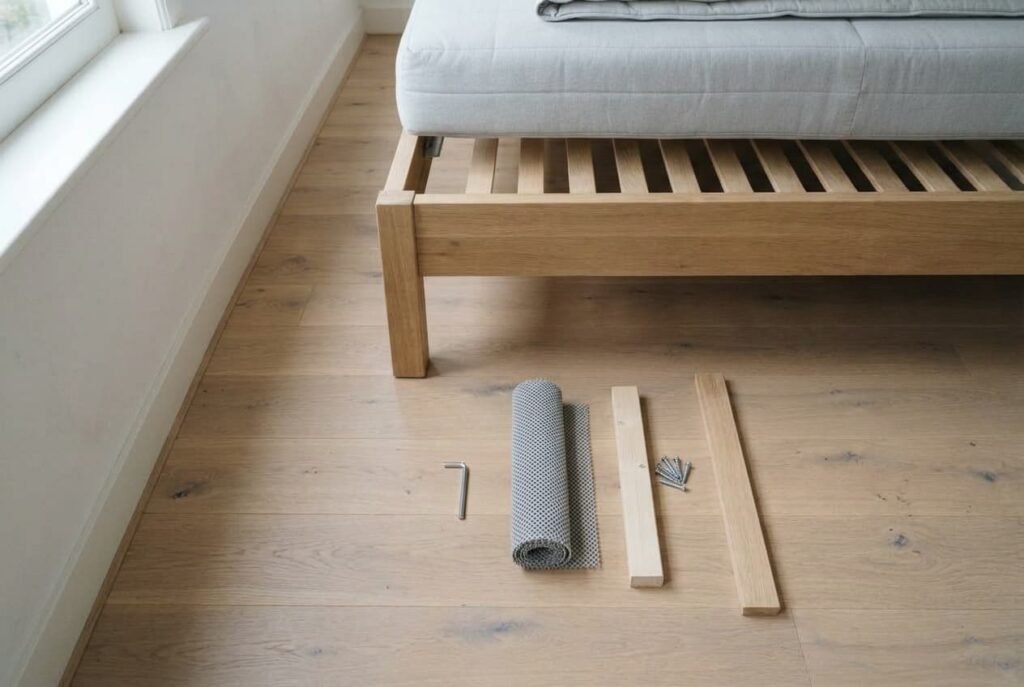
Tighten the frame and reseat the slats: a hex key and ten minutes do it. Lift the mattress away and snug every side-rail bolt until it resists a firm turn. Press each slat down into its holder until it clicks. With the rocking gone, the deck can no longer spring the mattress along. Four of our 18 holders had come loose, and the overnight creep fell from 1.2 cm to 0.5 cm. This does least for a mattress that keeps sliding because of a slick cover, and bent slats stay bent however tight the bolts are.
Lay an anti-slip mat over the slats: an open-mesh mat lifts the friction coefficient from 0.25 to roughly 0.8. Grip becomes 235 × 0.8 = 188 N, about three times the 60 N shove. Trim it with scissors to the deck’s size, and keep the mesh open so air still reaches the underside of the mattress. It costs little. A mat cannot cure a deck that flexes, because better grip only slows the walk.
Screw stop battens to the frame: this fix halts the mattress by geometry, with friction playing no part. A timber strip 3 cm high and 2 cm thick along the foot rail catches the mattress before it overhangs. Leave 0.5 cm of clearance so you can still lift the mattress out for turning. Two lengths of timber and a few screws make a modest purchase. Mark each screw position and drill a pilot hole beforehand, since a split rail is a much bigger job. A stop only holds the edge, and the mattress can still shuffle inside it.
Have a carpenter add a centre rail and fresh slats: a rail beneath the middle halves each slat’s span, leaving 70 cm where there were 140. A loaded slat bends by the span cubed, which cuts the flex to an eighth: 0.4 cm becomes about 0.05 cm. The work takes a single visit with the carpenter’s own tools. This is the dearest option here, and it’s overkill if a mat already holds. It pays off on a frame with years ahead of it where the slats themselves have tired.
What This Bedroom Allows
The head wall carries a skirting board 1.2 cm thick, which holds the frame 1.2 cm off the plaster. Whatever you fit at the head end has to clear that board. The creep runs towards the foot end, where 46 cm of floor remains before the door begins to sweep.
The door is 76 cm wide and opens inward, passing 8 cm beyond the foot corner. A batten there may stand only 3 cm proud, or the door catches it on every pass.
A wardrobe stands on the right and leaves a 70 cm strip at the bedside, room to kneel while you unroll a mat. The left side has a 5 cm strip against the wall, with a socket at 20 cm height right behind it. Keep the drill away from that corner and work from the right.
The Fix That Doesn’t Work
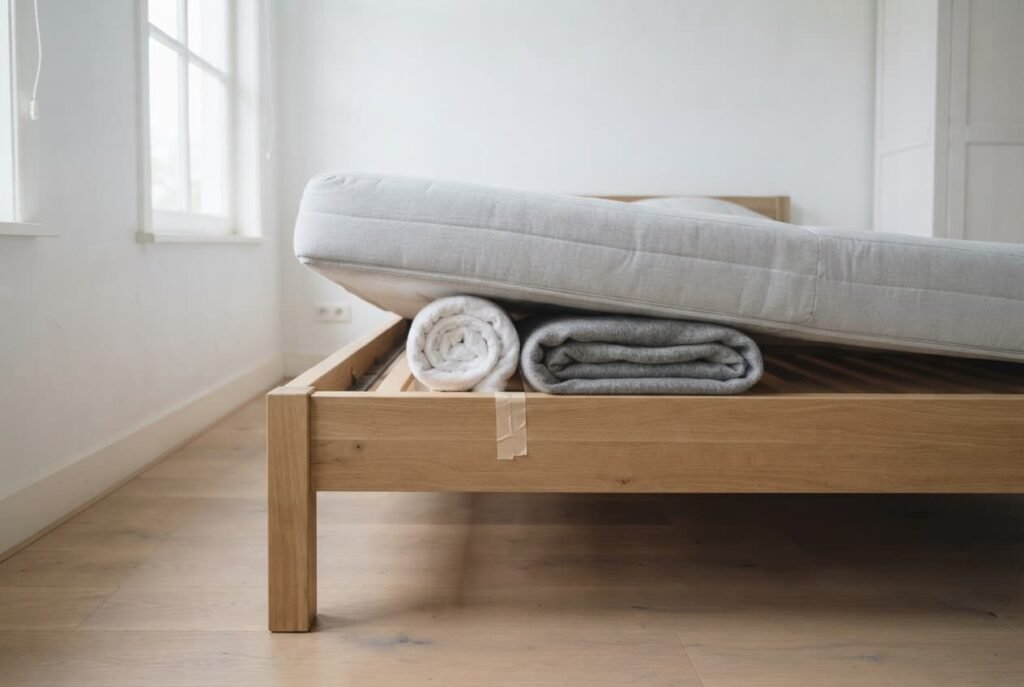
Rolled towels under the mattress edge are the usual reaction to a mattress that keeps sliding, and they hold for about a night. A towel compresses under 24 kg and then slides on the varnish just as the mattress did. Tucking the sheet tighter achieves nothing, as the sheet grips the mattress and never the slats. Double-sided tape leaves residue on the varnish and pulls at the cover’s stitching each time you turn the mattress. A folded blanket wedged between mattress and wall fills the gap for a few days before it packs flat. A heavier mattress feels like a cure, since 30 kg gives 74 N of grip, yet the shove grows with the person on top and the creep returns. Floor-rug grippers do work, but only the open-mesh kind laid on top of the slats, and a solid sheet traps heat against the cover.
Tonight, push once. Then mark the line. Choose a single remedy, apply it, then read the pencil again in the morning. You’re done when the overnight shift stays below 0.3 cm. The first two remedies usually settle a bed like ours. Battens and the carpenter suit a frame that keeps creeping however firmly you tighten it, and your starting reading lets you judge each step honestly.
Questions and Answers
Can a sliding mattress always be fixed?
Almost always. Slack slat holders and a slick cover can each be corrected with a simple job, as can a springing deck. Only a frame that has gone soft with age needs a carpenter. Two minutes of pushing and a pencil mark reveal the cause behind your bed.
What does each fix cost, in relative terms?
Tightening the frame costs nothing beyond a hex key. A mat and a few battens add a small amount, comparable to a box of screws. The carpenter costs more than the other remedies combined. Begin with the unpaid job, because everything after it assumes a frame that no longer rocks.
What is the most common cause?
A springing deck that has lost its tension. Slat holders slacken with age, and each turn then walks the mattress along by a couple of millimetres. Our bed crept 1.2 cm a night until four holders were reseated. A slick cover ranks next, and the push test separates the two.