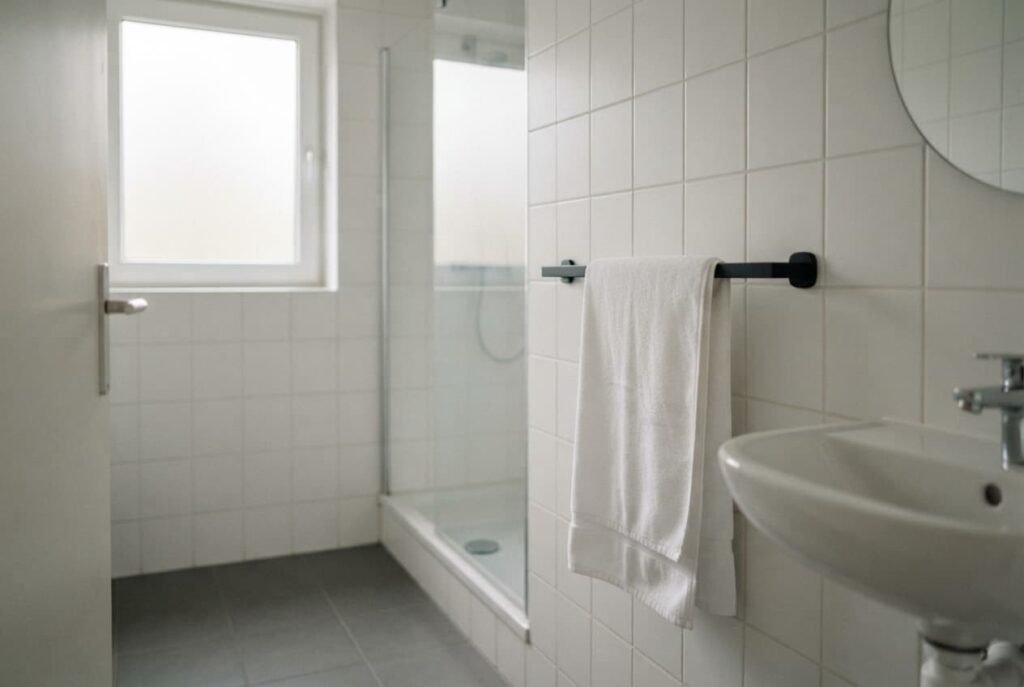
A wet towel dries only where moving air reaches the cloth, which makes the hanging spot matter more than the towel. A bar on the wall leaves the cloth out in the room, while hooks press it close to a door. The test room is a Delft flat bathroom of 170 × 210 cm with a 76 cm door that opens inwards, and a 75 × 150 cm bath towel gets used every morning. Choosing a towel rail or hooks here comes down to open air on the cloth, the walk from the shower and the door’s swing. Every size here belongs to one invented bathroom; rerun the sums on yours.
What a Towel Rail or Hooks Changes About How a Towel Dries
Evaporation does the drying, and it needs bare cloth facing moving air. Where two layers touch, neither gets moving air; the contact patch stays wet longest. A bathroom adds its own difficulty, because the air near the shower already carries plenty of moisture, and every spot dries more slowly there than in a hallway.
The sums for the sample towel are short. A 75 × 150 cm towel has 11,250 cm² on each face, which makes 22,500 cm² in total. Draped over a bar and folded once, it forms two layers of 75 × 75 cm whose inner faces rest together. Contact then covers 11,250 cm², and the other 11,250 cm² meets the room, an even split.
Hung flat by its loop from a hook at 175 cm, the same towel ends 25 cm up from the tiles and touches itself nowhere. The front face gives 11,250 cm² to the room, while the back face lies roughly 2 cm off the door. A gap that narrow doesn’t let much air through, and the back face dries last.
Two measures matter here. One is how much cloth has open air on it. The other is how far a wet person must walk to reach the towel, because water drips along the whole way.
Hooks or a Towel Rail Compared Row by Row
Fetch a towel and a tape measure, then run each row past your wall and your door. The values describe the sample bathroom alone. Hold the towel at each spot, and mark the rows you’d mind most.
| Point | Towel rail | Hooks behind the door |
|---|---|---|
| Towel position | draped over a bar in two layers | hung flat from a loop in one layer |
| Cloth touching itself | 11,250 cm² | none |
| Gap behind the cloth | about 7 cm to the wall | about 2 cm to the door leaf |
| Distance from the shower edge | 30 cm | 130 cm |
| Door clearance | no effect on the swing | 6.5 cm of hook and towel against a 4 cm gap |
| Width for one flat towel | 75 cm of bar | 75 cm of a 76 cm door leaf |
| Fixing | plug in tile or masonry | screws in a thin door skin, or an over-door hook |
Across a towel rail or hooks, two rows stand furthest apart: touching cloth at 11,250 cm² against none, and a walk from the shower that differs by 100 cm. Weigh the rows that bother you most. A longer bar or a lower hook can repair several of the others.
Where Hooks Behind the Door Earn Their Place
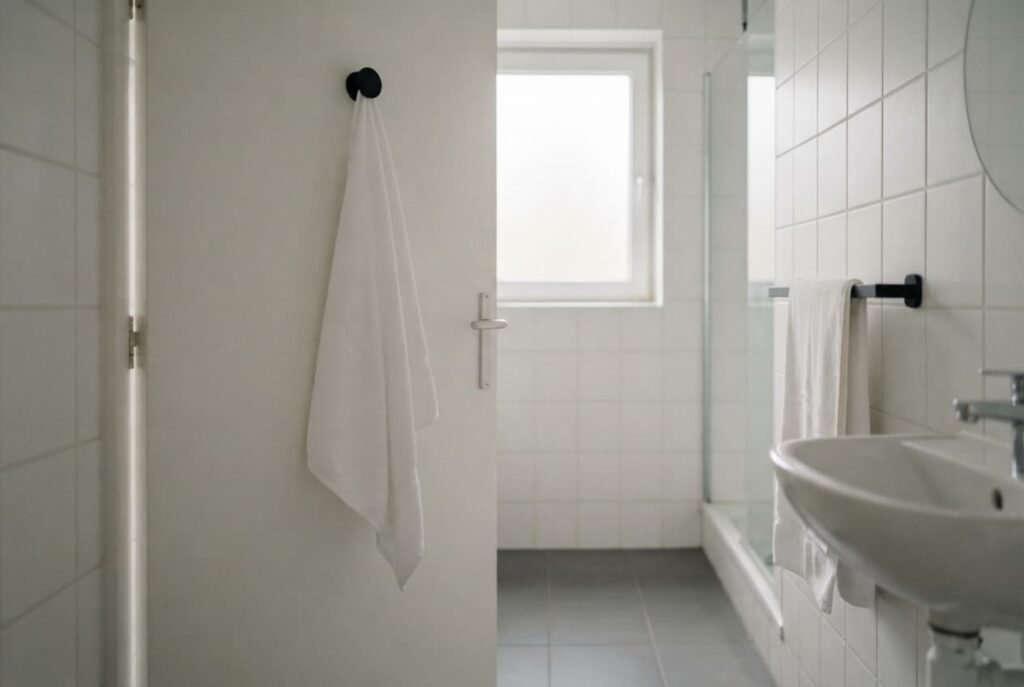
Hooks suit a bathroom with no spare wall. The door leaf is a free panel of 76 × 204 cm, and a towel hung there keeps the floor and the side walls clear. With a basin on one side of a 170 cm wide room, that spares you the 9 cm a rail pushes into the space.
Hooks let the cloth hang free.
Hung flat, the towel touches itself nowhere, which puts its full 11,250 cm² front face in view of the room. A towel hung like this often feels dry sooner than one folded over a bar. That’s a point about contact area and says nothing about hours.
Three drawbacks follow. Screws don’t hold well in a hollow door, because the skin is thin and the core is light. Pick a solid door leaf instead, or use an over-door hook that grips the top edge. That hook needs a gap at the frame, and the door must still close afterwards. The swing matters too: a hook 5 cm deep and a towel 1.5 cm thick take up 6.5 cm, and this door parks only 4 cm from the wall.
Where a Wall Rail Earns Its Place
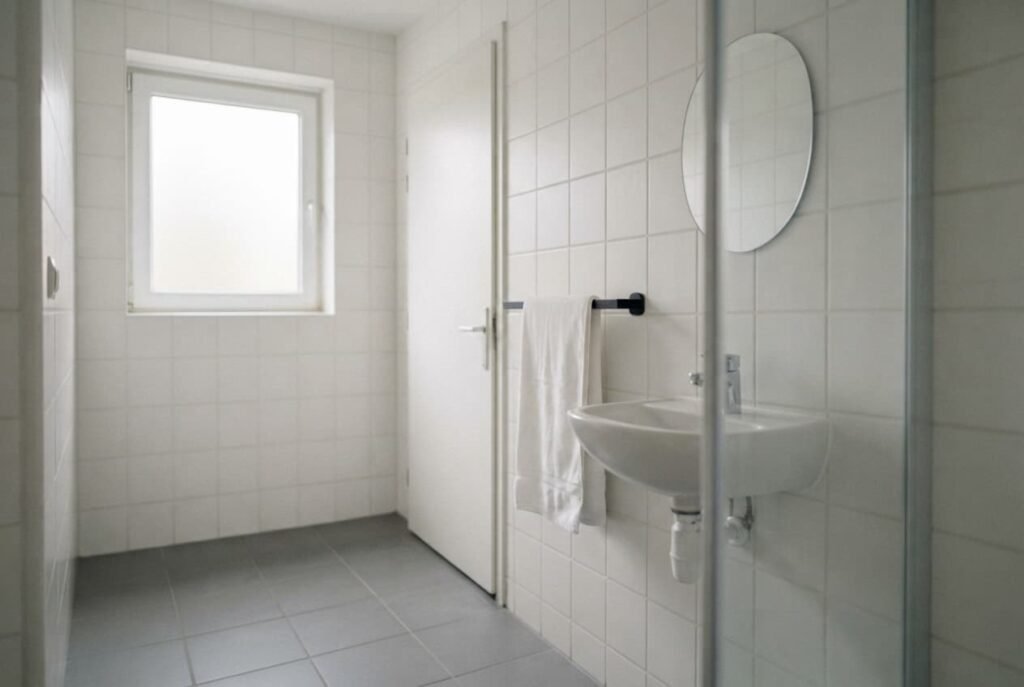
A bar suits a bathroom where the towel must be within reach. Fixed 30 cm out from the shower tray, it holds the cloth 100 cm nearer than hooks at the far end, where the walk is 130 cm. Each morning that trims 100 cm off a dripping walk, and the mat doesn’t get soaked.
A bar also carries a hand towel beside a bath towel, since each takes its own stretch of width. It never touches the door, and the swing stays as it was. The fixing is firm too, because the plug sits in tile or masonry and not in a thin skin.
Drying is the weaker point. Draped over the bar, the sample towel keeps 11,250 cm² in contact with itself, half of its cloth. Spreading the fold wide eases that, though 75 cm of bar then goes to a single towel. The bar juts 9 cm out, and a drilled tile is hard to undo. Mark the spot twice, because there’s no second try.
The Free Option Is the Hanging Spot You Already Use
Run a week-long trial at today’s hanging spot before drilling a single hole.
Each evening, pinch the thickest corner of the towel. A cold, heavy corner means wet cloth. A warm, light corner means dry cloth. Jot the verdict on a note for seven evenings.
Read the pattern next. Six dry evenings out of seven mean the towel needs no new fixing, only a better habit: shake it out after use and open the fold as wide as the space allows. A towel that stays heavy on most evenings isn’t getting enough air, and a wider spread is the simplest repair. Whether a towel rail or hooks would improve on your present spot is something this week answers better than any measurement.
When the trial passes, leave things as they are and buy nothing. A new fixing earns its place only after a failed week, and the trial takes about two minutes a night.
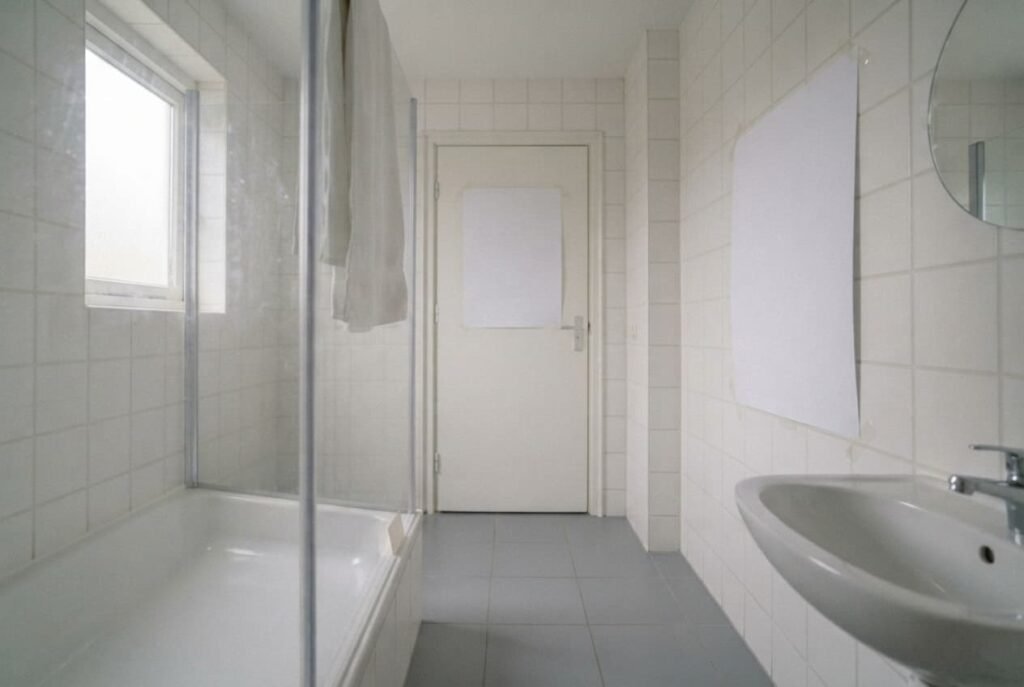
Which to Pick for Your Own Bathroom
Choosing a towel rail or hooks leads to one of two branches. Each asks you to accept one drawback up front.
If the shower is far from the door, choose the rail. It holds the towel 30 cm from the tray edge and trims 100 cm off the dripping walk. Accept that 11,250 cm² of cloth touches itself, and spread the fold wide after each use.
If the door stops 10 cm or more from the wall, choose the hooks. A hook and towel need 6.5 cm, which leaves 3.5 cm to spare. Accept the 130 cm walk, and choose a solid leaf or an over-door hook.
Before drilling either, tape a paper rectangle of 75 × 150 cm over each spot for one morning and stand where you’d dry yourself. The paper reveals the swing and the reach within minutes. Paper moves easily, while a hole in a tile stays there for good. Stand there with a dry towel in hand and check your elbow clears the wall. A spot that works with paper will work with a bar or a hook.
Questions and Answers
How long will each fixing hold up?
Bars plugged into tile or masonry carry a wet towel for years, since the plug takes the weight. Hooks screwed into a hollow door loosen sooner, because the thin skin gives way under a heavy towel. Choose a solid leaf or an over-door hook, and tighten any screws once a season.
How do I keep the towel from staying wet?
Shake the towel out after use and open the fold as wide as the fixing allows. Wash it when it smells stale, because a cloth that never dries fully holds the smell. Wipe the bar or hook and the tile behind it monthly, since soap film collects in that corner.
Which suits a bathroom shared by two people?
Neither gives each towel its own 75 cm, since two flat towels need 150 cm and the door leaf offers 76 cm. A bar by the shower for one towel and a hook behind the door for the other gives each person a separate surface. Let the smaller towel take the hook if the door stops close to the wall.