A pair of lined curtains hangs from a steel pole 240 cm long in a Dutch flat. By spring the pole has dipped 1.5 cm at the middle. The curtains meet in a shallow V where they should hang straight. You’ve probably tightened the end screws already. A curtain rail that sags in the middle can have four different causes, yet only one lives in the screws. A string and a spirit level will separate them. The figures that follow are rounded guesses for an ordinary window, and a tape measure at your own window will correct them. The method stays the same.
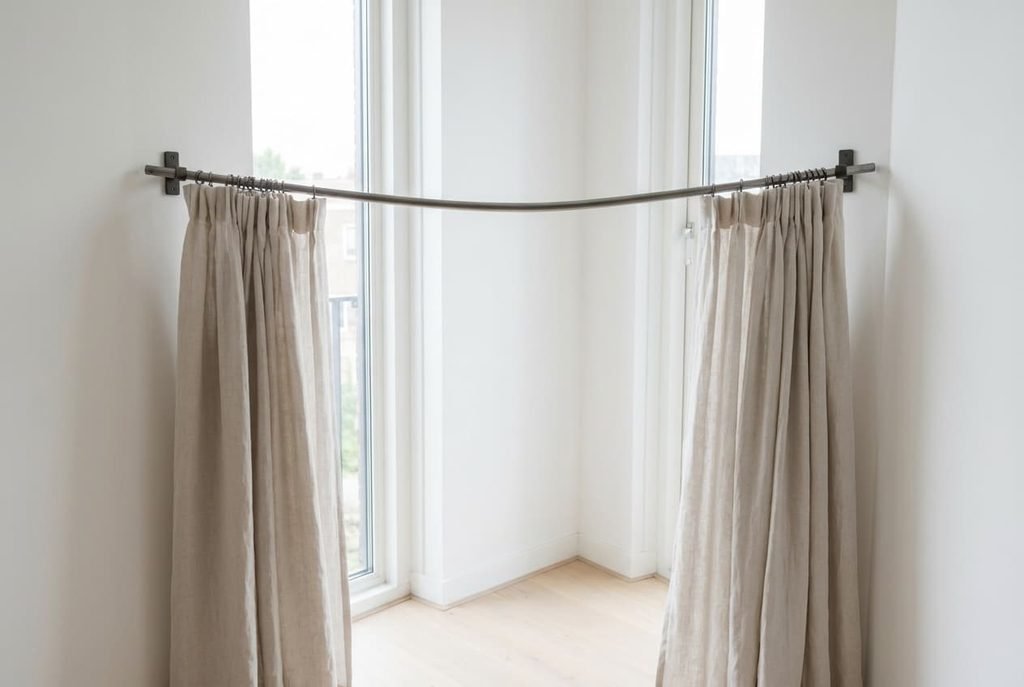
What Makes a Curtain Rail That Sags in the Middle Bend
A rail carrying curtains behaves like a plank laid across two supports. The weight pushes the middle down, and the stiffness of the pole pushes back. Hold a ruler between two fingers and press its centre to feel the same contest. Try it.
Distance has the loudest voice, because the dip scales as the span times itself four times over. Double the gap between supports, with the same curtain per metre, and the dip multiplies by 16. Say your pair of lined curtains weighs 4 kg and the supports stand 240 cm apart. A steel tube of 19 mm with a 1 mm wall then dips about 1.5 cm at the middle under that load.
A rail dips whenever the weight, spread across the span, wins against the stiffness of the pole, and the span has the biggest say. Halve the span and each half dips a sixteenth as much: 1.5 cm ÷ 16 comes to 0.09 cm, just under 1 mm. Halve the weight and the dip halves too, to 0.75 cm.
Four causes follow. Weight and span make one pair. The pole and its brackets make the other. A bracket that rotates in the wall lets one end drop, and the whole rail then slopes.
Four Quick Tests to Name Your Cause
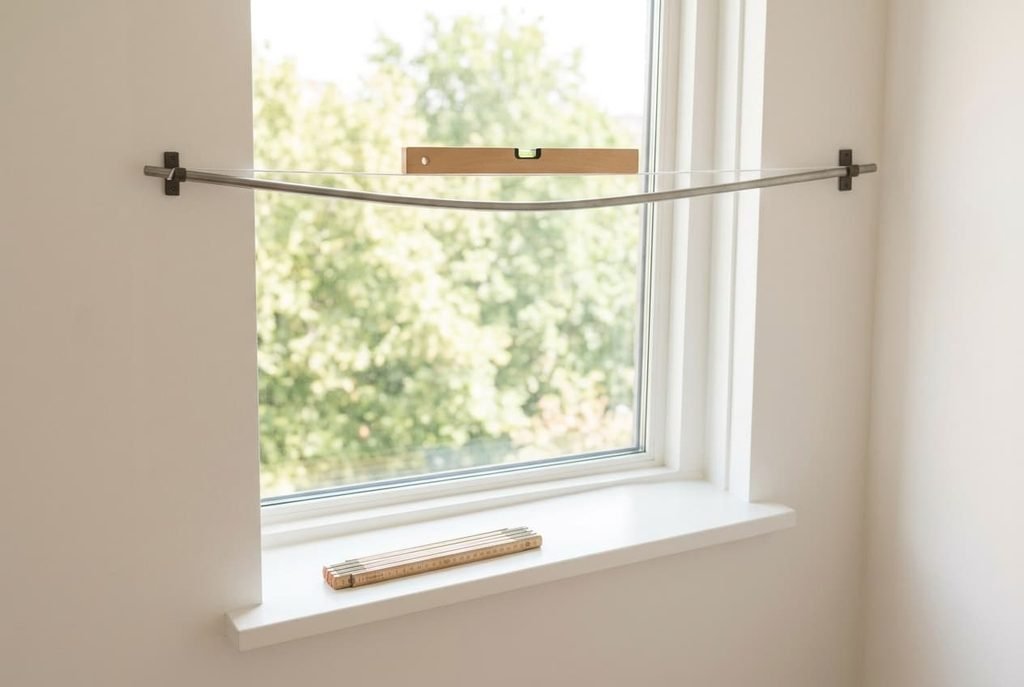
Name the cause before you touch a curtain rail that sags in the middle. Take the curtains off and stretch a string tight above the empty rail, end to end. If the pole lies on the string, it’s still straight, so the curtains are doing the damage. If it drops 3 mm or more below the string, the pole has bent for good and stiffness is your cause.
Next, lay a level along the rail, or measure down from the ceiling at both ends. Ends that differ by 5 mm or more mean a bracket has slipped. Then lift each end of the rail by hand, about 2 cm. A bracket that shifts against the wall means the fixing is failing.
Last, hang a single curtain, then measure the dip with a ruler held under the string. If it falls to about 0.75 cm, the weight is driving it. A dip that barely changes points at the pole or the span.
Note the four readings before any purchase.
Four Ways to Stop the Sag, From Free to Professional
Unhook the heavy layer when the days warm up, because the dip follows the load. Weigh each curtain on bathroom scales with the lining on, then off. A detachable thermal lining of 1.5 kg comes off a 4 kg pair and leaves 2.5 kg, so the dip falls from 1.5 cm to 0.94 cm, a cut of 37.5%. That job is unpaid and takes about a minute per curtain. The limit is plain: you lose the insulation and the dark room, and the sag returns the day the lining goes back on, which makes this a fix for one season.
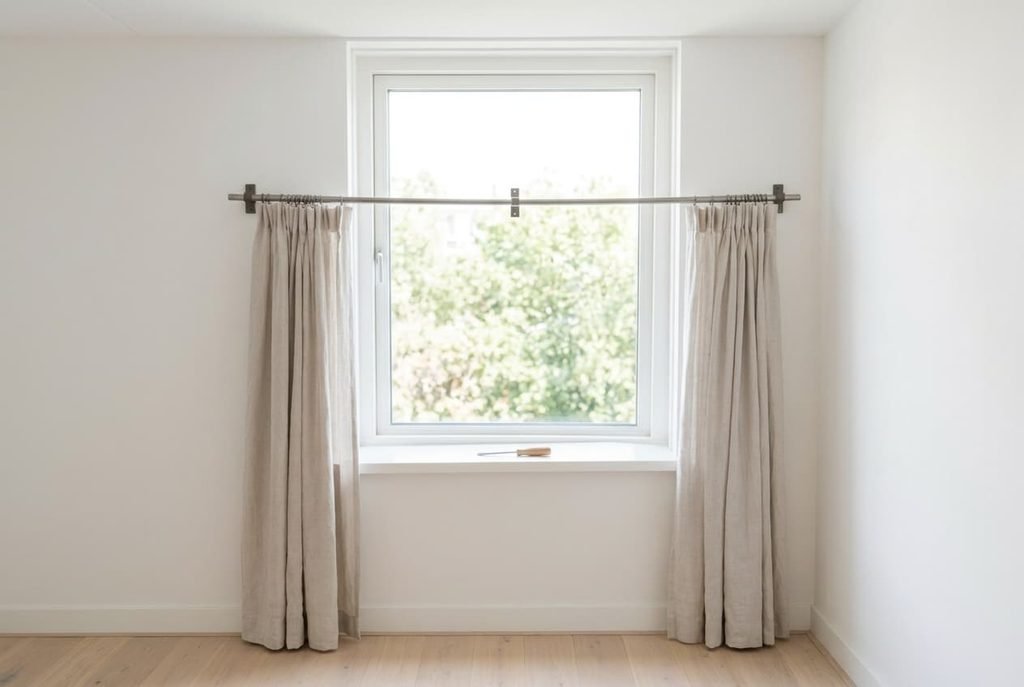
Add a centre bracket under the middle of the pole, since it attacks the span. Two spans of 120 cm each dip at most a sixteenth of one span of 240 cm, so 1.5 cm shrinks to under 1 mm. It means one bracket and two plugs, a modest outlay. Choose one with the same projection as the end brackets and set it to the string line. The catch is that rings can’t slide past it. Hang one curtain on each half and let them meet at the bracket.
Swap in a thicker pole of the same kind of tube, which raises the stiffness. A 28 mm tube with the same 1 mm wall is about 3.4 times stiffer than a 19 mm one. The dip drops from 1.5 cm to 0.44 cm. This is the dearest purchase, and the end brackets must be replaced to match its diameter. It leaves the long span untouched, so a few millimetres remain, and a thicker tube adds weight of its own.
Have a handyman re-fix the end brackets into the lintel, because a loose bracket is a support problem. A plug that has crumbled in soft plaster lets the bracket rotate under 4 kg, and one end drops. A proper plug in sound material holds both ends at one height. Allow a couple of hours of labour. Ask for plugs rated for concrete and a bracket with two screw holes, and have the lintel tapped first to check that it’s sound. It does nothing if your level test showed the ends already matched.
Where the Curtain Rail Sags in the Middle of a Fixed Window
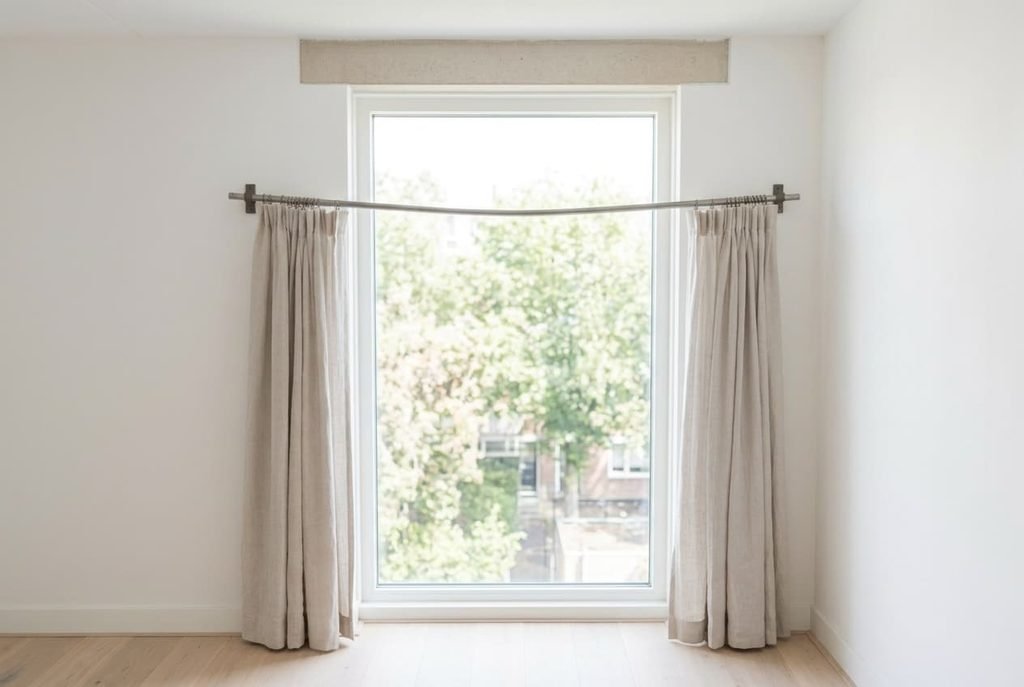
The wall sets the limits here. Many Dutch flats have a window 200 cm wide, a concrete lintel above it and a stretch of wall to the room corner. The end brackets sit 20 cm outside the glass on either side, so the span is 240 cm. A stack of lined curtains needs about 12 cm to gather, which is why you can’t move the brackets inward without covering the glass. The span of a curtain rail that sags in the middle is set by the wall, not by you. Raising the pole doesn’t change it either; extra support or less load does.
The lintel above the midpoint of the window is the one place for a centre bracket. Concrete needs a masonry plug and a hammer drill, not the light anchor you’d use in plasterboard. In a rented flat, get the landlord’s consent before drilling it.
The lintel is the one place the fix can go.
The Fix That Changes Nothing
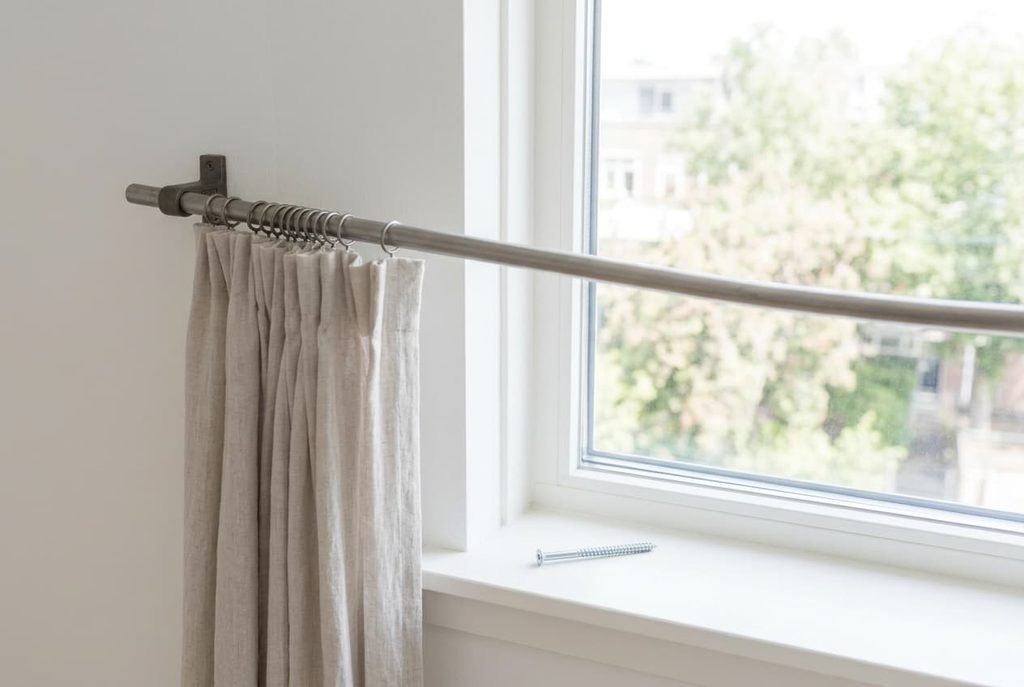
Longer screws in the end brackets look like the obvious answer, yet they leave the dip untouched. The sag happens between the brackets, and a screw can’t reach that far. A pole that dips 1.5 cm before still dips 1.5 cm after, measured with the same string. The screws were never carrying that part of the load.
Length mostly helps a screw resist being pulled from masonry, whereas the sag happens in the pole between the brackets, where extra depth can’t reach. Longer screws earn a place only when the lift test showed a bracket moving, and even then a proper plug beats extra length in crumbling plaster. They also carry a risk in a window wall, where a long screw can meet a cable or a pipe behind the surface. Check with a detector before you drill deeper.
A curtain rail that sags in the middle is telling you which term is losing, so read it before you spend. Run the string test and the one-curtain test on the first evening, then start with the cheapest fix that fits your result. Measure again with the same string after every change to see what worked. Stop the moment the curtains hang straight.
Questions Readers Keep Asking
Can this be fixed without replacing the pole?
Usually, yes. A centre bracket under the middle cuts the dip to under 1 mm without touching the pole, and unhooking a heavy lining cuts it by more than a third. Run the string and one-curtain tests first, because they show whether the pole itself has bent for good.
How much does fixing it cost?
The lining swap is free. A centre bracket is a modest outlay, while a thicker pole costs more. A handyman’s visit sits above both, mostly in labour. Begin with the lining swap and try the bracket next. Keep the dearer options for when your tests point at them.
What is the most common cause?
A span that’s too long for its pole. The dip rises with distance multiplied by itself four times, so a window wide enough for a 240 cm pole shows trouble first. A centre bracket tends to settle it, and the string test tells you within minutes whether your pole is straight.