A hard stripe of sun on the far wall at seven o’clock is the usual sign of too much morning light. A lined curtain that overlaps the window by 15 cm on each side resolves it most often, and the checks below show whether yours is a curtain problem or something else.
This guide assumes a nursery about 250 by 310 cm with an east-facing window on the short wall, its glass running from 90 to 210 cm above the floor. A room facing another way needs the same checks but a different timetable. Every sun angle below is an illustration, so measure your own mornings.
What happens when a room has too much morning light
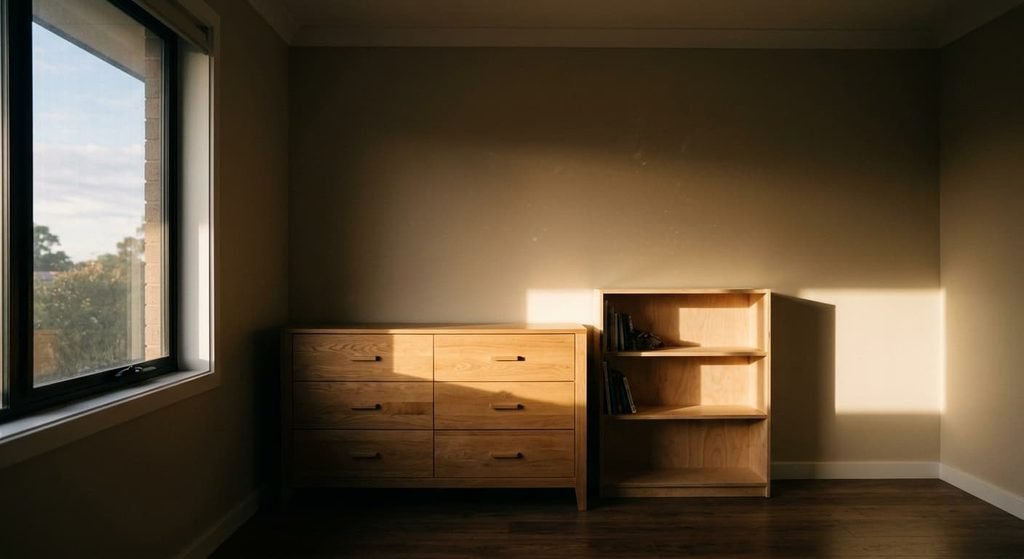
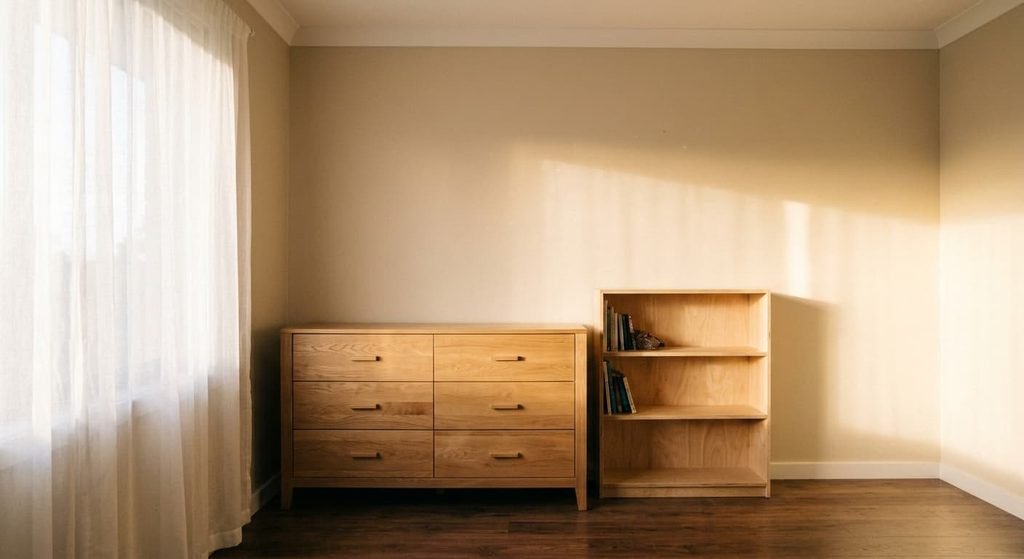
Morning sun arrives nearly flat. Take the sun square to the glass at 15 degrees above the horizon. Each metre of travel drops the beam by about 27 cm. Across a room 310 cm long, a beam from glass running 90 to 210 cm lands on the far wall between 7 and 127 cm. The band is where the chest and the shelf stand, along with the prints.
A low sun sends a flat beam deep into the room. Every gap and thin layer passes some of it, and three more mechanics follow. Light finds any straight gap, so a curtain that only just covers the frame leaves a glowing outline. Thin fabric transmits a share of what hits it, which turns a sharp stripe into a wide glow. And a layer inside the room lets the glass warm and glow before the light is stopped, while a layer outside stops it first.
The eye reads the stripe as glare because the band is many times brighter than the wall beside it. The same sun in a pale, evenly lit room would be much easier to ignore. Learn these four mechanics and you can predict the complaint in any east-facing room.
Is it too much light in the morning, or glare?
Do three checks on a sunny morning, and write the results down because the fix you need follows from them. Each takes five minutes and a tape measure, and each points at a different cause.
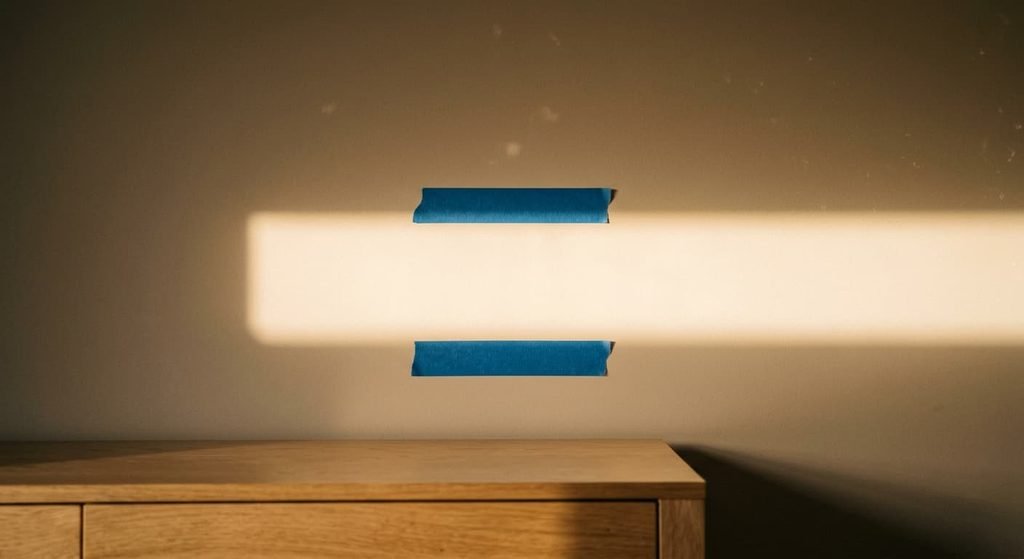
First, mark the stripe. Put a strip of tape at its top and bottom edge on the far wall and measure the heights. A clear band means a direct beam. An even glow with no band means diffuse light from a thin layer or pale surfaces.
Second, stand at the far wall with the curtain closed. A bright line around the edge shows gaps, so measure how far the cloth overlaps the frame, and check the hem as well as the sides. Under 10 cm is a leak.
Third, hold your hand behind the closed cloth. If you can see its outline through it, the fabric transmits. A stripe points to fix 1, a halo to fix 2, a glow through the cloth to fix 3, and a glass that is warm to the touch to fix 4.
Measure before you buy anything.
The fixes, in order
Free and low-cost fixes
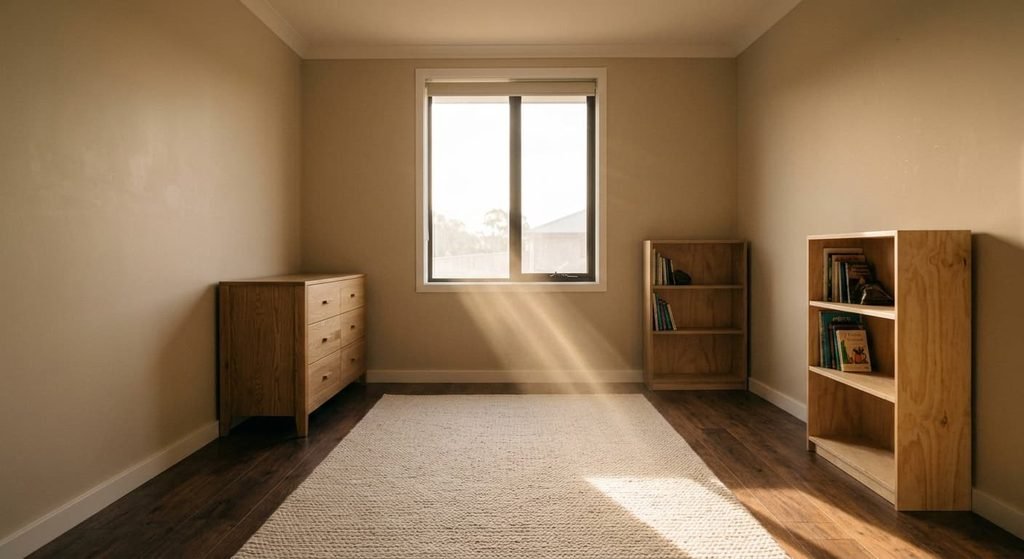
Move what the beam lands on. This answers the direct beam. Shift the chest and the prints out of the landing band, because sunlight fades printed paper and dyed cloth over months. Lay a rug you already own at the foot of the far wall. The beam reaches the floor there as the sun climbs, and a pale floor bounces it upward. A mid-tone rug absorbs part of what a pale floor would scatter into the ceiling. Re-run the tape check after the move to confirm the band is clear. It costs nothing. The limit is that the room stays just as bright, because you have decided where the light falls and not how much arrives.
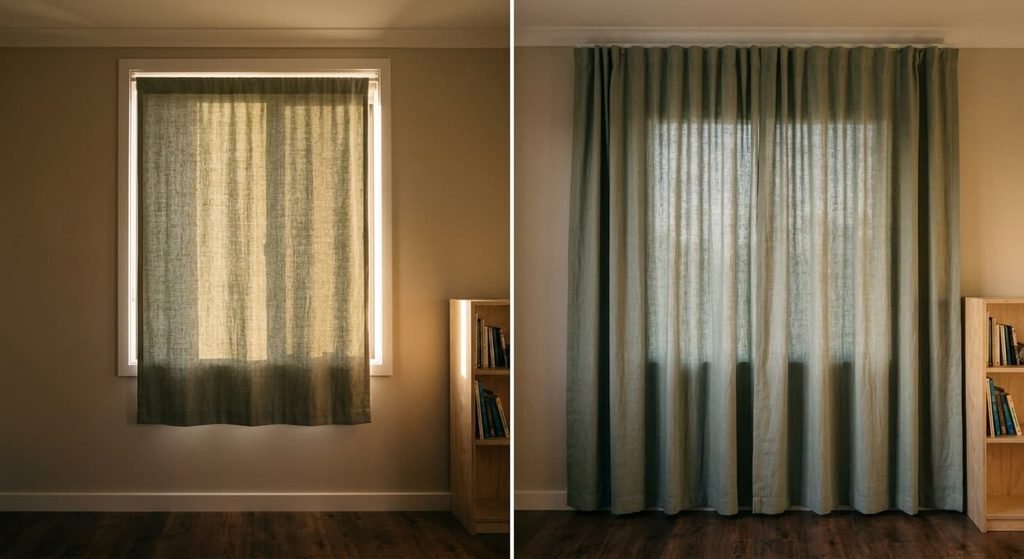
Widen the curtain overlap. This answers the gaps. Fit a track or pole that extends beyond the frame so the cloth covers 15 cm on each side and 10 cm above the glass. Let the hem clear the floor by about 1 cm. A bright strip under it is the leak people overlook. Hang the cloth on rings that slide, so it closes fully each morning. It is a purchase. The limit is that the cloth itself still passes light, so a thin weave glows even with perfect edges.
Fixes at the glass and outside
Fit a cordless blind inside the recess. This answers transmission at the glass. A close-weave blind catches the beam before it spreads into the room, and I’d fit it before thicker curtains for that reason. Measure the recess at three heights and order to the narrowest figure, since recesses are rarely square. Either a pleated or a roller style works, as long as the weave is close and the fabric sits about 2 cm from the glass. It is a purchase. The limit is a gap of 1 to 2 cm on each side of a blind sized to the recess, which glows. It also darkens the window all day while it is down.
Add an external screen or shutter. This answers the heat and light that reach the glass. Stopping the beam outside means the glass stays cooler and nothing glows in the room. Ask whether the screen retracts to keep the winter daylight. The work is professional. The limit is that the fitting needs the owner’s or the building’s approval, and not every façade can take one. Measure in advance, because fitting usually takes a few weeks to arrange.
What this room’s constraints mean for you
Too much morning light in this room comes from its orientation. An east-facing window will keep receiving a low beam on clear mornings, and nothing you place in the room alters the sun’s path. Its landing band slides up and down the far wall as the sun’s angle changes through the year. The stripe you measure in one month is not the one you will see in another.
The window height sets the band’s thickness, 120 cm in this case, and the ceiling at 250 cm sets how high it can climb. Styling can’t remove any of this. Paint and lamps can move the problem around, as can a rug, but none of them can make a room with a 120 cm east window dim at seven. Once you accept that, you stop chasing a result that only a covering can deliver.
The fix that doesn’t work
Adding a sheer curtain is the most common remedy for too much morning light, and it fails because a sheer weave transmits the beam and scatters it. A sharp stripe becomes a bright glow across the whole wall, which makes the room brighter at the far end than before. Softening a view and giving privacy are the jobs a sheer does well.
A sheer scatters light and stops none of it.
The same applies to a thin cotton sheet pinned across the frame. It looks like a blackout and works like a sheer, and the gaps at the edges remain. Close any thin layer and repeat the tape measurement: the stripe’s edges blur, but the brightness at the wall stays the same. Cover the glass with a layer that stops light, or move the stripe, but do not spread it.
Work through the fixes in the order they are numbered. Start by moving what the beam lands on, then close the gaps, then add a layer at the glass. Reach for the external screen only when the first three fall short. Most rooms get through the morning with the first two, and the third settles the rest. The best fix is the one that is dark when you pull it and invisible when you do not.
Questions readers keep asking
Can you fix too much morning light without buying anything?
Partly. Moving furniture out of the beam and laying a rug where it reaches the floor decide where the light falls, and both cost nothing. They don’t reduce how much arrives, so the room stays bright. For that you need a layer over the glass or outside it.
How much does it cost to block morning light?
It ranges from nothing to professional work. Rearranging is free. A wider track and curtain or a cordless blind in the recess is a purchase. An external screen is a job for a fitter. Start at the free end and measure the stripe again after each step.
Why does light leak around a closed curtain?
Light slips through any straight gap, and a curtain that sits only flush with the frame leaves one on every side. Extend the track so the cloth overlaps 15 cm each side and 10 cm above the glass. A gap between cloth and wall adds a second leak, so hang it close.