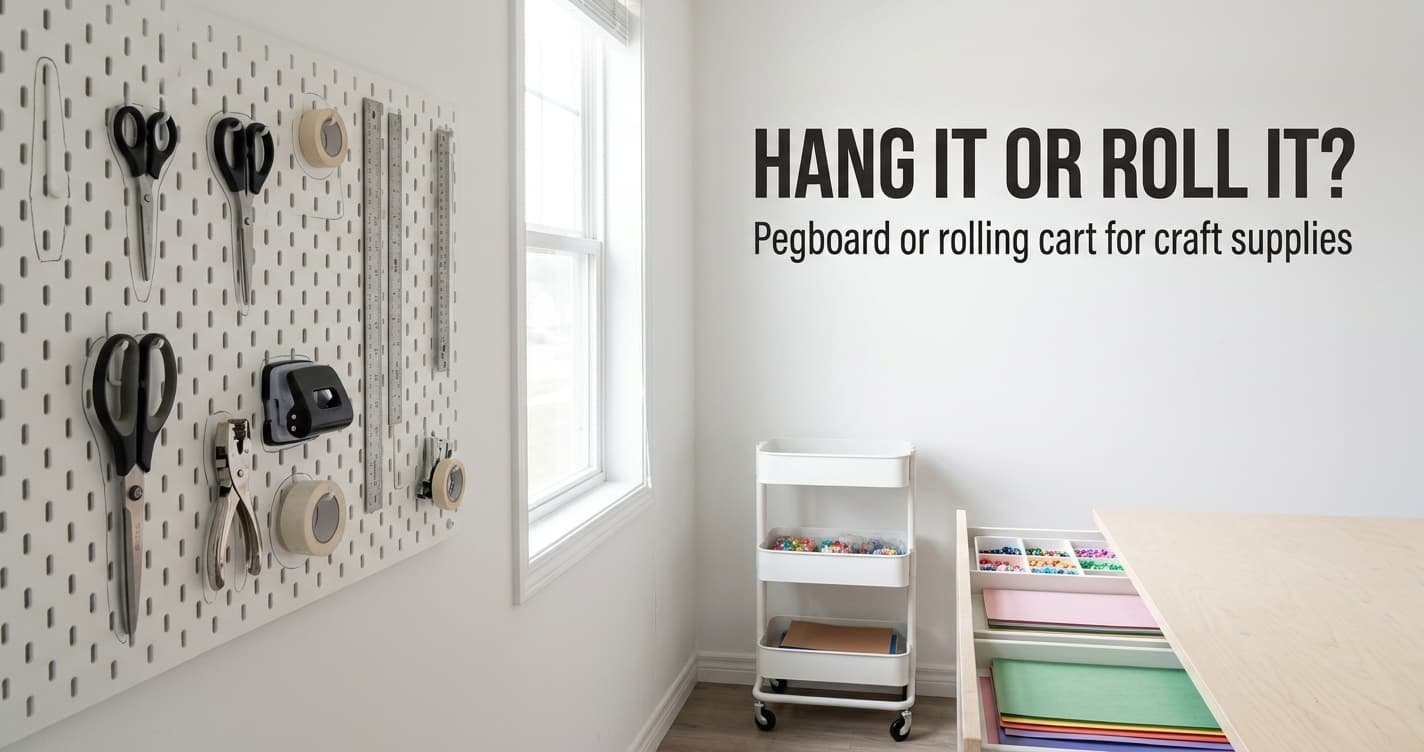
Visibility is overrated in craft storage, because the put-back decides whether a room stays tidy. With a pegboard or rolling cart, take the pegboard when most of what you use hangs by a handle or a hole, and the cart when most of it is loose. The deciding property is how exactly each one tells an item where to go.
This guide assumes a spare room of 280 by 340 cm in the Netherlands, with a door 78 cm wide. The sums are simplified. If you rent, check your lease before you drill into a wall. Treat every figure as a starting point for a tape test on your own wall.
The property that decides pegboard or rolling cart
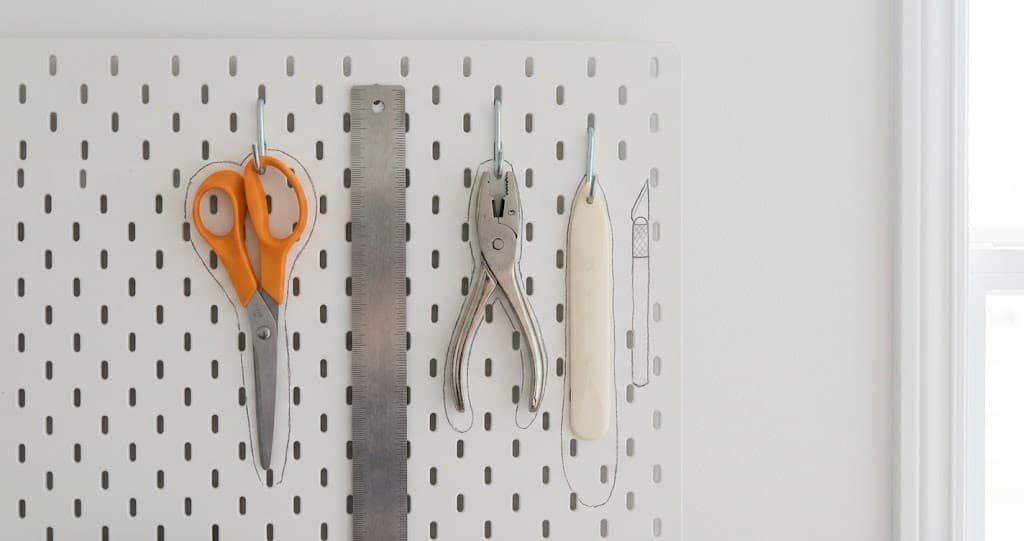
Compare the two on the address they give an item. A pegboard has holes on a 25 mm grid, and a hook fills one hole or a pair, so a tool’s address is about 6 cm². A tray on a cart takes the same tool anywhere on its 36 by 24 cm floor, an address of 864 cm². That’s 138 times looser. A hook must land within about 12 mm of its hole, half the grid pitch, which a hand manages without looking when an outline marks the spot. A tray gives the same hand 12 to 18 cm of slack in each direction.
The put-back is where tidiness is lost.
The deciding property is address precision, since a fetch finds a tool wherever it lies and a put-back must choose a place. A tight address makes the right spot obvious: a pencil outline behind each tool shows what’s missing from across the room. It costs a handle to hang by and a moment of aim when you’re tired. A loose address forgives a careless drop, and the cost is drift, because a tool left in the wrong tray stays there. Beads and paper have no handle, so they can’t have a tight address on a pegboard at all.
Pegboard and rolling cart, side by side
Every row below is something you can check with a tape measure or a hand. No row here depends on a brand.
| Property | Pegboard | Rolling cart |
|---|---|---|
| Address of one item | One hole pair, about 6 cm² | A tray zone, 864 cm² on a tray of 36 × 24 cm |
| Putting an item back | Aim a hook at one hole pair | Drop it anywhere in the tray |
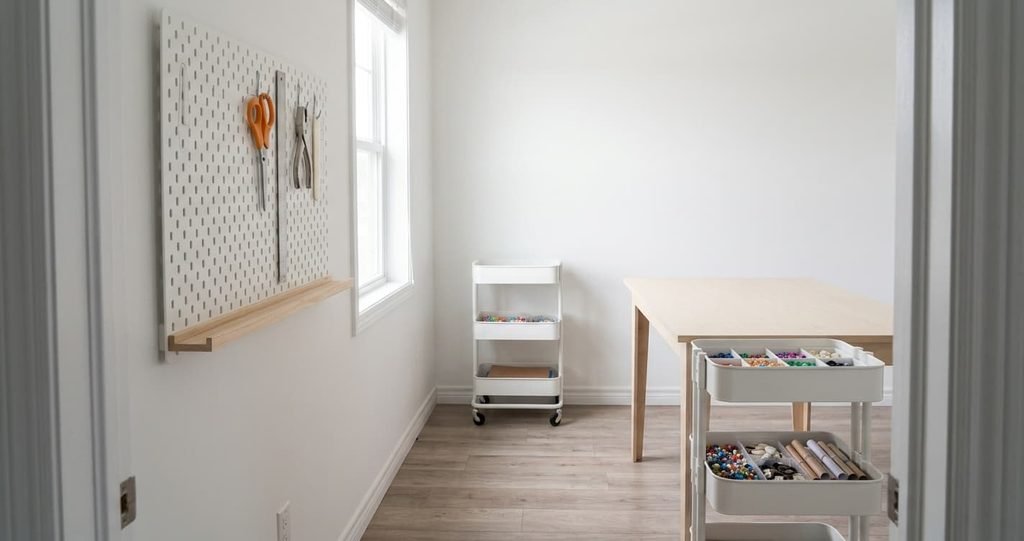
| Space taken | Wall of 60 × 90 cm, which is 0.54 m², and no floor | Floor of 40 × 30 cm, which is 0.12 m², and no wall |
| Visibility | Every hung item in view from the doorway | Top layer of open trays, while drawers hide everything |
| Loose and small items | Need pots or baskets on hooks | Sit in trays |
| Moving | Fixed once drilled, so the work comes to the wall | Rolls through a door 78 cm wide, so the wall comes to the work |
| Dust | Exposed on all sides | Closed drawers keep it out |
Space is the row that catches people out, because a cart takes only 0.12 m², about 1.3 per cent of this room’s 9.52 m² floor. The pegboard uses 4.5 times that area, but of wall, which is the part of a small room that sits idle.
Where a pegboard wins
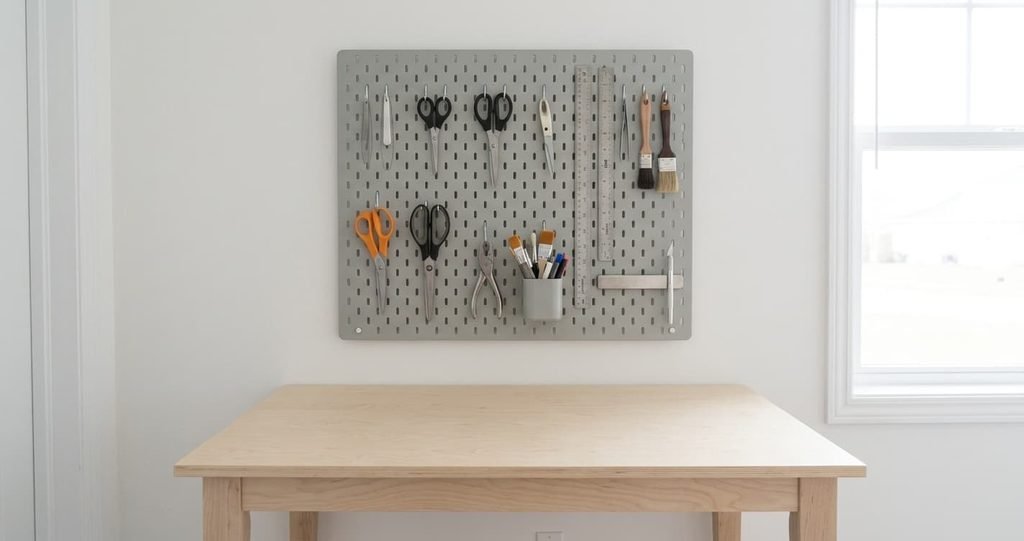
In the pegboard or rolling cart decision, the pegboard wins when you work at one spot and most of your tools have handles. Forty handled tools use 40 of the 216 positions that a panel of 60 by 90 cm offers at 5 cm spacing, so there’s room to grow. Every tool is in view, and a gap in the outlines shows what’s missing before you start. It takes no floor, which suits a room where a table and a chair already claim most of it.
The unglamorous reasons count too. One broken hook costs one hook, and a damaged section of board is replaced on its own. Wiping a panel takes a minute, which a stack of drawers can’t match. Perforated hardboard in matt white shows pencil outlines clearly, and a powder-coated steel panel takes magnetic holders.
The costs are plain. Hooks often work loose in soft hardboard holes and wobble within months, so steel suits heavy tools better. The wall also has to carry the panel, and whether yours is solid brick or hollow plasterboard changes the fixings, which I can’t judge from here.
Where a rolling cart wins
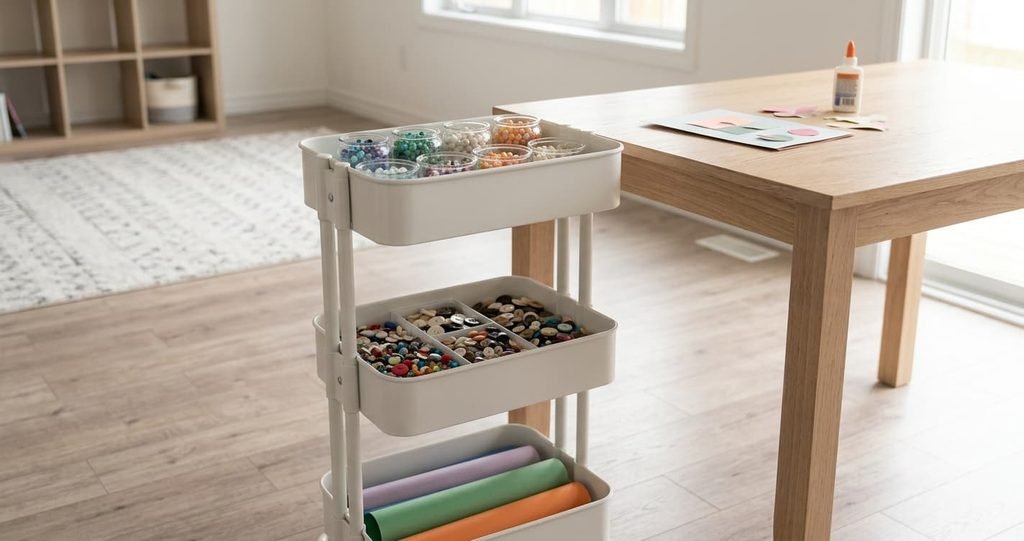
A rolling cart wins when your supplies are loose or your work moves. Beads and paper have no handle, so a tray is their only honest address. Roll the cart to the dining table and work there. Roll it back afterwards, and the same supplies serve two rooms.
The unglamorous reasons count here as well. It needs no drilling, so it suits a rental and moves house with you. Trays lift out and wash. A half-finished project can be wheeled into a corner and left. A cart of 40 by 30 cm clears a 78 cm door with 38 cm to spare.
The costs are the flip side of that looseness. Trays drift into piles unless each has one job, so label them by use and not by material. Castors under about 5 cm across stall on thick pile carpet, and hard floors are kinder. A drawer also hides what’s inside, so you open several to find one thing. Because trays travel, two people in one household can keep a tray set each.
When neither a pegboard nor a rolling cart is right
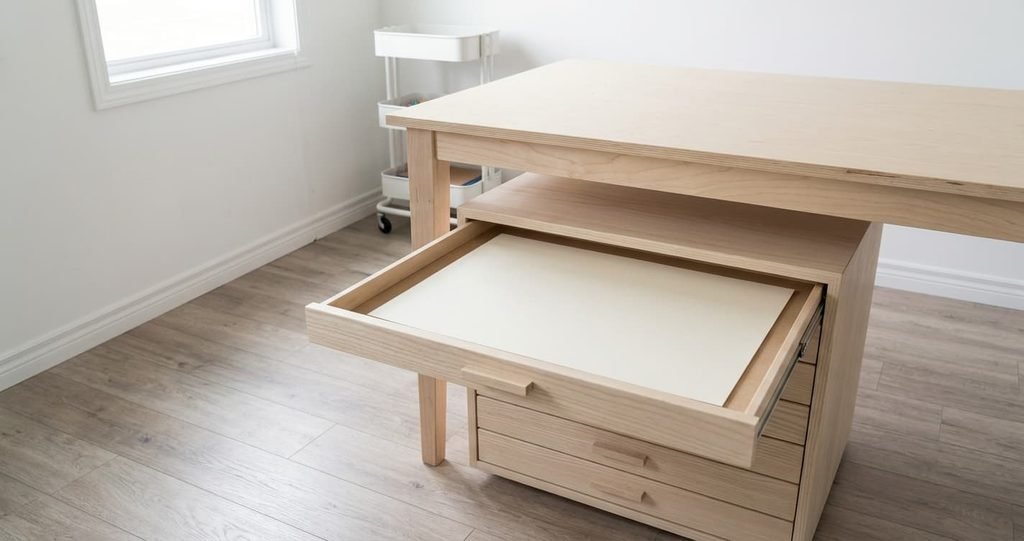
If your supplies are mostly flat, neither holds them well. A tray of 36 by 24 cm takes A4 (29.7 by 21 cm) but not A3 (42 by 29.7 cm), and a pegboard can’t hold a sheet at all. Paper and cut fabric fall into that group. Count your A3 and larger sheets first, because a single large pad is reason enough.
Flat things want to lie flat.
A shallow flat-drawer unit is the third route. Drawers about 44 by 31 cm inside clear an A3 sheet by 2 cm and 1.3 cm. A drawer 4 cm deep holds a stack you can lift in one go, while a deeper one buries the bottom sheets. A unit 50 by 37 cm takes 0.19 m² of floor and sits under a table. If your current boxes already work, leave them where they are. A system you already use beats a better one you must learn.
How to decide in thirty seconds
Lay out everything you used last month and sort it into two piles: items that hang by a handle or a hole, and items that don’t. Be strict: an item that only hangs with a string tied to it counts as loose. It takes about ten minutes. If the first pile is bigger and you work at one spot, take the pegboard and outline every tool. If the second pile is bigger or you work in more than one place, take the rolling cart and give each tray one job.
Free wall of 0.54 m² is the pegboard’s requirement. A cart needs a clear way through the door and a floor its castors can handle.
A pegboard gives a tool one exact address, and a rolling cart gives a loose item a forgiving zone. The pegboard or rolling cart question comes down to what you own, so count what hangs before you buy anything. I’d outline the first tool tonight and see how the put-back feels. Check a month later whether the tools still sit in their outlines.
Questions readers keep asking
Is a pegboard or a rolling cart easier to keep clean?
The cart, because its trays lift out and wash. A pegboard needs only a quick wipe, but every hung item stays exposed, and dust settles on glue bottles and fabric. If dust matters to you, keep those items in a closed box and hang only the tools.
Will a rolling cart fit in a small craft room?
Yes. With a pegboard or rolling cart, only the cart uses floor, and a cart of 40 by 30 cm takes 0.12 m². In a room of 9.52 m² that’s about 1.3 per cent. Check the door and the floor instead, since castors under 5 cm across stall on thick pile.
How long does a pegboard last?
Steel panels last for years. Perforated hardboard sags under heavy loads and softens in damp rooms, and the usual first failure is a hook working loose and wobbling in its hole. Hang heavy tools on steel and keep hardboard for light ones.