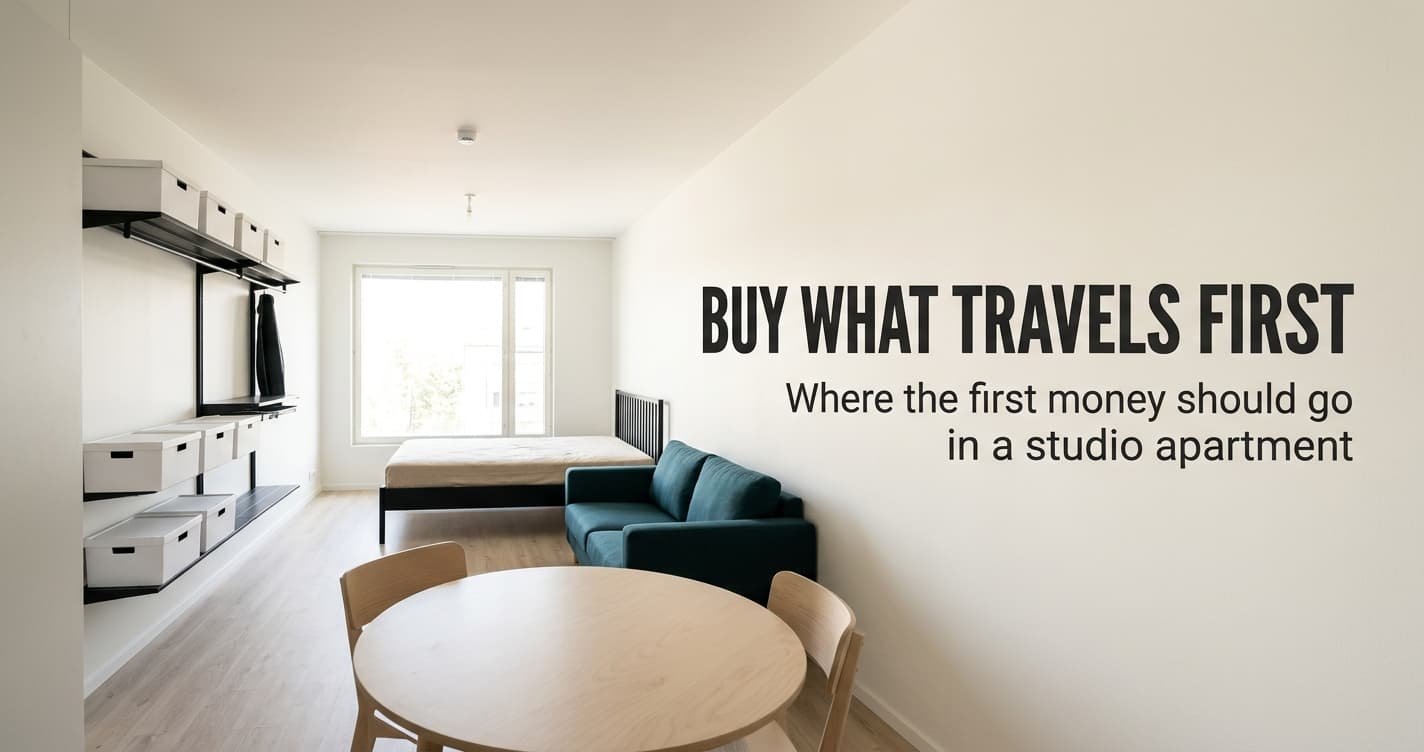
What should you buy first for a studio apartment? Where the first money should go is the mattress, then the bed base. The sofa comes third. A rail with boxes follows, and the table comes last. One test sets that order: a body or a standard sizes the pieces that earn the money, and the room sizes the ones that don’t.
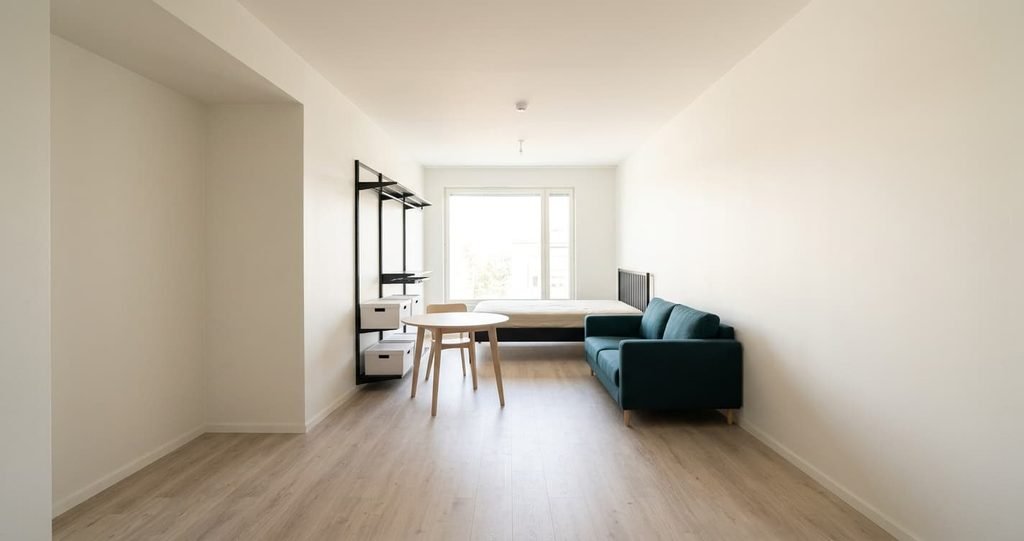
The studio here measures 320 by 600 cm, which is 19.2 m², in the Netherlands. I’ve left prices out since they date fast, and ranked every piece by its construction instead. The figures assume you rent and will move on within a few years.
The rule behind where the first money should go
A studio is usually a stop, and the next home has different walls. So ask of each piece what sets its size. A mattress is 140 by 200 cm in any room. For any body a seat is 45 cm high, and a table top stands 75 cm from the floor. A fitted wardrobe has to match a wall’s width and the ceiling’s height. It must also match the depth that the walkway allows.
Say each dimension tied to the room fits the next flat half the time. A piece with no such dimension survives the move every time, and one with a single dimension survives half the time. A fitted wardrobe with three survives one time in eight.
Standard pieces also keep a resale route, because the next buyer’s room takes them too. A piece cut to your wall suits one buyer, and that buyer is you.
Fit is the cost that a price tag hides.
Spend first on pieces whose size is set by a body or a standard, and buy cheap the pieces whose size is set by this room. Money in a standard piece follows you out of the door, while money in a room-sized piece expires with the lease.
The list, in buying order
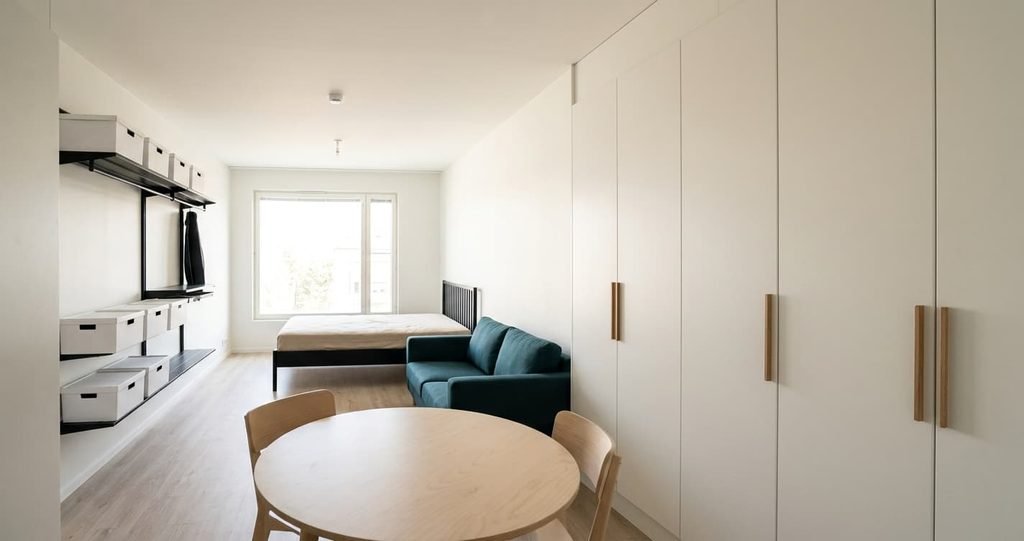
1. A mattress of 140 by 200 cm with a core of individually wrapped springs or dense foam of high resilience, plus a zip-off cover. It goes first because it takes 2.8 m², about 15% of the floor, and has no dimension tied to the room. Tier: BUY ONCE, since the core is hidden and decides everything. The weak version is a thin comfort layer over a soft core, which settles into a body-shaped dip.
2. A slatted base of 140 by 200 cm in steel or laminated beech, with slats set in flexible caps. It sits second because the mattress needs it to perform. Tier: MID, since its parts are visible and you can replace a worn slat alone. The weak version has stapled joints and slats spaced wider than the mattress maker allows.
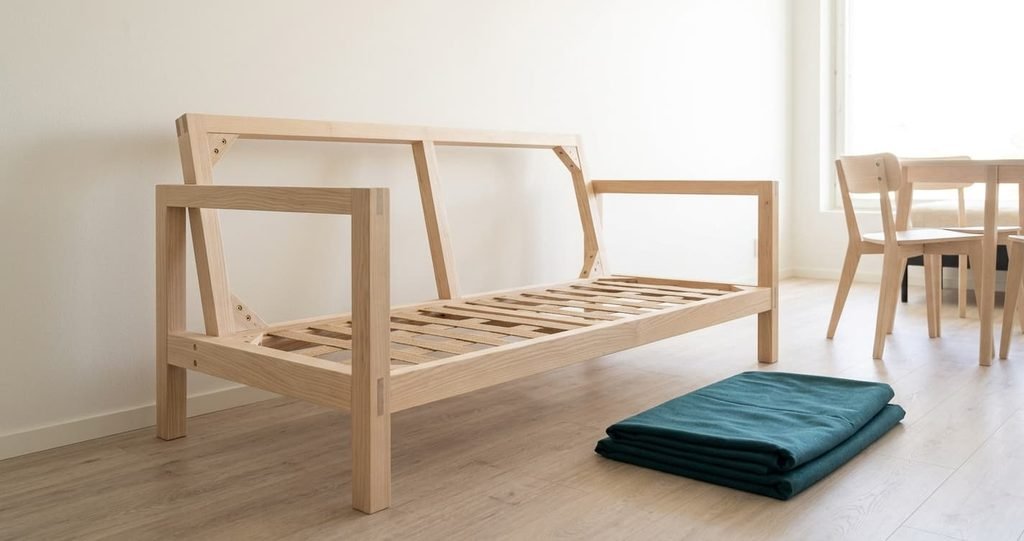
3. A two-seat sofa of 160 by 80 cm with a kiln-dried hardwood or multi-layer plywood frame. Glue and screws hold the corners. It comes third because a seat is set by a body, and it takes 1.28 m², 6.7% of the floor. Tier: MID, since the frame is the hidden part and the cover can be changed. The weak version is softwood held by staples, which loosens at the corners.
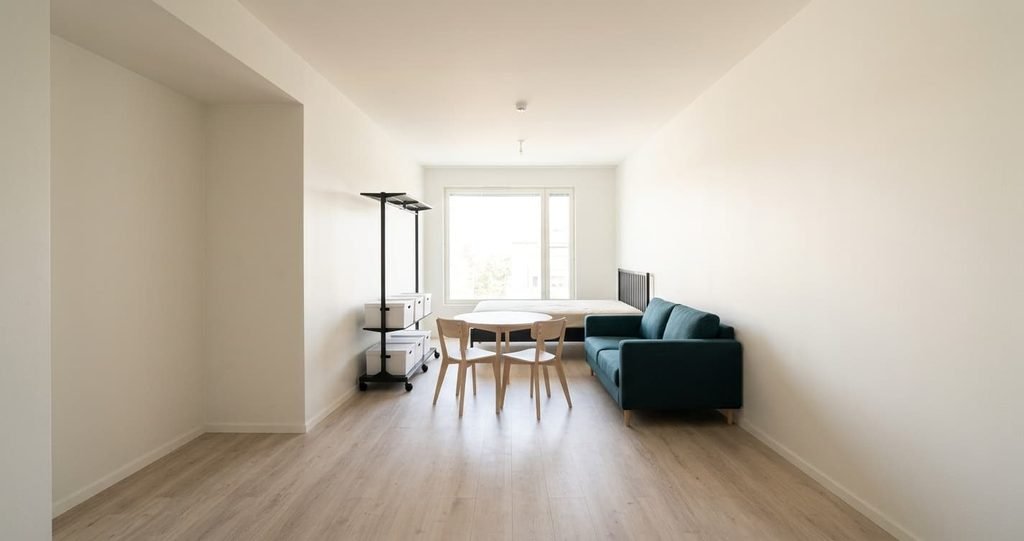
4. A freestanding steel rail 120 cm wide and 45 cm deep, with lidded boxes under it. It follows because it’s a standard job with nothing hidden, and it hangs 30 garments at 4 cm each. Tier: BUY CHEAP, since a welded tube has no moving part. The weak version has thin tube and push-fit joints that rock when you pull a coat.
5. A round table of 90 cm across and 75 cm high on one central column. It comes last because it’s the only room-sized piece, needing 210 cm of clear line with a chair on each side. Tier: BUY CHEAP, since a plain top on a column hides nothing. The weak version has a base under 55 cm across, which tips when you lean on one edge.
Where to spend and where not to
Spend on the core of the mattress and on the corner blocks inside the sofa frame. Both carry load every day and you can’t inspect them once a cover hides them. A coil core that springs back after you press a palm into it is one to keep. A frame that doesn’t twist when you lift one corner is too. You can swap a slat and wipe a tube.
Everything else can be plain.
The fitted wardrobe is the piece to argue down. Most guides treat it as the large outlay of a studio, yet it ties three dimensions to this room and takes 0.9 m² even at a modest 150 by 60 cm. A rail of 120 by 45 cm, which is 0.54 m², hangs the same garments. It also moves with you. The rail hides no parts, so there’s nothing to pay for. Boxes below it hold what you fold. The one cost is that clothes stay in view, so keep the rail beside the bed, not the sofa. That’s where the first money should go instead: into the mattress and the frame, not the wardrobe.
What this order assumes, and when it breaks
The order assumes a rental and a stay of a few years. It suits one person or a couple. How long you’ll stay is the variable I can’t see from here. If you own the studio and expect a decade there, where the first money should go changes, because the wardrobe’s three dimensions stop being a risk. You know them, and the walls stay. Fitted storage then moves to second place, ahead of the sofa. You can pay for good runners and a full-height door.
A furnished let changes the start. The mattress may be thin and the base may be fixed, so check item 1 against the bed that came with the flat. If the mattress is poor, replace only the mattress, because the frame can stay.
A couple changes the numbers. A bed of 160 by 200 cm takes 3.2 m², which is 16.7% of the floor. Add a second rail of the same size before you buy a bigger table.
Where the first money should not go: what to skip entirely
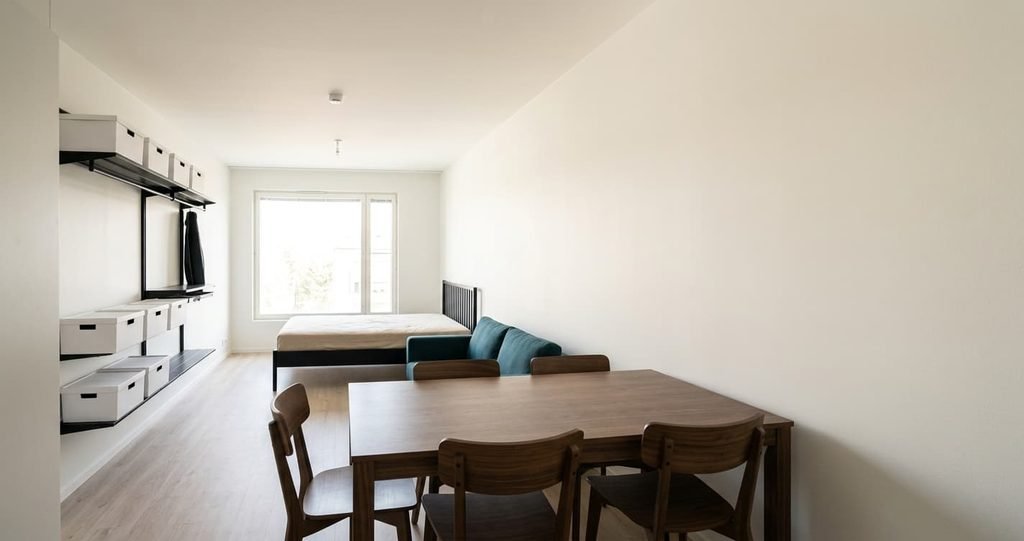
A matching furniture set heads the list. It ties several room-sized pieces to one look, and a set bought for one flat rarely fits the next. Next comes a dining set for four, whose table of 150 by 90 cm takes 1.35 m², 7% of this floor, and a table of 90 cm across covers most evenings. A bed with built-in drawers is third, since the lifting mechanism is a hidden part you pay for and rarely open, and it raises the mattress. Under-bed boxes work as well and cost nothing in hardware. A statement rug is fourth, since it’s room-sized by definition and dictates the sofa you buy after it. None of the four travels well, which is the same test again.
Where the first money should go in a studio apartment is the mattress, because a body sizes it and the room doesn’t. The rule is to spend on what travels and buy cheap what only fits here. I’d stand by that order over the habit of buying a sofa first. A wrong sofa shows itself in the first week of use, while a sagging mattress costs you every night until you replace it.
Questions readers keep asking
How many things should a studio apartment start with?
Five pieces cover day one. Start with a mattress and a base. Add a sofa, then a rail with boxes, then a table. A furnished let may need only the rail and the table. Add nothing else until you’ve lived there for a few weeks and noted what you reach for.
Should I buy the sofa or the bed first in a studio?
Buy the bed first. The mattress takes 2.8 m² and has no dimension tied to the room, so it moves with you. A sofa can wait a week, and a borrowed chair covers the gap. Borrowing can’t fix a night on the floor.
How can I tell a good mattress without knowing its price?
Ask what the core is made of. Wrapped springs or dense, high-resilience foam should spring back after you press a palm into them, and the cover should unzip for washing. A thin comfort layer over a soft core is the fault to avoid.