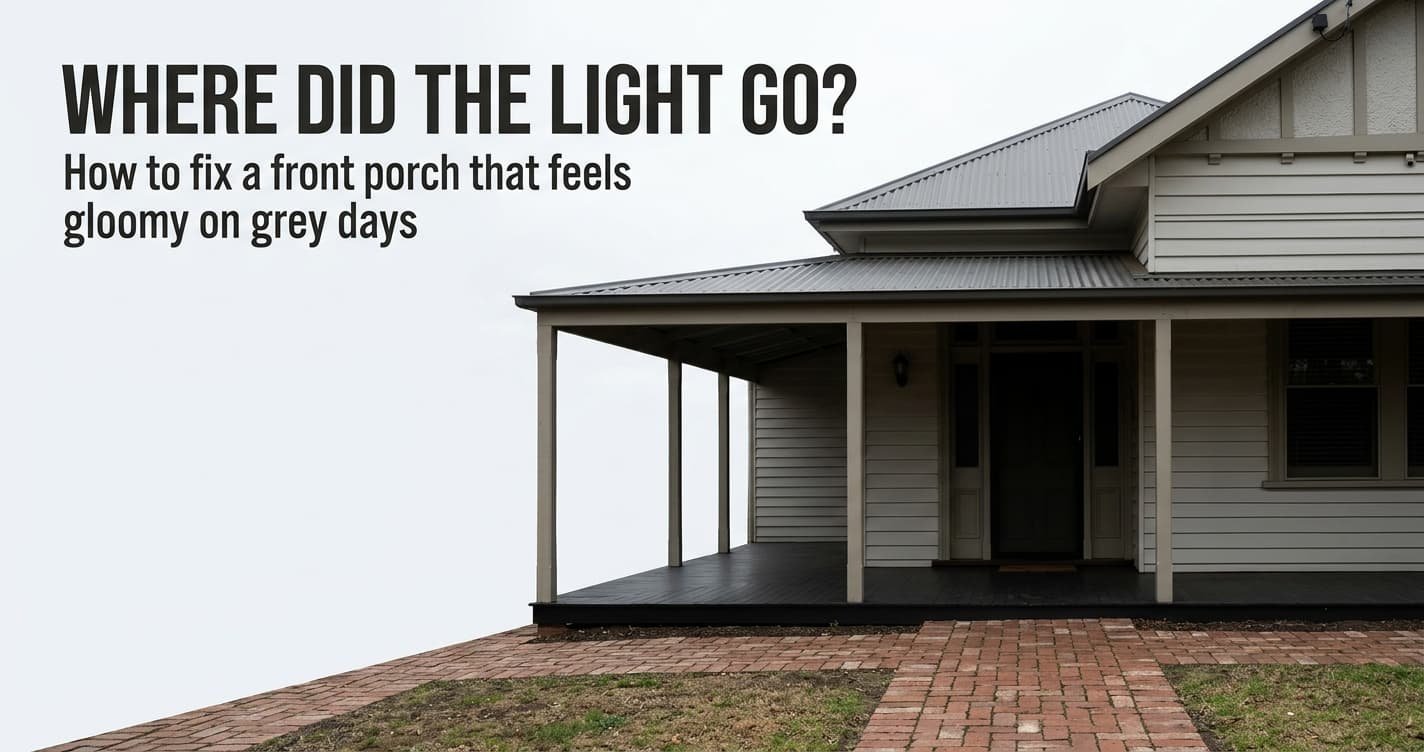
A sheet of white paper held at the door of a porch looks greyer than the same sheet held at the front edge. That is how a front porch that feels gloomy on grey days behaves. The cause starts with the roof taking the brightest part of the sky. Begin by clearing whatever stands in the open sides, because it costs nothing.
The sums take a covered porch of 240 by 150 cm under a 250 cm roof, on a Dutch terrace, with red-brown brick on two sides. They use a standard model of an overcast sky and round reflectance values, so treat them as shapes and not as readings.
Why the front porch feels gloomy on a grey day
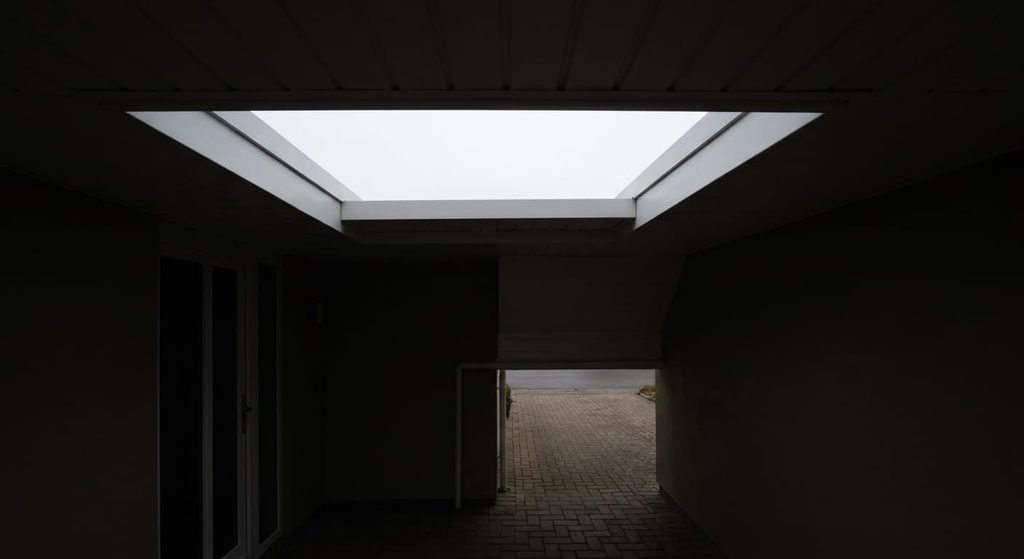
On a grey day the whole sky is the light source, and it isn’t even. A standard overcast-sky model puts the brightness overhead at about three times that at the horizon. A porch roof hides exactly that part.
Take the door handle at 120 cm. The roof’s front edge sits 250 cm up and 150 cm away. It therefore cuts the view of sky at 41° above the horizontal, and everything higher is roof. In the model, that leaves the door about two thirds of the light an open wall would get, before the side wall takes its share.
The loss looks bigger than a third, and four things explain why. The roof hides the brightest part of an overcast sky, so what remains arrives low and flat, with no shadows to give shape. That light is also cooler in tone than direct sun, which dulls warm brick. Dark surfaces return little of it: a floor with a reflectance of 15 sends back 15% of what lands on it. Your eyes have just adapted to the open street, so a front porch that feels gloomy reads darker than it measures. Rain adds to it. Wet brick and tile darken as water fills their pores.
Confirm which version you have
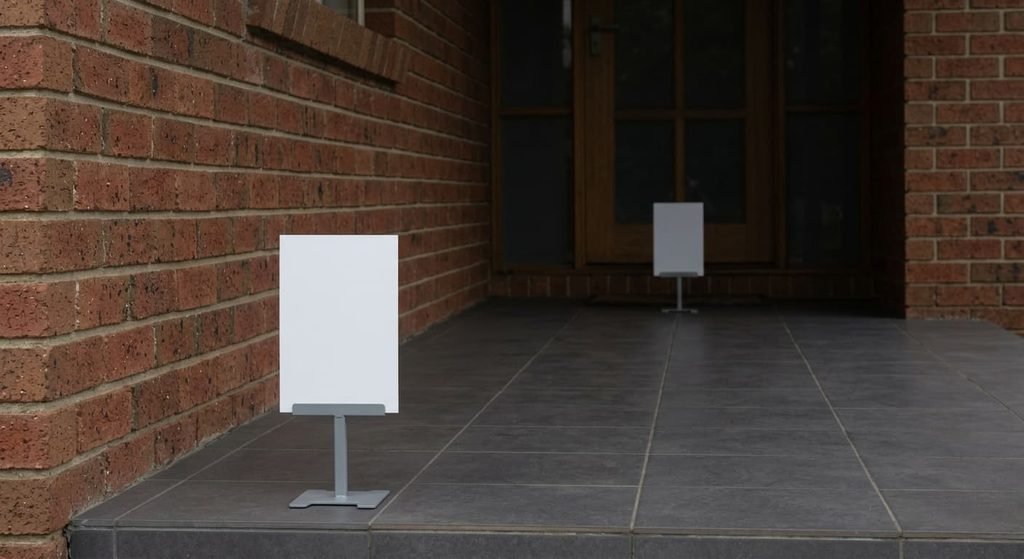
Two checks separate the causes. On a grey midday, hold a sheet of white paper at the door at 120 cm and photograph it. Hold it at the front edge at the same height and photograph it again with the same phone setting. If the sheet at the door looks clearly greyer, the loss builds along the depth. The first and fourth fixes then matter most. If the two match, the roof isn’t the main thief and the porch mostly looks dark by comparison with the street.
Then measure the openings. Add up the width of anything solid standing in the open right side and the open front, such as a trellis or a tall pot. If it covers more than a tenth of the opening, the first fix will show at once.
Last, compare the porch on a wet day and a dry day with similar cloud. If it darkens more when the surfaces are wet, they are taking light. The second and third fixes then deserve more weight.
The fixes for a front porch that feels gloomy, in order
Clear the open sides. This costs nothing and it addresses the light that arrives low. The porch has 240 cm of open front and 150 cm of open right side, both 250 cm high, which makes 9.75 m² of opening. A trellis of 60 by 180 cm hides 1.08 m², or 11% of it. Move anything solid out of the right side first and the front second, then repeat the paper test at the door. The limit is that it returns only light already on its way, so the roof’s share stays lost.
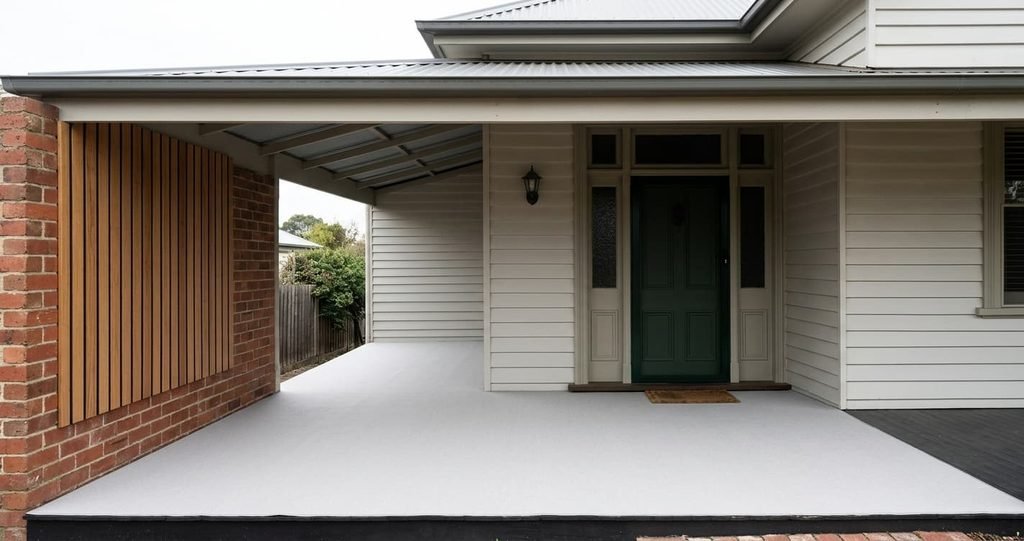
Lighten the floor with a pale, matt, loose-laid covering. This is a purchase and it addresses reflectance. The floor is 3.6 m². At a reflectance of 15 it wastes most of what lands on it. At 60 it sends back four times as much up to the soffit and the door. The catch is that it adds no light. It shows dirt sooner than the dark tile it covers, and it has to be a type rated for outdoors.
Add a warm, textured surface at eye level. This is a purchase too, and it addresses the cool, shadowless quality of overcast light. Timber slats 6 cm wide with 2 cm gaps on the left wall give warm colour. The gaps read as shadow lines even in flat light. A panel 120 cm wide and 100 cm tall is 1.2 m², about a third of that wall’s 3.75 m². The catch is that it brings warmth and rhythm but no light, and fixing it means drilling into brick, so it isn’t reversible.
Open a translucent strip in the roof. This is professional work and it addresses the sky the roof hides. A strip 40 cm deep across the 240 cm front edge is 0.96 m², or 27% of the 3.6 m² roof. The light through it arrives steeply and lands on the floor, so the pale floor multiplies it. The limit is that it can’t return the whole third. Whether it’s allowed depends on the roof’s construction and the owner’s rules, so check with them before you rely on it.
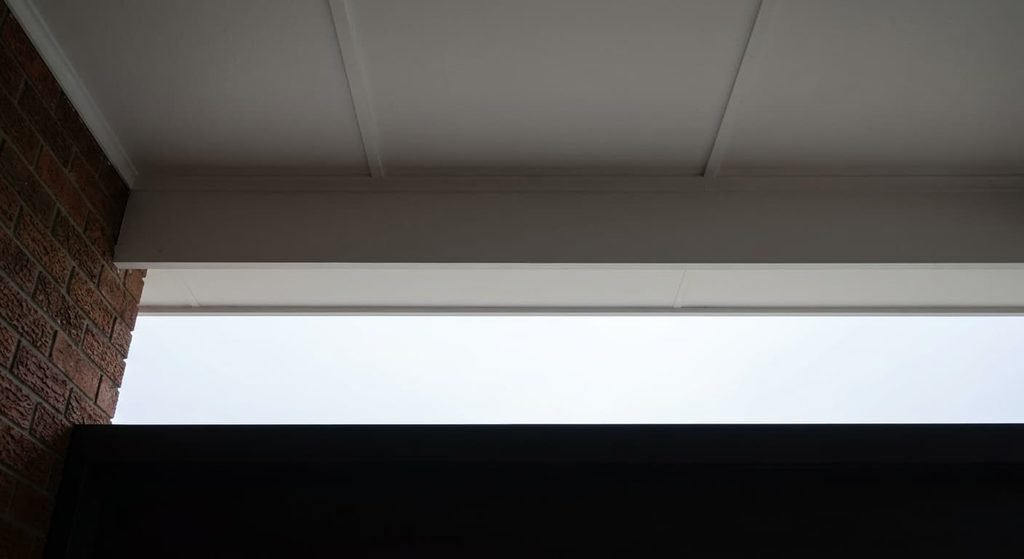
What this porch’s own construction means for you
On a front porch that feels gloomy, the 41° cut-off is a product of two numbers: 150 cm of depth and 250 cm of height. Only a change to the roof moves it. Orientation is fixed as well, and I can’t see yours from here. A north-facing porch gets no direct sun on a clear day, though on a grey day the difference shrinks because the whole sky is the source.
The brick on the back and left walls has a reflectance of its own, about 25 in these sums. It stays there unless you coat it, which changes the look of the building for good. No styling alters any of this. Pale flooring and warm cladding can’t restore the third the roof takes.
Judge the first three fixes as improvements and the fourth as the cure.
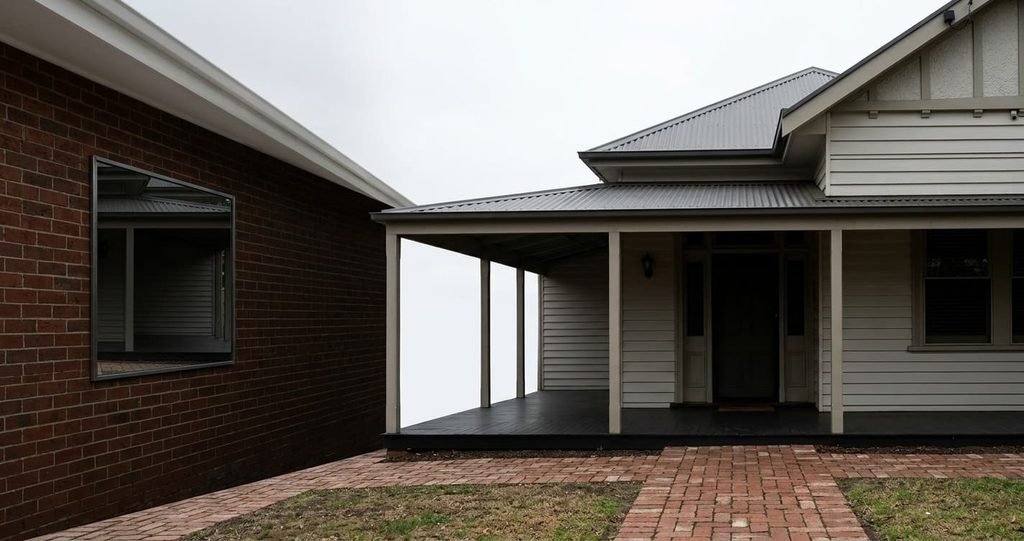
The fix that doesn’t work
A mirror on the porch wall is the popular remedy, and it fails. A mirror adds no light. It redirects what reaches it. In an open porch most of that light is travelling in from the side or the front, so the mirror sends it back out toward the street. It also doubles whatever it faces, and facing dark brick it doubles dark. Exterior silvering degrades in damp air too. I’d keep mirrors in hallways with a window opposite and leave them off a porch.
Brightness comes from light that reaches the surface, and a mirror only moves it.
Glossy paint and metallic panels behave like weak mirrors and send the same light back toward the street. A matt surface scatters light in every direction, including into the porch, which is why the pale floor in the second fix is specified as matt.
To fix a front porch that feels gloomy, first find where the light is lost. The roof takes a third. Dark surfaces waste more, and the street makes what’s left look dimmer. Clear the sides, then lighten the floor. Add warmth last. Then repeat the paper test, because the two sheets show what each step returned. The roof strip is the only step that returns what the roof took.
Questions readers keep asking
Can a dark front porch be made brighter without changing the roof?
Yes, partly. Clearing the open sides raises what you see, and so does a pale floor or a warm surface. None returns the share the roof takes. Only a translucent strip in the roof does that. Start with the free step and judge from there.
What does brightening a gloomy front porch cost?
The range runs from free to tradesperson work. Clearing the sides costs nothing. A pale floor and wall slats are purchases, and a roof strip needs a tradesperson. Do them in that order, because each cheaper step shows how much the next one is worth.
Why does my front porch look darker when it rains?
Rainy days usually bring thicker cloud, so the sky gives less light. Wet brick and tile also darken as water fills their pores and traps light that dry surfaces send back. Your eyes adapt to the bright street too, so the porch reads darker than it measures.