Inside the camera, a person is only a number between zero and one. What lets a security camera tell a person from a car is that score. It measures how closely a moving patch of pixels resembles thousands of labelled examples. A second check on how the patch moves confirms or cancels the label.
One courier and one car travel through the steps below, and the sorting goes wrong in a few marked places. Each figure assumes a 1920 × 1080 picture from a lens that spans 100 degrees across, mounted high enough to look slightly down.
The short answer, and what it leaves out
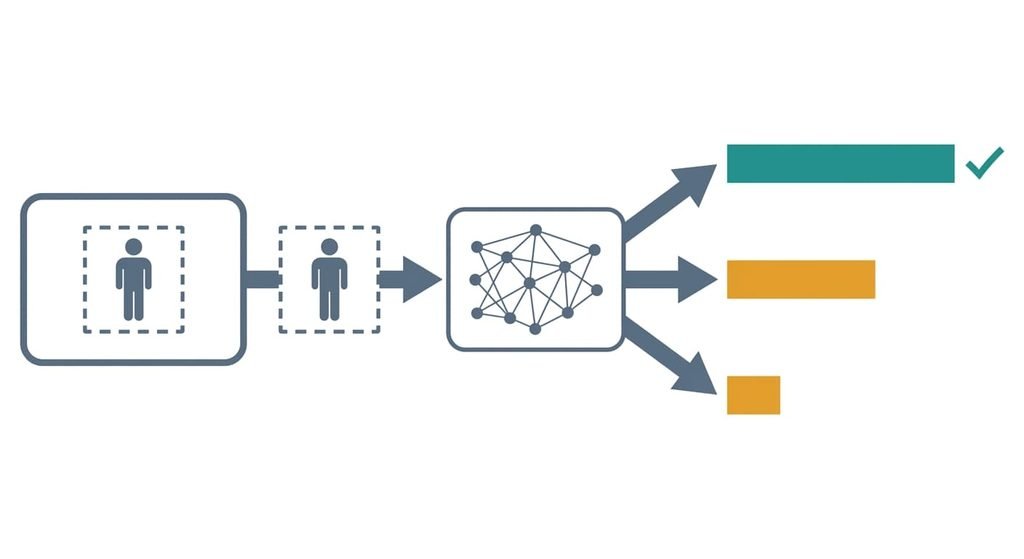
Precisely, a classifier maps each cropped patch of pixels to one score per class on a fixed list. A tracker then keeps the best label only if the patch moves the way that class moves. That model is trained on labelled examples, so it holds patterns instead of definitions.
The plain answer above skipped the list. Person and vehicle are choices someone made before the camera shipped, and every patch gets pulled towards the nearest entry. A score of 0.9 means the patch sits close to the person pattern, which is weaker than a certainty. Most cameras also hide a threshold behind a setting called sensitivity or confidence, and only scores above it become alerts. Much of what lets a security camera tell a person from a vehicle comes down to that list and the cut-off.
Two more details sit inside that definition. The model sees a crop, a box cut from the frame, and never the whole scene around it. The label also depends on time: one frame produces a guess, while several in a row produce a decision.
What lets a security camera tell a person from a car, step by step
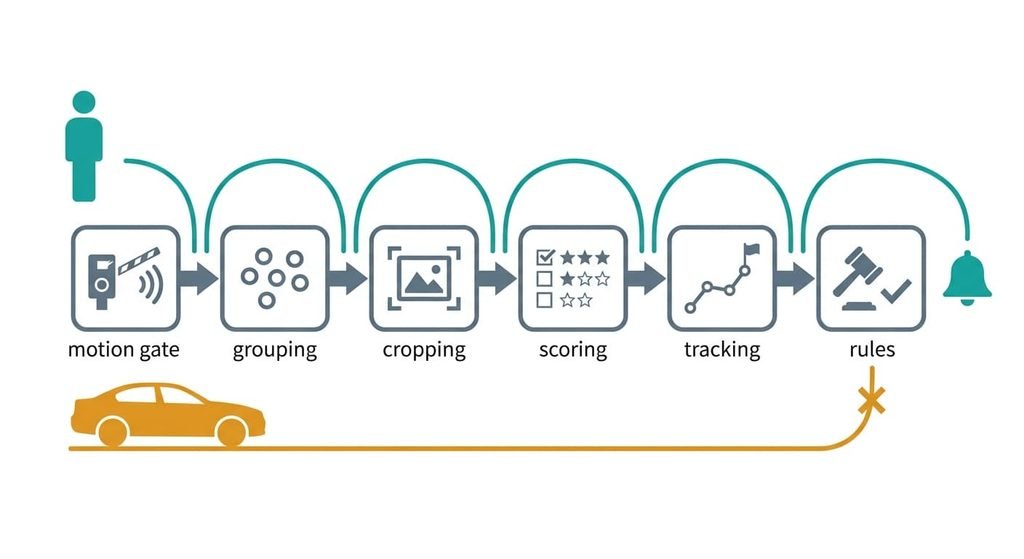
A courier walks across the drive 20 m from the lens while a car passes on the road 12 m away. The motion gate runs first: enough changed pixels, for long enough. Both pass, and only then does the costly model wake up, since classifying every frame would need far more processing than counting pixels.
Grouping comes next. Changed pixels that touch merge into one box. At 20 m, the courier’s box comes out roughly 69 pixels tall and 20 wide, an upright shape about 3.4 times taller than it is wide. The car, side-on at 12 m, makes a box about 302 pixels wide and 101 tall, a shape three times wider than it is high.
Cropping follows. Each box is cut out and resized to the fixed square grid the model expects, usually larger than 69 pixels. The courier’s figure is stretched up to fill it, and stretching adds no detail.
Scoring is the step people picture as recognition. The model returns one number per class. An illustrative result is 0.91 for person and 0.03 for vehicle on the courier, and 0.97 for vehicle and 0.01 for person on the car. Treat those as examples.
Tracking then links each box to its match in the next frame. A car at 30 km/h covers 8.3 m/s. It crosses the 28.6 m wide slice of road at 12 m in about 3.4 s, which at five analysed frames a second gives roughly 17 looks. The courier, walking at 1.4 m/s through a view 47.7 m wide, stays in shot for about 34 s and gets around 170. A label must hold across several looks in a row before it’s trusted. That’s why a person alert lands a beat after a plain motion alert.
The rules layer closes the chain. It checks the class against your filter, then asks whether the box sat inside your zone for the dwell time you set. The courier is a person inside the drive zone for long enough, so the alert fires. A car inside the road zone is a vehicle, so a person-only rule drops it.
The analogy, and where it breaks
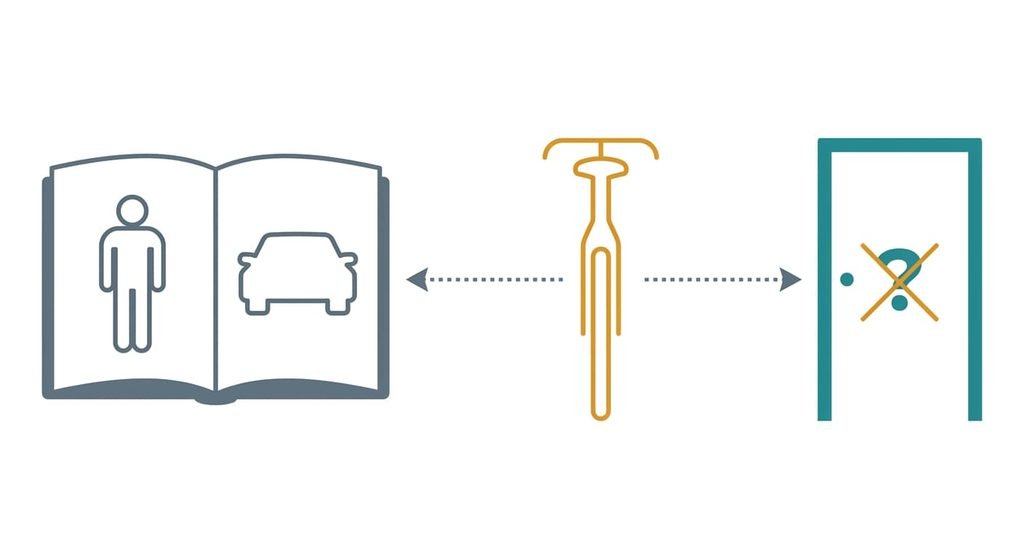
A birdwatcher with a field guide does the same job. She glances at a shape, flips to the page it resembles and names the closest match. Her guide is drawings, where the camera’s is statistics from labelled examples.
The analogy breaks at the answer “no idea”. She can close the book and admit she can’t place a bird. The model returns a score for every class on its list, every time. Unless the designers add a minimum score, the closest page wins however poor the match. A poor guess therefore arrives wearing a clean label.
She also has colour and birdsong to lean on, whereas the model gets one resized crop and a single pass.
ihere a camera fails to tell a person from a coat on a hookAnything outside the list lands on the nearest entry, because the model can only choose among the classes it was given. That explains most odd alerts.
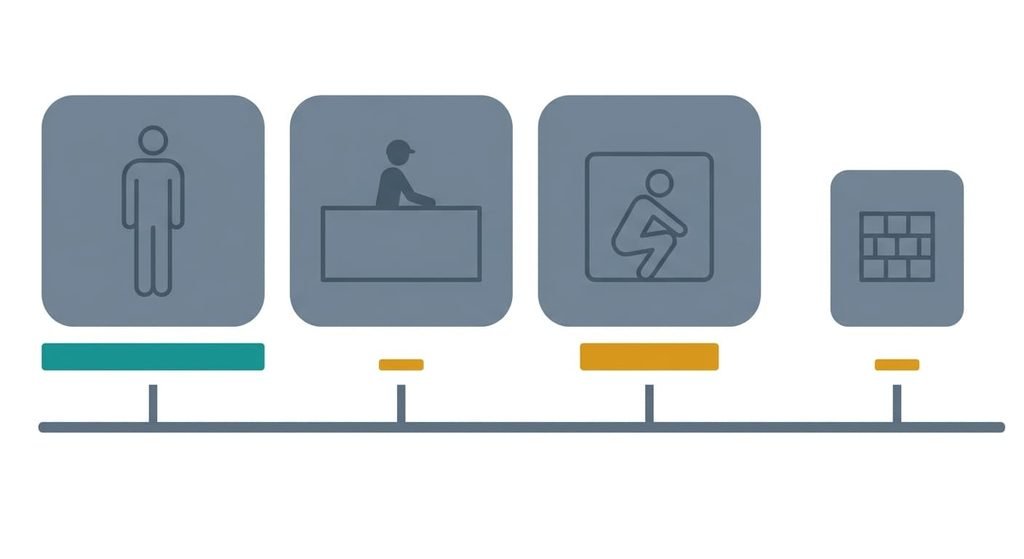
Shape drives the score. A cyclist riding straight at the lens forms a tall narrow box that can pass for a person. Side-on, the same rider forms a wide box that scores clearly nowhere. Someone crouching squashes the 3.4 to 1 ratio towards 1 to 1, so their person score falls. Coats on hooks and life-size posters can score as a person, because the model reads outline and texture.
Night removes more clues. Infrared mode gives a grey picture with no colour, and the courier at 30 m shrinks to about 46 pixels tall and 13 wide. I’d defend trusting a far-off person alert less than a plain motion alert, since beyond about 30 m the classifier works from a thin sketch. The category is also all it assigns; who the person is stays unknown to it.
What people get wrong about person detection
A person alert means a person was there. The label reads like a fact, so the belief took hold. It only means the score crossed your threshold. Set it low and an upright shadow gets announced as a person.
More megapixels always help a security camera tell a person from a car. The habit comes from photography, where extra detail sells the sensor. Here the crop is resized to a fixed grid, so extra pixels matter mainly for distant figures. At 10 m the courier already fills 137 pixels, which is plenty. Beyond that, a larger picture is squeezed onto the same small grid.
The camera knows the family. Some systems add a separate face-matching stage, and the marketing blurs the two. Where that stage exists, it has its own setting. Class detection compares categories, and a category contains no names.
Who needs person detection, and who can skip it
Class filtering, the feature that lets a security camera tell a person from a vehicle, pays when a road or pavement crosses your frame. A door camera watching a step 3 m away gains little, since the figure fills about 456 pixels of height and nothing else passes.
Test it with a helper walking the route you care about, noting where the alert first fires. If it fires only inside 15 m (a figure about 91 pixels tall there), shrink the zone or move the camera closer.
Whether the model runs inside the camera or on a remote server depends on your model, and from here I can’t tell which applies to yours.
A camera sorts moving things by scoring a cropped patch against a fixed list of classes, then checking that the movement fits the label. The list is the limit worth remembering, because every patch lands on the closest entry whatever it really is. Judge a far-off person alert by its distance and the light. Judge a plain motion alert by what’s in frame. Both report something real once you know what they measured.
Questions readers keep asking
Can a camera tell a person from a large dog?
Usually, when the dog is on all fours and the model has an animal class. The box is wide and low, closer to that class. A dog on hind legs and a person bent double both squash towards the same shape, so scores split. A camera with only person and vehicle classes must pick one.
Do I need person detection on a home security camera?
Cars and passers-by fire most alerts when a road or a shared drive sits in the picture. That’s where it earns its place. A camera watching only your own front door from 3 m gains little, since nothing else passes it. Walk your route once and see where the alert starts.
Is person detection better than motion detection?
They answer different questions. A pixel-change alert reports quickly and cheaply that something moved. A person alert adds a second opinion about the cause and arrives a beat later. Use the pixel-change alert where nothing else moves, and add the class check where traffic crosses the view.