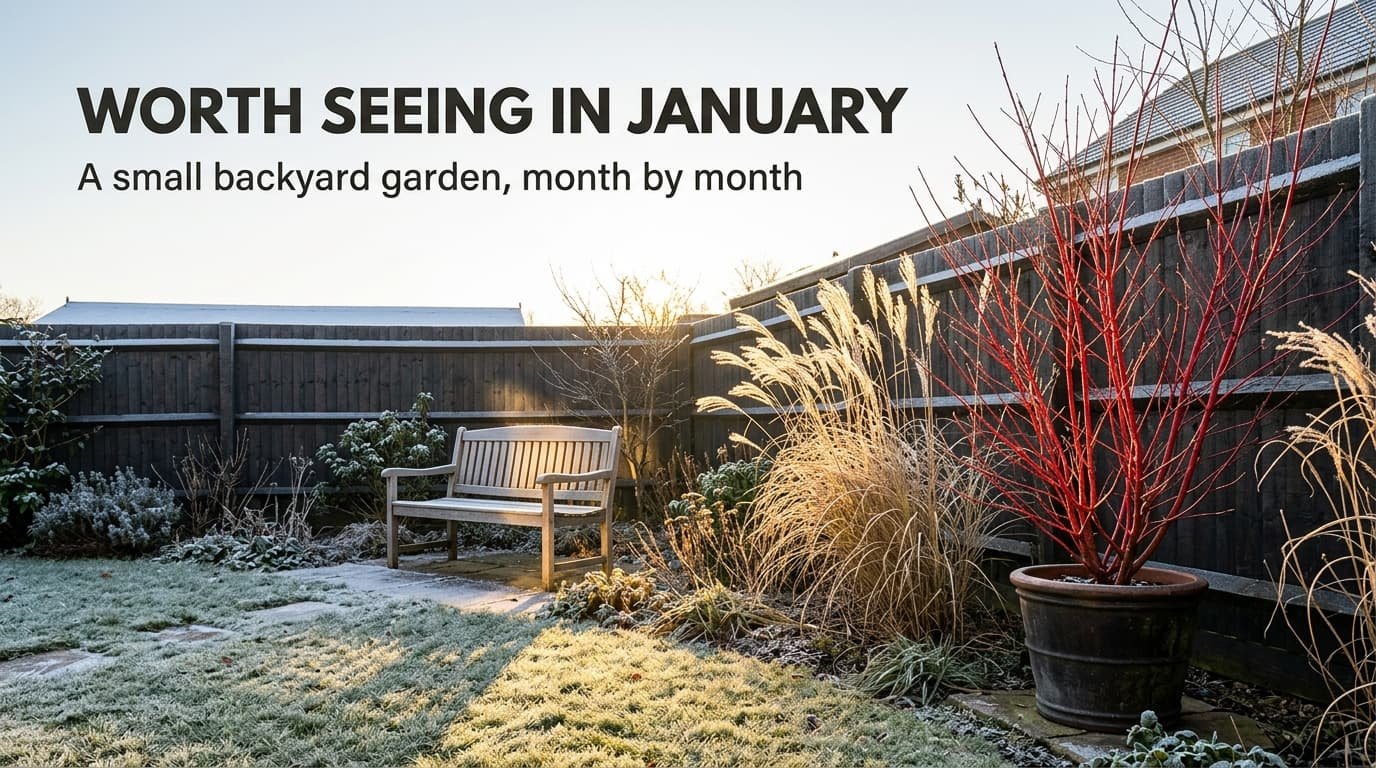
What is there to look at in a small backyard in January? Mostly shadow. At noon on 21 December the sun stands about 15° above the horizon. A 1.8 m fence then throws a shadow 6.9 m long, and a small backyard garden with something worth seeing in every month has to be designed around that angle.
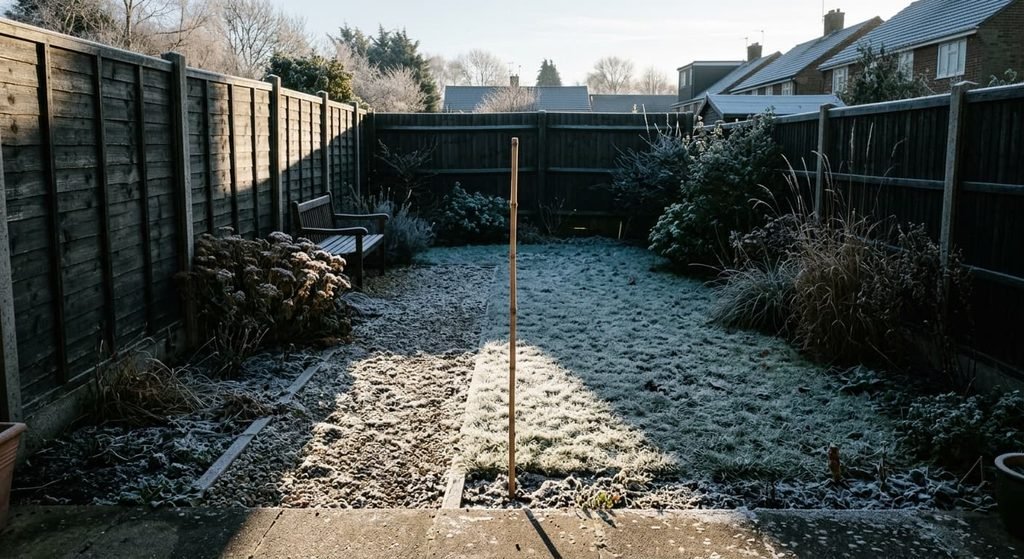
This plot is a backyard in a Dutch terrace, measuring 4 × 8 m. The kitchen window at the north end looks south. Fences of 1.8 m close three sides, and a 2 × 2 m terrace by the door leaves 28 m² to plant.
What a small backyard garden with something worth seeing demands
Start with the sun. At the March and September equinoxes the noon sun stands 38° up, because 90° minus the latitude of about 52° N for the Netherlands gives 38°. The same fence then throws only 2.3 m of shadow. In December 6.9 m of the 8 m lies in shade at midday, and only the first metre by the house gets direct light. Winter interest therefore has to work in shade. That favours bark and evergreen shapes over flowers that need sun.
Then comes distance. The kitchen window is the main viewpoint, and it looks at plants 2 to 8 m away. A snowdrop 3 cm tall reads as a rumour from 4 m. A red stem or a 1.5 m grass reads from the far fence. Daylight lasts only about 7½ hours in December, so you see this garden through glass, often in the dark. One rule I’d defend, though many gardeners resist it: judge every plant from the window, not from the bed.
So every month needs one lead that reads from the kitchen window.
Winter leads come from stems and bark. Spring to autumn leads can be flowers. Where the sun actually falls depends on your orientation and your neighbours’ walls, and I have no way to see either from here.
Four layouts for small backyard gardens with something worth seeing
– Rental-friendly: paved 4 × 8 m, nothing dug. Six pots stand in a 60 cm strip along the east fence. Red-stemmed dogwood (*Cornus alba*) carries December to March. *Sarcococca* opens in January and tulips in April. *Salvia nemorosa* runs June to September, and a *Miscanthus* plumes until February. A 2700 K spotlight lights the stems, and pots from 40 to 180 cm tall give the window tiers.
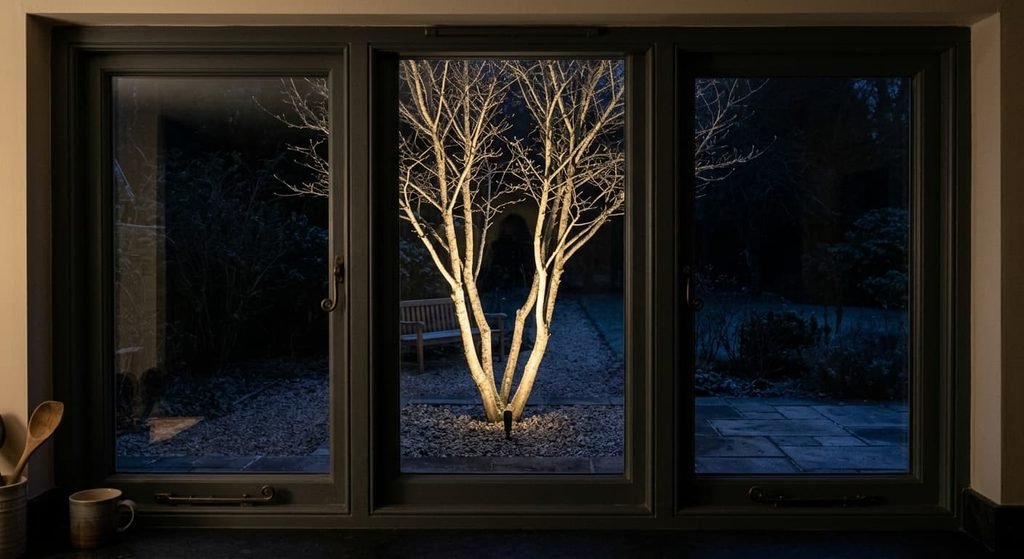
– Tight footprint: a strip 2 × 6 m by a bare wall. A multi-stem *Amelanchier* anchors the far end, with white blossom in April and red leaves in October. Hellebores flower under it from February, beside a 90 cm gravel path. An uplight at the trunk gives a night view. One tree carries four months on 1 m² of ground.
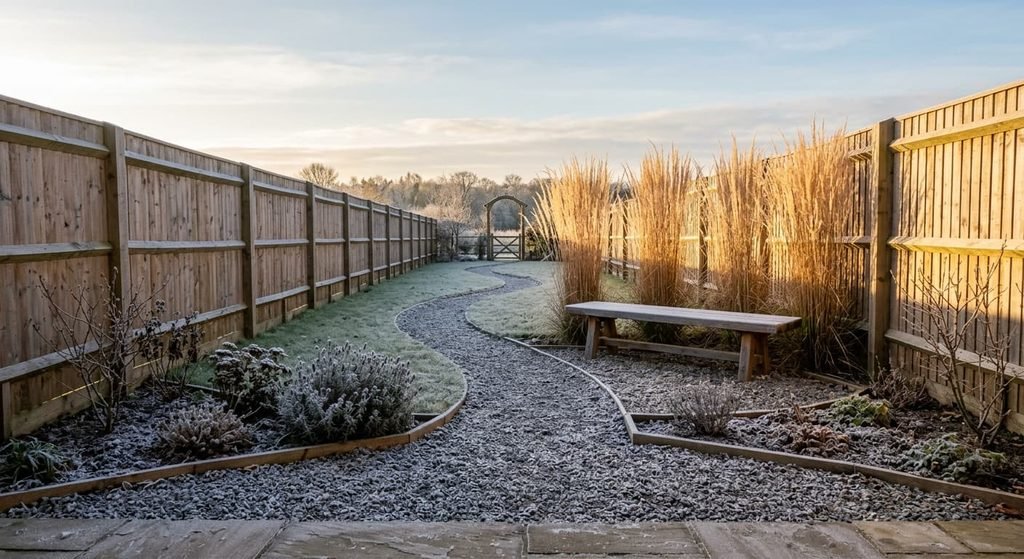
– Awkward shape: a wedge 5 m wide at the door and 2 m at the far end. A curving 90 cm path leads to a bench at the narrow end, with five feather reed grasses (*Calamagrostis*) behind it. A low spotlight lights them. Converging edges push the far end away, so a 1.5 m grass reads at 8 m.
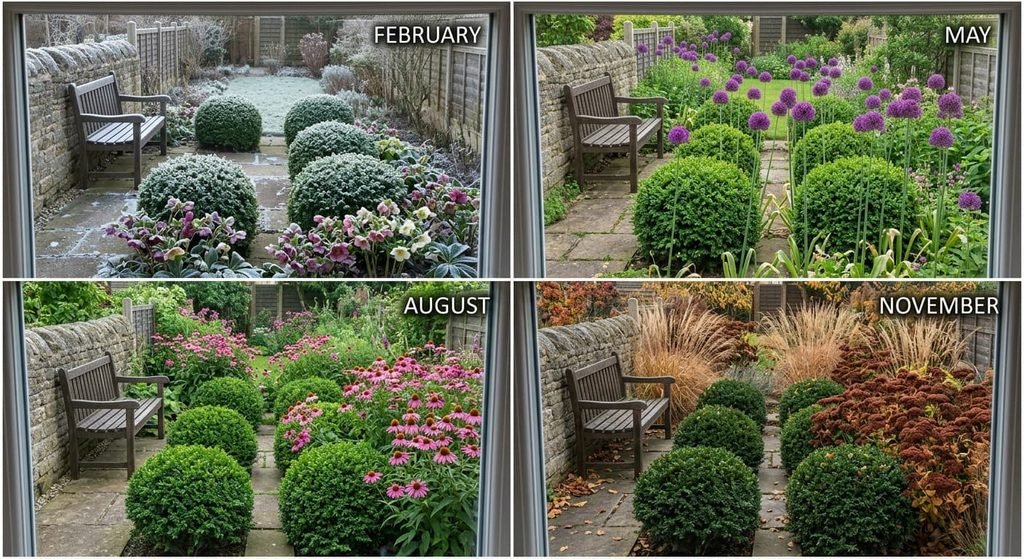
– Full furnish: 4 × 8 m. Borders 1 m deep flank a 90 cm clay-paver path, with a 2 m larch bench at the far end. Four clipped Japanese holly (*Ilex crenata*) domes, 50 cm wide, hold a shape through winter. Path lights, 30 cm high, 2700 K. The domes keep an outline all year.
Where people get this garden wrong
They plant for the month they shop. A garden centre sells whatever flowers in the month you visit. Anything bought in flower is at its peak, so a spring shopper collects bloom that all peaks together. Visit in January and November too, because a small backyard garden with something worth seeing is judged on its worst month. Note which shapes the window can see on those days.
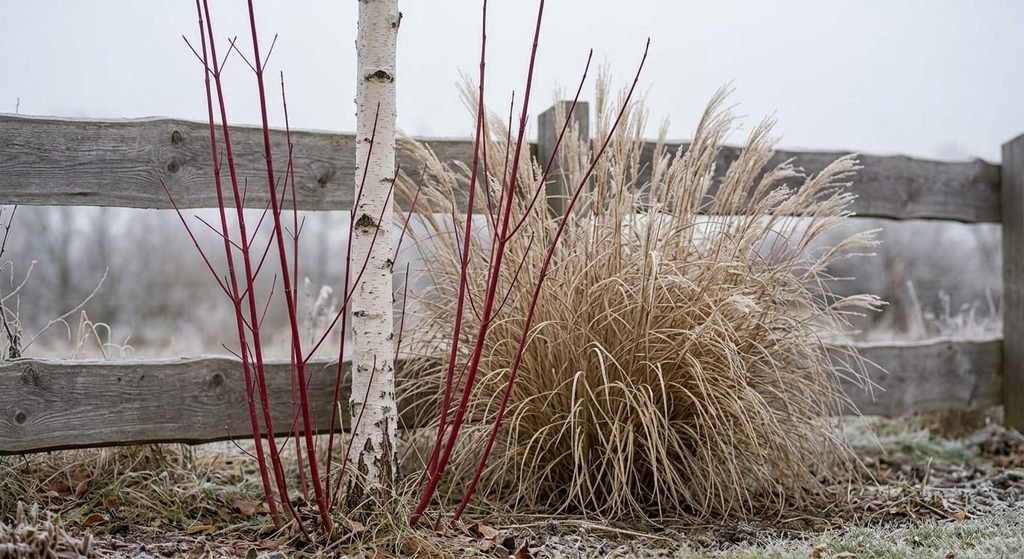
They cut everything back in autumn. A bed cleared to bare soil in October leaves nothing for the window until April. The stubble sits at 15 cm, far below the sill line, and that’s why a tidy garden looks empty from inside. Leave grass plumes and seedheads standing until late February, then cut them just before new growth starts. A 1.5 m plume edged in frost is the cheapest winter show there is.
They scatter one of everything. One of each looks varied up close and breaks into confetti from 5 m, because the eye reads masses. Groups of the same plant, each about 60 cm across, become one shape the window can read, and they’re easier to water.
They forget the window at night. The lit kitchen turns the glass into a mirror, so a dark garden loses to the reflection. One warm 2700 K uplight aimed up a bark trunk or a stem clump makes the garden brighter than the glass. Aim it from the base so the beam climbs 1 m or so of the stems.
When the obvious plan is wrong
Most advice for a small backyard garden with something worth seeing in every month is a flower for each month. That takes 12 leads at 0.5 m² each, which is 6 m², a fifth of the 28 m². A typical flush lasts three to six weeks.
The result reads as twelve weak spots instead of one garden.
The second popular move packs in bulbs everywhere. Bulbs flower for two to three weeks. Their untidy leaves then linger for six more.
A small garden works better with four loud seasons and structure between them. Bulbs and blossom carry March to April. Perennials carry June to July. Grasses with autumn colour carry September to October. Bark and stems cover the winter, with scent from January. Quiet gaps in May and November give the loud seasons room, and August can stay modest.
Flowering dates also shift by a few weeks between a mild year and a cold one. Treat every month named here as a window rather than a date. A garden planned for structure survives that drift, while a garden planned for a calendar doesn’t.
Three things to try this weekend
1. Push a 1 m cane into the ground by the far fence and measure its shadow at midday. In mid-December it would run about 3.8 m, and today’s length shows how far the sun has moved. Mark the tip with a peg.
2. Stand at the kitchen window at dusk and hold a warm lamp near your tallest shape. If the shape reads from there, it can carry a winter night. A dull result means you’ll want a stronger light.
3. Write the twelve months down and put one plant visible from the window against each, because a small backyard garden with something worth seeing needs a lead every month. Every blank is a shopping item, and a month with two entries can lose one. You’ll know the order to buy in by Monday.
A small backyard garden stays interesting when each month has one lead that reads from the window. The sun decides the winter, so structure carries it through. The flowers get their loud seasons, and the quiet months let them stand out. Check the shadow line this weekend, before you buy a single plant, and let it tell you where the winter lead belongs.
Questions readers keep asking
How wide should a path be in a small backyard?
Plan 90 cm. One person walks it comfortably while plants lean in from both edges, and a barrow still passes. A 60 cm path works as a stepping route to a bench but feels tight with a watering can. In a 4 m yard, a 90 cm path still leaves two borders about 1.5 m deep.
Where should winter interest go in a small garden?
Where the kitchen window looks, and within the first metre by the house if you want direct winter sun. Use things taller than 1 m, such as red stems or white bark. Evergreen domes and grass plumes work too. Low flowers like snowdrops need massing at the front to be seen at all.
Which colours show up in a winter garden?
Warm and pale tones. Red dogwood stems and straw-coloured grasses stand out against grey fences in flat light, while pale flowers fade into it. White birch bark does the same. The low winter sun backlights grass plumes and makes them glow from the window, which a green shrub can’t do.