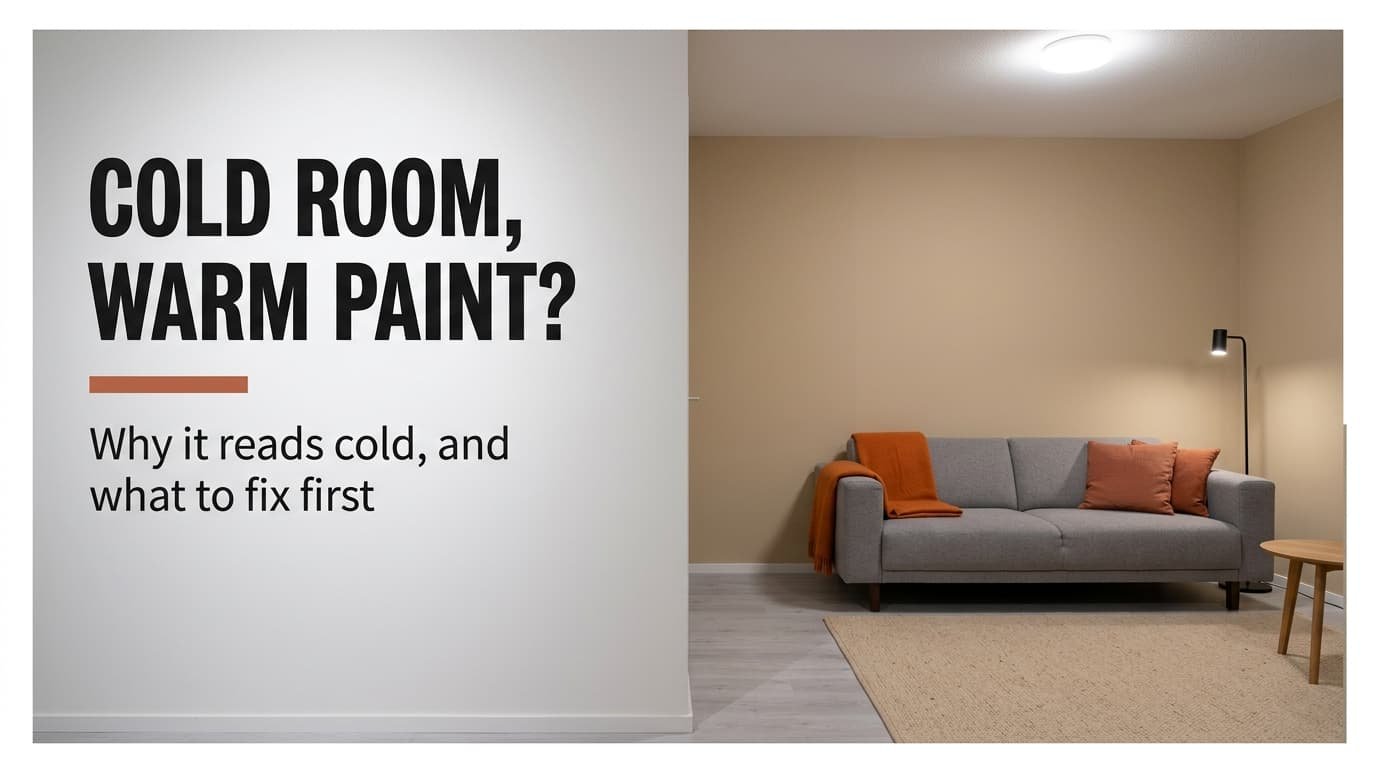
You painted the walls a warm sand and added an orange throw, and the room still feels cold. That’s the picture in a living room that feels cold even with warm colours. Here the chill is visual, so the thermostat plays no part. The quickest fix costs nothing: move one lamp until it lights the wall.
Figures below describe a living room measuring 400 by 500 cm, under a 250 cm ceiling, with one window in the north wall. These readings are examples, so swap them for your own once you’ve taken them. You need a phone and a tape measure, plus one free evening.
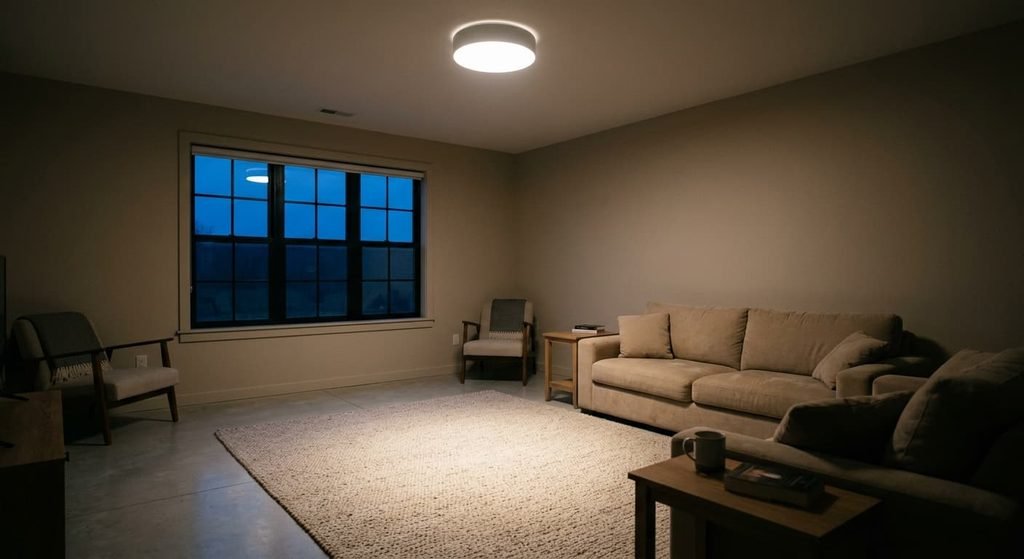
What is happening in a living room that feels cold
A room feels warm when the surfaces the eye sees most of are bright enough to show their colour, and four things decide that. Each one has its own number.
The first is light level. Colour fades as light drops. A free light-meter app reads 25 lux on the sand wall behind the sofa and 120 lux on the rug under the single ceiling light, so the room’s warm wall gets the least light of any large surface.
The second is share of view. From the sofa you see the far wall at 10 m², the floor at 12 m², the ceiling at 6 m² and the window at 2.1 m², which is 30.1 m² in all. Only the wall is warm, so warm colour fills 10 ÷ 30.1 = 33% of the view.
The third is the tint of the light. One ceiling bulb sold as 4000 K, a neutral-cool white, gives most of the evening light, and it pulls every surface a little toward grey. The fourth is the paint itself. A sand with a grey base holds little colour even in full light, and it holds less as the light drops.
Why that living room feels cold: check which cause is yours
Every check below ends in a result you can write down. Do them on one evening with the usual lamps on, and write each result down.
First, hold the phone flat against the wall behind the sofa with the light-meter app open, then hold it on the rug. Take both readings at the same height, about 100 cm up, so the comparison is fair. A wall reading under half the rug’s means the walls are dim. Here it’s 25 against 120, a ratio of 0.21.
Second, take a photo of the room from the sofa, then colour the warm areas on a print of it. Under 40% warm points to the second cause.
Third, read the box of the ceiling bulb for its kelvin figure. Anything over 3500 K sends a cool white across the room. Note the figure next to each lamp too, because a table lamp can carry a different tint.
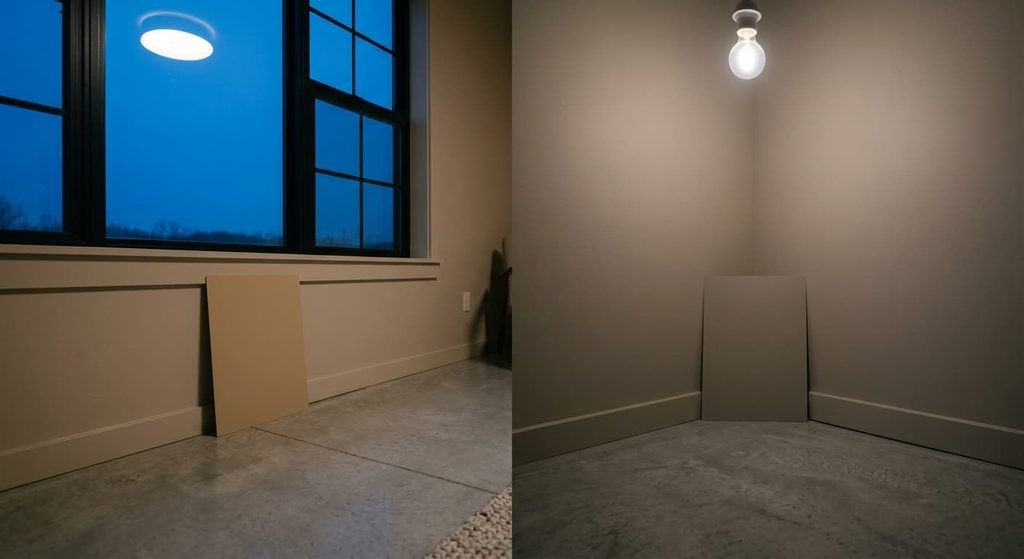
Last, hold the paint swatch against the wall beside the window and again in the far corner. A swatch that looks rich by the window and grey in the corner shows paint that lacks colour once the light drops.
The fixes, in order
In a living room that feels cold, alter one thing each evening. Then repeat the wall reading and the photo.
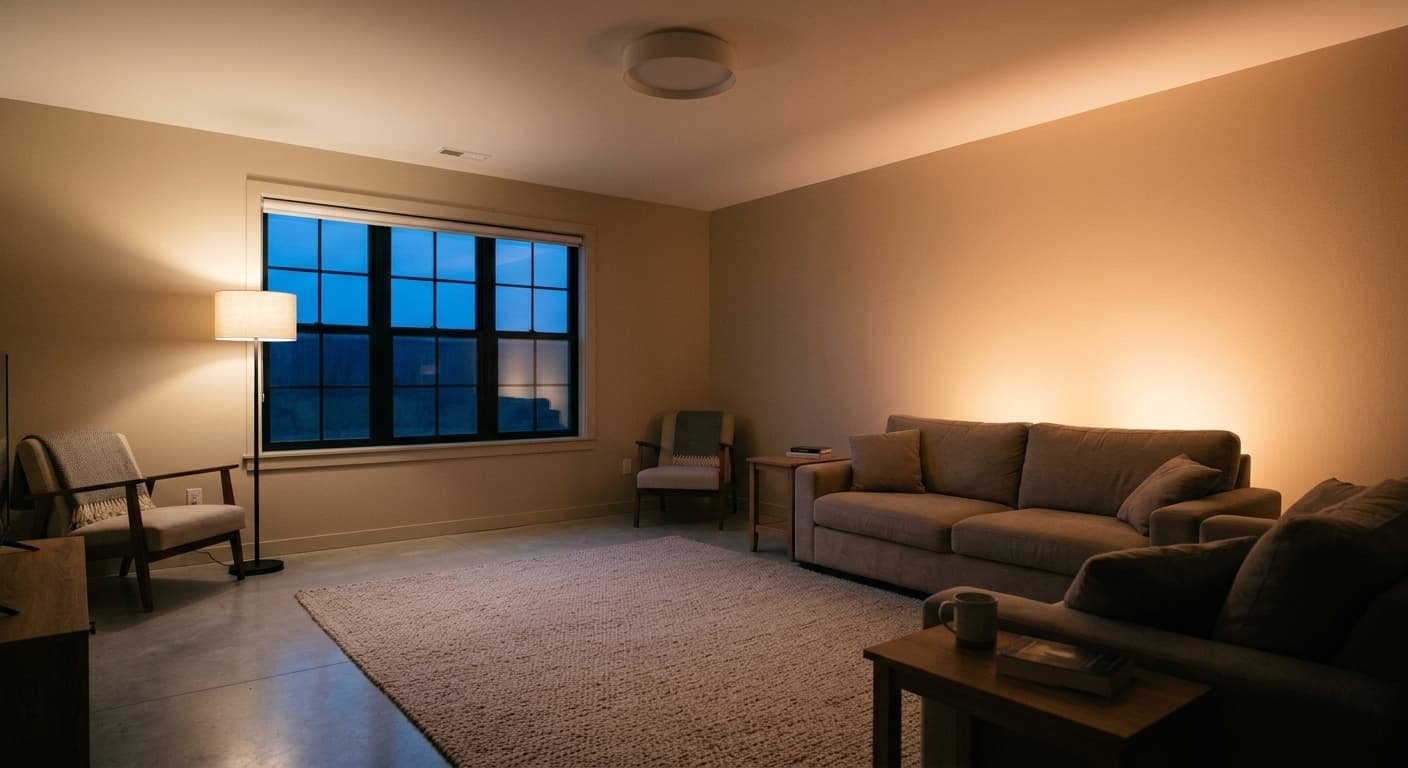
Moving a lamp to within 30 cm of the wall costs nothing and tackles light level. The wall reading rises from 25 to about 90 lux, which closes most of the gap to the rug’s 120. The limit is reach, since the cable has to get to a socket and the lamp has to stand clear of the sofa end. It also lights only the 150 cm of wall nearest to it, so the far wall is unchanged. Choose a shade that lets light out sideways, so the wall gets a soft wash and not one bright patch.
Swapping the 4000 K ceiling bulb for a 2700 K one tackles the tint of the light. It costs one bulb, and the brightness figure on the box stays the same. The evening light now leans warm, and the sand wall reads a shade closer to its colour on the tin. The catch is that the new bulb changes tint and nothing else, so a wall at 25 lux stays dim. Some fittings cap the bulb type, so read the label on the fitting first. Keep the old bulb until you’ve compared the two on the same evening.
A wool rug measuring 200 × 300 cm in a warm tone tackles share of view. It covers 6 m² of the 12 m² of floor you see from the sofa, so warm colour grows from 10 m² to 16 m², which is 53% of the 30.1 m² view, up from 33%. It’s the biggest spend of the four. The limit is placement: the rug needs its edge about 10 cm clear of the sofa legs to sit square, and it uses floor that you may want for another piece. Pick a plain weave in a muted terracotta or oat, since a loud pattern pulls the eye away from the wall.
Repainting the sofa wall in a richer version of the same sand tackles the paint itself. Expect paint and a weekend of work, or a day of a painter’s time. A rented flat needs the landlord’s consent first. Pick a sand with colour in it at the same lightness, and test a 50 by 50 cm patch for two days of light before you commit. The catch is that richer paint can’t add light, so do it last.
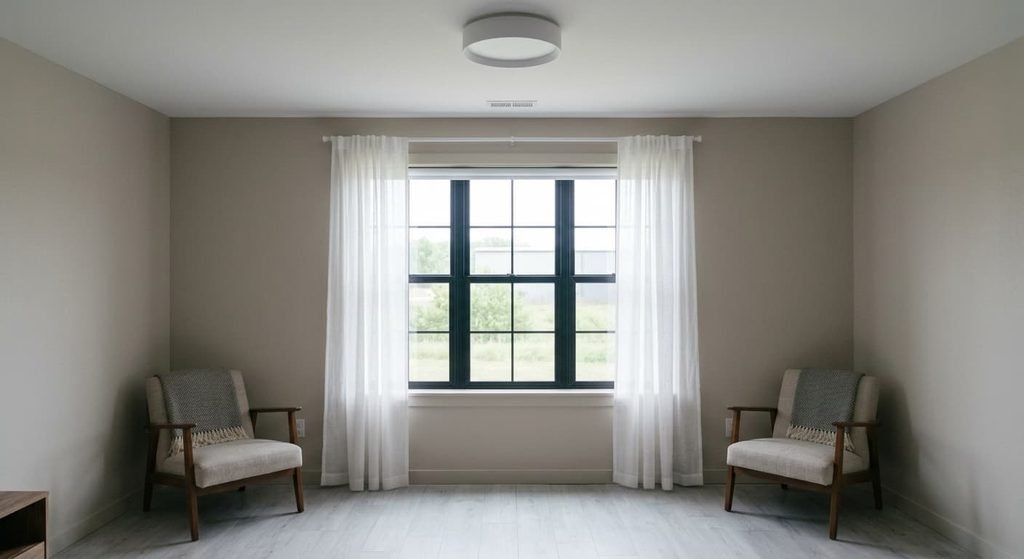
What this room’s own architecture means for you
In a living room that feels cold, some limits come with the room. The north window stays where it is, and north daylight is cooler, so the sand reads greyer by day whatever you do inside.
None of this changes where the window faces.
Together the ceiling and the window take 6 + 2.1 = 8.1 m² of the view. That’s 27%. So the warm share can’t pass 73% in this room, and 53% after the rug is already most of the way there. Your grey laminate floor belongs to the flat, so the rug is the only lever you have on it. Socket positions also decide where the lamp can stand. The 250 cm ceiling also sets how far light from the bulb travels before it reaches the wall, which is why the wall reads dimmer than the rug beneath the bulb.
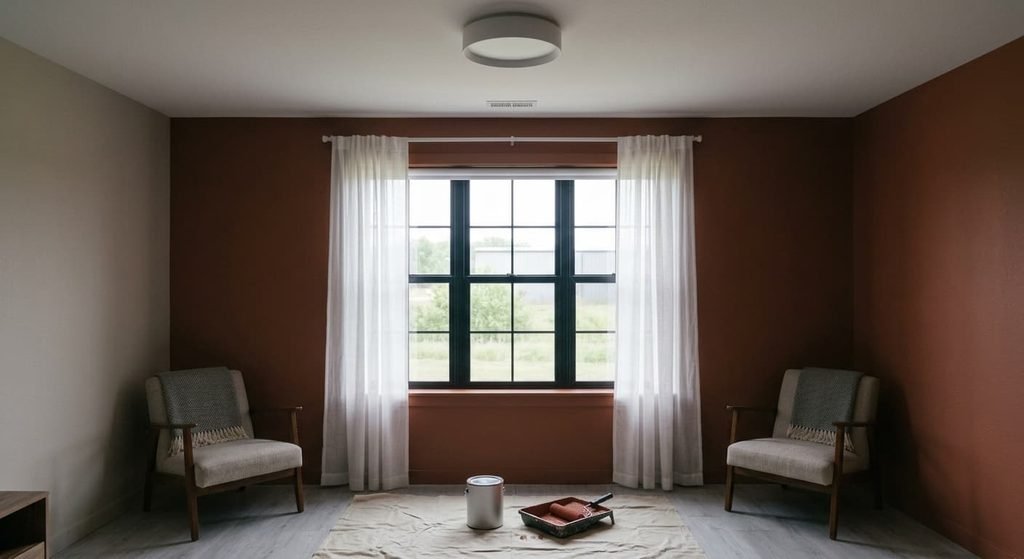
The fix that doesn’t work
Painting every wall a deeper warm colour is the usual first move, and it backfires. Surface brightness follows the light on the wall times its reflectance. The sand at a reflectance of 35% gives 25 × 35 = 875 units. A deeper terracotta at 20% gives 25 × 20 = 500, which is 43% less. The wall gets richer in hue and dimmer at once, so the room reads darker and the cold stays. A third coat of the same sand changes nothing either. Coats alter coverage and leave reflectance where it was. Lighter warm paint does the opposite. A pale peach at 60% gives 25 × 60 = 1,500 units, which is 71% more than the sand. It brightens the wall while the hue stays, though a pale colour holds less richness than a deep one, so test a patch first.
A deeper colour can’t give back light it never receives.
A living room that feels cold even with warm colours is short of warm surface that’s lit and in view. Start with the lamp by the wall, then the bulb, then the rug. Repaint only when the wall reading and the photo say the rest is done, and stop once the wall reads close to the rug and warm covers half of the view. Measure again after each step.
Questions readers keep asking
Can a cold-looking room be fixed without repainting?
Mostly, yes. Moving a lamp and changing one bulb cover two of the four causes, and a rug covers a third, with no paint needed. Repaint only when the readings show the three cheaper steps are done and the swatch still goes grey in the dim corner.
What does it cost to make a room look warmer?
Moving a lamp costs nothing and a bulb costs little. A rug costs more. Paint or a painter costs most. Prices vary by shop and region, so work upward from the cheapest step and stop once the wall reading sits near the rug’s.
Why does my room look colder by day than at night?
North daylight is bluer than lamplight, so warm paint reads greyer while the sun is up. In the evening your lamps set the tint, and a 2700 K bulb pulls the room back toward warm. The window’s direction is fixed, so choose paint under daylight.