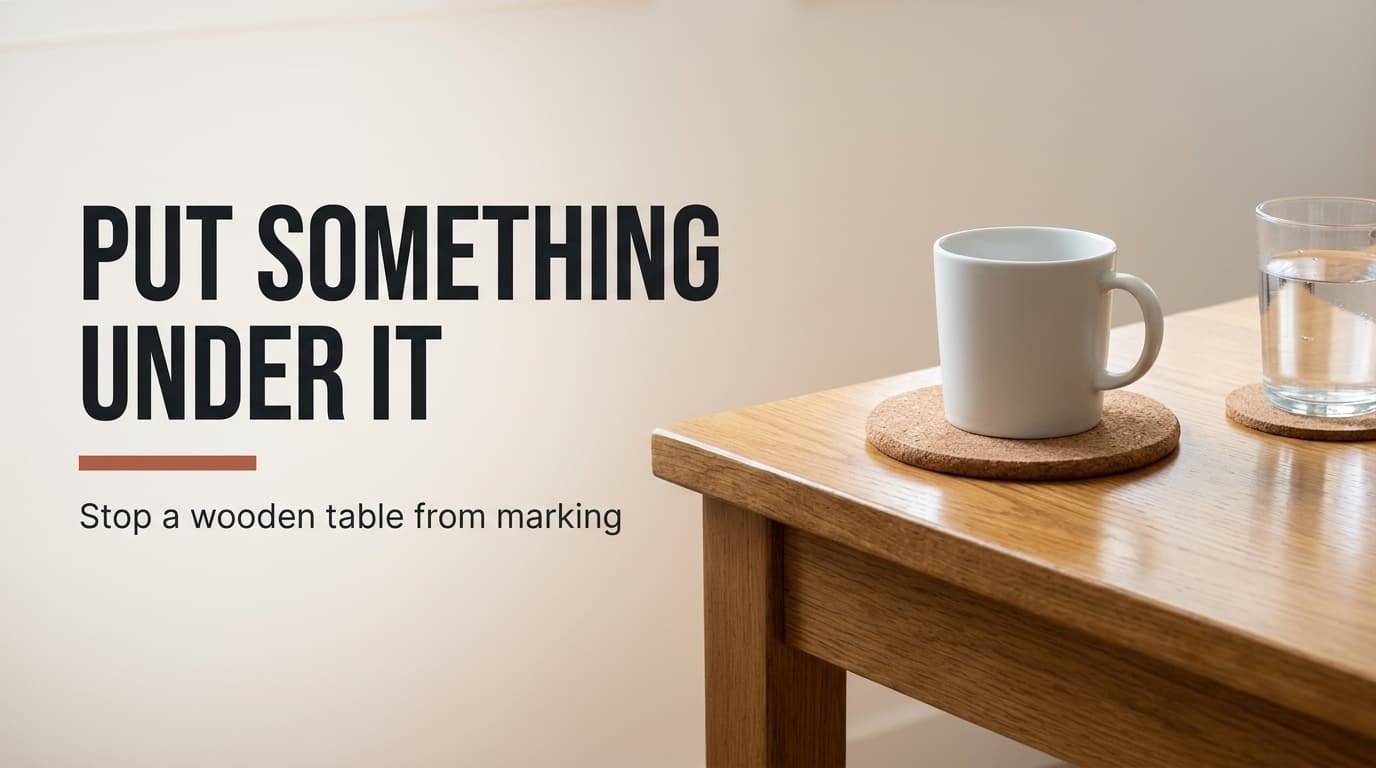
What does it take to stop a wooden table from marking under mugs and glasses? A 5 mm cork coaster under every cup. That one habit cuts the heat rise under the cup by about two thirds and soaks up the water a cold glass sheds.
The table here is a Dutch solid oak dining table with a top 22 mm thick, 21 °C air and a lacquered finish of unknown age. Marks come from two causes, and the fixes follow them. The figures come from a simplified model with round numbers, so use them to rank the fixes and not to read off exact degrees.
What actually decides whether you can stop a wooden table from marking
The finish, not the wood, decides how a table marks, because a mug or a glass never touches the timber. It stands on a film a fraction of a millimetre thick, and that film has two weak points: heat and trapped water. Everything you do to the table either shields the film or hardens it.
Heat comes first. When two surfaces touch, the contact temperature settles nearer the one that moves heat faster. That property is called effusivity. A ceramic base scores about 1,600 and oak about 530 in our model. A base at 80 °C then puts the oak surface near 65 °C within seconds, and 68 °C at its peak. Assume a lacquer that softens at 60 °C. A bare mug then keeps the surface above that line for about nine minutes. That’s long enough to leave a dull circle.
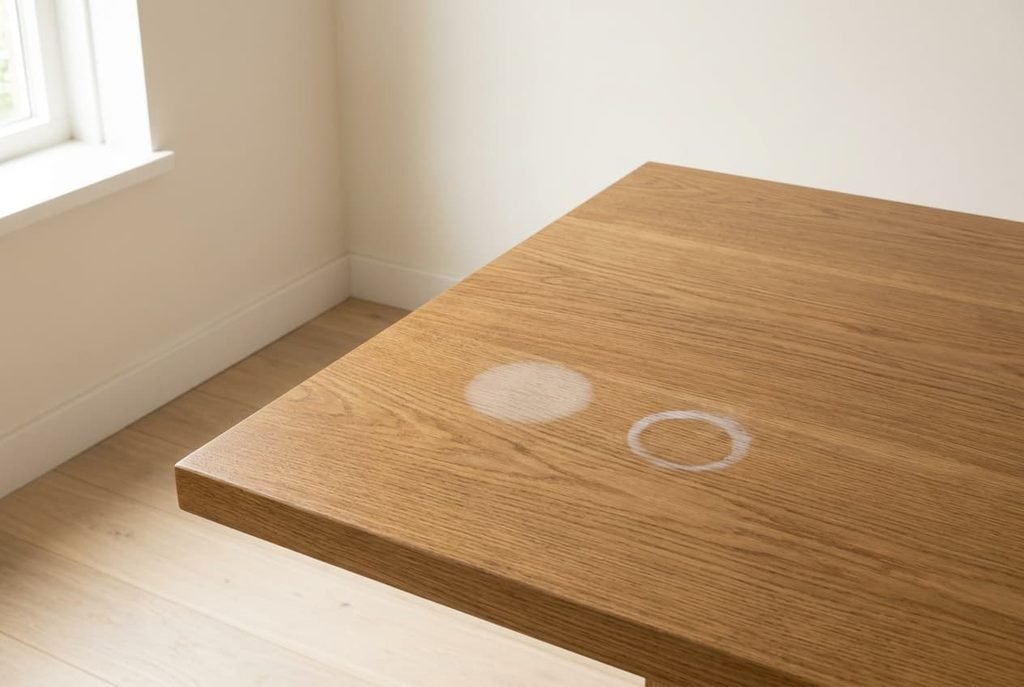
Water comes second. A drink at 8 °C in a 21 °C room at 55% humidity sits below the dew point of 11.6 °C, so its glass sweats. The water runs under the base and into the film. White rings are moisture trapped in the film, and dark rings mean it reached the wood, where it can’t be wiped away.
Confirm which mark you have
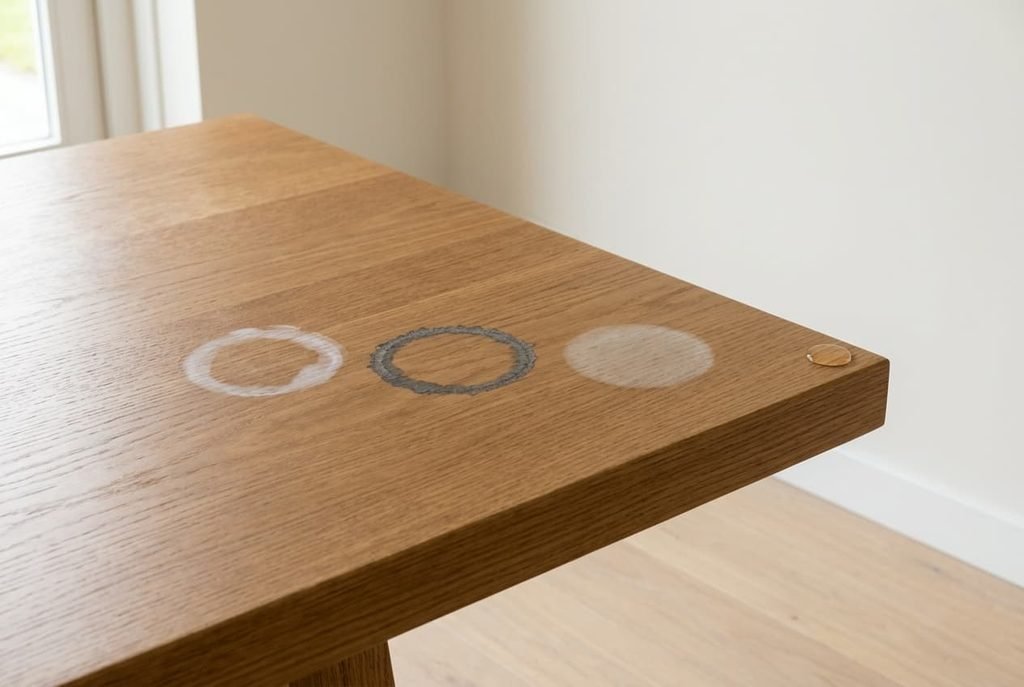
Read the mark before you buy anything. Look along the top from 20 cm above the surface, with a lamp low to one side, because raking light shows depth that daylight hides.
A cloudy white ring with a smooth edge sits inside the film, which is the easiest kind to fix. Heat leaves a pale, dull patch the shape of a mug base, with no ring around it. Water that reached the wood shows as a dark grey or black ring, and no coaster will undo it. A rough, raised edge means the grain has swollen.
Then test the finish itself. On a hidden spot such as the underside of the edge, leave one drop of water for ten minutes. If it stays a round bead and wipes away clean, you have an intact film. If it spreads and darkens the wood, the finish has gone thin. Water passes straight through it. That result tells you how to stop a wooden table from marking in your case, and which fix below to start with.
The fixes, in order
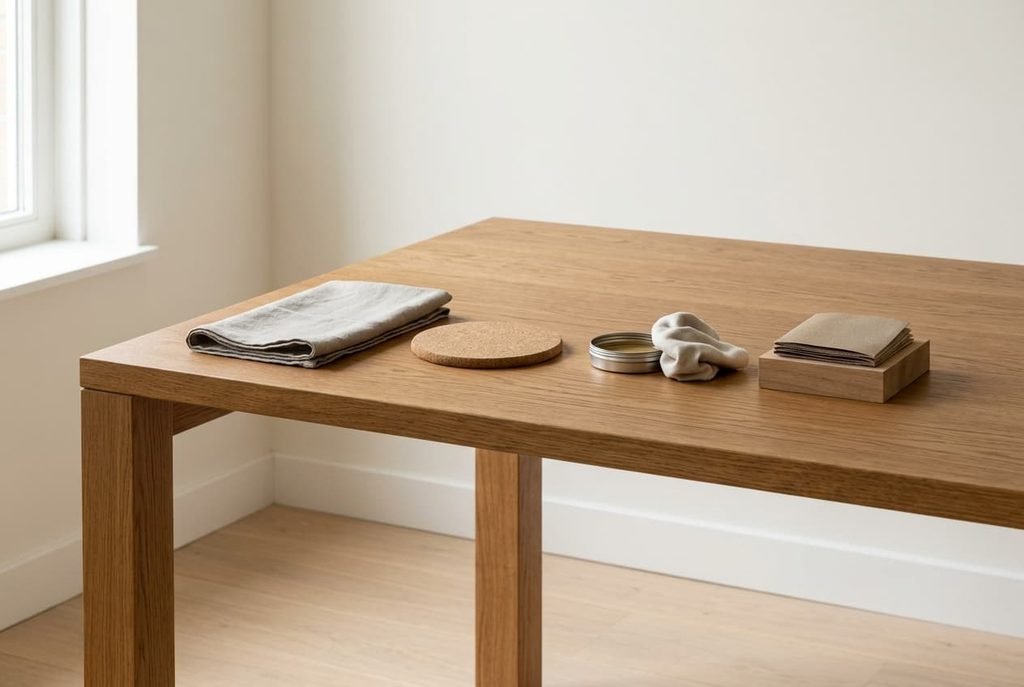
Each fix addresses one mechanism from the first section, and together they stop a wooden table from marking at the source. The order ranges from no cost up to a tradesperson, and the mark you found above tells you where to stop.
Fold a tea towel under hot mugs, which addresses contact heat. A cotton towel folded to 4 mm drops the peak under the base from 68 °C to 40 °C in our model, well below the 60 °C line, at no cost. The limit is the drip. A towel does little for a sweating glass, because the water runs out around its edges. You also have to remember it at every cup, including the one you carry in half asleep.
Buy cork coasters 10 cm wide and 5 mm thick, which addresses both mechanisms at once. Cork has an effusivity near 130, far below ceramic’s 1,600, so the peak under it falls to 35 °C, and the cork drinks the film of water a cold glass sheds before it reaches the lacquer. It’s a minor purchase. The coaster’s limit is the circle it covers, because a glass set down on the coaster’s edge, or a jug with a 12 cm base, still wets the top.
Re-oil an oiled top, or wax a worn lacquer, which addresses how long water sits on the surface. A fresh coat fills the pores, so a spill stays on top for minutes where it once soaked in within seconds, and you have time to wipe it. It costs a tin of finish and two evenings with the table cleared. It can’t lift a ring that is already dark, and it can’t make a thin oil finish tolerate 68 °C.
Have the top refinished in a hard, cross-linked film, which addresses the threshold itself, the 60 °C line. A two-component finish cures by chemical reaction and softens at a higher temperature than an old lacquer, so a bare mug no longer crosses it. It means professional work and a table out of use for about a week. The limit is the top: a 2 mm veneer survives one light sanding, and a new film may differ by a shade from the edges it meets.
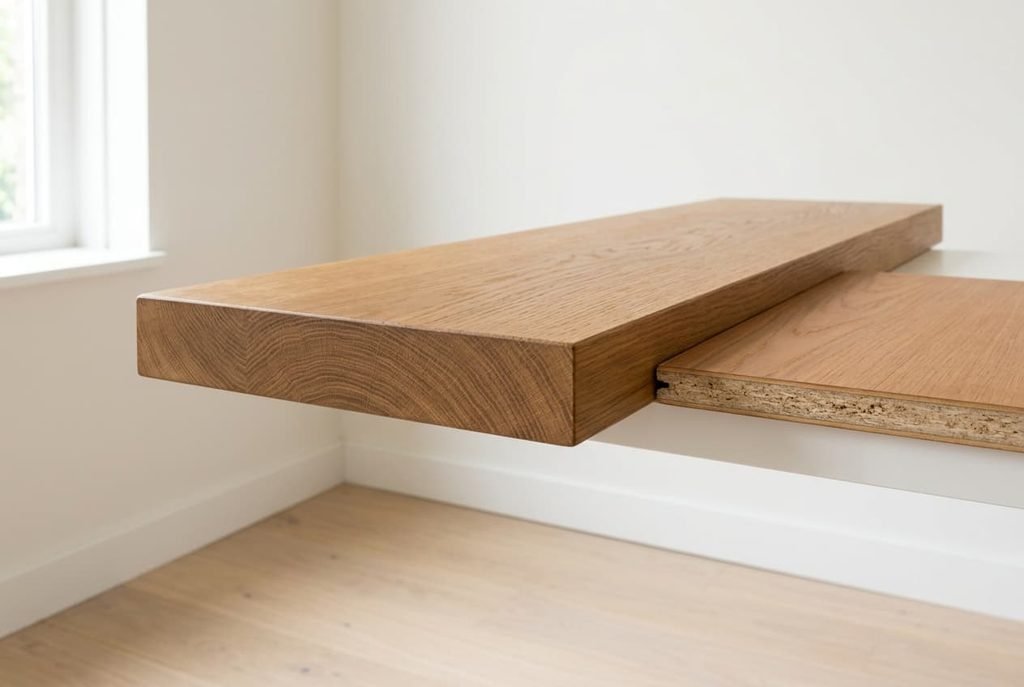
What the build of a wooden table means for how to stop marking
Three facts about this table are fixed, and no coaster changes them. A solid 22 mm top can be sanded back several times, while a veneered top allows it once. Oak has open pores that take up water faster than a closed grain such as maple. The finish is also of unknown age, so the 60 °C line stays a guess until the water-drop test says more.
These facts set your expectations. Fixes lower the risk of a mark and don’t remove it. A table of open-pored oak under an old lacquer will always mark more easily than a new film on maple, whatever you put under the cups. If a second-hand table came with the flat, assume the worst finish until the test proves otherwise, and buy the cork first.
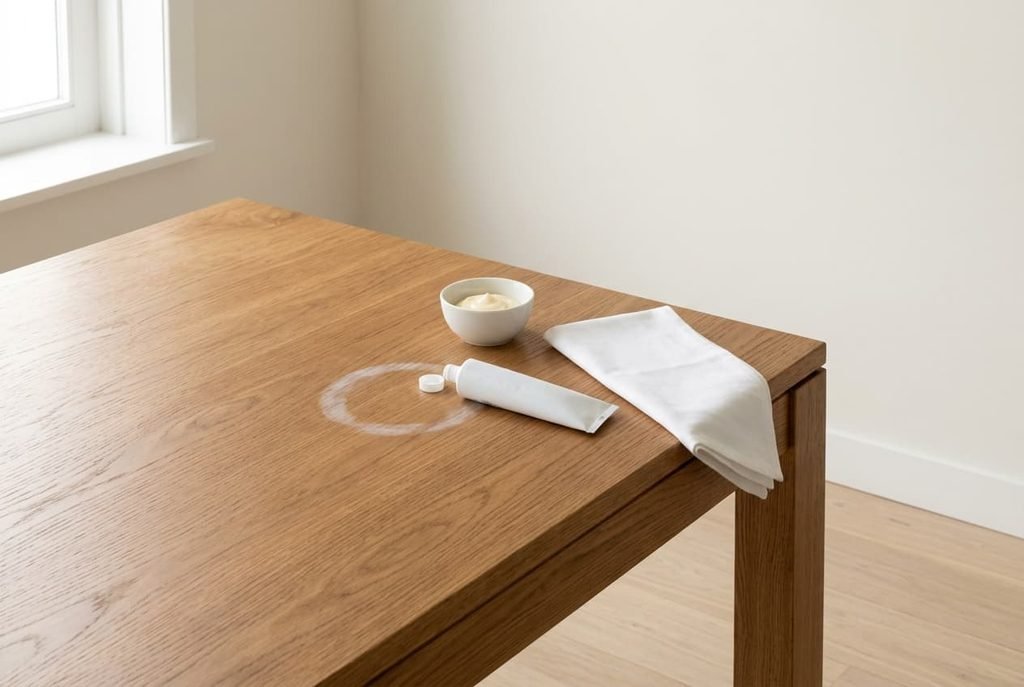
The fix that doesn’t work
Rubbing the ring with toothpaste or mayonnaise is the folk remedy most owners try first. It feels logical, because the mark looks like a stain on the surface. The moisture sits inside the film, so rubbing from outside moves nothing. Toothpaste is an abrasive and dulls the sheen across a patch wider than the ring. Mayonnaise is oil and water, and it can darken the ring for a day before it dries and the cloud returns. Either way you’ve added a second problem to the first. A hot iron over a cloth fails the same test, since it adds the very heat that softens the film.
Neither will help you stop a wooden table from marking, because both treat a symptom the finish has already absorbed.
Leave the ring alone until you know which mark it is.
Put a buffer between every cup and the top, and the cause disappears at the source. A folded towel costs nothing today, and cork replaces it once the pile of mugs grows. Run the water-drop test this evening, and you’ll know whether a tin of oil or a refinish comes after that. Then decide how much risk you’ll live with, and keep the towel by the kettle so the habit starts today.
Questions readers keep asking
Can marks on a wooden table be removed at home?
Sometimes. A white ring inside the film often fades after repeated gentle warmth and a fresh coat of finish. A dark ring has reached the wood and needs sanding, and a veneered top calls for a specialist. Test the finish first, because the fix depends on what the mark is.
How much does it cost to protect a wooden table?
Little, if you start early. A folded towel is free, cork coasters are a minor purchase, and a tin of oil sits between the two. A full refinish is the expensive end, since it needs a specialist and a week without the table. Each step costs more than the one before.
Why do hot mugs leave a pale patch and glasses a ring?
They attack the finish in different ways. A hot base heats a round patch above the softening line, which leaves a dull circle. A cold glass sheds water. It creeps beneath the rim and soaks into the film as a ring. Check the shape, since it points at the cause.