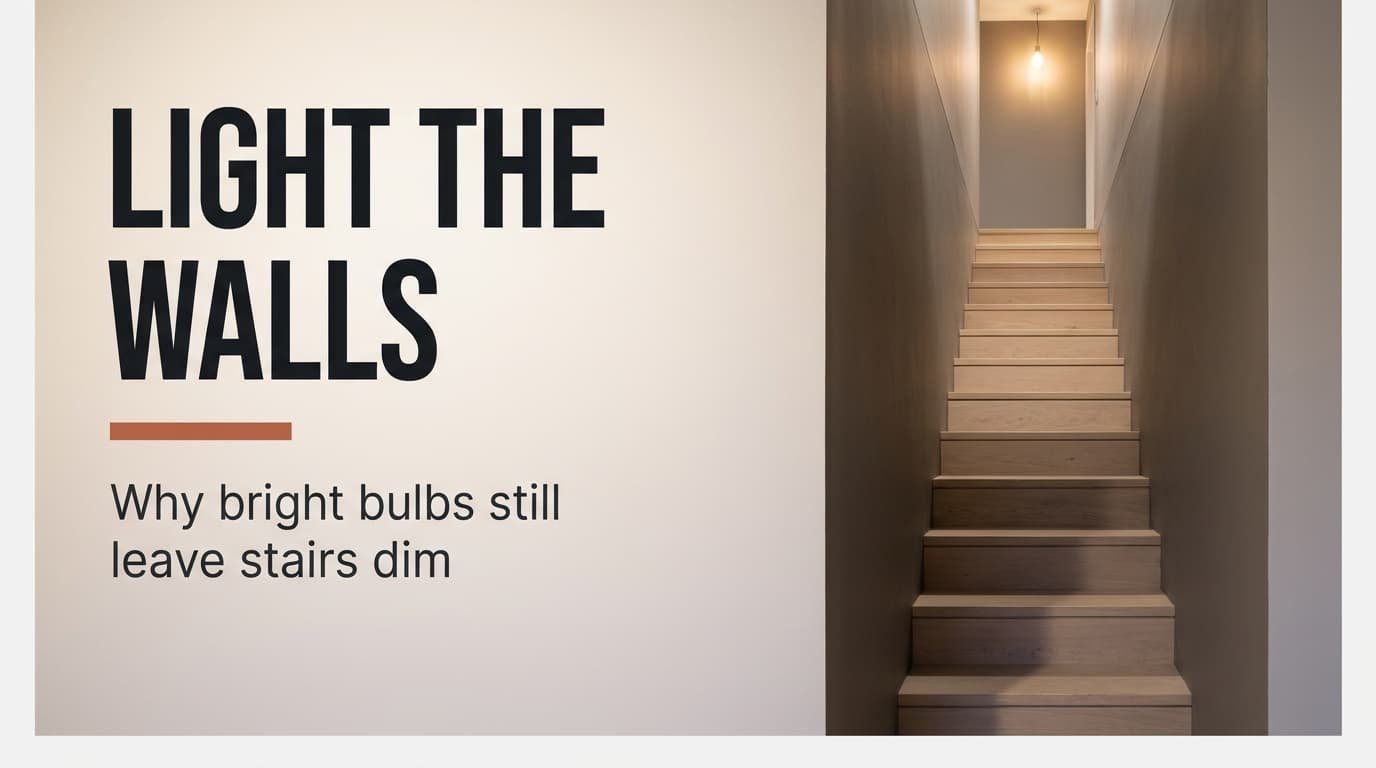
We swapped every bulb on the stairs for something brighter and the climb still looks like a tunnel. Why does our staircase feel dark even with brighter bulbs? The answer sits in the walls and in where the light starts. The bulb has less say than you’d think. This page works through a short diagnosis in an invented Dutch terrace. The staircase is 80 cm wide with 17 treads, and every number here is a guess for you to overwrite. Three quick looks come first, then three faults in the order you’d fix them, so you can start tonight with what’s already in the house.
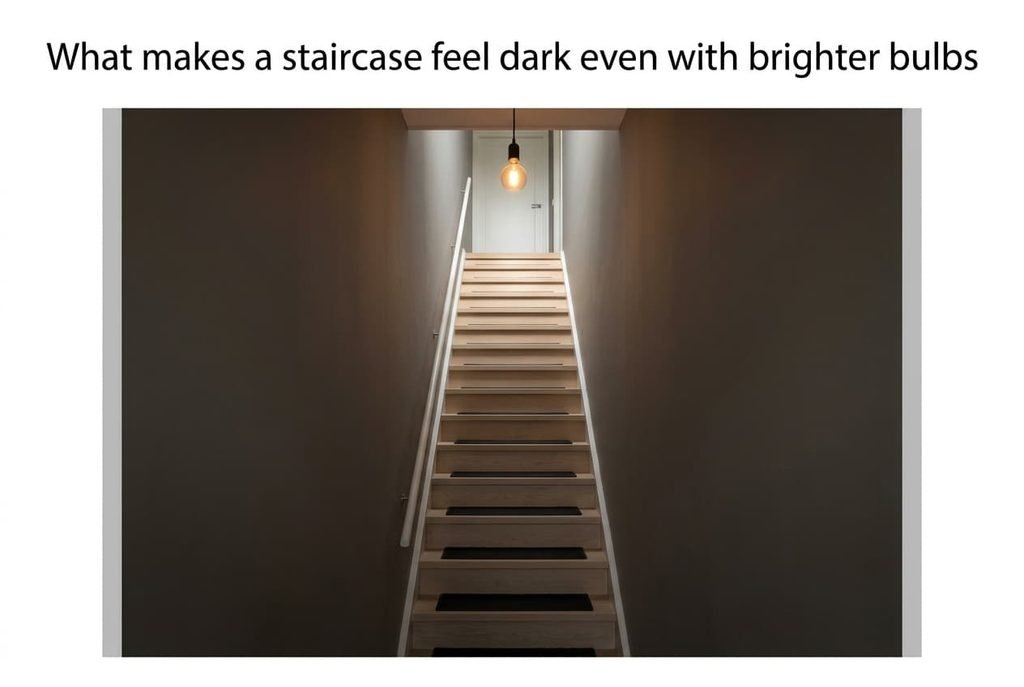
What makes a staircase feel dark even with brighter bulbs
Light has to bounce before you can see a space. A narrow stairwell has little to bounce off: two walls of 10.9 m² each and 3.4 m² of treads, so 25.2 m² in total. Assume 60% of a bulb’s output lands on those surfaces. A 470 lm bulb then gives 282 lm ÷ 25.2 m², or 11 lux. A 1,055 lm bulb gives 25 lux, which is 2.2 times more.
What reaches your eye is the light the walls send back, and that depends on reflectance. Take 25% for mid grey-brown paint and 80% for a pale matt white. Luminance is lux × reflectance ÷ π, so the dim bulb on grey-brown walls gives 0.9 cd/m² and the bright bulb gives 2.0. The old bulb on white walls gives 2.9 cd/m², which beats the new bulb on grey-brown. The question of what makes a staircase feel dark even with brighter bulbs has a plain answer. A common misdiagnosis is blaming the bulb when the walls absorb three quarters of what it gives. Wattage is the first thing people change, and the wall is the number that matters.
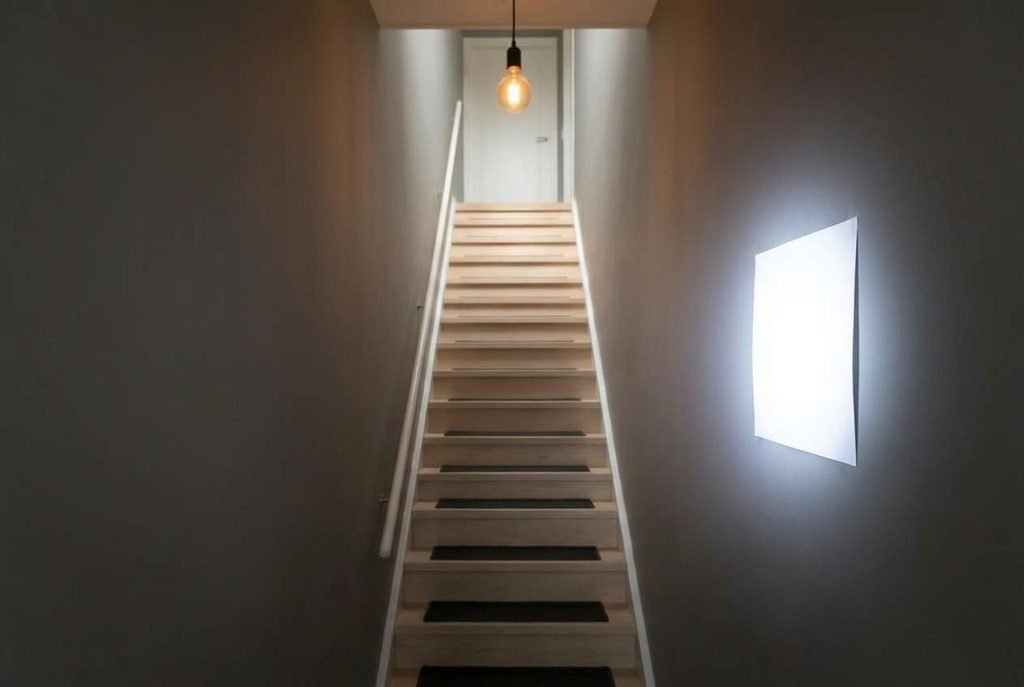
Three looks that show why a staircase feels dark with brighter bulbs
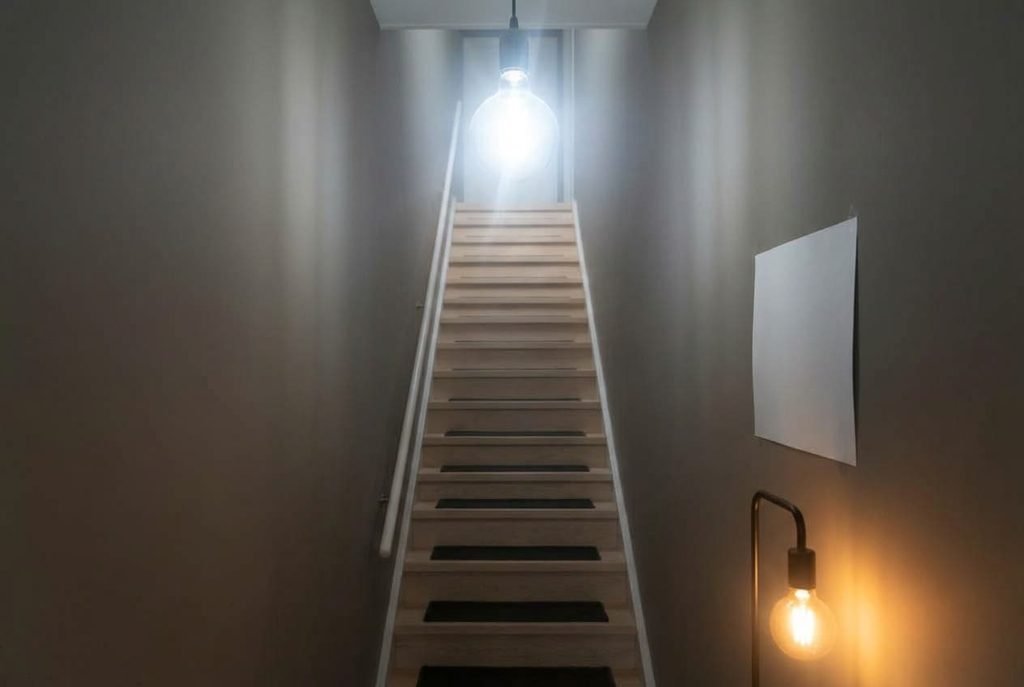
Stand at the bottom of the stairs with the light on and make three short looks. First, hold white paper flat against the wall at mid height. If the paper glows and the wall looks dull beside it, the wall is soaking up light, and you’ve found the contrast fault. Second, look up the run. Watch how the light changes. When the top treads are clear and the bottom three fade, the source is too far away, which is the scale fault. Third, glance at the bulb. If your eye lands on it before anything else, and the treads below look darker than they did, you’ve found the placement fault. Each look takes about ten seconds, and most stairs fail two of them. Hold the paper on the lit part of the wall and judge by eye, since no meter is needed. Jot the three results on the reverse of the sheet, one line each. A tick beside a fault marks your starting point.
Do the paper look first, because it settles the order.
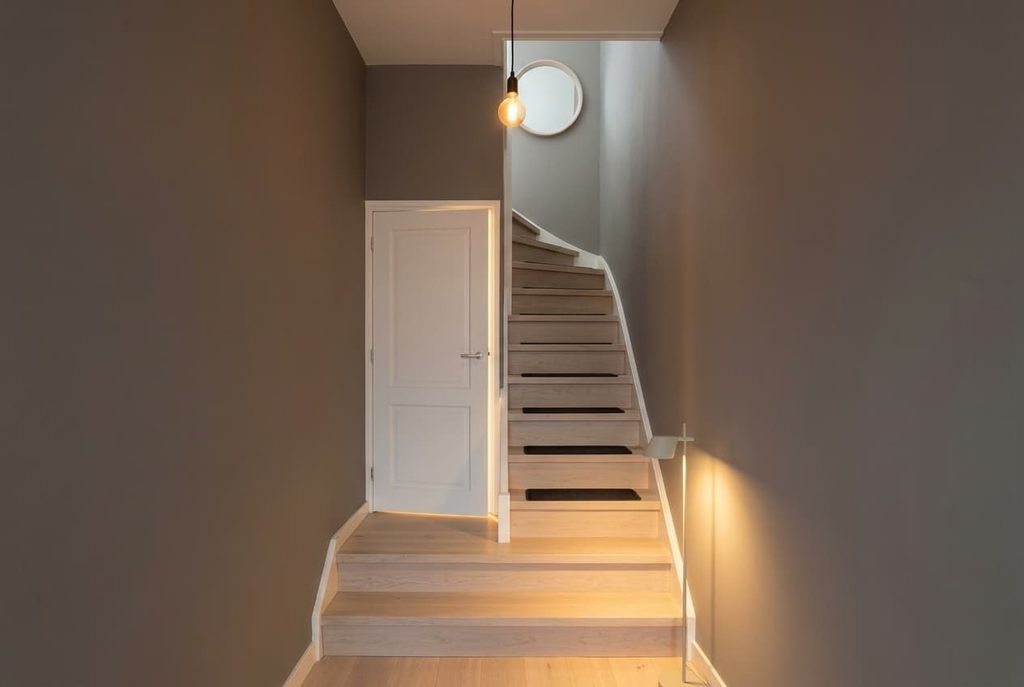
The three faults, diagnosed
People who type “staircase feel dark even with brighter bulbs” into a search box usually have one of three faults, each with its own symptom. Work through them in the order shown.
“The top steps are fine and the bottom three vanish.” The cause is scale. One pendant sits 1.4 m from the top treads and 5.6 m from the foot, and brightness follows the inverse square of distance. The ratio is (5.6 ÷ 1.4)² = 16, so the bottom receives roughly 6% of the top’s level. Start free by leaving the door at the bottom of the stairs open in the evening. Spill from a lit room lands exactly where the light is missing. Then rearrange by carrying a floor lamp of 400 lm from the living room to the bottom corner. If that works, buy a plug-in wall light of about 200 lm. The cost runs from ten minutes to one shopping trip.
“The bulb looks bright but the walls look black.” The cause is contrast. At 25% reflectance the walls return 2.0 cd/m² under the new bulb, where white would return 6.4. Start free by taking the coats off the wall hooks. Eight dark coats cover about 1.6 m² and soak up light you’ve already got. Then rearrange: hang the pale mirror from the hall at 140 cm so it carries light along the wall. The purchase is matt white paint at 80% reflectance, two coats over 21.8 m², which needs about 4 L and a weekend.
“Your eye goes straight to the bulb and the steps look darker.” Placement is the cause here. A bare bulb on the landing is the brightest spot you can see, so the dim treads below read as darker by comparison. Start free: swap the bare bulb for a frosted one if you own a spare. Then rearrange by hanging your largest frame at the first turn, 140 cm up, to give your eye a lower place to land. The purchase is a fitting with an opal shade around the bulb, which costs five minutes of fitting and one new part.
What to check before you buy the next bulb
Work out the surfaces first. Read the colour on the paint tin or hold the paper against the wall, and write down the area. If the reflectance is 40% or lower, spend on the walls before you spend on lumens. Next, compare the farthest tread with the nearest. If it’s more than four times as far, one source can’t cover the run, so plan a second low one. Last, find the bulb in your sightline. Anything bare at eye level on the landing wants a shade. Then rank your options by what they multiply. Paint at 80% reflectance multiplies wall luminance by 3.2, a bulb twice as bright multiplies it by 2. A frame or a shade multiplies nothing, though it fixes where the eye lands.
A brighter bulb should be the last purchase, never the first.
The fix that isn’t worth doing
The tempting move is a bulb of 1,500 lm or more in the same pendant. By the sums it gives 36 lux and 2.8 cd/m² on grey-brown walls. White paint gives the same with a bulb a third of the size. The match is false, because the bulb itself becomes the first thing you notice, and that makes the placement fault worse. Shoppers who search for “staircase feel dark even with brighter bulbs” are sold this fix more than any other. The treads stay as dim as before and the walls are no cleaner, while the fitting may not be rated for that output. Dim the big bulb back to 470 lm and you’ve paid for something that behaves like the old one. The pull towards a bigger number is strong because lumens are printed on the box and reflectance isn’t.
Fix the walls and the distance first, since a modest bulb behind a shade will then look bright enough. Keep the 470 lm bulb you already own and put the money into paint and a low lamp. If the paper still glows against the wall tonight, you know where to start. Nothing on this page needs a new fitting before it needs a brush. The sums are only a model, so test every step with the bulbs you have and a sheet of paper before any bigger purchase. A week of evenings on the stairs will teach you more than any figure here can.
Questions readers keep asking
What is the most common cause of a dim stairwell?
Wall colour, in most narrow stairs. Walls at 25% reflectance return a third of the light that white walls do. A bulb that’s 2.2 times brighter still loses to a repaint. Check with white paper against the wall, and compare how the two surfaces look.
What is the quickest fix to try tonight?
Open the door at the bottom of the stairs and take the coats off the wall hooks. Both cost nothing and need under ten minutes. Then carry a floor lamp to the bottom corner for the evening. If the stairs look clearer, you’ve confirmed the scale fault and can plan a permanent lamp.
Can a dark stairwell be fixed without repainting?
Partly. Moving a lamp or hanging a frame helps with scale and placement, and a shade does the same for the bulb. Contrast is the stubborn one, because the walls set a ceiling on what any bulb can show. A pale mirror or a light runner narrows the gap, but only paint closes it.