Window film or net curtains sounds like a simple pick, but the two hide you at different hours. A film blurs the view in around the clock, whereas a net curtain only works while the street is brighter than your room. Take a window of 140 by 160 cm. A film band can shield half of that glass for good, and a net can shield all of it until you draw it aside. Below you’ll see the two compared on daylight and night, then on removal, followed by a third route that leaves the glass bare. Two short rules close the article. All sums use a Dutch ground-floor window that opens straight onto a pavement.
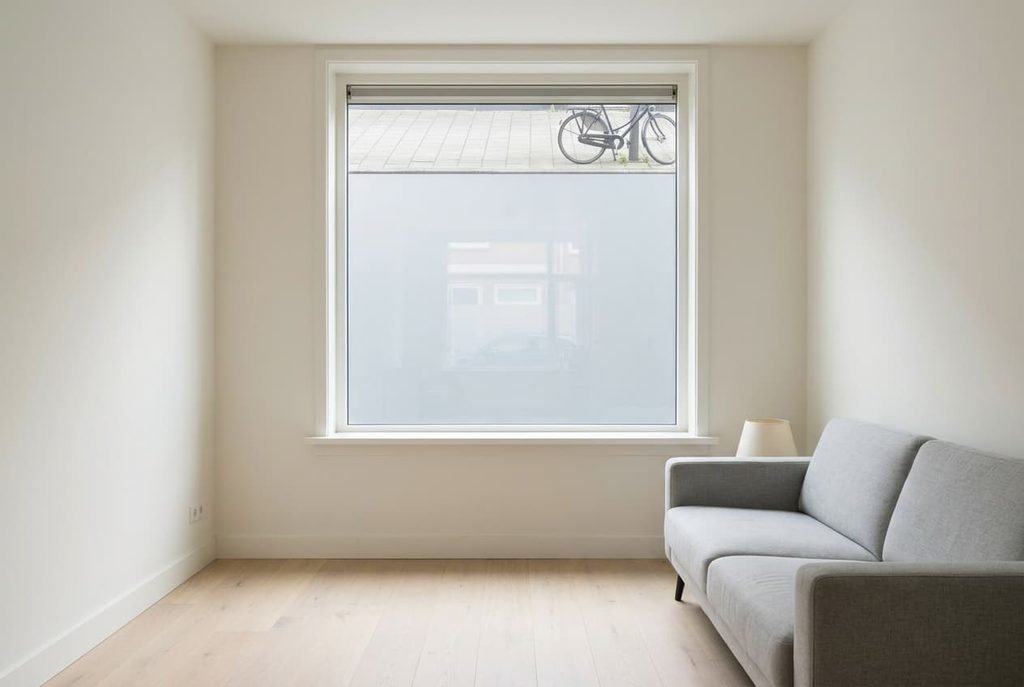
How window film or net curtains compare for privacy on a ground-floor window
Privacy at a window comes down to which side is brighter. The darker side can see into the brighter one, while the brighter side mostly sees its own reflection. By day the street wins, so passers-by meet a dark-looking pane. After dusk the balance flips, because your lamps outshine the pavement. Assume daylight outside is 15,000 lux against 300 inside, and at night the pavement holds 10 lux against 150 in the room. A pane doesn’t change those numbers. It only controls the share of the room’s detail that reaches the street. That’s why the same net that works at noon can fail at ten in the evening.
Here is where the two differ. The film alters the glass itself and blurs shapes by scattering light, whereas a net curtain adds a loose layer of fabric in front. Fabric holds back detail by day and fails to stop a lit room showing its outline at night.
The window holds 2.24 m² of glass, with the sill sitting 90 cm above ground level. A standing adult has eyes near 160 cm and a seated one near 110 cm. A film band running from the sill up 80 cm covers both eye lines, and it’s half the glass.
The hour you most need to be unseen decides everything.
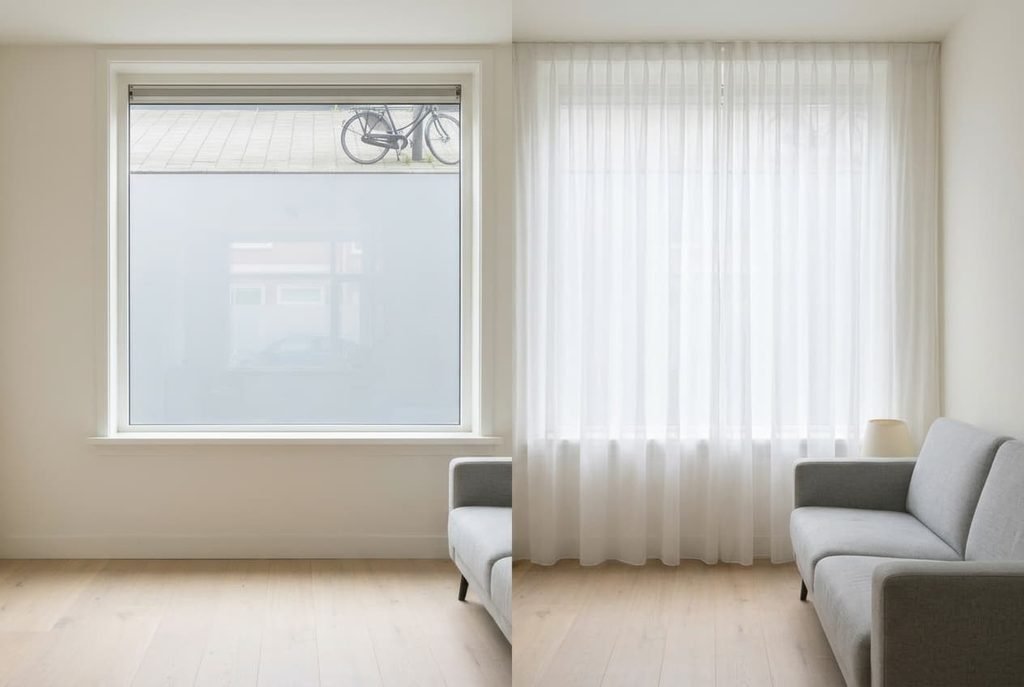
The two options side by side
Six properties split the options, and each one stays true whatever the pattern or the maker. A table suits that better than a review of one product. Read the rows downwards and you’ll see them divide. Film leads on night and on fixings, while net leads on light and on how fast it comes down. Every film and every net behaves this way, since the gaps come from how each layer meets the glass and the room.
| Property | Window film band | Net curtain |
|---|---|---|
| Glass covered | lower 80 cm, half the pane | the full 160 cm height |
| Daylight passed | about 80% through the covered part | about 70% through the whole pane |
| Lamps on, dark outside | shapes stay blurred | shapes and movement show through |
| Needs holes or fixings | none | a rail, or a tension rod |
| Cleaning | wipe flat with a cloth | machine wash a few times a year |
| Reversible | yes, using warm air | yes, in a minute |
Film wins on night and fixings, while net wins on light and removal. For most ground-floor rooms, that night row settles the matter. Anyone who sits in the room after dark should weigh it first. People who are out until late and use the room only at weekends can give more weight to the light row instead.
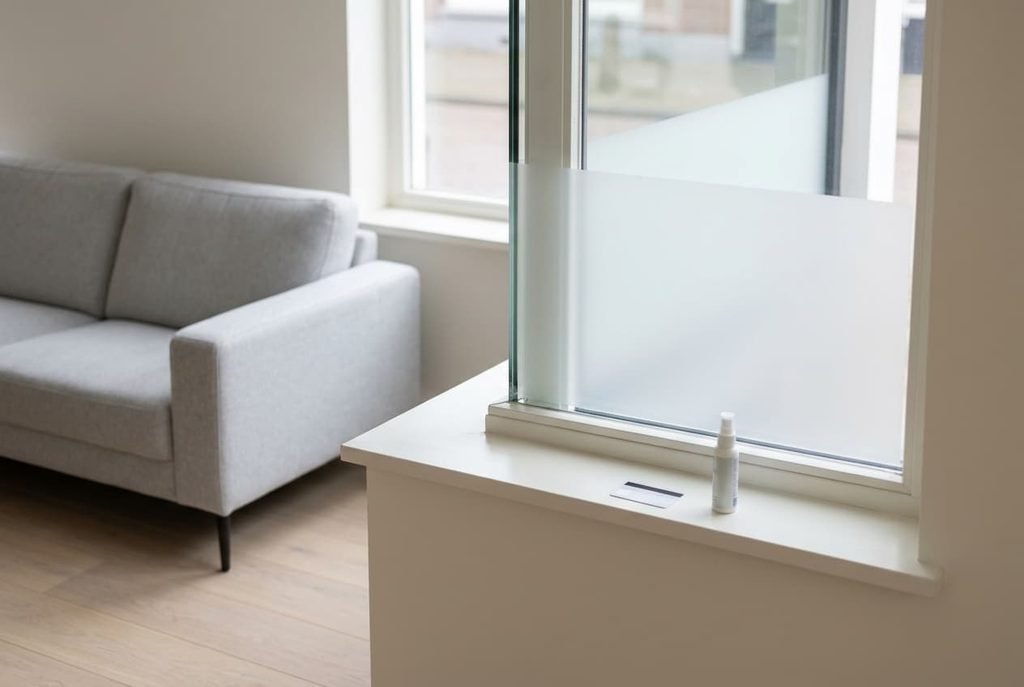
How window film behaves day to day
A film band of 140 by 80 cm takes about 40 minutes to fit, on a clean pane. Wet the glass with soapy water, lay the film down, then push the water to the edges with a flat card. Trim it 2 mm shy of the frame so the edge doesn’t lift. A trapped bubble stays for good, so smooth each strip outwards from the middle.
The band blurs shapes at any hour. Someone 3 m away on the pavement sees a pale smear and not a face. A standing adult sees over the top edge only by leaning in. The top half of the glass stays clear, so the room keeps about 90% of its daylight overall.
When the tenancy ends, warm air softens the adhesive and the band peels away in strips. A razor scraper removes any residue, which adds half an hour. If sun has baked the film for years it can mark the window seals, so test a corner first. Anyone choosing window film or net curtains for a short stay should weigh that risk.
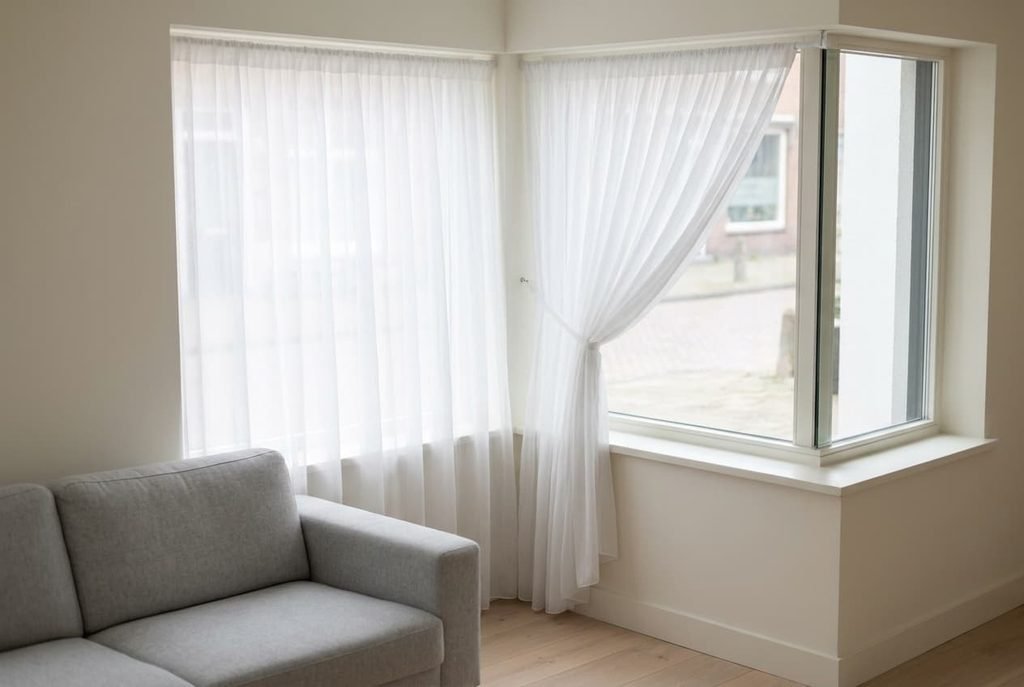
How net curtains behave day to day
A net hangs from a rail 20 cm above the frame and reaches the sill. For a 140 cm-wide window, buy fabric 210 cm wide so it falls in soft folds. A tension rod fits inside the reveal without a drill, which suits a rental, though it can slip under the weight of long fabric.
By day the net shows the street nothing but a soft shape. After dark it shows a silhouette of anyone near a lamp, and a person crossing the room reads even through the weave. If the lamps stand behind the sofa and away from the window, the effect drops sharply.
Net needs a little care. It gathers dust at about the pace of the room around it, so a wash every three months keeps it fresh. Hang it damp to dry so it doesn’t shrink. Because it hangs loose, a tie at the side lets you open it for the view whenever you like.
Easy removal is the net’s real strength.

The third option: keep the glass bare
A bare window needs no product. Night privacy depends on how bright your room is against the street, so the lever is the room and not the glass. Move the lamps to the far walls and push the seats back by 100 cm, because a lamp that lights the wall facing away from the window sends only a fraction of its light onto the pane.
A metre behind the glass, a seated person is lit by lamps behind them, and the view in narrows to a thin angle. The change takes five minutes and costs nothing. A shelf 100 cm high along the sill, with plants on it, also breaks the sight line at standing eye height.
The route fails when the pavement lies within 1 m of the glass, because even a dim room shows. Where the street is further off, it needs little effort. Nothing stays behind when you move. Unlike window film or net curtains, it leaves nothing to tidy up.
Which suits a ground-floor window: net curtains or window film?
If the window faces a street within 3 m and you use the room after dark, choose a film band. The cost is that half the glass stays frosted. You gain blurred shapes at any hour and no rail or hooks to fit. Apply it in daylight and check the line against your seated eye level.
If you want soft daylight and an easy way back to the original window, choose net curtains. The cost is a silhouette after dark. You gain a layer that hangs from a tension rod and comes down in a minute. Hang it 20 cm above the frame and let it fall to the sill.
Window film or net curtains will both work if the room fits the choice. Keep the lamps low and away from the glass, then stand on the pavement at dusk and look in. That one look tells you which one the room needs, and it costs nothing at all. It also catches the case where neither is needed, because a room that stays dim at night may already be private enough.
Questions readers keep asking
Which lasts longer on a ground-floor window?
A film band can stay good for years if it’s applied cleanly and kept from strong heat. A net stays good while the fabric survives washing. Both age slowly, which means the question is whether the privacy covers the hours you use the room.
How do I clean each one?
Wipe a film with a soft rag dipped in soapy water, and leave the scraper in the drawer. Wash a net in a mesh bag at a low temperature, then hang it back damp so it dries flat. Heat shrinks fabric and loosens film edges, so skip hot cycles.
Which suits a rented flat?
A net on a tension rod suits a rental best, because it leaves no marks and comes down in a minute. A film band suits a long tenancy better, since it can mark the glass edges at the end. If neither feels right, move the lamps first, because that’s the lowest-risk change.