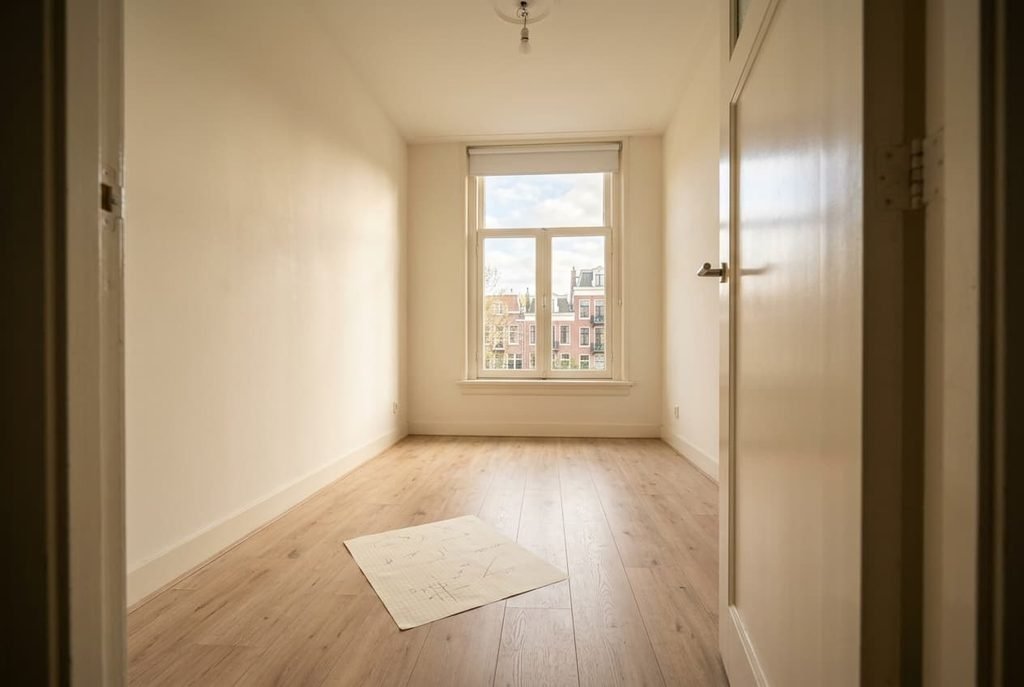
Start with the mattress, since you’ll lie on it longer than you’ll touch anything else and a photograph can’t tell you how it feels. A student room in a shared house gets furnished by hours of contact, and the cheap pieces queue behind the costly ones. The room here is invented: 300 by 350 cm, ceiling at 250 cm, one 100 by 140 cm window and a door whose swing takes 80 cm of floor. The stairs outside turn through just 70 cm. All numbers are assumptions, so measure yours before ordering anything.
The rule that sets the order of every purchase
A piece earns its place by the hours you spend with it, then by how badly a wrong choice stings. We assume a 16-hour waking day with 8 hours in bed and 5 on the chair. The desk takes another 5 and a lamp 4, since winter dark arrives near half past four. Clothes take about one hour. Floor space leaves no room for error either: a student room in a shared house offers 10.5 m², and a single bed claims 1.8 m² of it.
The habit to adopt is to put the largest share where contact lasts longest and a mistake costs most, with little going where a swap takes ten minutes. We assume four tenths of the budget for the bed and a quarter for the chair, a tenth each for lamp and desk, and the remainder for the rail. Shares are relative, so scale them to your own total.
Timing follows the first evening you’d miss each piece: bed on day one, chair before the first essay, lamp by November. Sketch the floor on squared paper, one square for 25 cm, and place the bed before anything else, because its position fixes where the rest can go.
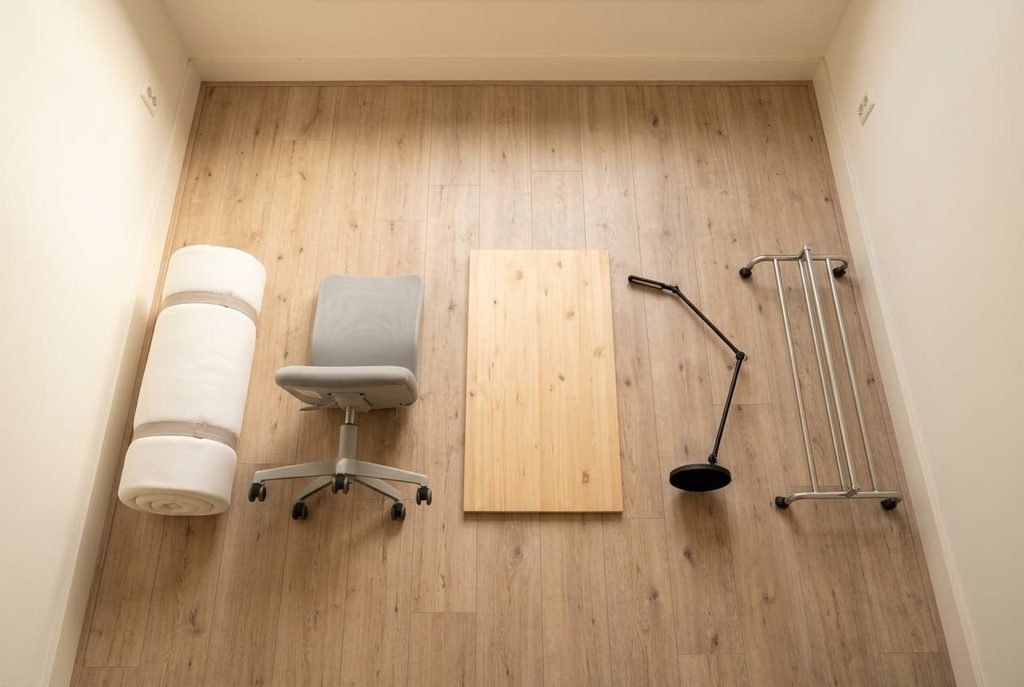
Five purchases for a student room in a shared house, in order
1. A roll-packed mattress of 90 by 200 cm with a 14 cm foam core, laid on a slatted base 25 cm high. It leads because it takes 8 of your 16 hours, and a roll about 35 cm across gets round the 70 cm stair turn where a rigid frame jams. Tier: BUY ONCE (foam) and MID (base). Density is what resists a permanent hollow, so look for at least 35 kg/m³. The fault shows after a term as a dip along the middle, a gap above 2 cm under a straight 100 cm ruler.
2. A chair with a gas-lift seat running from 42 to 52 cm and a seat 42 cm deep. It ranks second because it carries 5 hours of each day, and a 73 cm surface wants a seat near 45 cm so feet rest flat. Tier: MID. A lift welded into a steel plate holds its height, while a pressed plastic collar creeps. The fault is a seat that settles 3 cm in an hour, which a dot of marker pen on the column reveals.
3. A work surface of 1.2 by 0.6 m, standing 73 cm above the floor. It sits third because flatness matters more than the furniture beneath, and that depth fits a laptop beside an open book. Tier: BUY CHEAP, since 25 mm chipboard on four legs matches dearer wood here. The fault is a leg joint that racks sideways, so lean a 5 kg bag on one corner first.
4. A task lamp on a 60 cm arm with a reflector shade, holding a 600 lm warm-white bulb in an E27 socket. It lands fourth because the dark covers your study hours. Tier: BUY CHEAP, because the fittings are plain parts. A reflector spreading light over a 90° cone yields about 326 candela, which reads as 509 lux at 80 cm. The fault is an arm that droops within a month on a single spring.
5. A free-standing clothes rail with two steel feet, standing 160 cm tall over a 120 cm width. It ends the list because clothes can wait in a box while the room still works. The footprint is 0.54 m². Tier: BUY CHEAP, since 25 mm steel tube carries 15 kg. The fault is a crossbar that sags once winter coats arrive, plain to see along its length.
The desk is the item to scale down
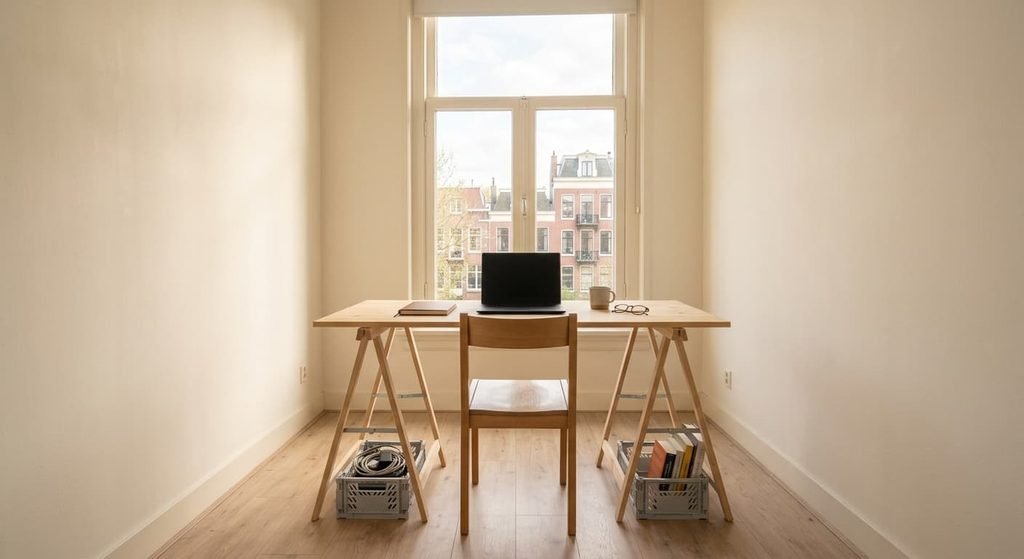
A desk exists to hold one flat surface steady at 73 cm. Almost anything can do that, so here the money comes back with no loss to the room. Lay a 1.2 by 0.6 m board across two adjustable trestles instead, and move what the desk would have cost to the chair.
The sums are short, and they hold for any student room in a shared house of this size. The board gives the same 0.72 m² of work area, and the trestles fold flat on moving day. They cost about half the desk’s share, so roughly a twentieth of the budget passes to the chair. Push sideways on the board with 5 kg of force to test the build. A shift above 1 cm calls for tighter bolts or a diagonal strap.
Drawers are the price. Two stackable crates under the board hold cables and notebooks in less floor than a drawer unit would claim. The same trick on the chair would be foolish, because you’d feel it every evening. On a surface it costs you almost nothing.
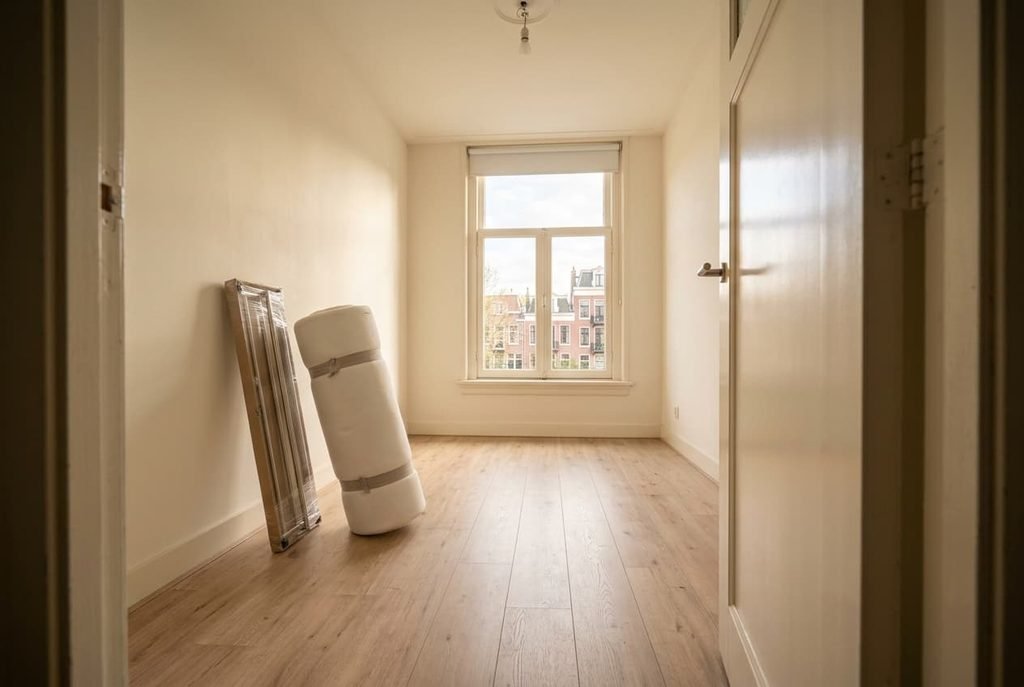
What a shared house changes about a student room
The order assumes an empty room and a 12-month tenancy with a landlord who forbids drilling. Check each before you pay for anything. A furnished room often arrives with a bed and a table, so the chair takes the top spot and the lamp comes second. Whether you’d keep the mattress already there becomes the open question.
Judge that mattress by the ruler test in the last answer below.
A stairwell of 90 cm or wider lifts the roll-pack rule and allows a rigid frame. The door matters too: with an 80 cm opening, any piece wider than 75 cm has to arrive flat. A built-in wardrobe removes the rail, and its share goes to the lamp.
Housemates alter the noise and the light, though not the sequence. A kitchen that stays busy until midnight argues for a chair you can use for five hours and a lamp that keeps working once the hall light goes off.
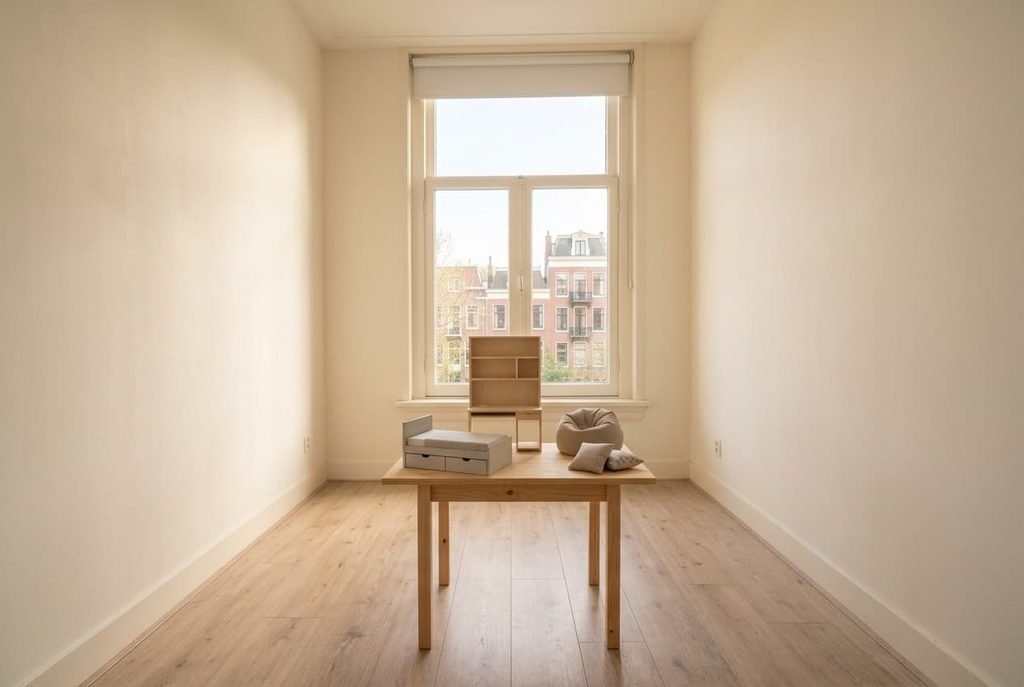
What to skip entirely
A bed frame with built-in drawers heads the list. It adds 20 kg of flat-pack bulk and needs 50 cm of free floor so the drawers can open, which leaves 100 cm beside the bed here. A slatted base plus two crates stores as much and travels better when the lease ends. A desk hutch piles weight onto a 70 cm stair turn. Bean bags eat 0.6 m² and rarely last a term. Decorative cushions can wait for the second month. Skipping all four pays for the chair, and the room stays clearer for the move out.
None of these fixes a problem the room has today, so each one can wait until it does.
Buy the mattress, then the chair, then lay a board across trestles and clip on the lamp. A student room in a shared house stays workable on those four pieces for a whole term. The rail can wait for the first week to show how your clothes pile up. Pin the list by the door and strike through each line as its piece arrives. Leave a gap for one surprise, such as a second lamp or a spare plug, because the first month always shows one.
Questions readers keep asking
How many pieces do I need to start with?
Four pieces carry the first week. They are the mattress on its base and a chair, plus a flat work surface and a lamp. The rail is the fifth and can follow. Anything beyond the list is optional, so add pieces singly once the room has shown a need.
Should the chair or the desk come first?
The chair, because you feel it for five hours daily and a board on trestles can follow within a week. Until then any table you already own does the surface’s job. Spend on the seat height range and the lift, since you can’t swap those cheaply afterwards.
How do I judge a mattress I can’t try in a shop?
Ask for the foam density and look for at least 35 kg/m³ on a 14 cm core. Check the return window as well, because a rolled mattress needs a few days to expand. After a week, lay a straight ruler across it and look for a gap under 1 cm.