Money goes to the table first. Everything else in a sewing corner in a rented bedroom leans on it. A table that sways turns every seam into a gamble. Picture an alcove 150 cm wide and 70 cm deep, 1.05 m² in all, in an Eindhoven flat. You already own the sewing machine. Five purchases fit, ordered by how much a wrong choice costs, dearest first. You’ll stop buying the moment a seam runs straight without effort. For plenty of people that comes after the third item. The sequence weighs heavier than the shopping list.
What Decides a Sewing Corner in a Rented Bedroom
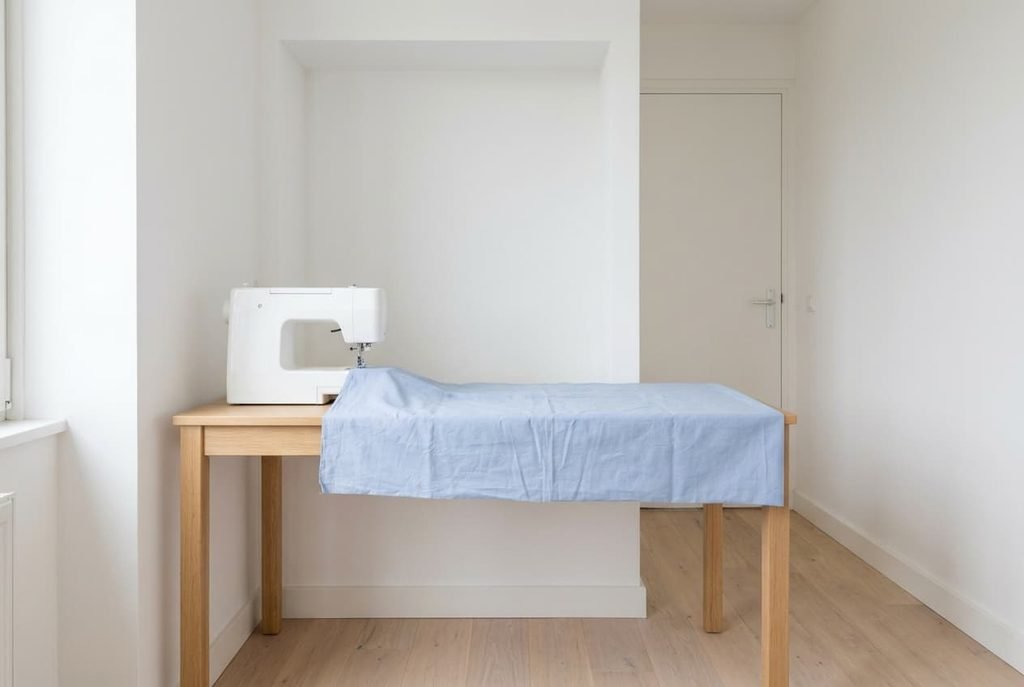
A sewing machine is a fast, small hammer for thread. It drives a needle through cloth many times a second. Every tremor in the table reaches the cloth as a wobble in the line. At 2.5 mm per stitch, a 5 cm seam takes 20 stitches. A table that shifts 3 mm moves the fabric by more than one stitch’s length. Stability has to come before comfort, because a comfortable chair at a swaying table only lets you make crooked seams for longer.
Light and height follow next. Your own hand shades the needle from most overhead bulbs. The cloth under it sits in a shadow you cast. A seat that’s wrong by 5 cm leaves your forearms rising or dropping with every pull of the fabric. Tired arms make uneven stitches long before you notice the tiredness.
A rented alcove adds two limits of its own. Drilling isn’t allowed, so every item has to stand at floor level or sit on the table. By evening the bedroom has to look like a bedroom again, so the corner needs to be quiet and easy to cover. Those limits shape the shortlist below, which starts with the table and ends with a pressing surface.
Five Purchases for the Alcove, Dearest Mistake First
1. A rigid table, 110 × 60 cm and 74 cm tall, comes first. The machine’s hum and the needle’s stroke both pass through it. Tier: BUY ONCE. Cross rails joining the leg pairs stop the frame folding sideways. Legs fixed only under the top loosen over the years. Push one corner sideways with a flat hand in the shop. Walk away from any table that sways more than 3 mm. The machine’s 40 cm width then leaves 70 cm of top for fabric.
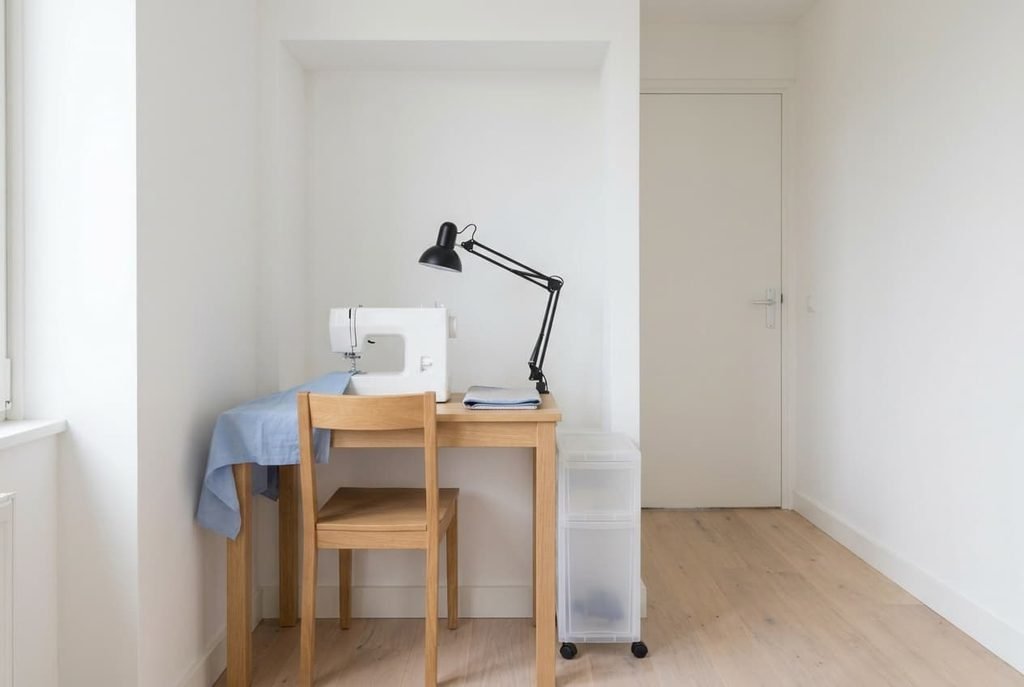
2. The chair takes second place, with a 47 cm seat that adjusts by 5 cm either way. Your elbow should land level with the 74 cm top. A 47 cm seat plus a 27 cm rise from seat to elbow gives exactly that. Tier: MID. Height adjustment relies on a gas strut or a threaded post, and the cheapest struts sink within a year. Sit down and count to sixty, then look for a drop above 1 cm.
3. A clamp-on task light with a 45 cm reach and a neutral 4000 K bulb is third. Clamped to the back edge, it lights the needle from above and a little to the left. Your right hand then doesn’t throw a shadow. Tier: MID. A rubber-lined jaw tightened by a hand screw holds firm. Metal arms keep their angle where thin plastic ones creep downwards. Extend it fully and wait a minute, then check whether the head has crept lower.
4. A two-drawer trolley, 35 × 40 cm and 70 cm tall, holds the small things. It tucks beside the table, which keeps the whole setup inside the 150 cm width (110 + 35 = 145). Tier: BUY CHEAP. A single shell with two plastic runners has few parts to fail. The casters are the weak point. Push it a metre across your own floor and refuse one that squeaks or drifts sideways.
5. A 60 × 35 cm pressing mat ranks last because a seam can wait a day for the iron. Tier: BUY CHEAP. A 10 mm wool-felt layer stitched at the edges has nothing to peel, unlike glued foam layers. Press a thumb into it for ten seconds. The dent should spring back within two seconds, because a mat that stays dented will mark every seam you press.
Why the Pressing Mat Is the Item to Scale Down
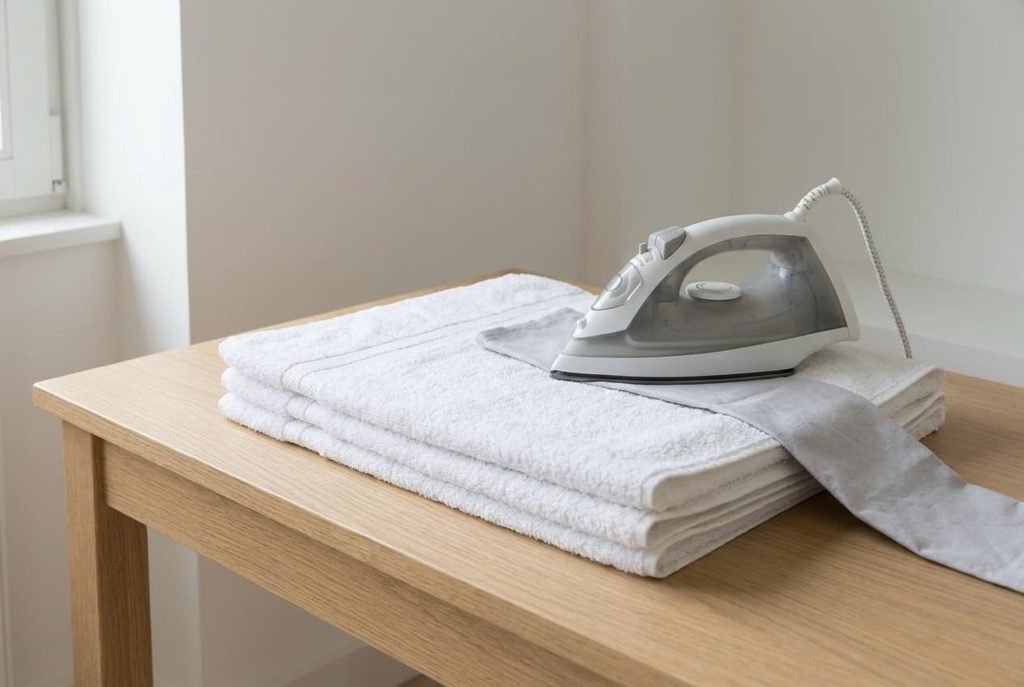
Of the five, the mat is the easiest to put off for a month. Four folded layers of a cotton bath towel, 60 × 35 cm, do the same job, since a seam needs something soft beneath it. Without that, the stitches print through to the right side. You already own the towel, and it goes back into the wardrobe in five seconds.
That return matters in a bedroom. A mat that lives on the table claims 0.21 m² of the 0.66 m² top. The corner never quite clears. A towel leaves the whole top free whenever you stop. On a laminate top, slide a wooden bread board under the towel. A hot iron can mark laminate even through cloth. Keep the iron on a medium setting and lift it every few seconds.
Buy the mat once a project has more than 20 seams to press, such as a pair of curtains. Until then a sewing corner in a rented bedroom runs happily on the towel. The money goes toward a steadier table or a better chair.
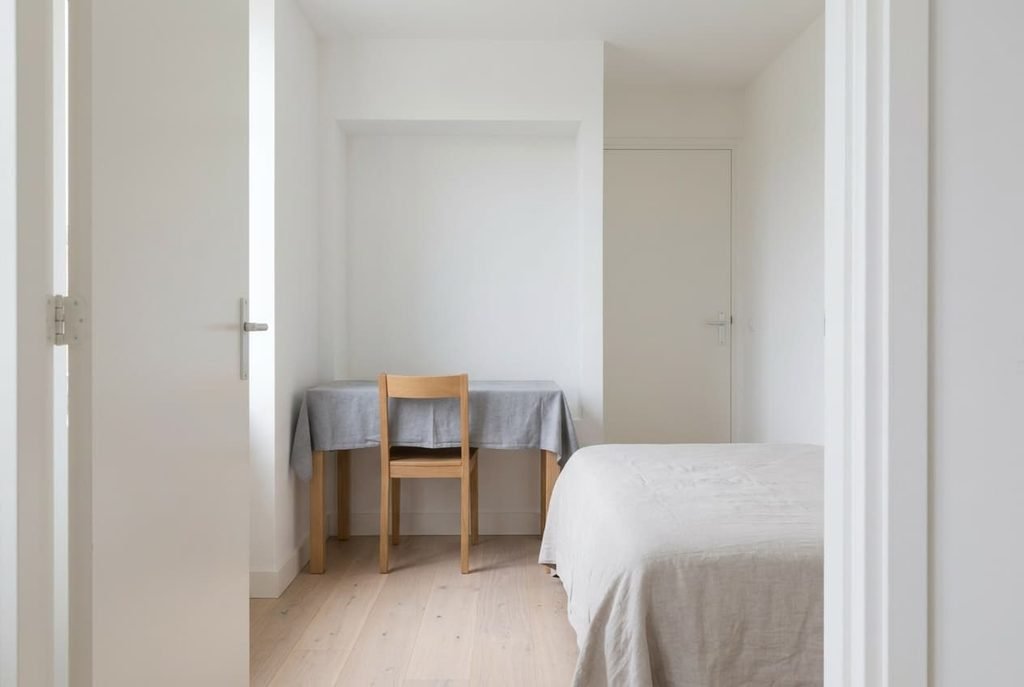
Living With a Rented Bedroom Sewing Corner
A sewing corner in a rented bedroom shares floor and air with everything else you do in the room, so a few habits count for as much as the purchases do. A running machine is audible through a floor, so keep it to daytime and early evening hours. Put 3 mm felt pads under the table’s feet and under the chair’s wheels. They protect a wooden floor, and they take the edge off the hum that travels downwards. Slide the chair back and forth ten times once to check that the pads stay in place, since a pad that has wandered off leaves a scuff within weeks.
Keep pins in a magnetic dish on the table, since a pin lost in the carpet is hard to spot.
Finish each session with a two-minute reset. Fold the fabric into the trolley’s top drawer. Lower the machine’s cover, then throw a blanket over the table. The alcove then reads as a quiet corner with a bedside look, and nobody who walks in sees a workshop.
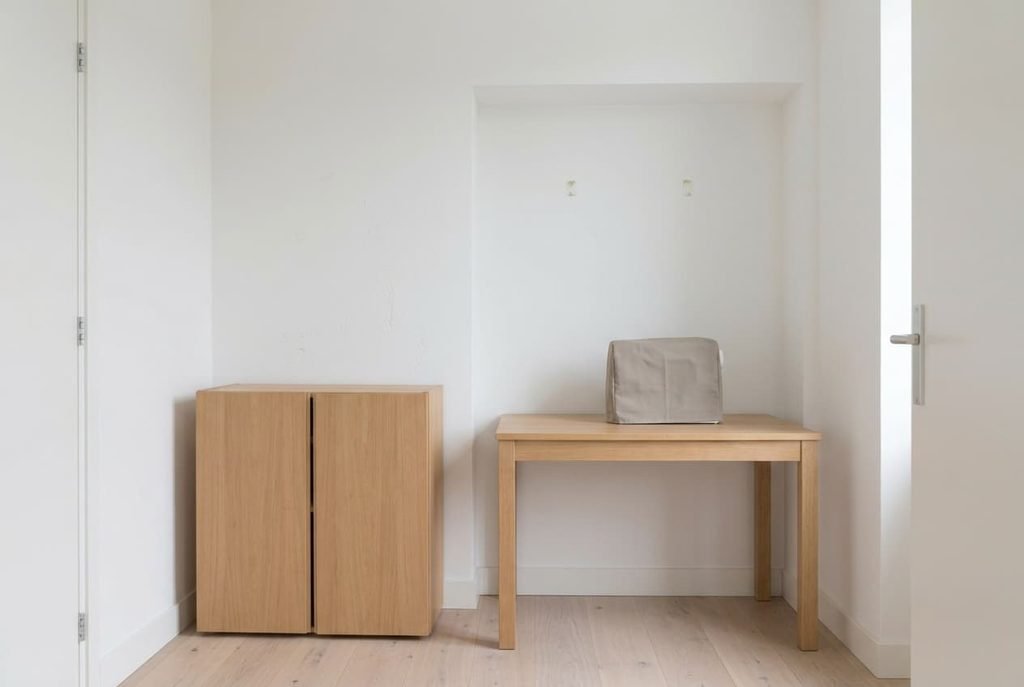
What to Skip
Skip any purpose-built cabinet for the machine, because a cabinet with a lift-out mechanism needs 60 cm front to back, and the alcove only has 70 cm to give. A plain table with a cover does the same job in less room, and it still looks like furniture when the machine is put away.
Leave out wall shelves too. Adhesive strips give way under a full thread rack within weeks. A fallen rack takes paint with it, and a landlord will notice that. The trolley carries the same load at floor level, and it can roll into a wardrobe if a guest stays over.
A second lamp adds nothing once the first reaches the needle, and it only turns the bedroom into a workshop that stays lit all evening.
Work down the list only as far as your seams need. Each extra item has to earn a place in 1.05 m². For most people the table and the chair come first, with a towel standing in for the mat. A sewing corner in a rented bedroom that clears in two minutes earns more evenings at the machine than a corner that demands a long tidy beforehand. Habit decides more than any single item you could buy.
Questions Readers Keep Asking
How many items do I need before I can start sewing?
Three cover most seams, namely the first three on the list. A folded towel stands in for the mat, while the trolley waits until small things start to pile up. If a seam still wanders after those three, check the table’s sway before spending anything else. Most crooked lines begin there.
What if the table I own is the wrong height?
Hold a tape against the leg and read the tabletop’s height. If it’s 74 cm, nothing changes. At 70 cm, set the seat 4 cm lower, which the chair’s range allows. At 78 cm the seat has to rise 4 cm, and a footrest keeps your feet planted if they leave the floor.
How do I judge a chair’s height adjustment before buying?
Sit on it for a full minute and watch whether the seat sinks. Then raise it and lower it twice, listening for a grind. A smooth, quiet movement that holds position means the strut is sound. Check that the lowest setting reaches 42 cm, because short people need that range.